Ppresentation by Tim
AUDIO
Consider how much of the time spent together in this community goes to catalyst — the hardships, the trials, the tribulations being endured at any given moment. That work is necessary. But an evening spent on something happy has been earned.
So here is the question, put directly. Are you happy?
It is a dangerous question. John Stuart Mill observed that the moment a person asks whether they are happy, they cease to be. Ask it and the thing evaporates. So sharpen it into something more useful: what gift could the Creator give you that would make you happy?
No gift that cannot become a burden
There were three sons living abroad who wanted to make their elderly mother happy.
The first bought her a Mercedes-Benz and had it delivered to her door. The second, not to be outdone, bought her a mansion. The third gave it real thought. His mother loved her Bible, but her eyesight was failing — so he traveled to South America, found an extraordinary parrot, and spent twelve years working with the elders of his church to teach the bird to recite scripture from Genesis to Revelation. All she would have to do is name chapter and verse.
The letters came back. Milton, I am too old to travel; I stay home and have little use for the Mercedes. Gerald, the house is too big — I live in one room and now I have to clean the rest of it. And to the third son: Donald, the little chicken you sent was delicious.
There is no gift that cannot be turned into a burden, and no burden that cannot be turned into a gift.
The research on lottery winners says the same thing in colder language. After the spike of euphoria, winners drift back toward the baseline they had before the money arrived. Happiness that depends on what arrives from outside has a short half-life.
Which raises the real question. What is joy?
Joy as the medium, not the destination
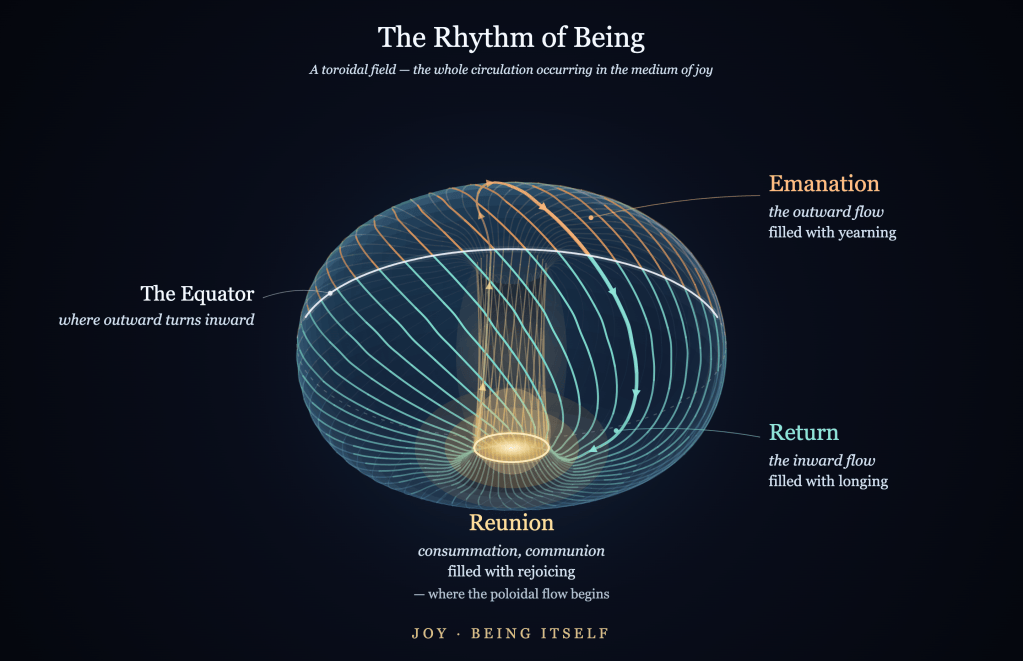
Doug taught something in this community a few months back about the rhythm of being — a cosmic tide with three movements. There is the outward flow, an emanation from the Creator, filled with yearning. There is the inward flow, the return to the Creator, filled with longing. And there is the reunion, the consummation, filled with rejoicing.
Here is the part worth holding onto: in all three of those movements, there is enjoying. The entire circulation of beingness occurs in the medium of joy, because joy is being itself.
So joy is not something lacking that must be hunted down. It is closer to what you already are. When you say you are seeking joy, what you are actually seeking is your own essence. You are seeking to know your own nature, which is joyous.
That reframe changes the practical question. It stops being how do I acquire joy? and becomes how do I uncover the frequency at which my joy is already awake?
Call it your unique frequency of being — the particular pitch through which your joy enlivens, so that what is uniquely yours can be offered back to others and back to the Creator. Joseph Campbell’s follow your bliss is the pop version. The older version is dharmic: each person has their own path, and a great deal of unhappiness gets attracted by trying to live someone else’s life and meet someone else’s expectations.
One note on an infinite staff
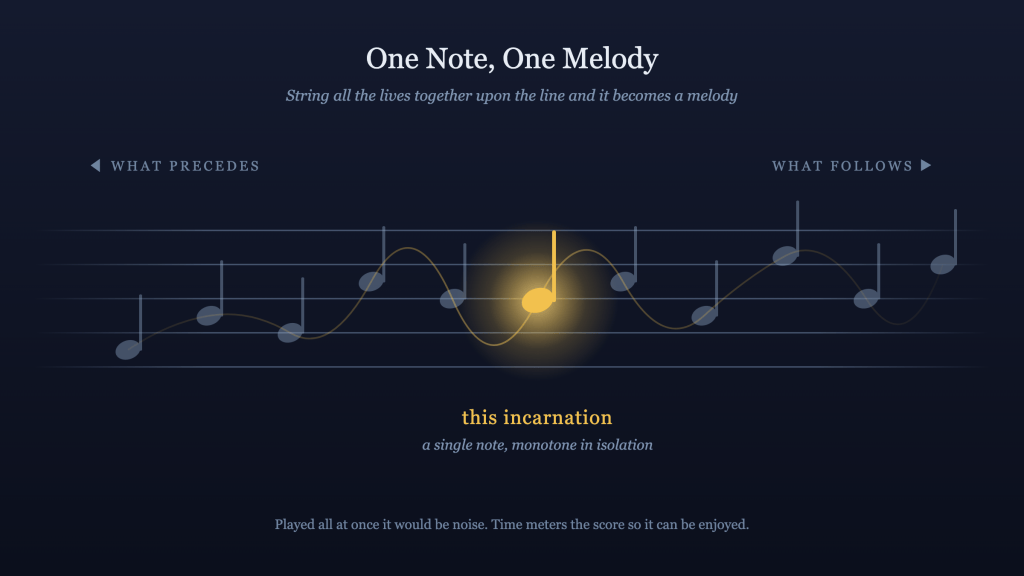
Picture a bar of sheet music. Look at a single note on it — a G, first on the staff. Pretend that note is your current incarnation. Right now, on that staff, you are that note.
What precedes it in former incarnations, and what follows it in states still ahead, is so much more than can be seen of yourself from inside any one lifetime. Alone, a single note is monotone. It does not add up to much. String all those lives together along the line and a melody emerges that would take the breath out of you if you could see it whole.
And here is the turn. If all of that is already true, why the stretching-out? Why the veil, why the sequence, why the slow crawl of time?
Because if every note on a score sounded simultaneously, the result would not be the piece. It would be noise. The notes have to be metered and spaced. Time is the gift that makes the score coherent. Eternity may exist in totality now, but if the whole of Mozart’s Requiem sounded at once, no one could enjoy it. To en-joy it, it has to be stretched out and taken in stages.
The Creator generates the illusion of time precisely in order to experience itself, since otherwise everything remains an undifferentiated totality. Alan Watts used to say that the hurry toward enlightenment — the wish to die and be reunited with source — is like going to a concert and telling the conductor to play everything faster because only the ending matters. You need the whole ninety minutes. The tension and the anticipation are what make the finale mean anything at all.
Doug added a distinction here worth carrying forward: there may be three fundamental kinds of joy. There is the joy at the precipice of creation — before the thing is made, before the activist acts, that charged sense of it is this, this is the one. There is the joy of creating it, of taking it up in imagination and potentiating it into activation. And there is the joy of experiencing the finished thing, which is a different flavor altogether, built on the scaffolding the first two laid down.
The anticipatory one may be the best of the three. Christmas morning is never quite as good as it gets built up to be beforehand.
What Ra says about revitalizing
For anyone feeling burned out or sad, the Law of One has something practical to offer. It is in Session 25.
Carla asked how she might best revitalize herself, not only in the moment but going forward. Ra answered by naming the basic needs of her constitution: meditation, acceptance of limitations, experiences of joy through association with others and with the beauty as of the singing, and exercising with great contact whenever possible with the life forces of second density, especially trees (Ra, 25.2). Ra added moderate and steady intake of food, and exercise early and late in the day.
That answer was tailored to Carla. But the universal principles can be lifted out of it, and each one could hold an evening of its own.
Meditation. In silence you hear the music of stillness, which is among the greatest songs creation sings to the heart.
Acceptance of limitations. This is the hardest of the four. Are limitations not supposed to be overcome? Ignorance is a limitation, and seeking knowledge is the whole enterprise. Sickness is a limitation — and one of the most reliable catalysts there is — and the teachings are full of healing. So when do you accept and when do you transcend? The question is worth sitting with rather than answering too quickly. Plenty of people think about it every single day without arriving anywhere final, and there is company in that.
Association with others. The news keeps reporting what the research keeps finding: the strongest driver of human happiness is the quality of social bonds. Which is the reason for gathering at all. With friends.
Second-density contact. Hiking, and talking to the trees. The empirical literature on this exists — studies comparing exercise in urban environments against exercise in natural ones. The outcomes are better among the trees.
The beauty as of the singing. This one deserves the rest of the essay.
Songs from the Spirit
Paul tells the Ephesians to be filled with the Spirit, speaking to one another in psalms and hymns and songs from the Spirit, singing and making music from the heart. Songs from the Spirit. Take the phrase apart.
What is a song? A sound, but not random noise. A song is sound that is structured, ordered, crystallized. A sound vibratory complex. And look at the middle word — vibration — which simply describes waves moving in particular ratios.
There is no reason to think this means only sound waves. There are songs that move in the frequencies of the heart, in the amplitude of light, in the rhythm of love and intelligence. The Creator sings through every snowflake, and each person has a voice as singular as one. There is no other entity in the whole of creation that praises the Creator the way you do.
All was formless until wisdom entered the void and spoke let there be light — and it vibrated, and it resonated. How would anyone describe the Creator’s frequency? Two images held together: the sound of the rushing of great waters on the one hand, and the sound of stillness on the other. The Logos sang, and it was heard, and the answer came — running, flying, leaping into incarnation to embody its music. Every entity became part of an ongoing infinite song, sounding the universe’s heart chords, extending light so that the borders of outer darkness recede.
And there are as many kinds of joy as there are tones. The joy that hurts so good. Tears of happiness. The joy that makes you laugh, or make love, or dance. Hip-hop and rock and roll and a funeral dirge. The scampering of a squirrel, the wind in the leaves of an oak, the whisper of moonlight. Isaiah called them songs of everlasting joy.
Balance, tuning, harmony
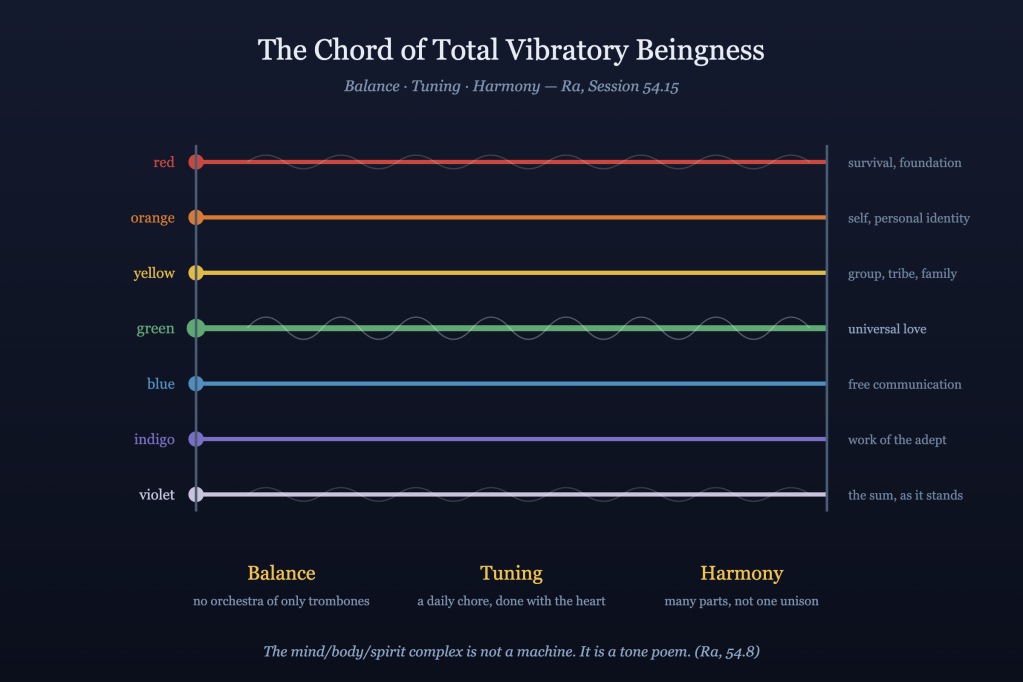
Now the objection, which is a fair one. This is all very nice, but the joy is not there. Life is heavy and dark right now, full of catalyst, and the cup of sorrow overflows. How is anyone supposed to feel joyful in times like these?
The honest answer is that everyone asking it is in the saddle together, riding into the harvest sunset. And then there is Ra, Session 54.
Ra says that beyond activating and unblocking each energy center, it is equally a priority to begin refining the balances between the energies, so that each tone of the chord of total vibratory beingness resonates in clarity, tune, and harmony with each other energy. Ra calls this balancing, tuning, and harmonizing of the self most central to the more advanced or adept mind/body/spirit complex (Ra, 54.15).
Three musical words. Take them one at a time.
Balance. Picture an imbalanced orchestra — ninety-five percent trombones, one lonely trumpet, a pair of violins, no woodwinds at all. Could the B Minor Mass be played with that? Technically the trombones could eke out the melody. But every texture that made the piece worth playing has been lost. A person can soldier on in an unbalanced life the same way, and what comes of it is friction, resistance, static in the frequency of joy.
So the question for you is: what parts of your life are competing against each other? In a recording studio the vocals get mixed against the track so that they complement rather than compete. There are tools for that mixing too, and three of them come up again and again — faith, hope, and charity.
Tuning. Anyone who plays a guitar knows you never tune once and are done. You tune every time you pick up the instrument. Spiritual hygiene is a daily chore, and an instrument played out of tune is its own kind of catalyst. Anyone who has heard a third grader play the viola already understands this.
But tuning also means what it means on a ham radio: turning the dial to bring in a particular frequency. So the question doubles. How do you tune, and what exactly are you tuning yourself to?
Troy gave the best answer this community has produced on the question. In his quiet times it is a feeling in the heart — a resonance he works to make sure he can perceive, and then he works to get his conscious mind flowing with it.
If nothing else from all of this stays with you, let it be that. Tune with your heart.
Harmony. This is the one that matters most. Nobody is playing in unison. Nobody was ever meant to play in unison. The music is more than melody — the parts are different, sung in relation to one another, and not on the same tone. Each person vibrates with a unique signature.
Which is where Ra’s most quietly beautiful line comes in. Explaining that the precision with which energy centers match the Original Thought lies in fluid and plastic placement rather than rigid systematic arrangement, Ra says the mind/body/spirit complex is not a machine — it is rather what you might call a tone poem (Ra, 54.8).
What makes a person poetry? A poem has structure. A poem has meter. A poem carries a message. Is this the Logos crystallizing? Your life is the lyric sung by the Creator.
And the universal language worth looking for — the lingua franca of the Logos, the tongue in which one could commune with God and with other people and with all of creation, the one you wish you had when you look into an animal’s eyes — is the light of love and wisdom.
Sympathetic resonance
The metaphysics get concrete here.
Don once asked Ra to expand on why certain Hebrew and Sanskrit sound vibratory complexes are powerful — how they are mathematically related to the creation. Ra answered that the linkage is mathematical, or that of the ratio, and that it may be considered musical (Ra, 75.26). Asked what use precisely vibrated sounds would be to the adept, Ra offered the concept of sympathetic resonance, and added that when certain sounds are correctly vibrated, the creation sings (Ra, 75.27). Asked to name the notes, Ra declined.
Everyone reading this is at least New Age-adjacent, so everyone has done some version of this already — binaural beats, the Monroe Gateway tapes, Gregorian chant, whatever the proclivity. The common thread is using frequency to attune something fundamental shared by mind, body, and spirit, and entraining all three together.
Take 432 Hz. A hertz is one cycle per second, so 432 Hz is a wave repeating 432 times a second, which happens to be the A above middle C, and a pitch many people associate with heart-chakra work.
Then take Om, the seed syllable that resonates with Brahman, and the claim that its frequency is 136.1 Hz. Where does that number come from? Not the Schumann resonance. A Swiss mathematician took the length of one Earth orbit — a year, roughly 31.6 million seconds — and doubled that ratio thirty-two times until it rose into the range of human hearing. What comes out is 136.1 Hz. C-sharp. Struck on a Tibetan cymbal, it hangs in the air.
The word mathematical is too cold for what is actually happening. Better to say there is a closeness, an orbit around which everything gravitates with everything else, circling and dancing. Which is, of course, perichoresis — the circle dance of the Creator.
Transposition
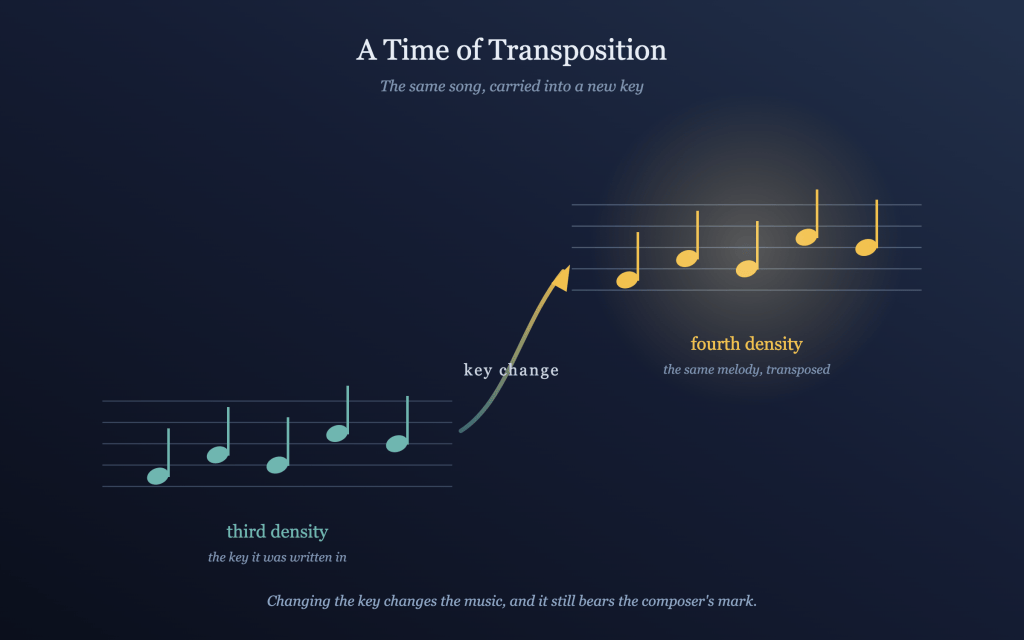
An octave holds twelve notes in the chromatic scale, though the major and minor keys use only seven. What matters is that keys can be transposed. Keys unlock the fluidity of frequency.
One of the most exhilarating things in a piece of music is the moment the key signature changes — and the way a key changes is usually through chord progressions.
Like the way the Earth is transitioning into fourth density.
“Over the Rainbow” was written in A-flat for Judy Garland. But you are not Judy Garland, and you do not have to sing it in her key. Israel Kamakawiwoʻole sang it in G on a ukulele and it is unmistakably the same song — the composer’s mark is still all over it. Changing the key changes the music without erasing what it is.
This dispensation is a time of transposition. Here at the end of the master cycle, what is needed is the nimbleness of skilled musicians who can move through all the keys, because the whole point is to play with all the chords. Otherwise, how would anyone become a co-composer with God? Nobody is here to rehash and recycle what Bob down the street does, or what some sensei says, however much can be learned from their examples. Everyone is here to make the song their own, to create new arrangements and new styles as the octaves visibly transform.
And this ties back to the beginning. The Creator has need of the creature just as the creature has need of the Creator, because both are co-creators.
Notated music is only symbols on paper. Language is only words on a page. Until there is a performer, it stays lifeless ink. There is a large difference between studying a song and singing it. The task is to embody the music — to translate for the Logos, instantiating and phrasing God’s love into space-time.
Which is also the account of why wanderers are here. Any musician knows a piece is easier to play once someone else has been heard performing it. Anyone who has sung in a choir knows how much a strong voice beside you trains your ear, steadies your pitch, makes you bolder. The great masters of the past and the wanderers on Earth today are here to sing shoulder to shoulder at your side, tuning hearts as the voices blend.
Coda
An essay arguing that the point is to sing rather than to study should not end in prose.
So the presentation ended with a recording — “One Song” from Snow White, performed with the lyrics rewritten. Which is exactly the instruction: take the composition, transpose it into your own voice, change the words so they work for you.
Sympathetic resonance is the piece that lands hardest. When a person sings their own song with some measure of crystallization — when they embody their own energetic signature, when they are actually a tone poem — that is attractive to other people who are still trying to find theirs. Those people will not end up singing that same note. But everyone needs a loud confident voice nearby in order to find their own.
Tune yourself to the song of the Creator, that of love and joy.

