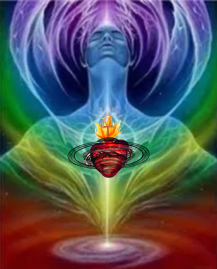
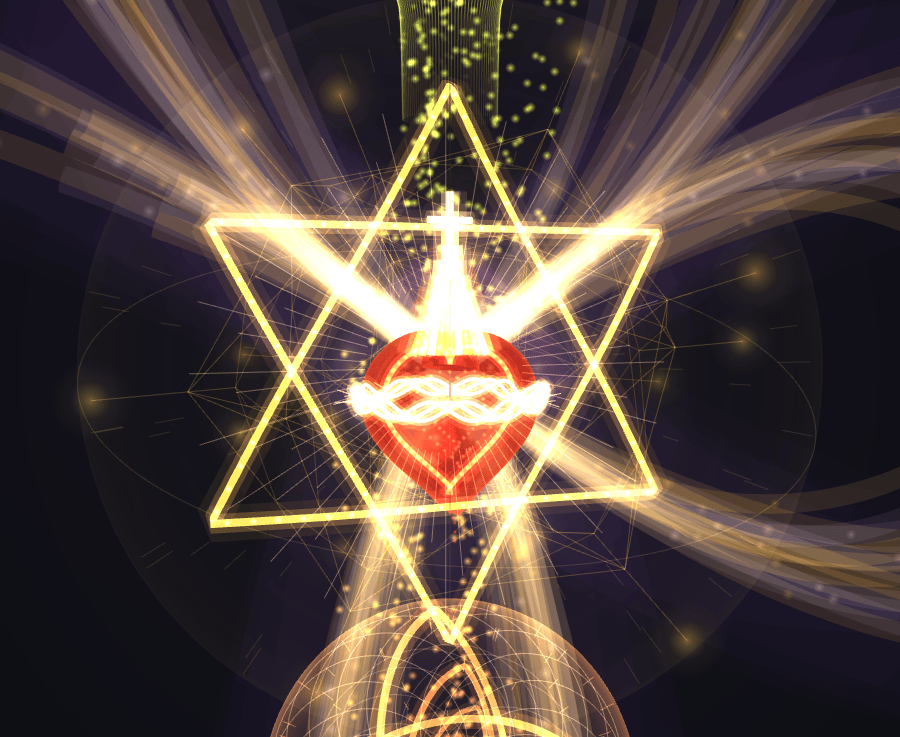
Article by Doug Scott, LCSW
“Who do you say that I am?” (Mark 8:29). Jesus put that question to Peter, and I think he still puts it to each of us. Everyone who has heard of him carries some picture of him (believers, seekers and skeptics alike), and the picture we carry says as much about us as it does about him.
A friend recently sent me Kahlil Gibran’s Jesus the Son of Man (1928) and asked what I made of it. I’ve known Gibran’s work on Jesus for some time, and his life from earlier study, and over two days I spent many hours with it: reacquainting myself with his writing, and developing the images you’ll find below, which try to depict how I understand Jesus and what I call the Jesus Christ Event. That understanding draws on mystical Christianity; on my own tradition of origin, orthodox Catholic spirituality; on the Ra contact (the Law of One); and on my own experience and intuition. What follows grew out of my reply.
The Jesuses We Carry
Here are some of the versions of Jesus I meet most often, in the pews, in my counseling office and in spiritual circles. Each holds something true.
God in a human costume. Much popular piety holds a Jesus who only seemed human: all-knowing from the crib, never really tempted, never really afraid. The church condemned this view long ago (it’s called docetism), yet it survives quietly in many hearts.
The wise teacher. Here Jesus is a sage and ethical genius, the Sermon on the Mount without the resurrection. Thomas Jefferson famously took scissors to the Gospels to get this Jesus, and much historical-Jesus scholarship has a similar flavor.
The Liberator. Liberation theologians such as Leonardo Boff and Jon Sobrino remind us that Jesus was executed because he threatened both the religious and the political powers of his day. This Jesus stands with the poor and against empire.
The adept who achieved Christ consciousness. This is the most common New Age reading: Jesus was a human being like us who, through discipline and awakening, realized the Christ within, one master in a line of masters. “Christ” becomes a state of consciousness anyone can attain, and Jesus is the great example of attaining it. Gibran is an early and eloquent voice for something close to this. “My Jesus is human like you and me,” he insists, and in his chapter told by John the son of Zebedee, “the Christ, the Word” comes upon a Jesus “born and reared like ourselves.”
I want to spend some time with Gibran, because he shows how much a life shapes the Jesus one sees. Then I’ll offer my own reading as an alternative.
Gibran’s Tempest
First, I think Gibran has every right to push against what he perceives as the church’s teaching. Plenty of Christians do confuse meekness with weakness, and plenty hold the costume Jesus I described above. His insistence on a fully human Jesus is a needed corrective.
Some speculation on why he pushes where he does. He was deeply shaped by Nietzsche, especially Thus Spoke Zarathustra, whose wandering prophet is a clear ancestor of Gibran’s own Prophet. His tempest-Christ carries Nietzsche’s scorn for a weak, slavish faith. He grew up Maronite under Ottoman rule, and during the First World War he watched a famine, one he believed the Turkish government had planned, kill something like half the people of Mount Lebanon. To a colonized people, a passive, suffering Christ can look like exactly what the colonized are taught to be. And this is my clinician’s hunch: his own body may be in it too. Tuberculosis took his sister and half-brother, and cancer his mother. He was slight and often ill, dependent for years on his sister’s wages and then on his patron Mary Haskell, and he died of cirrhosis at forty-eight. I wonder whether some of his own fragility got projected onto the church’s Jesus, and whether the tempest is partly a portrait of who he longed to be.
Meekness Is Strength
Where I’d gently push back: I think Gibran takes meekness to mean weakness and then blames the tradition for it. I’d define meekness as empowered surrender for the sake of something greater. It is the way of transformation itself, loss and renewal, with an eye on the renewal: willingly choosing the loss for the sake of the greater gain. I’m not defining it in a vacuum; this is what has always been taught at the heart of Christianity. But as Ra says, each of our orthodox religious systems has “become somewhat mixed in orientation yet offer[s] a pure path to the One Creator which is seen by the pure seeker” (60.18). Most of us come to the living tradition mixed inside, unclear in our deepest aim, and so we read into it what we already prefer. As Aquinas put it, whatever is received is received according to the mode of the receiver. We might even say meekness is what Ra means by the disciplines of the personality: “know yourself… accept yourself… become the Creator,” the last of which “renders one the most humble servant of all, transparent in personality” (74.11). It takes great agency to know when to hold on and when to let go.
The Greek word, praus, means strength under restraint, like a broken-in horse; Moses is called the meekest man on earth. Before Pilate, Jesus knows he is powerless in that moment and chooses it: “You would have no power over me unless it had been given you from above” (John 19:11). Then, from the cross, “Father, forgive them.” As far as I am concerned, that is the fullness of the tempest Gibran wants. By 1928 he was edging there; his Pilate says “the lonely man is the strongest man.” But he never let himself call it meekness.
And Gibran is right that Jesus was a tempest, a force of nature. I think he would be grateful for much of what has been written since the 1960s and ’70s, especially by Jesuits and Franciscans: Teilhard’s cosmic Christ, Boff’s and Sobrino’s Jesus the Liberator, Richard Rohr’s Universal Christ, and Ilia Delio’s work on Christ in evolution. These writers build on the tradition, which has always seen Jesus as embodying the very nature of love itself. And if we take Ra’s description of the green-ray energy center, love is first receptive, and then, at “the great turning point,” it is “turned outward, the entity then giving rather than receiving” (32.5). That is surrender for something bigger, the same meekness I described above. I’d only add that Gibran isn’t fully consistent himself: a Christ, a Word, that comes upon Jesus doesn’t quite square with “human like you and me.”
A Third Way of Seeing: The Law of Three
To explain my own reading I need a simple pattern I call the Law of Three, which I see behind every genuine new arising. Two forces meet and create a dynamic tension, and that tension is felt. A third force, the reconciling force, holds the tension and resolves it. When that resolution is brought into activation, something new arises. I see this as the rhythm of being itself that Ra speaks about, and the power behind all transformation. Ra never states it outright, I think because it runs through everything Ra says. Ra describes intelligent infinity’s rhythm “as of a giant heart,” beating outward and inward (27.6), and says these rhythms “are being itself” (27.7). And the pattern is encapsulated in the ankh, which Ra describes as “the circle indicating the magic of the spirit; the cross indicating that nature of manifestation which may only be valued by the losing,” an image “of the eternal in and through manifestation, and beyond manifestation, through the sacrifice and transformation of that which is manifest” (93.24). In other words, gaining through losing.
Cynthia Bourgeault, drawing on Gurdjieff, has brought the Law of Three back into conscious awareness and calls it Christianity’s hidden driveshaft. So I see the cosmic Christ as this rhythm, the reconciling movement wherever two are held in tension.
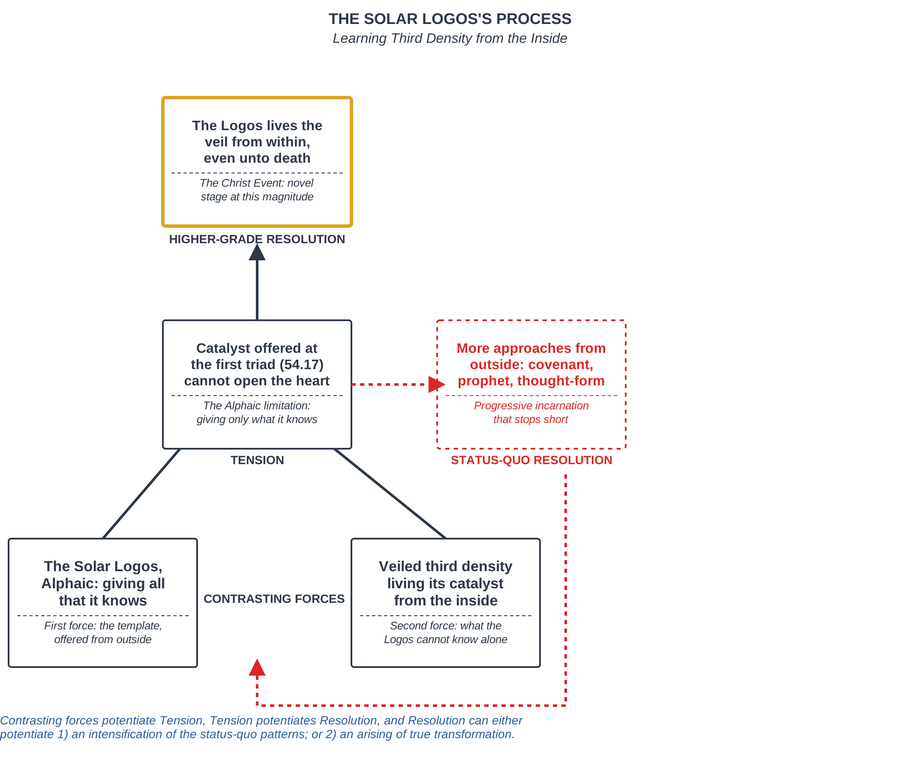
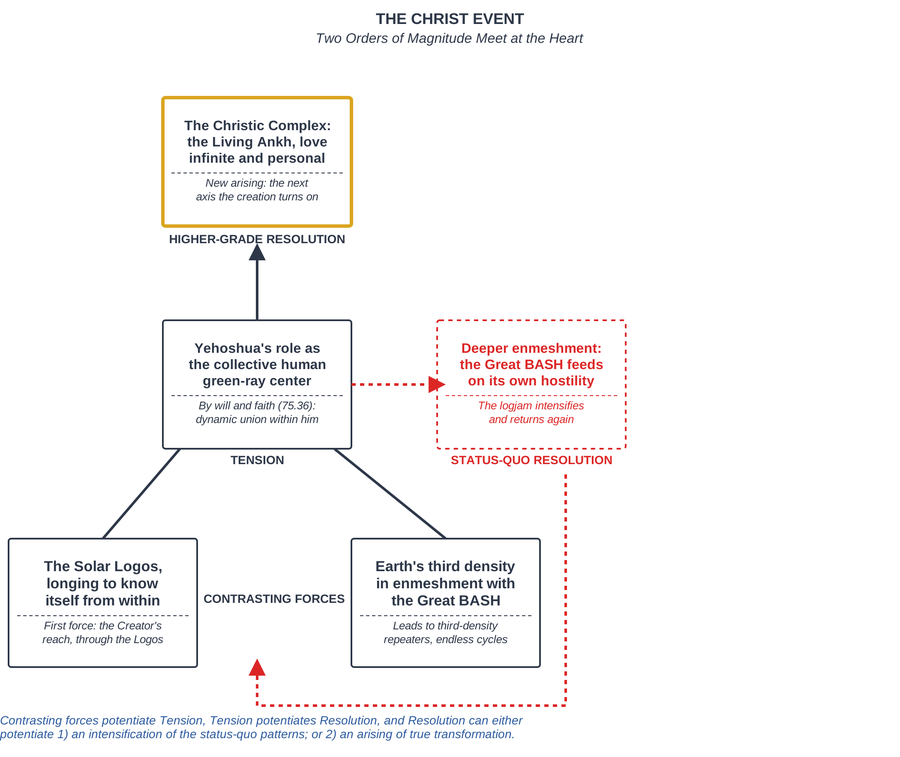
A word on the diagrams. Each one maps a Law of Three: two contrasting forces at the bottom, the tension they create in the middle, and two ways that tension can resolve. It can rise into a higher-grade resolution, the new arising, or it can slide sideways into a status-quo resolution that only feeds the old pattern back into itself.
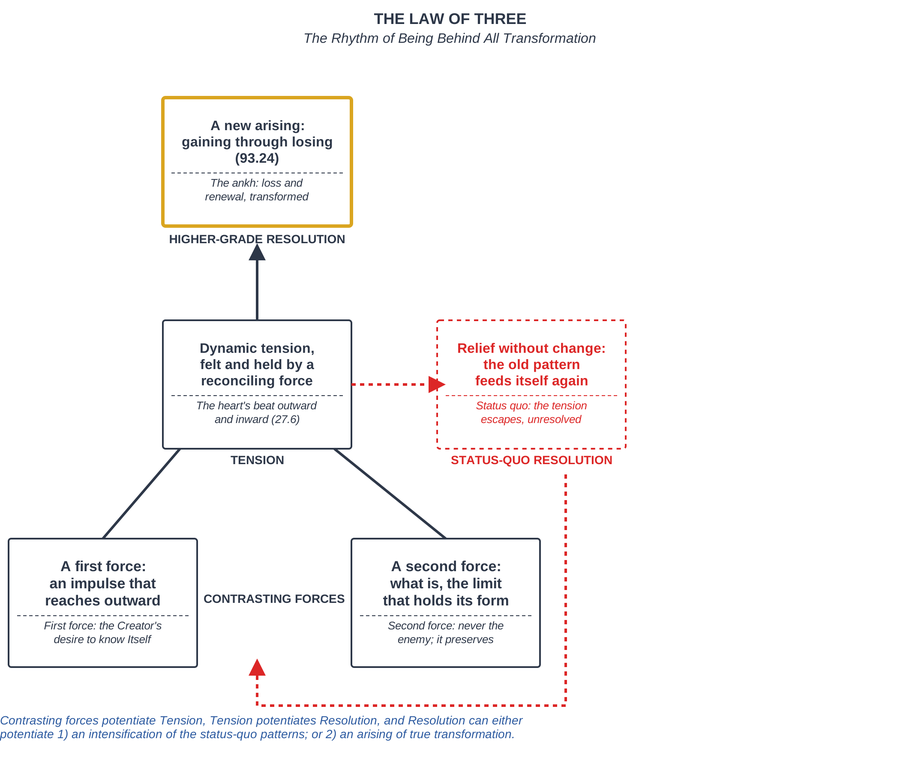
You can see the pattern at the very beginning of this octave. The archetypes began as a system of three: two aspects, the Matrix and the Potentiator, which the Significator used “to balance all catalyst” (78.10). Ra calls the Significator “the most efficacious nature,” what I call the agential self. Two forces in tension, and a third that reconciles so that a chosen novelty arises. Later, with the veil, the system grew to include Catalyst, Experience and, at its heart, the Choice.
But the archetypes are themselves a complexification of something more primal. The Creator desires to know Itself; that is the first force. At some point that knowing reaches a plateau: everything available had been explored to its fullest, and it no longer yielded greater intensity or novelty; that is the second. The tension is felt, and the reconciling force arrives as the innovation of a new concept. Its application is the new arising. The veil came exactly this way: after the “turtle” pace of the early octave (82.18), a Logos conceived of the Significator becoming a complex, “to be what it is not” (78.19).
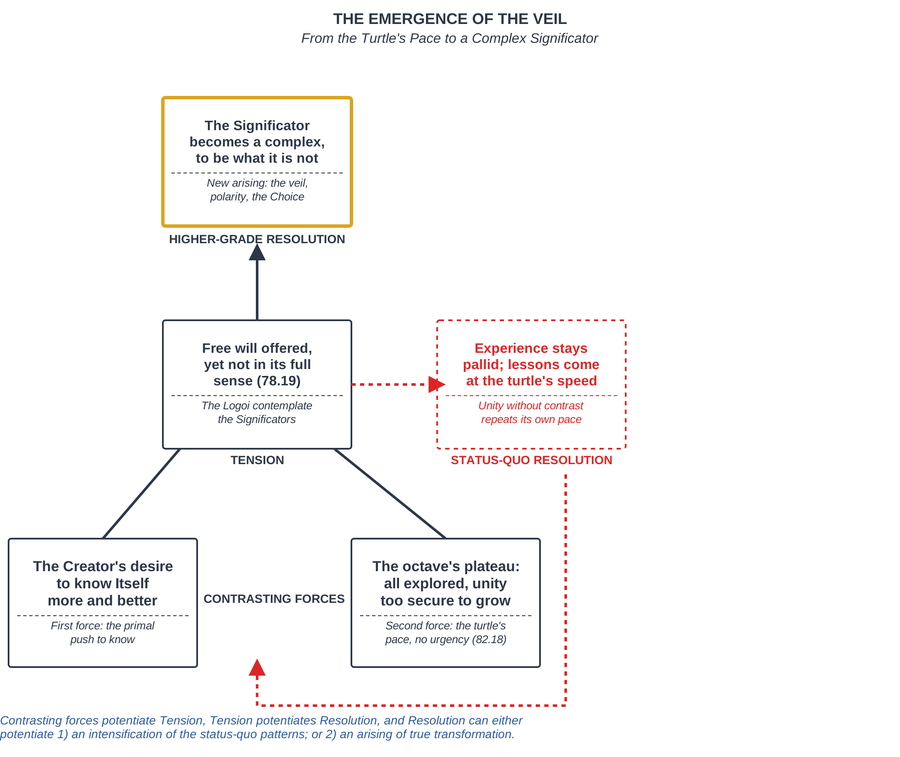
The same pattern shows up twice more on the way to the Christ Event.
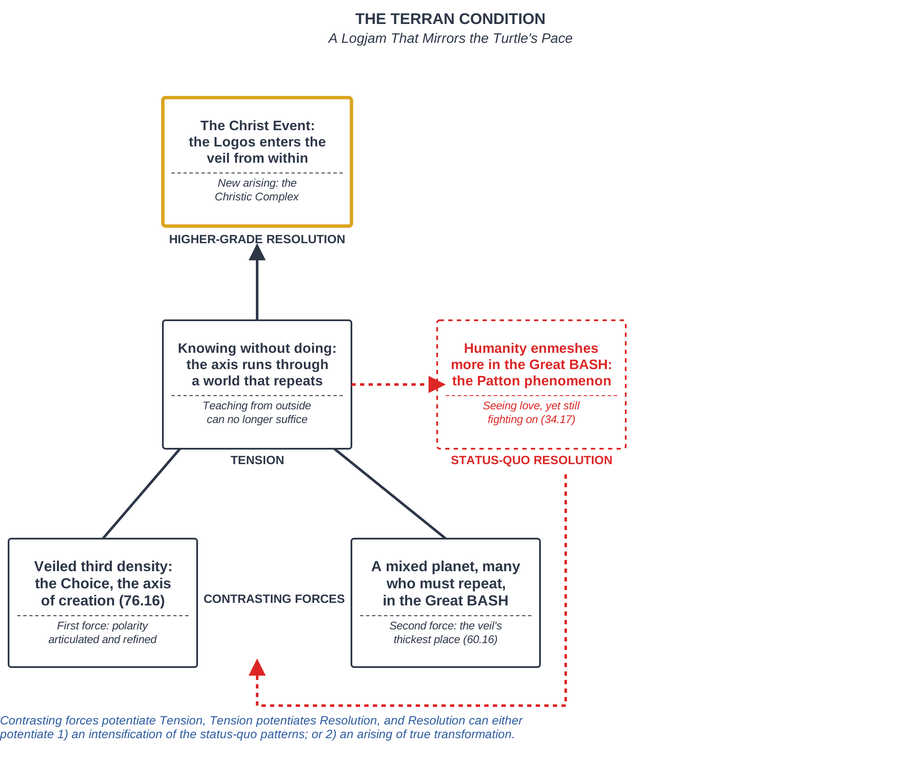
(By the Great BASH I mean the collective pattern I name Bellicose Attitude, Aggressive Actions, Scarred and Scared, Hope through Hostility.)
My Reading: The Christic Complex
In the Christ Event that rhythm became personal. Jesus was fully a third-density human (16.59), yet aware that he “was not an entity of itself but operated as a messenger” (17.22). My reading is that he held the door open at the heart by will and faith. Within his embodiment, the Solar Logos and veiled third density came together in one dynamic union, a fullness that had always been there in potential but was not activated until the Christ Event. In that union Jesus stands in for all of veiled third density throughout the universe, not only for himself. He became, and is, the tabernacle (John 1:14), the green-ray heart center of the collective, a kind of portable Queen’s Chamber. And once inside third-density space/time, the Solar Logos could at last meet the world face to face: looking out through the eyes of Jesus and engaging creation as a veiled third-density being for the first time.
What arose from this was something new, the Christic Complex: the Living Ankh, the coincidence of opposites made flesh, now able to relate heart to heart with every veiled third-density being, wherever it is in the universe. Through it the Solar Logos, and through the Solar Logos the Galactic Logos, the Primal Logos and the Creator itself (81.33), experienced veiled emergence at its most intense. If the choice of third density is “the axis upon which the creation turns” (76.16), then that axis has a place of maximum intensity, a singularity, and I believe that singularity is Earth (60.16). What arose there is, I think, the next axis upon which the creation turns: the Presence so many contemplatives describe meeting, love that is both infinite and personal. Rohr calls Jesus “a third something”; I’m trying to say the same thing a little more metaphysically.
Orthodox with a Small o
I want to be honest about where this sits. I offer it as a viable alternative to the versions above, and in particular to the Christ-consciousness Jesus.
Against the adept reading, I don’t think Jesus was simply one awakened master among many who reached a state we can all reach. Something happened once, in him, that changed the axis itself: the meeting of two orders of magnitude in one life. We can grow into it and participate in it, and that is the whole point of the spiritual life; but it was given before it was attained.
Against the costume reading, I hold that Jesus was fully human, veiled as we are, and chose his path by faith. Gibran and the New Age writers are right about that.
So in its shape my reading is orthodox in the small-o sense, orthodoxia, right praise. It keeps the grammar of the Council of Chalcedon (451): two natures in one person, united “without confusion, without change, without division, without separation.” In my language, the Solar Logos and veiled humanity are joined in Yehoshua, and each stays itself. I see my reading as that confession allowed to flourish, carried out into a cosmos the Council couldn’t have imagined.
At the same time, I know that from inside the Catholic magisterium, parts of this would be read as heterodox. The church identifies the divine nature in Christ with the eternal Word, the second person of the Trinity, and would not speak of a Solar Logos, of densities, or of a Logos that learns. I don’t want to blur that difference. I hold my own tradition with love, and I hold this reading as a pilgrim’s proposal, not a ruling.
And it is consistent with the Ra contact as far as I can tell. Ra describes Jesus as a messenger aware he was not acting of himself (17.22), names the heart as the great turning point (32.5), and calls the choice of third density the axis upon which the creation turns (76.16). My additions (the Christic Complex, the next axis, the Law of Three as the rhythm of being) are mine, and I’ve tried to keep them visibly apart from what Ra says.
The Son of Man
One more word, since it’s in the title of Gibran’s book: “Son of Man.” It is the title Jesus took for himself. Richard Rohr calls it Jesus’s “most common and almost exclusive self-name,” and renders it “The Human One” or “Son of Humanity” (Everything Belongs). Cynthia Bourgeault reminds us that his early followers also called him the ihidaya, Aramaic for “the single one,” the unified one (The Meaning of Mary Magdalene). I hear in both what the tradition has always called him, the new Adam (1 Cor 15:45): the archetypal third-density human, who makes the journey intentionally, by faith and will. But from Ra’s perspective there is more to it. Jesus became aware that he “was not an entity of itself but operated as a messenger” (17.22). I’d go a step further: the messenger became the Message itself, in his role as the collective human green-ray center. In the pyramid model I’ve been working with, that is the fourth zone, the Queen’s Chamber position, where, as Ra says, the spiraling energy “is always centered and at its strongest point” (56.7). So the Human One is also humanity’s heart.
The Green Ray in Six Stages
I’ve also been trying to picture the green ray itself, since that’s where I locate all of this. Here are six stages of a 3-D model I’m building. Explore the interactive model — drag to orbit, pinch or scroll to zoom, and step through the stages.
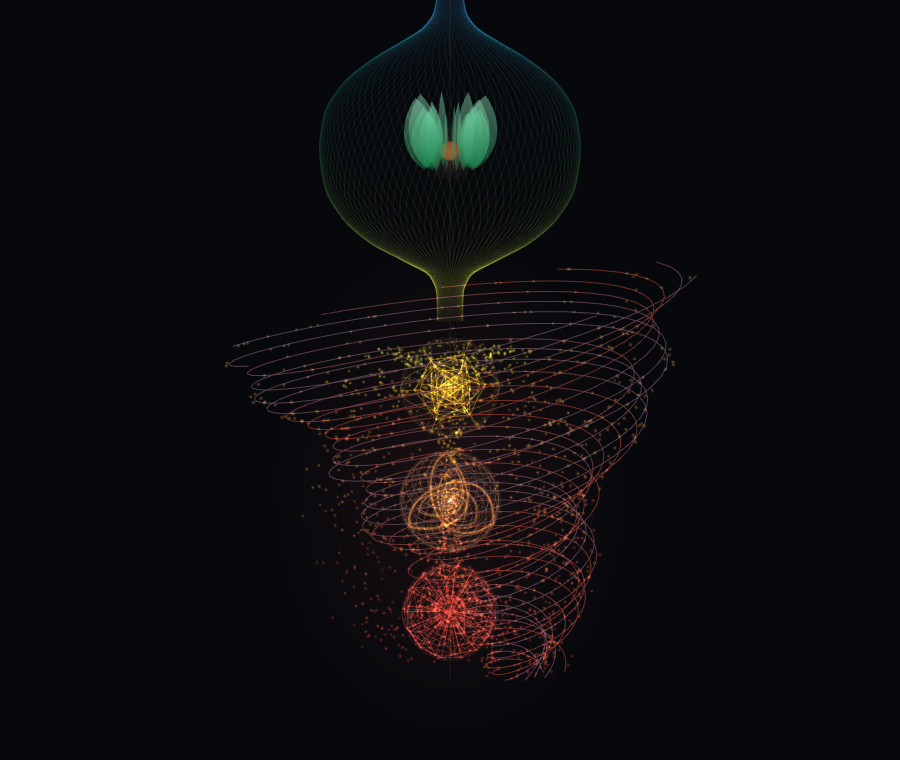
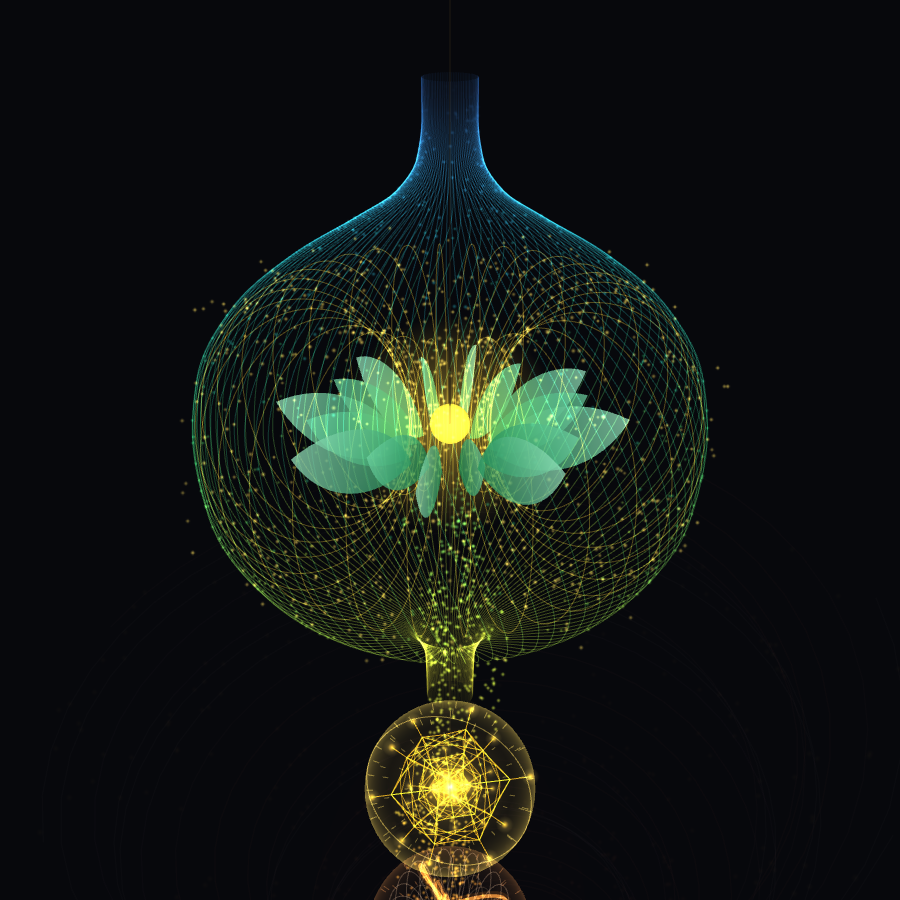
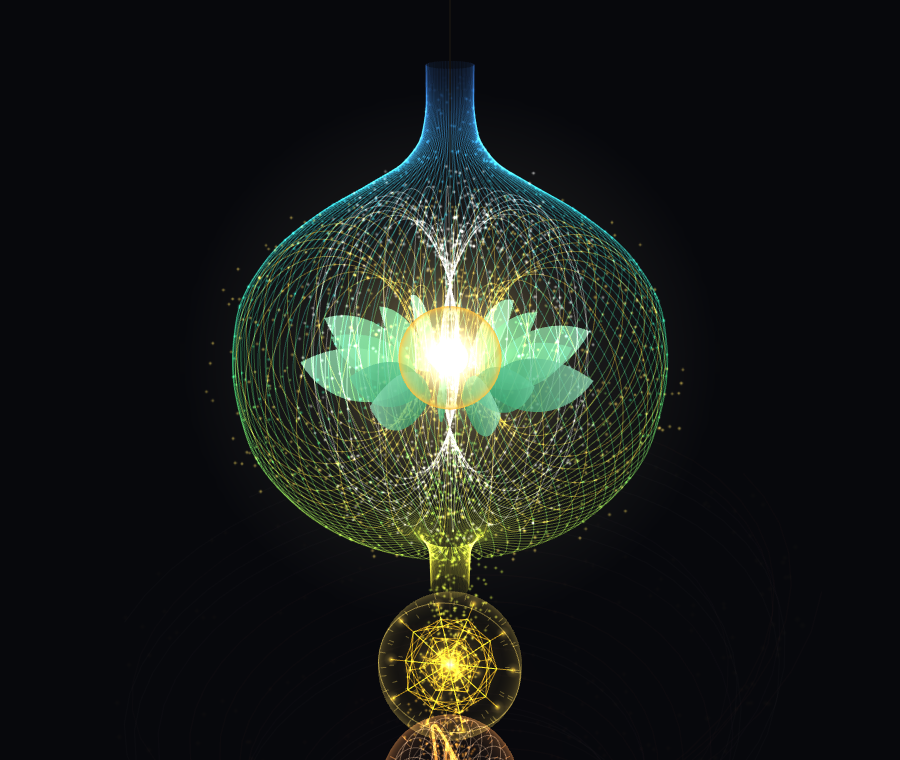
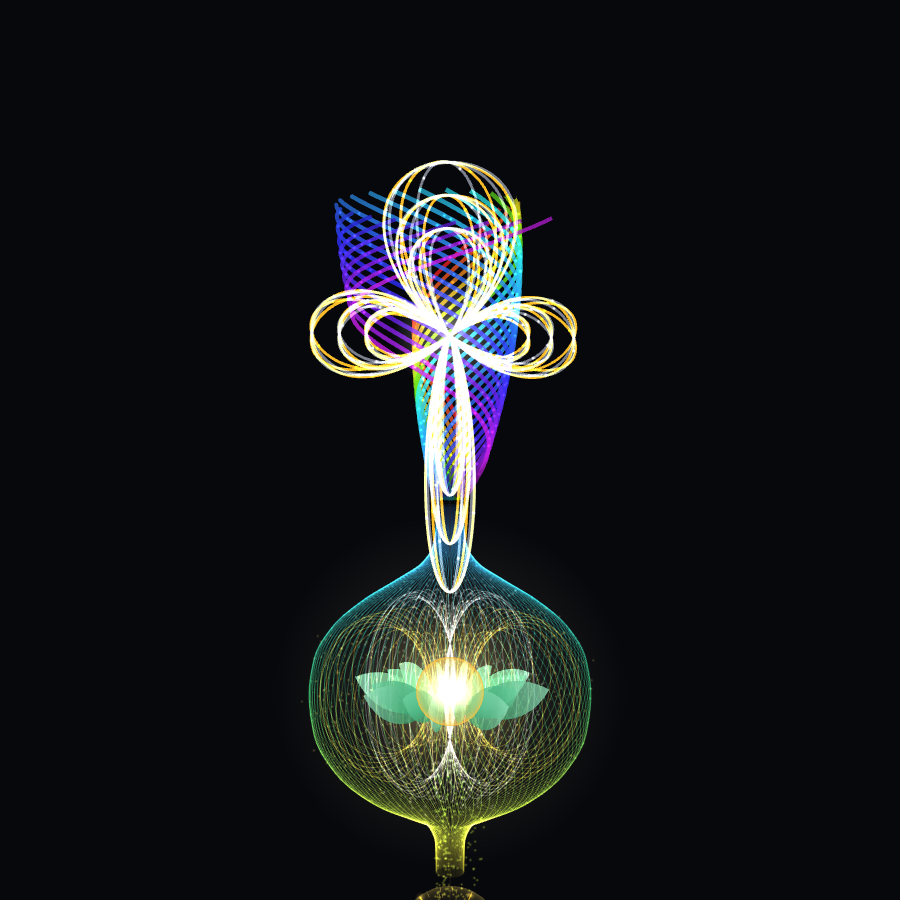
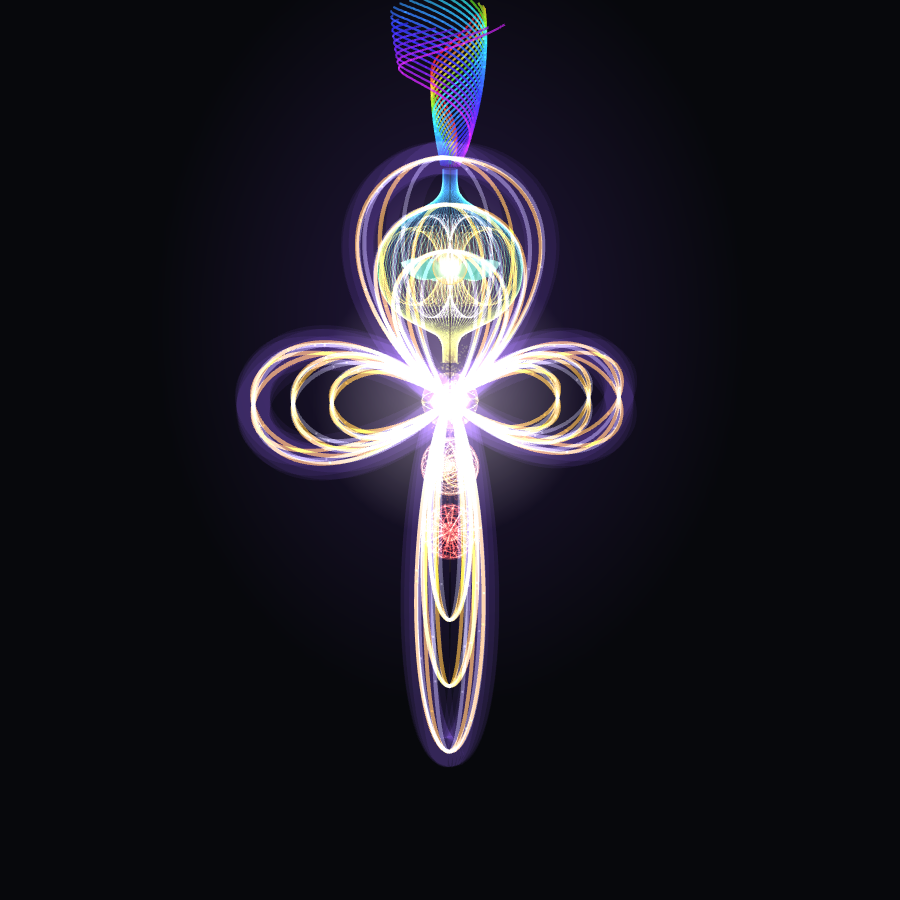
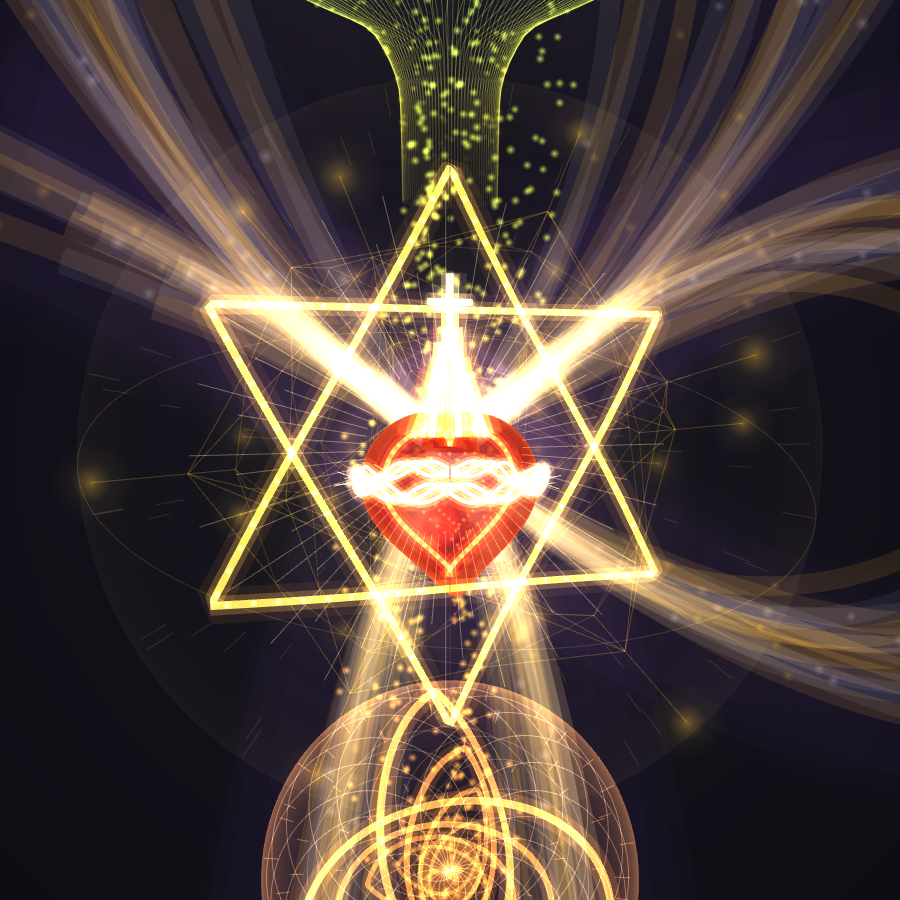
Explore the interactive model — drag to orbit, pinch or scroll to zoom, and step through the six stages.
Who Do You Say That I Am?
So Gibran is right that Jesus was human like us, and right that he was a tempest. The New Age writers are right that the Christ is meant to come alive in us. The liberation theologians are right that he stood against the powers. For me, all of that is where the story begins. The question Jesus asked Peter is still open, and this is my answer for now.
I’m offering these thoughts for what they are worth.

