by Doug Scott, LCSW
Originally published May 2019; revised November 2026.
The word radical comes from the Latin radix, “root.” I keep returning to that etymology because it names what I am after here. At the root of the Christian message — beneath the creeds, the denominations, the arguments — lies an experience of union with the Infinite Creator, and that union is felt as intimacy. Rooted intimacy with everything and everyone.
When I first wrote this piece in 2019, I said that the Law of One and mystical Christianity are “the same.” I would put it a little differently now. They are two languages describing one territory, and when you walk that territory long enough, the two maps start to overlap at the places that matter most. This revision keeps the original bones — the name “Jesus Christ,” the three classical stages of the spiritual life, the Christ Event — and adds what the last few years have taught me about kenosis, about vulnerability, and about what Ra means by intimacy.
Christ as Logos
In the Law of One, the word closest to what Christians mean by “Christ” is Logos — the Creative Principle, which Ra also calls Love, the Second Distortion. Ra’s name for this Love in action is intelligent energy. John’s Gospel opens on the same word: “In the beginning was the Logos.” So when I say “Christ,” I mean the Logos — Love as a kind of personhood — and when Ra says “Logos,” I hear Christ.
The Activated Heart
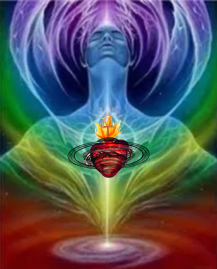
When a person’s heart opens far enough to become activated, it comes “online” and can hold intelligent energy in a new way. Christians call this indwelling the Holy Spirit; many today call it Christ Consciousness; a student of the Law of One might call it the beginning of adepthood. The labels matter less than the experience. To receive and hold a threshold level of this Love is what Ra describes as harvestability to fourth density.
But that threshold is one lesson of the Christian message, and only one. The Jesus Christ Event illuminates much more than the entry gate.
The Name “Jesus Christ”
The name Jesus — Yeshua, or Ra’s preferred Jehoshua — means, roughly, “YHWH saves” or “YHWH is salvation.” Christ comes from the Greek Christos, “anointed one.” So the name itself already holds two things together: a particular human being, and the anointing of universal Love upon him.
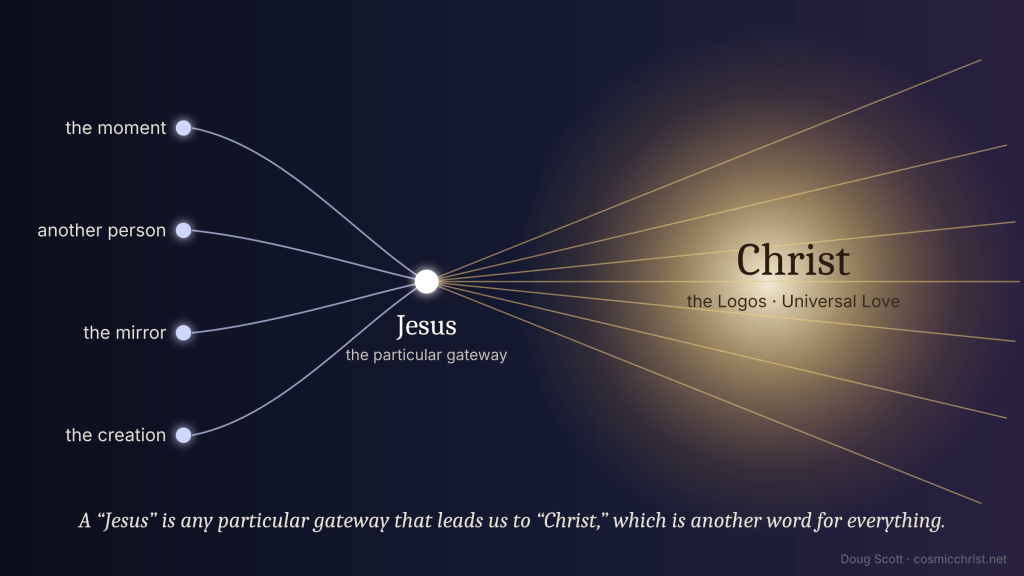
That is the key I want to turn. “Jesus” names the particular — this face, this body, this moment in history. “Christ” names the universal — the Logos, Love as the ground of everything. Put the two words together and you are making a statement about how the universal and the particular meet. In other words, Jesus is the particular face through which we enter universal Love. When John has Jesus say, “I am the way, and the truth, and the life. No one comes to the Father except through me” (John 14:6), I read the me as the particular gateway — and I have come to believe that any genuine particular, met with an open heart, can become such a gateway.
Here is how I would put the cosmic meaning of the name in my own words:
The Logos-Love is not impartial. It reaches toward you, as one of you, and draws you back into Itself by awakening in you the fact that your essence is divine. The Logos in all Its grandeur stands in radical solidarity with your suffering, because you are the Logos, the Christ, in third density. The Logos is both Almighty and All-Vulnerable, at once.
The one who incarnated to carry this dynamic was, by Ra’s account, a wanderer of fourth density (17.12), and he had to grow into his Christhood. His commitment was total. As I read it, he held the space open through will and faith at the highest level of adepthood — the way an adept puts on what Ra calls the magical personality (75.36) — and through that conjunction our Solar Logos entered third density. In other words, Creator and creature met face to face in one human body. And because, as Ra puts it, “That which is learned by one is known to all” (81.33), the whole of creation tasted that meeting too.
Kenosis: How the Particular Holds the Universal
Since 2019, the word that has done the most work in my thinking about this is kenosis — self-emptying. Paul’s hymn in Philippians says that Christ “did not regard equality with God as something to be exploited, but emptied himself, taking the form of a slave” (Phil. 2:6–7).
I now understand the Christ Event as kenotic indwelling. The particular does not hold the universal by grasping it, or by becoming large enough to contain it. The particular holds the universal by emptying — making room — so that Love can work as and through a willing consciousness. (I explore this at much greater length, and much more speculatively, in my article The Christ Event as Kenotic Indwelling.)
I picture this with what I call the Living Ankh. Its vertical beam is the kenotic descent — the Creator emptying into creation. Its crossbeam is the embrace — the creature opening to the Creator in consent, the way Mary said fiat, “let it be done unto me.” Where the two cross is the heart, the meeting point where both are changed. And the loop above is the space that kenosis and consent open together: eternal life as co-presencing.
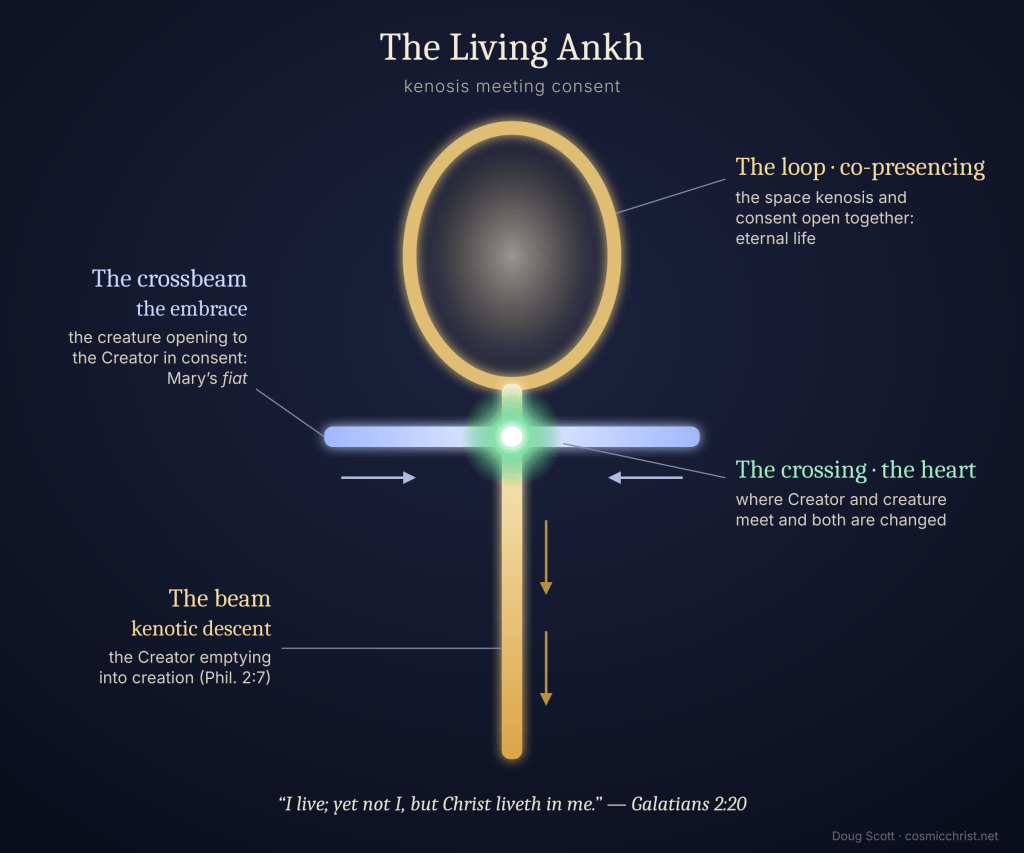
That self-emptying is the doorway, and it is the same doorway for us. Centering Prayer, which I have practiced since 2013, is simply a daily rehearsal of it: consenting, again and again, to God’s presence and action within.
Why the Holy Name Is So Effective
If “Jesus Christ” names Universal Love interfacing through the particular, then it makes sense that this name carries power. To say “Jesus Christ” with faith is to invoke the wholeness of the Logos and shine it onto a particular situation — like a flashlight finding an object in the dark.
Consider what happens when an entity committed to the path of separation (the negative path, in Ra’s terms) is suddenly flooded with the luminosity of wholeness. It is too much love and too much light, and the entity recoils from such an open invitation to union. When a pastor commands a spirit to leave in the name of Jesus Christ, what is happening metaphysically, as I understand it, is that he or she becomes an instrument of that love and light, opening a vortex of intelligent energy that beckons whatever is challenged to come home — to follow its deepest longing toward union.
Those on the negative path resist that longing deliberately. Their whole path is a chosen separation, and as I understand it, that path can be pursued only so far — in sixth density it can no longer be sustained. Wholeness wins in the end. In third density, though, the entity committed to separation will flee the encounter of love that the name carries.
The Three Stages
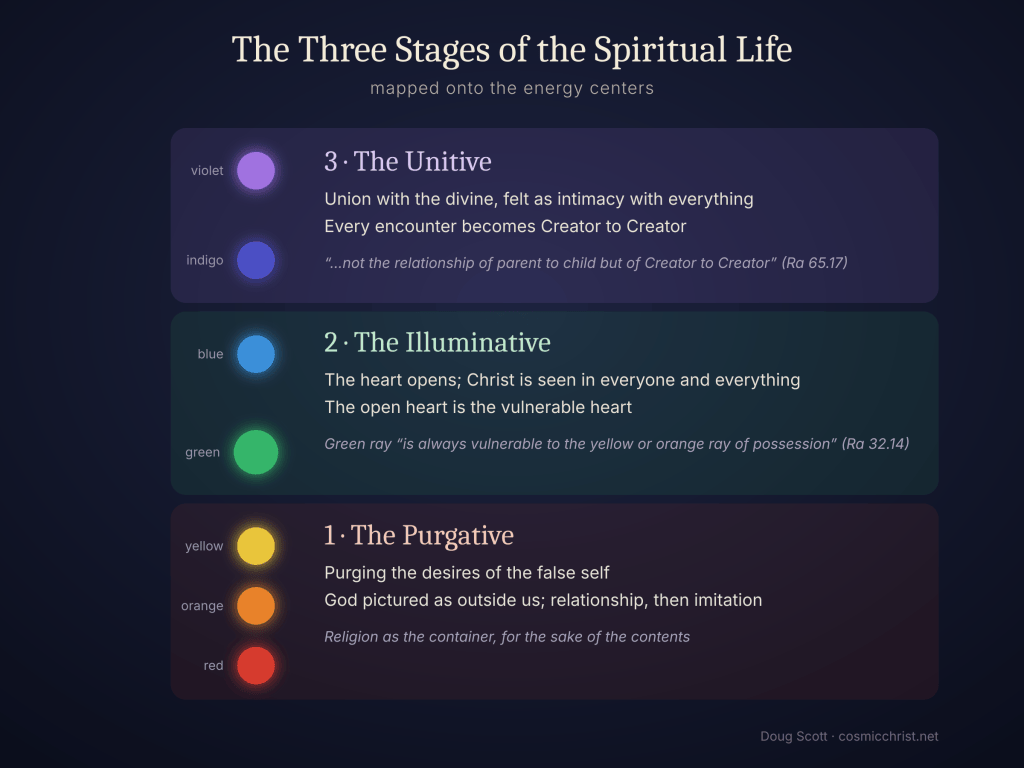
The Christian contemplative tradition describes three stages of the spiritual life: the Purgative, the Illuminative, and the Unitive. We enter the Jesus Christ mystery at whatever depth our own development allows, and these stages map well onto what Ra describes in the energy centers.
Stage 1: The Purgative
In my experience — both personal and across many years of sitting with people in counseling — most of us spend most of our lives in the Purgative stage, and most religious life finds its center of gravity here. The work is purging the egoic desires of the false self. Religions help by offering dogmas and rituals that picture God as outside and separate from us. That gives us a relationship with the divine, a starting place for turning our behavior toward service to others, and it is fitting for the early stages of psychological and spiritual growth.
As Richard Rohr puts it in Falling Upward, religion gives us a container, and the container exists for the sake of the contents. The trouble comes when we mistake the container for the contents — when Christianity shrinks into “churchianity.” At worst, people repeat the same lessons for a lifetime without fuller activation of the heart.
From a Law of One perspective, the Purgative belongs to the first three energy centers: learning from life’s catalyst how to let Love rise toward the heart with less distortion. Christianity at this stage tends to hold that one must believe in Jesus in order to be saved. I see belief and worship as a beginning rather than the point. And the good news is that belief leads to relationship, relationship leads to imitation, and imitation through service starts to activate the heart. Serving others, people begin to see that they are serving the Christ in others — “just as you did it to one of the least of these … you did it to me” (Matt. 25:40). Eventually they recognize Christ in themselves, too, and the veil between persons begins to thin. That is the threshold of the Illuminative.
Stage 2: The Illuminative
In the Illuminative stage, the heart is open enough that a person lives from Christ Consciousness to some real degree and begins to see that Christ is in everything. This lines up with what Ra calls harvestability — a person polarized more than half toward service to others. Here people give their lives to building the Kingdom of God on Earth, which is another name for the love and understanding of fourth-density living. When Christ Consciousness resonates at a certain threshold within the collective, that, to me, is the return of Christ.
This is also where vulnerability becomes unavoidable, and I want to linger here, because it is what I most wanted to add to this article.
Ra says that “the green-ray activation is always vulnerable to the yellow or orange ray of possession,” and names the distortions: “Fear of possession, desire for possession, fear of being possessed, desire to be possessed” (32.14). A member of our Building 4th community, presenting on this passage, sharpened that teaching: it is less that the green ray is vulnerable and more that the green ray is vulnerability. The open heart is the exposed heart. The word vulnerable comes from the Latin vulnus, “wound” — it names the capacity to be wounded.
In other words, there is no intimacy without vulnerability, and the moment we make our openness conditional on our own safety, Love drops back into the arithmetic of the yellow ray — still love, but conditional love. This does not mean abandoning boundaries or choosing martyrdom. It means keeping the heart open while acting with discernment. The resurrected Christ carries his wounds into glory; glorification does not erase vulnerability. That is the Illuminative stage’s hardest and most beautiful lesson.
Stage 3: The Unitive
Fewer still enter unitive consciousness with the divine. The Logos-Love’s final message, for those with the eyes to see it, is that complete union with God is possible — and is our birthright. This kind of living and seeing resonates, I believe, with late sixth density and beyond.
We enter a gnosis that reveals our participation in the very flow of the Infinite Creator, as God unfolds in eternal becoming. Personal encounter with God (third- and fourth-density territory) leads into a union that is transpersonal — and more intimate, not less. That is, the transpersonal is a condition of personal intimacy with everything.
Ra gives a passage I return to often: “You may begin to see your relationship to the Logos, or sun, with which you are most intimately associated. This is not the relationship of parent to child but of Creator (that is Logos) to Creator (that is the mind/body/spirit complex as Logos).” Once that recognition lands, ~one may widen the field of “eyeshot” to recognize parts of the Logos throughout the One Infinite Creation (65.17). This is the Unitive stage in Ra’s own language: everything becomes a Creator-to-Creator encounter, where the Purgative and Illuminative stages were still, largely, Creator-to-creature.
What happens to the self in that union? Ra speaks to it in two places. Of the crystallized healer: “the crystallized healer has no will. It offers an opportunity without attachment to the outcome, for it is aware that all is one, and that the Creator is knowing Itself” (66.15). And of the third step in the discipline of the personality: “Three, become the Creator. The third step is that step which, when accomplished, renders one the most humble servant of all, transparent in personality and completely able to know and accept other-selves.” Then: “To become the Creator is to become all that there is. There is, then, no personality in the sense with which the adept begins its learn/teaching” (74.11).
Here is how I read those passages, and I offer it as my reading. The separate self the seeker started with falls away; the person remains. Personality becomes transparent — the Creator shines through it — and the healer’s will is surrendered to the Creator’s activity rather than abolished. I call this co-presencing: the person uses will and faith to allow a fuller expression of the Creator, and discovers that their own identity was the Creator’s all along. In other words, union costs us our separateness, and gives us back ourselves. My own tradition says it simply: “I live; yet not I, but Christ liveth in me” (Galatians 2:20).
I want to stress that Christian unitive consciousness is not a checking out of this world into private bliss. It is seeing creation from the Creator’s point of view, delighting in Itself while continuing to call all things home. Compassion and forgiveness abound. There is work to be done. Because all of creation is one Body and all entities seek to become one again, there is need for agents of light — incarnate magnets helping all that seeking and “oneing.” Transformed people transform people and systems. The unitive Christian accepts the honor and duty of bearing, as the Creator bears, the tension of joy and despair happening in parts of the same Body at once. It is a more radical engagement with the world — roots, remember?
The Jesus Christ Event
The Jesus Christ Event says this: the Infinite Creator incarnates as the material world. The material world is the hiding place of God; the universe is the Body of Christ. When that knowledge moves from idea into lived experience — which is another way of saying “mystical” — you feel a connectedness to everything that delights in the intimacy of it all. That is the message of the Law of One, and that is the Christian message at its core.
Ra offers a simple exercise (10.14): “The moment contains love.” Seek love in the moment. Then look upon another person and see the Creator; gaze into a mirror and see the Creator; gaze at the creation around you and see the Creator. Here is how I see the two traditions meeting in that exercise:
- The moment that contains love is a “Jesus” — a particular gateway. Engaging the moment with full surrender, meeting the Presence hidden in it, leads you into Christ, the Logos, the Infinite Creator.
- Looking into the mirror, and looking upon another person, and seeing the Creator in both, is meeting “Jesus” in all the particularity of the moment — which leads you into Christ. There you have the Jesus Christ dynamic.
- Looking at creation — the grass, the rock, the bird, the car — and seeing the particular manifestation of the Infinite Creator is a “Jesus” moment, the singular gateway into the unity of everything: the Christ.
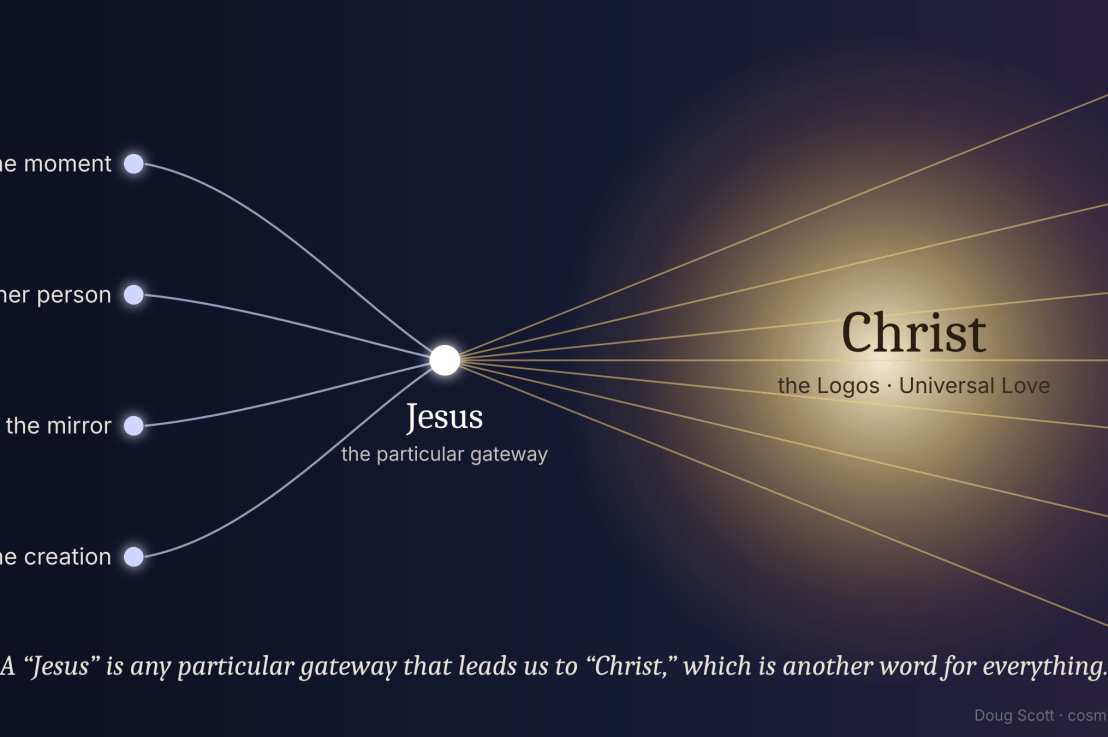
In other words: a “Jesus” is any particular gateway that leads us to “Christ,” which is another word for everything. The historical Jesus was the full revelation of this particular-plus-universal dynamic — in one place, one time, one person — so that we could see the same truth in ourselves. What it asks of us is a spirit of surrender and participation in the divine flow.
With that realization, we go to work in our relationships, bringing Love and Light — bringing Christ — to people and places caught in separation, elitism, and disunity. We become Jesus Christ for the world, as imitators of, and channels for, the dynamic that broke open on Earth two thousand years ago. And this is always done in community, even by the hermit who rarely sees another human face. The cosmic community holds everything as the manyness of the One. Though physically apart, the hermit in Christ is radically united to everything, because she knows there is no separation from the divine anywhere. He feels that intimacy so completely that the knowing engages his whole mind, body, and spirit.
Love Incarnated
Christianity, at its root, is less a religion to join or a label to wear than a statement about Reality — and an invitation to participate in the divine unfolding. We are “Christian” when we engage, care for, and nurture the world immediately around us with the intimacy that lovers share: a subject-to-subject recognition that delights in this — you and I are the same Christ, clothed as you and me. We are love, incarnate.
Ra puts it with a touch of humor. Asked about “close encounters,” Ra answers that in a universe of unending unity the very idea is humorous — “for are not all encounters of a nature of self with self?” (53.9). Amen.
Concluding Words: God’s Ecstasy
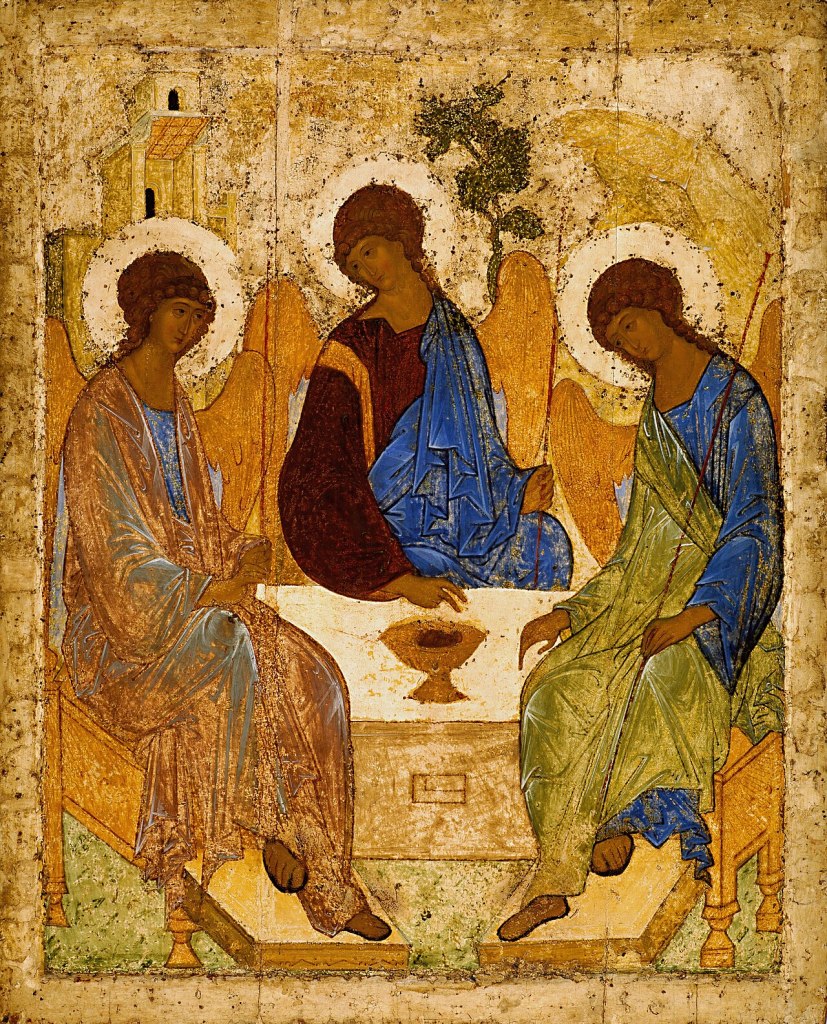
In 2019 I closed this article with a long passage from Richard Rohr’s daily meditation featuring the theologian Beatrice Bruteau’s reflection on the Trinity. Rather than reprint it, I will point you to it: “God’s Ecstasy,” Center for Action and Contemplation, May 15, 2019, drawn from Bruteau’s book God’s Ecstasy: The Creation of a Self-Creating World (Crossroad, 1997).
Bruteau describes creation as God’s ecstasy — God standing outside Godself in a self-giving that she links directly to the kenosis of Philippians 2. Her summary line has stayed with me for years: “God is creating a self-creating world.” It is the same intimacy I have been circling here, seen from the side of the Creator: a Love so given away that it becomes the world, and a world so loved that it can find its way home.
Sources
- Ra Contact: 10.14, 17.12, 32.14, 53.9, 65.17, 66.15, 74.11, 75.36, 81.33 (verified against The Ra Contact: Teaching the Law of One, L/L Research)
- Philippians 2:6–7; John 14:6; Matthew 25:40; Luke 1:38; Galatians 2:20
- Beatrice Bruteau, God’s Ecstasy: The Creation of a Self-Creating World (Crossroad, 1997, 2016)
- Richard Rohr, Falling Upward: A Spirituality for the Two Halves of Life (Jossey-Bass, 2011), 12–15
- Richard Rohr, “God’s Ecstasy,” Center for Action and Contemplation, May 15, 2019
- “The Art of Intimacy,” Building 4th presentation by a community member, cosmicchrist.net, June 2026


Thank you!…I have just stumbled across your website and I am truely grateful. I love how information, ideas, thoughts, ours or others show up exactly at the most divine and perfect of timings. When I, at times, find it difficult to put into words what you have done here so beautifully. I look forward to making my way through your writings as to be illuminated more and more. The perfect union that most certainly exists between Mystical Christianity and The Law of One will brings us that much closer to what we all know to be the truth. exciting times!
Many blessings, love and light.
Rachael:-)
LikeLike
Wow! This came along at just the right time for me. I can hardly add much to the previous comment – so beautifully rendered! I’m grateful someone did the research and created the path ahead of me. Resolving internal conflicts with interconnecting points of light. Clearing false entities and entering union with the Divine.
Thank You, Thank You, Thank You
LikeLike
Thank you, Rick. I’m very pleased that this article met you well. I’ve written two articles that go deeper and more succinctly into this theme, if you’d be interested:
1. http://cosmic-christ.org/2019/12/11/a-christmas-message-for-the-seeker-community-allowing-logoic-love-to-enter-and-transform/
2. http://cosmic-christ.org/2019/12/13/celebrating-christmas-as-the-entrance-of-a-new-concept-complex-jehoshua-as-an-upgrade-to-earths-third-density-operating-system/
Peace and all goodness,
Doug
LikeLiked by 1 person