by Doug Scott, LCSW
This post began with a small question that wouldn’t leave me alone. When Don asked where the Council that guards our planet is located, Ra answered: “This Council is located in the octave, or eight[h] dimension, of the planet Saturn, taking its place in an area which you understand in third-dimensional terms as the rings” (6.8). Why the rings? Ra doesn’t say. What follows is where that question took me — and, as usual, I’ll keep three things apart: what Ra says, what the science says, and what I propose.
The Rings Are a Marker
I take the rings themselves to be incidental. Ra places the Council in the octave, the eighth dimension — a position in time/space — and then translates that position into terms we can picture: the rings. In other words, the rings mark where that place shows up in our space. That frees the question from the ice and dust. It becomes this: what is special about that region of Saturn, such that a governing body would sit there?
What Converges at the Rings
Quite a lot, it turns out. The rings lie in Saturn’s equatorial plane. Collisions between ring particles bleed off their up-and-down motion while their orbital spin is conserved, so the material settles into a sheet only tens of meters thick across hundreds of thousands of kilometers. The planet’s equatorial bulge pulls that sheet into the equator.
Saturn’s magnetic field adds something unusual. Its magnetic axis lines up with its spin axis to within a few thousandths of a degree — the most symmetric planetary field ever measured. So the plane of the rings is the one plane where the planet’s spin, its gravitational bulge and its magnetic field all agree.
Within that plane, several things happen at once:
- Two rotations cross. The magnetic field turns rigidly with the planet; ring particles move at orbital speed, faster close in and slower farther out. At about 1.86 Saturn radii, inside the B ring, the two rates match — the synchronous orbit. Inside that line the ring material outruns the field; outside it, the field outruns the ring material. The faint radial “spokes” of charged dust gather near this line and turn with the field.
- Material leaves the plane and returns to the body. Cassini found charged ring material drawn out of the equatorial plane and carried along magnetic field lines into Saturn’s atmosphere at mid-latitudes, in both hemispheres — “ring rain.”
- Material peels off outward. Farther out, gas from the geysers of the moon Enceladus becomes a plasma torus in the same plane, and that plasma is carried outward in fingers while emptier regions move inward to take its place.
- Resonance gives it structure. The rings are full of tightly wound spiral waves raised by the moons, and the Cassini Division sits where ring particles orbit exactly twice for each orbit of Mimas.
And on the axis itself, at the north pole, sits a cyclone, ringed by Saturn’s famous hexagon-shaped jet stream.
What I Learned from the Great Pyramid
That list looked familiar to me, because I had seen the same pattern before. Earlier this year I wrote about my work modeling the Great Pyramid at Giza as a toroidal field — Raian Process Metaphysics, the Pyramid at Giza, and Fluid Dynamics — with an interactive model you can explore.
The breakthrough there came when I stopped treating the pyramid as a container of energy and started treating it as a marker sitting on the central axis of a toroidal field much larger than the stone. The field has two motions that have to be read together. The toroidal flow circles the axis, like water around a drain. The poloidal flow is the great wheel: up the central column, out over the top, down the outside, and back in at the bottom. Together they make helical streamlines spiraling up the column, which I mapped against a fluid-dynamics phenomenon called vortex breakdown.
In that model the Queen’s Chamber sits in a recirculation bubble, a closed pocket of circulating flow on the axis. That fits Ra’s description of the Queen’s Chamber position as the place of the initiate, where the instreaming light spirals upward and becomes centered (55.11, 57.14). The King’s Chamber sits just above the bubble, in its wake, and it turned out to be the busiest level in the whole field. Three things meet there:
- A shear layer. The rising inner flow pushes outward while the descending outer flow pulls inward. Both still turn the same way around the axis, and rotation holds the shear together as a defined belt instead of tearing it into turbulence.
- The poloidal turnaround. The upward flow slows, and part of it peels off outward at this level.
- The widest point of the helical ascent. The rising spirals swing out to their widest radius here and then narrow again above it.
Ra’s own description of the King’s Chamber position, which Ra calls the healing position (55.12), points the same way. The spiraling energy “is beginning to be diffused at the point where it goes through the King’s Chamber position,” the spirals “closing and opening in double spiral fashion,” and the King’s Chamber position is “the first spiral after the centered beginning through the Queen’s Chamber position” (56.6). So the King’s Chamber level is the field’s equatorial plane — the disk where the circulation turns, meets itself, and exchanges.
Carrying It to Saturn
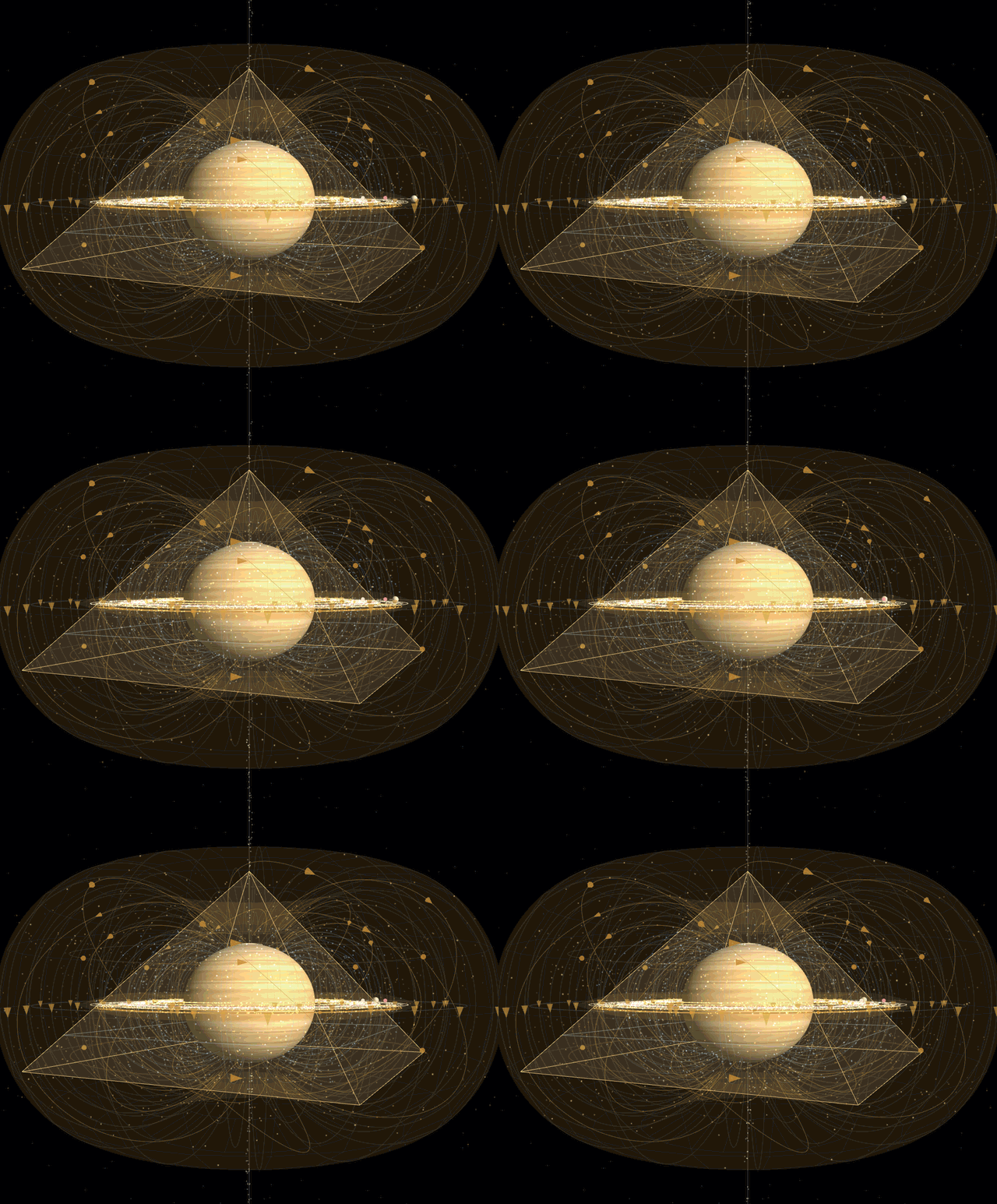
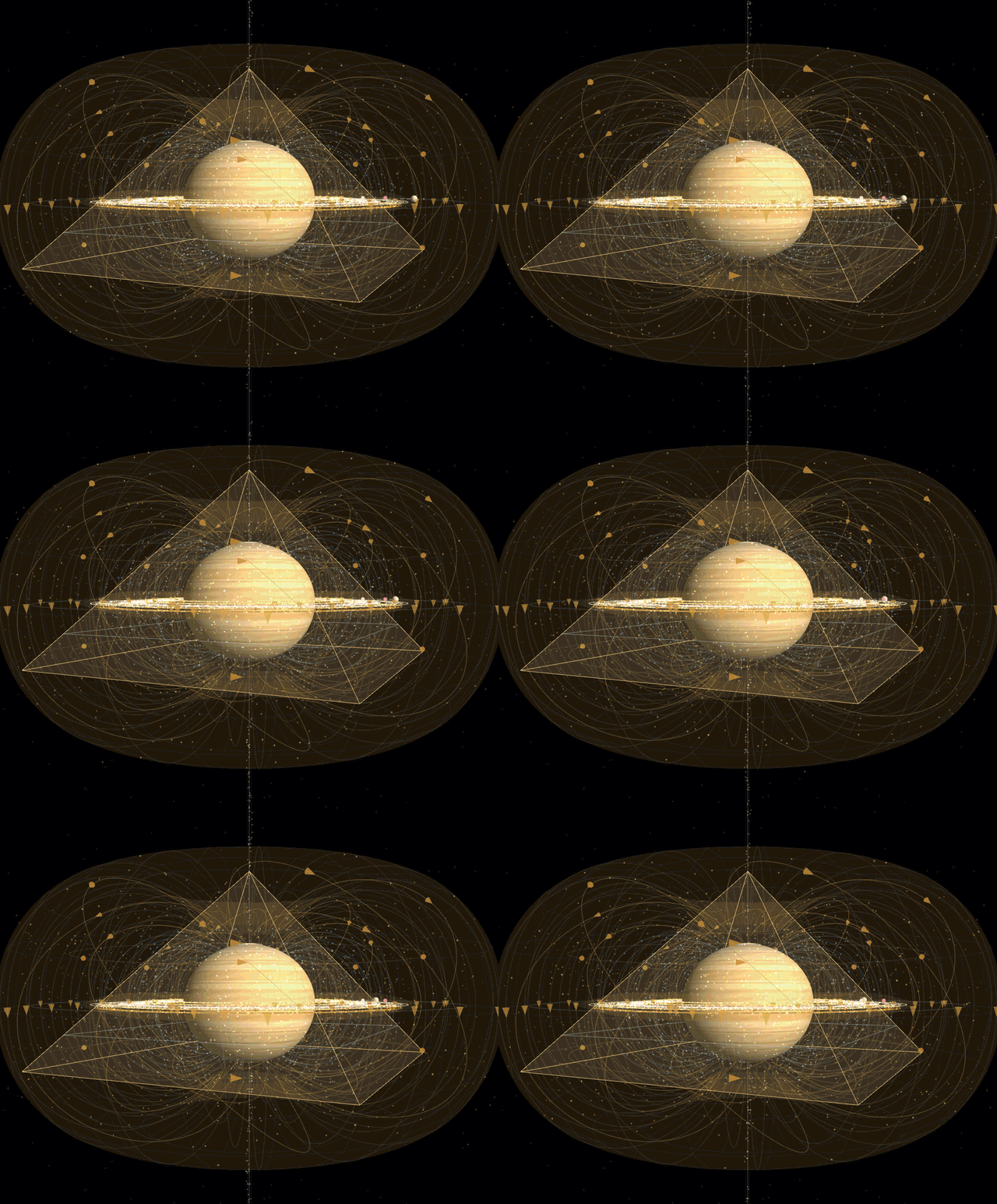
For a sphere, the field’s equatorial plane passes through the planet’s middle instead of sitting partway up an axis. The structural role is the same, and the rings occupy exactly that plane. Here is how the correspondences line up:
| Great Pyramid model | Saturn |
|---|---|
| Equatorial shear belt at the King’s Chamber level | The rings, and the synchronous orbit where field and ring matter cross rates |
| Poloidal turnaround | Ring rain along field lines; Enceladus plasma carried outward |
| Widened helical ascent | Spiral density waves and the Mimas resonance |
| Central axis | The polar cyclone, ringed by the hexagon |
| Queen’s Chamber, the centered being | The planet itself, the body on the axis |
The last row is the one I find most suggestive. If the Queen’s Chamber position is the centered beginning, then in a planet the centered body is the planet itself, and the rings become the first spiral after it — the very place 56.6 gives the King’s Chamber.
Where the Council Sits
~Ra describes the Council of Saturn as the body before which a social memory complex lays any proposal for aiding our planet, and which decides whether the quarantine is lifted (7.8). The nine sit in constant session, working by telepathic contact, “the distortions blending harmoniously so that the Law of One prevails with ease” (7.9).
There is one more piece. The King’s Chamber was where the adepts positioned themselves to work with those who came seeking healing. These were physically incarnate intelligences who could operate the subtle energetics of the place. Ra says the crystallized healer “is analogous to the pyramidal action of the King’s Chamber position,” with the healing energy spiraling up through the healer’s own energy centers, “passing through the green energy center in a microcosm of the King’s Chamber energy configuration of prana,” and continuing “for the third spiral through the blue energy center” (66.5). A strongly crystallized entity is, in effect, “a portable King’s Chamber position” (57.16). That is why I link the King’s Chamber to the fifth chakra, the blue ray — the seat of agency and co-creatorship. Ra calls blue ray “the first ray of radiation of self regardless of any actions from another,” and says plainly, “The blue-ray entity is a co-Creator” (41.25).
My proposal: read as a toroidal field, Saturn’s ring plane is the structural position the King’s Chamber holds in the pyramid — the zone where opposing streams meet without tearing apart, where exchange is most intense, and where rotation holds the whole in balance. If the King’s Chamber is the station of agency, where incarnate intelligences worked the subtle energies on behalf of others, then it stands to reason that the same position, at the order of magnitude of a planet, would be the time/space position for a governing body in charge of the heliosphere. A council whose work is mediating, balancing and blending distortions into harmony sits, in our terms, in the one region of the field built for co-creative agency. Ra places the Council in the rings and says no more; the rest is my reading, and I hold it as a reading.
Where the Analogy Bends
- The shear in the rings is mostly a difference in rotational speed (inner orbits faster); the shear in my pyramid model is mostly a difference in radial motion. Both are shear layers in the equatorial plane, though of different kinds.
- In a magnetic dipole, field lines leaving the equator curve back to both hemispheres. In the pyramid model the flow rises up the axis and returns around the outside. The geometry rhymes; it isn’t identical.
- Saturn’s real magnetosphere is squeezed by the solar wind on one side and stretched into a tail on the other. The model draws it symmetric to show the toroidal reading.
- Scientists still debate how old the rings are, from a few hundred million years to the age of the planet. Since I read the rings as a marker of a time/space position, their age doesn’t change the argument.
For the larger picture of what the Council does and who the Guardians are, see my earlier post, The Guardians, the Council of Saturn, and the Rhythm of Being. I’m offering these thoughts for what they are worth. If you spend some time with the model, I’d be glad to hear what you notice.
Sources
- Ra Contact: 6.8, 7.8, 7.9, 41.25, 55.11–55.12, 56.6, 57.14, 57.16, 66.5
- Cao et al., The landscape of Saturn’s internal magnetic field from the Cassini Grand Finale
- NASA: Groundbreaking science emerges from ultra-close orbits of Saturn
- JHU APL: Cassini’s Grand Finale yields findings inside Saturn’s rings
- Planetary Rings (review)
- Frontiers: transport in Saturn’s inner magnetosphere
- Space.com: Saturn’s rings could be much older than first thought

