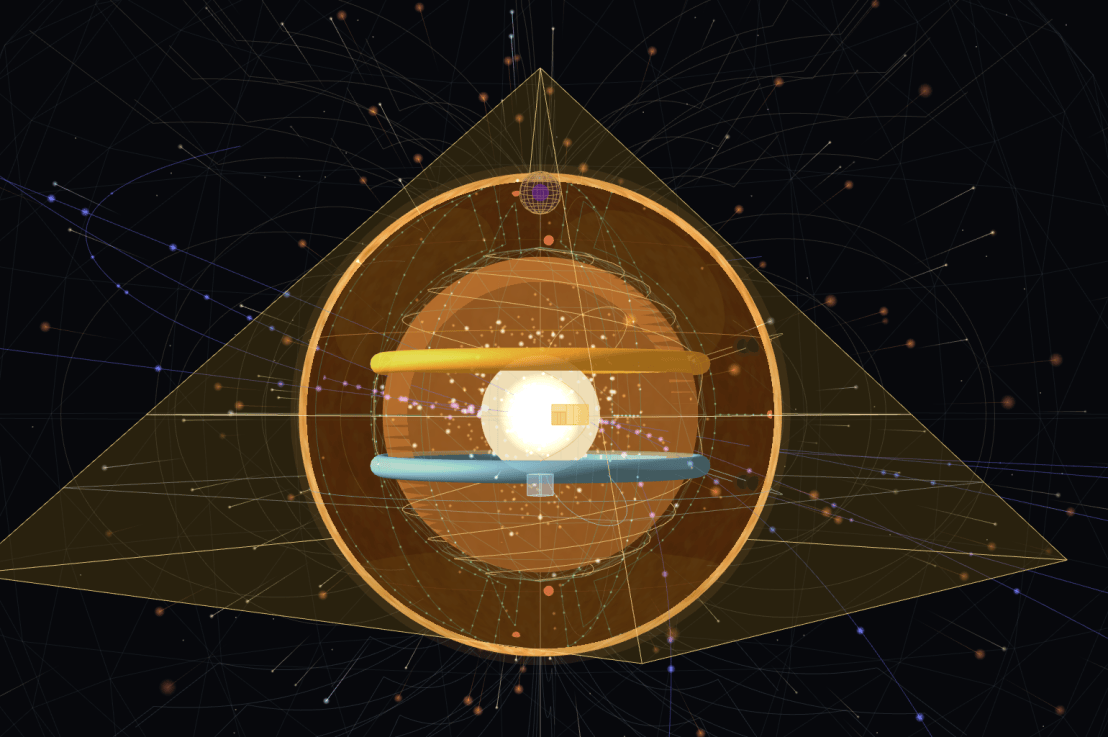
Inside the Solar Logos there is a torus — a real one. Two rings of magnetic field circle the rotation axis, one in each hemisphere, wound tight by the Solar Logos’s own turning, surfacing as sunspots and reversing every eleven years. Of all the places I have looked for toroidal structure in the solar system, this is the one where the word is literal rather than a figure of speech.
I have built a model of it — The Solar Logos’s Toroidal Belts — that you can turn in your hands, cut open, and watch breathe through its cycle. This post walks through what it shows: the flows of the Solar Logos as the science describes them, the Great Pyramid and its chambers imagined inside the solar body, and what Ra says about the beings who, late in sixth density, come to dwell there. I have tried to keep three voices distinct throughout — what Ra says, what the science says, and what I am proposing — because each deserves to be heard on its own terms.
The Flows of the Solar Logos
The Solar Logos is layered. At the centre is the core, inside roughly a quarter of the solar radius, where hydrogen fuses into helium. Around it lies the radiative zone, out to about 0.7 of the radius, where energy creeps outward as light, absorbed and re-emitted countless times. Above that is the convection zone, where the plasma itself boils — hot material rising, cooler material sinking — all the way to the visible surface, the photosphere.
Three flows move through that outer shell, and in the model I gave each its own colour so they never blur into the magnetic field:
- Differential rotation (coral). The Solar Logos doesn’t turn as a solid ball. Its equator goes round in about 25 days; near the poles it takes about 33. That is the turning motion — azimuthal, in the physicist’s word.
- Meridional circulation (teal). Plasma drifts poleward near the surface at roughly twenty metres per second and returns toward the equator near the base of the convection zone — one great slow loop in each hemisphere, a conveyor.
- Convection (violet). The rising and sinking itself, which carries the heat out. At the surface it shows as granules about a thousand kilometres across.
Now the beautiful part. Thread a north–south line of magnetic field through that differential rotation, and the faster equator drags it ahead of the slower poles. Round and round, the line is stretched east–west until it closes on itself as a hoop. That is the Ω-effect, and the hoops it builds are the two toroidal belts. Sections of a belt grow buoyant, bow upward and break the surface — leaving two dark marks where the field exits and re-enters. That is why sunspots come in pairs.
The whole thing breathes on an eleven-year rhythm. The belts build and migrate toward the equator, throw up their loops, and dissolve; then the field rebuilds with its polarities swapped. In between, the field relaxes into its poloidal shape — pole to pole, like a bar magnet. In other words, the Solar Logos alternates between two geometries, ring and loop, and two of those cycles (twenty-two years) make the full round trip.
The Two Bands and the Hale Cycle
Cut open the model and two bands catch the eye first, one yellow and one blue. They are the belts — the Solar Logos’s magnetic field wound into a ring in each hemisphere. As you watch, they slide toward the equator, fade before they ever touch, and come back with their colours traded. Here is what’s happening.
Why one is yellow and one is blue. The colour shows which way the field runs around the ring. The two hemispheres always carry opposite directions, so one band is always yellow and the other blue. We can’t see these buried fields directly — helioseismology reads the flows inside the Solar Logos, but not its magnetism. We know the directions from what surfaces. Where a band breaks through, it leaves a pair of sunspots, one where the field comes out and one where it goes back in, and the leading spot of each pair has one polarity in the north and the opposite in the south. That steady pattern is the strongest evidence that what lies underneath is a ring and not a tangle.
Why they fade before they meet. Each band is born at about 30° of latitude early in the eleven-year cycle and drifts toward the equator as the cycle goes on, spending itself as sunspots along the way. That drift is why spots appear at high latitudes early in a cycle and near the equator late in it — the pattern astronomers call the butterfly diagram. By about 8° the two bands are carrying opposite fields toward each other, and opposite fields cancel. So they fade out before they can meet, the surface quiets into solar minimum, and the pole-to-pole poloidal field brightens in their place.
Why they seem to switch places. They don’t actually trade places; what changes is direction. At solar minimum, the remnants of the spent field are carried toward the poles and reverse the Solar Logos’s polar field. The next cycle’s bands are wound from that reversed field, so the northern band that was yellow comes back blue, and the southern one comes back yellow. It takes a second cycle to bring the colours home. That full round trip of about twenty-two years is the Hale cycle, named for George Ellery Hale, who found the reversal in the polarities of sunspot pairs in the early twentieth century. In other words, the Solar Logos breathes in eleven-year breaths, but its full rhythm — out and back to where it began — is twenty-two years long.
My proposal: the two bands are a picture of polarity held in dynamic tension at the scale of the Solar Logos. Two opposite fields are always present, never collapsing into one and never meeting head-on — spent in service of what rises to the surface, then reborn reversed. As I’ve come to see it, polarity of every kind creates dynamic tension, and dynamic tension creates transformation. Here that rhythm is written into the body of the Solar Logos itself, breath after breath.
How deep the belts sit is still argued. The textbook places them at the tachocline, about 0.7 of the radius. Vasil and colleagues argued in 2024 that the dynamo starts in the outer five to ten percent; a 2026 helioseismic study pushed back toward the deep reading. The model lets you move them and see both.
How the Light Reaches Us
The light on your face began as fusion in the core, but it didn’t fly straight out. The radiative zone is so dense that light travels only a tiny distance before it’s absorbed and sent off again in a random direction, so its path is a random walk. Estimates for that crossing run from about 40,000 to 170,000 years. With each absorption, in a slightly cooler layer, the high-energy gamma rays are traded for gentler light. In other words, the photon that finally leaves is a distant descendant of the energy born in the core.
At about 0.7 of the radius, convection takes over. The boiling plasma carries the energy the rest of the way comparatively quickly, and at the photosphere, around 5,800 K, the gas turns transparent and the light streams out. It reaches us eight minutes and twenty seconds later. Just under half of that energy is visible light; most of the rest is infrared — the warmth we feel on our skin.
Imagining the Pyramid Inside the Solar Logos
The second layer of the model is speculative, and marked that way on the page: I set the Great Pyramid inside the Solar Logos, using the same cubit geometry as my earlier poloidal core and Saturn builds — a base of 440 cubits, a height of 280, the King’s Chamber from 80 to 91 cubits, the Queen’s Chamber from 40 to 52, and Position 2 on the central axis at 210.
The anchor is the King’s Chamber. Its mid-level sits exactly on the solar equatorial plane, and the model traces that level around all four faces so you can see the lock. It is the same convention I used for Saturn, where the King’s Chamber level rides the ring plane.
Then comes the question of scale — how big a pyramid? I first tried the scale at which Position 2 lands exactly on the photosphere. Ra calls this the place where light, which was working in a space/time–time/space configuration, “becomes light working in what you might consider an inter-dimensional time/space–space/time configuration” (59.14). No chamber was built there; Ra says the position is useful only to those able to serve as conductors of that focused spiral (59.15). At that scale the underside of the solar core came within a hair of the ceiling of the Queen’s Chamber — 0.250 of the radius against 0.269. So I settled the pyramid a fraction smaller, until the core rests exactly on the Queen’s Chamber. At that scale Position 2 sits at about 0.93 of the radius, just beneath the photosphere.
My proposal: the photosphere is the Solar Logos’s own interdimensional threshold — the surface where light finishes its long passage through the solar body and goes out into the system as the light we receive. That gives Position 2 a place that fits its description. And the King’s Chamber, which I link to the blue ray (the seat of agency and co-creatorship), sits on the equator where the belts are wound and the Solar Logos’s rotation runs fastest.
I hold this layer loosely. The Solar Logos’s real circulation is confined to its outer shell, has no flow up the central axis, and does not close through the space outside it. So the pyramid’s axial column and chambered sequence have no physical counterpart in the solar interior. What I can defend is the correspondence at the level of a body that circulates within itself and converts between two field geometries.
What Ra Says About Late Sixth-Density Life in the Solar Logos
In Session 41, Don asks Ra to describe our Solar Logos. Ra answers in layers. In relation to intelligent infinity, the Solar Logos is part of that infinity like every part of creation. In relation to intelligent energy, it is the offspring of the Galactic Logos, using its free will to co-create the full nuances of our densities. And physically, Ra says, it is “a large body of gaseous elements undergoing the processes of fusion and radiating heat and light” (41.4).
Then Ra turns toward the metaphysical. The Solar Logos’s meaning grows for fourth through seventh density as entities learn to grasp its living, other-self nature — and “by the sixth density the sun may be visited and inhabited by those dwelling in time/space, and may even be partially created from moment to moment by the processes of sixth-density entities in their evolution” (41.4).
Don asks what that means. Ra says some entities in this density, “whose means of reproduction is fusion,” may choose to perform it “as part of the beingness of the sun body.” And then the line I keep returning to: “Thus you may think of portions of the light that you receive as offspring of the generative expression of sixth-density love” (41.5). Don asks whether this brings them closer to co-Creatorship, and Ra says that is “precisely correct as seen in the latter portions of sixth density, seeking the experiences of the gateway density” (41.6).
What does Ra mean by fusion? Earlier, Ra says fifth- and sixth-density propagation is “still based upon polarity” (32.8). ~Ra describes sixth-density fusion as the complete melding of mind, body and spirit — felt, in Ra’s words, as a constant orgasm of joy and delight each in the other’s beingness (32.10). In other words, this is the union of whole beings, and the light is what that union brings forth.
And Ra places itself right at this stage: “I am sixth density with a strong seeking towards seventh density” (14.19). Ra describes their present seeking this way: “rather than surrounding ourselves in light, we have become light” (64.6). Ra says they are “no longer of Venus” (6.23) and left that planet because “we wished to be of service” (89.13).
One more sentence completes the frame. Asked whether the Solar Logos itself has a density, Ra says “the sub-Logos is of the entire octave and is not that entity which experiences the learning/teachings of entities such as yourselves” (41.7). The Solar Logos doesn’t climb the densities. Those who have climbed them come to dwell in its beingness.
My proposal: late sixth-density social memory complexes — Ra among them — fuse with the Solar Logos as part of their reproduction, so that their generative union becomes part of the Logos’s own life. Ra never says outright that Ra has done this; that step is mine. But everything Ra does say about itself points in that direction.
And since roughly half of sunlight’s energy arrives as warmth, I take the warmth we feel on our skin as part of the same gift: the love of the Creator, received bodily, through light. Ra pairs light and love throughout, saying their search has become internalized “as we become light/love and love/light” (64.6). Ra doesn’t speak of warmth in 41.5, but Ra does say this Logos made a choice that fits it. “This Logos has a bias towards kindness” (90.21). And where other Logoi “offered a neutral background against which to polarize,” this one “chose not to do so but instead to allow more of the love and light of the Infinite Creator to be both inwardly and outwardly visible and available to the sensations and conceptualizations” of those in its care (90.23). Warmth on the skin is about as plain a sensation of that love as I can think of. Linking the two is my step, but Ra gives it solid ground.
Four Movements, as the Model Draws Them
I wanted to see what Ra’s words would look like inside the model, so I added a third layer in indigo and silver — colours kept apart from the gold of the magnetic field and the coral, teal and violet of the plasma flows. It unfolds in four movements.
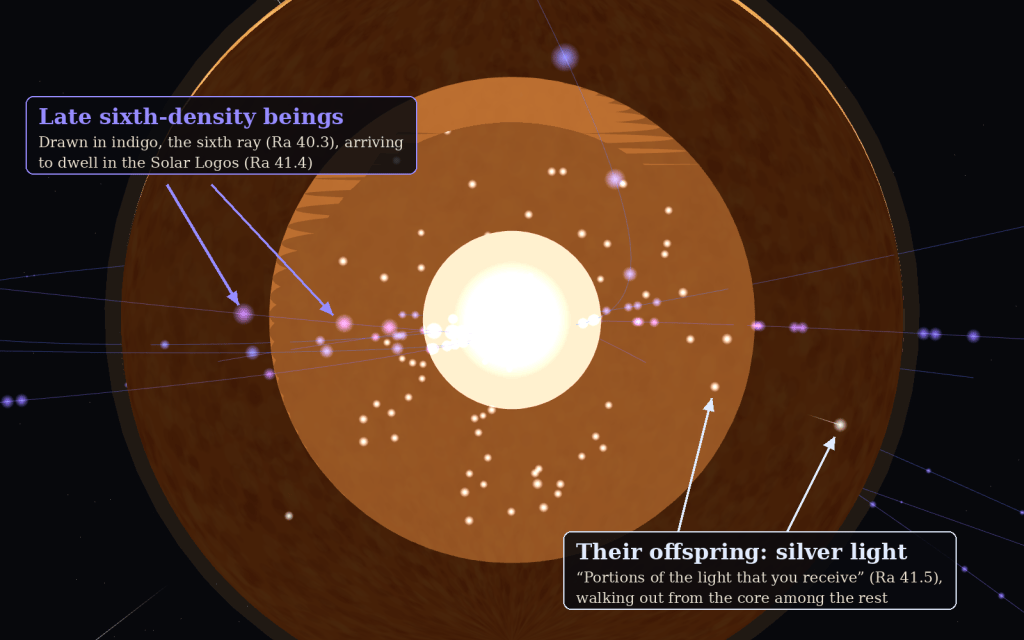
- The arrival. Pull back to the whole field. From beyond the frame, paired indigo threads drift slowly inward — the late sixth-density complexes themselves, coming to dwell in the Solar Logos’s beingness. They are indigo because Ra says “each density is of the metaphysical characteristic complex of its ray” (40.3), and the sixth ray is indigo. One thread of each pair leans violet, one leans blue, since Ra says their propagation is still based on polarity (32.8). They pass through the photosphere without a ripple, because their crossing happens in time/space.
- The union. Inside the cutaway, the threads settle into the core. There the two indigo tones meet and meld into white — the complete melding of 32.10, performed “as part of the beingness of the sun body” (41.5). It is a steady glowing, ongoing, “from moment to moment” (41.4).
- The offspring. From that union, light is born and joins the long walk outward. In the model, most of the motes making that walk are the ordinary energy of fusion, in amber; a portion are silver, because Ra speaks of “portions of the light that you receive” (41.5). Both wander the radiative zone for an age, rise through convection, and leave the photosphere together as streaming light and soft ember-coloured warmth. Physically, that escape from the core takes on the order of a hundred thousand years. So the sunlight falling on us across this whole 75,000-year cycle was begotten, roughly, before the cycle began.
- The two currents. With all three layers on, watch both motions at once: indigo flowing in, light flowing out, meeting at the core. Beings who climbed the densities move down and in toward the Logos, while the Logos’s light moves out toward its sub-sub-Logoi. Concrescence happens where they meet — Whitehead’s “the many become one, and are increased by one,” seen vertically.
In the model, Camera → Sixth-density light pulls slowly in from the whole field to the cutaway so you can watch this unfold. I deliberately left these layers uncoupled from the eleven-year cycle. The dynamo is the Logos’s own breathing; the sixth-density work goes on steadily beneath it.
Keeping It Honest
Before drawing any of this, I asked what would make it false. The physics here is well tested. The Solar Logos’s light comes from hydrogen fusion in the core, and solar neutrino measurements — including Borexino’s detection of the CNO cycle in 2020 — agree closely with the standard solar model. If my overlay implied some extra energy source at work in space/time, those measurements would count against it.
Ra places this activity in time/space: “those dwelling in time/space” (41.4). So the silver layer makes no claim on fusion rates. It is a correspondence of place — the core is where space/time sunlight is born, and that is where I set its time/space counterpart.
A few more limits, stated plainly:
- The paths of the arrival threads, their number, and their two tones are drawing choices. Ra gives no geometry.
- The light’s outward walk is sped up enormously, from on the order of a hundred thousand years to about twenty seconds on screen.
- The pyramid superimposition is my reading, and the Solar Logos’s real circulation has no counterpart to its axial column or chambers.
- The Ra cycles of 75,000 years resolve to Earth’s precession and have no counterpart in the solar dynamo, so I keep them out of the solar model entirely.
The model’s About panel keeps all three voices in separate paragraphs — what Ra says, what the science says, and what I propose — so anyone exploring it can weigh each on its own.
Closing
The next time you stand in sunlight, consider what it may carry. Physically, it is the long-delayed product of fusion at the heart of a star — light that began its journey outward before our present cycle of harvest began. In Ra’s telling, some portion of it is also offspring: the generative expression of beings who climbed the densities, came home to the Solar Logos’s beingness, and there brought forth light in love. The Solar Logos gives us light, and in the same moment those who have come to dwell in it give it back.
I’m offering these thoughts for what they are worth.
Sources
- The model: The Solar Logos’s Toroidal Belts
- The Ra Contact: Teaching the Law of One, sessions 6.23, 14.19, 32.8–32.10, 40.3, 41.4–41.7, 59.14–59.15, 64.6, 89.12–89.13, 90.21–90.23
- Vasil et al., The solar dynamo begins near the surface, Nature 629 (2024)
- Helioseismic evidence that the solar dynamo originates near the tachocline, Scientific Reports 16 (2026)
- Kosovichev et al., Structure and Dynamics of the Sun’s Interior Revealed by HMI
- Owens & Forsyth, The Heliospheric Magnetic Field, Living Reviews in Solar Physics
- Petrie’s internal dimensions of the Great Pyramid, via this summary

