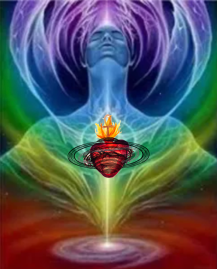
Presentation by Troy Caldwell, MD
AUDIO
Tim opens our gathering with a story from his boyhood. He is ten or eleven, sharing a basement bedroom with his older brother, and there on the dresser sits a Snickers bar. He knows it isn’t his. He eats it anyway. When his brother comes home and tears the room apart looking for it, Tim plays innocent (“What’s Snickers?”), and he admits that underneath the first flush of shame there is a small, perverse pleasure in getting away with it. Then, a few days later, his mother reaches into his pants pocket on laundry day and pulls out the wrapper.
Tim’s point lands gently. Life teaches us to lie early, and the little lie about a candy bar grows up into lies about who we are, the worst of them being the ones we tell ourselves. Spiritual maturity, he says, means coming clean. He describes our circle as a place where we “stand before each other naked,” with no need for the fig leaves Adam and Eve reached for, because the room itself has become a temple of charity.
That word, temple, is the doorway into the rest of the night. In the monthly study group on Troy Caldwell’s Adventures in Soul Making (troycaldwell.com), Tim was moved by Troy’s chapter on the Temple as a picture of the soul. So he asked Troy to take all of us through it. Troy, a retired Jungian psychiatrist and one of our founding members, had recently prepared exactly that presentation.
A Map Before the Journey
Before we walk anywhere, Troy shows us his diagram of the psyche, which he calls, with a smile, his magnum opus: years of putting the Bible and Jungian psychology side by side, compressed into one picture.
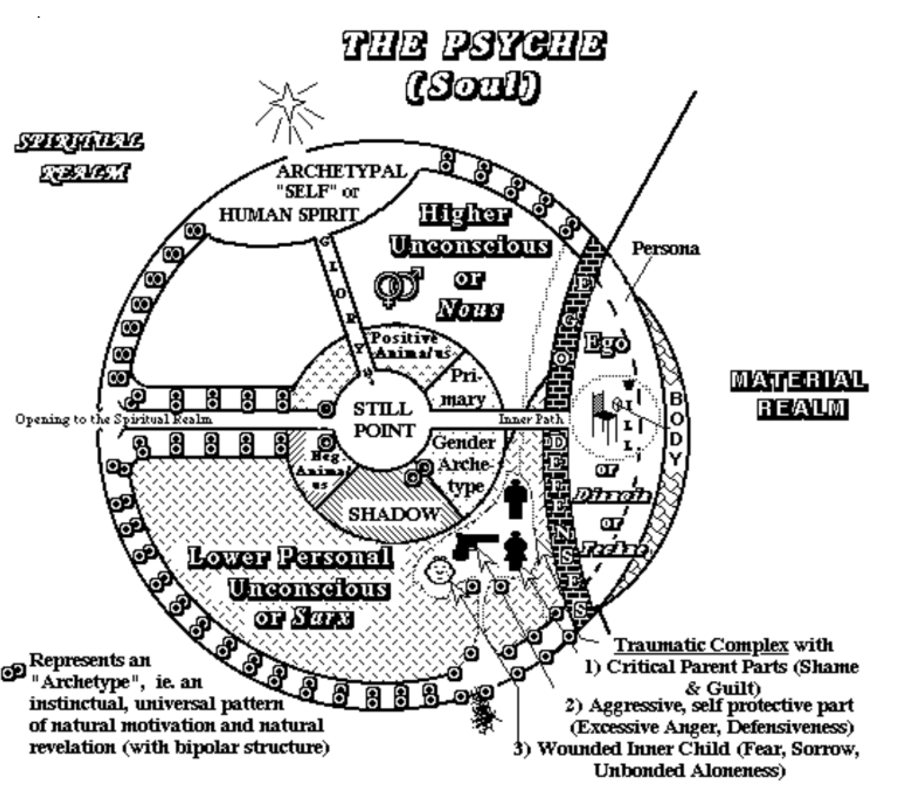
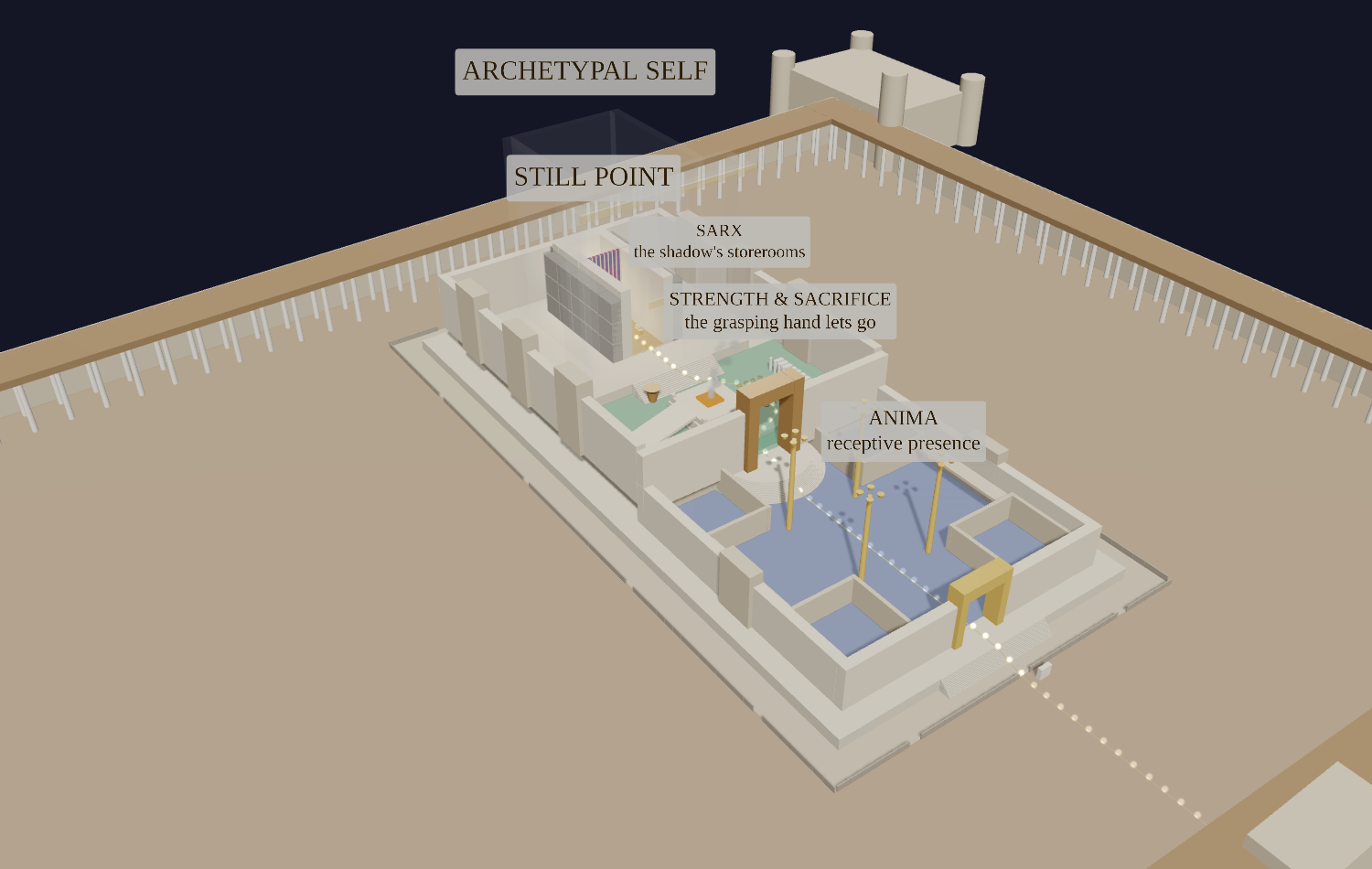
The structure is simpler than it looks. There is the ego, our center of ordinary consciousness, which Troy calls a middle manager between outer life and inner life. There is the higher unconscious, which Paul’s Greek calls nous, crowned by the archetypal Self, the larger organizing and guiding center of the whole psyche. And there is the lower personal unconscious, Paul’s sarx (“flesh”), which Jung calls the shadow. At the center sits the still point, the inward place we touch in meditation and recollection.
Troy borrows a list from Richard Schwartz’s No Bad Parts to describe how the Self feels from the inside: calm, curiosity, clarity, compassion, confidence, courage, creativity and connectedness. When those qualities are present, the ego and the Self are working together (Jung’s “ego-Self axis”). When they aren’t, the ego has probably gotten stubborn, or so busy facing outward that it has stopped listening.
Then Troy lays the map over the Temple. The ego corresponds to the outer courts. The still point corresponds to the Holy Place, where the priests went every day to renew the bread and tend the lamps (in other words, our daily quiet time). And the archetypal Self corresponds to the Holy of Holies, which the high priest entered once a year. Faithful tending of the Holy Place, Troy says, occasionally opens the way into the Holy of Holies.
The Temple as It Actually Stood
Troy’s meditation takes place in Jerusalem around 30 AD, which means the building he walks us through is the Second Temple as Herod rebuilt it. I wanted to see it clearly, so after our gathering I went back to the sources: the Mishnah’s tractate Middot, which records the Temple’s measurements in cubits; Josephus, who saw it standing; and the archaeology of the platform itself, much of whose Herodian masonry is still in place.
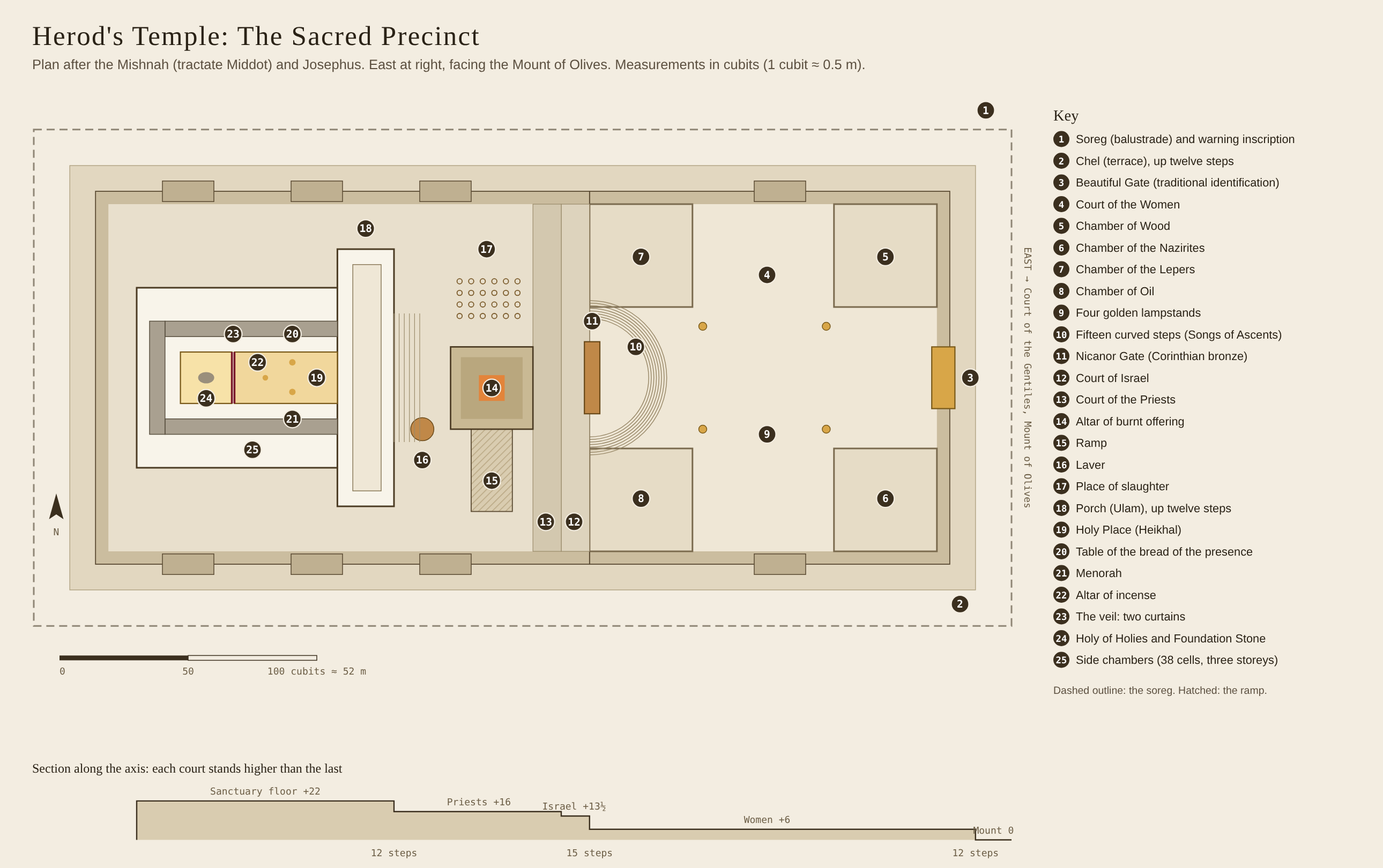
A few things stand out once the plan is in front of me.
The whole platform was enormous, about 36 acres after Herod doubled it, and most of it was the open Court of the Gentiles, ringed by colonnades, with the great Royal Stoa along the south side. Anyone could walk there. It was also, as the Gospels make clear, a marketplace: animals for sacrifice, money-changers, noise.
The sacred precinct proper began at the soreg, a low stone balustrade with warning signs in Greek and Latin. Two of those warning stones have been recovered. They forbid any foreigner to pass the barrier, on pain of death. Inside the soreg rose the chel, a terrace reached by twelve steps.
The Court of the Women was a square 135 cubits on a side, with a roofless chamber in each corner: one for the Nazirites, one for the altar wood, one for those being cleansed of skin disease, and one for oil and wine. Four golden lampstands stood in it. Men and women both gathered here; women simply went no further.
From its western side, fifteen curved steps rose to the Nicanor Gate, its doors of Corinthian bronze, the gift of a man named Nicanor from Alexandria. The Mishnah says the Levites stood on those fifteen steps and sang the fifteen Songs of Ascents (Psalms 120–134).
Through the Nicanor Gate lay a narrow strip called the Court of Israel, then the Court of the Priests, then the great altar with its ramp on the south side, the laver where the priests washed, and finally the twelve steps up to the porch of the sanctuary.
The sanctuary itself was a hundred cubits wide and a hundred high. Inside, the Holy Place held one golden menorah on the south, one table for the bread of the presence on the north, and the golden altar of incense before the veil. The veil was actually two curtains hung a cubit apart. Behind them lay the Holy of Holies, twenty cubits square, and by Herod’s day it was empty. The Ark had been lost since the Babylonian destruction. What remained was a bare outcrop of bedrock the rabbis called the Foundation Stone. Around the sanctuary on three sides ran thirty-eight windowless side chambers, stacked three storeys high.
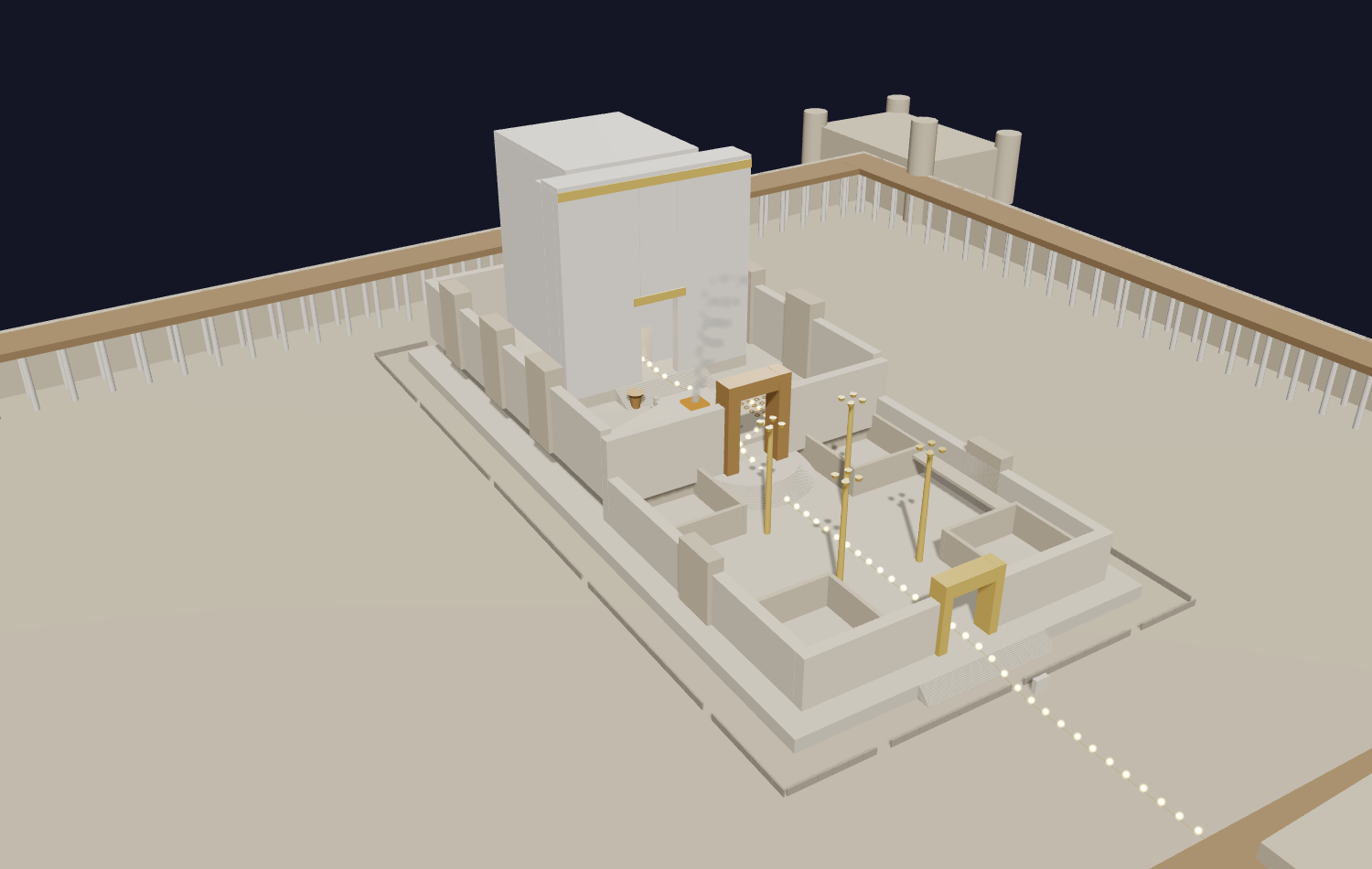
What strikes me most is the section drawing. From the Temple Mount to the terrace is twelve steps. From the Court of the Women to the Nicanor Gate is fifteen more. From the Court of the Priests to the porch, twelve again. Troy says at one point in his meditation that “everything about this place suggests upwardness,” and the stones agree with him. Every step inward is a step upward. The way in is the way up.
Walking Inward
Then Troy asks us to close our eyes.
He leads us in the imaginative form of prayer that Ignatius taught: we enter the scene ourselves. In Troy’s telling, the seeker is a Gentile visiting Jerusalem who has heard members of a new Jewish sect (the followers of Jesus) claim that the Temple is a picture of the soul, and that the kingdom of God is within a person. It sounds too wild to be true, so he decides to test it. He will walk the Temple as if he were walking into his own unseen soul.
The Court of the Gentiles disappoints him immediately. He expected a quiet place to ponder the God of the Jews and found a barnyard: noisy, crowded, and it stinks. Then the recognition comes. Isn’t this a lot like the noise of my everyday life? Worry about money, work, success, the effort to keep the world’s grime at bay. The outer part of the soul, the ego, is exactly this busy and this cluttered.
At the soreg he finds himself shut out. Troy turns even that into self-knowledge: there are places in each of us we don’t let just anyone see, our deepest thoughts, our loving and sexual feelings, our sense of the sacred. If someone barges in uninvited, we feel exposed.
Then Jesus appears, disguised, and beckons. He gives the seeker a white robe with stains on it like spilled blood, and a staff made of two kinds of wood grafted into one. Dressed this way, the Gentile can pass. Together they climb toward the Beautiful Gate, and Troy pauses to define beauty as the union of what is true and what is deeply desired. Without that inner music of joy, he says, approaching a holy God could feel heavy and grim. Beauty makes the effort of the climb feel light.
The Court of the Women is the passage Tim asked for, and I understand why. Troy asks the obvious question first: is this separation just patriarchy? Then he reads the court another way, as the receptive, feminine dimension of every soul, what Jung called the anima. Its gift is presence, which Troy defines as attention fully attuned to another’s being, affirming who someone is beyond what they do. In prayer it feels like stillness, resting under the shelter of God’s wings. He quotes Psalm 46 in the translation that says cease striving, and know that I am God. And he notices that when Jesus talked with Martha after Lazarus died, the conversation became theological; when Mary came, Jesus wept.
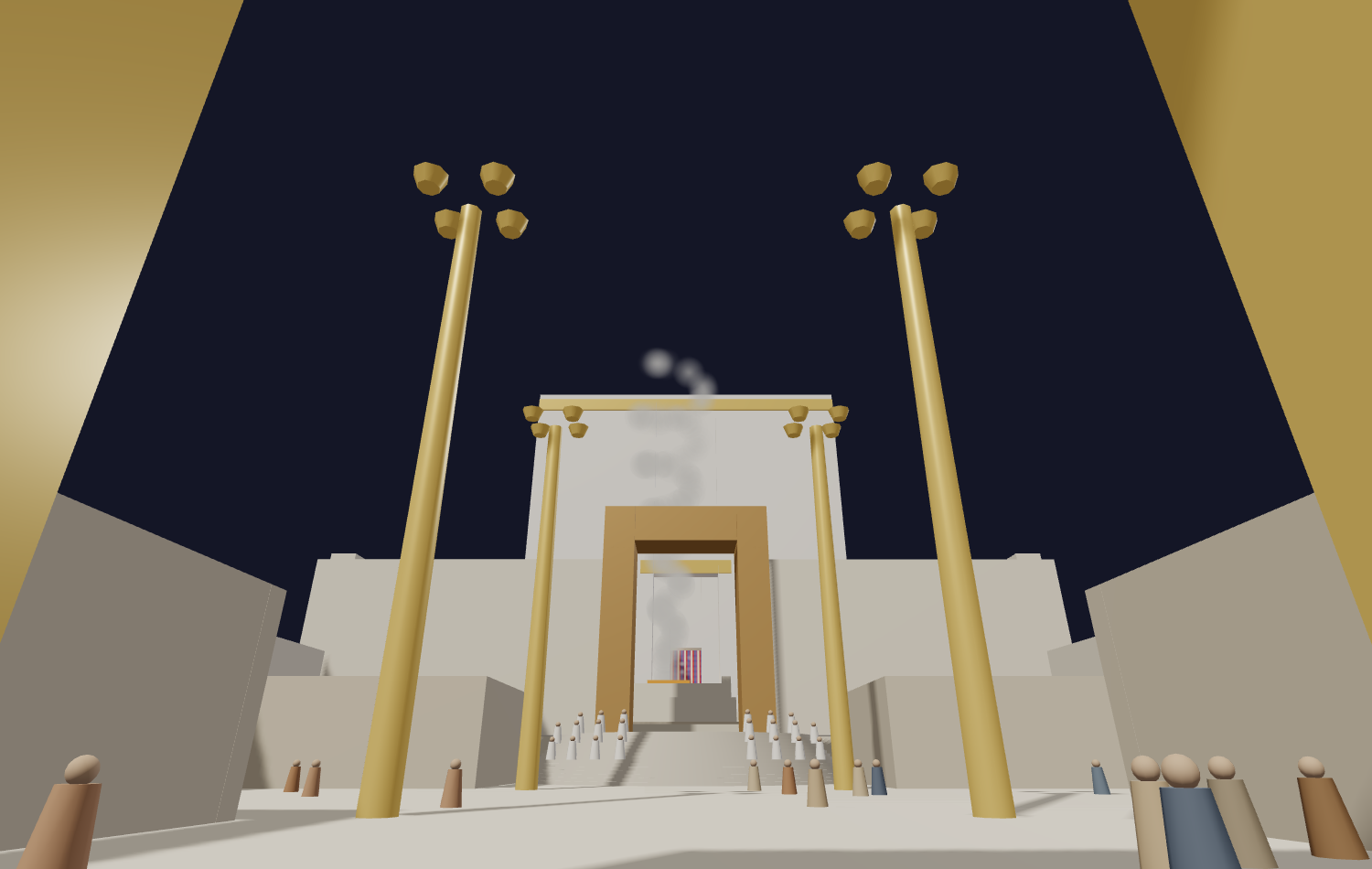
At the Nicanor Gate (the name means victory), the music of the Levites swells and then falls behind, and the seeker steps into shadow. The nurture of the women’s court has warmed him. Now his masculine strength is being summoned for struggle. He can’t stay on the mountain of transfiguration forever.
The Court of the Priests smells of fire and blood. Troy reads the altar as the place where the grasping hand learns to let go. We work by the sweat of our brow and then feel entitled to what we’ve earned. We become territorial about what we call mine, and we may even try to own parts of our own heart. God’s answer, in the smoke rising from the altar, is give it back to me. Troy is careful to add that this grasping belongs to the masculine in women and men alike.
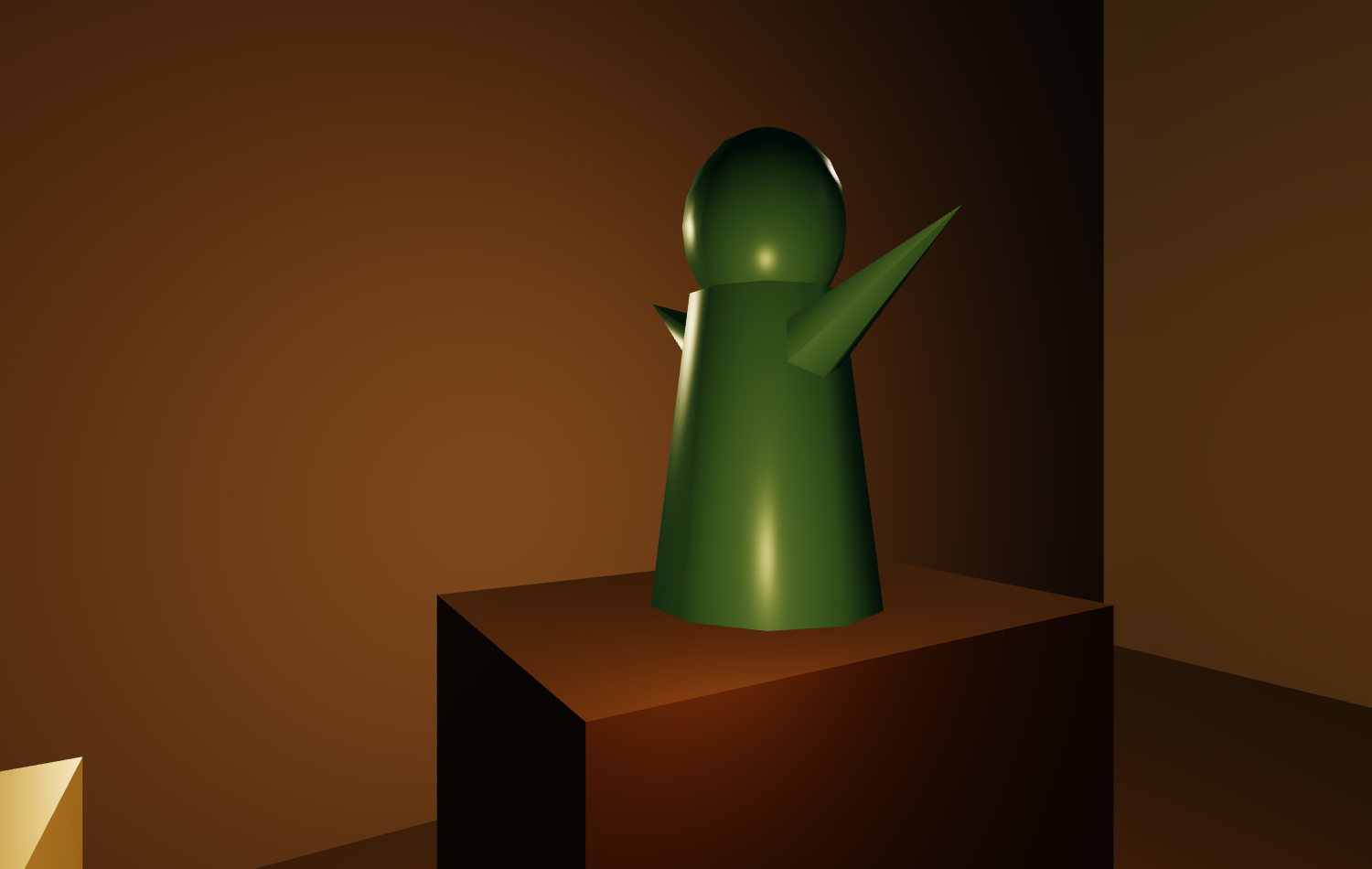
Then comes the part of the meditation I keep returning to. Jesus slips the seeker into priestly robes and leads him off the main path, through a side door into a dim corridor of storerooms. One door won’t open; it seems barricaded from inside. In the room next door Jesus digs into a pile of grain and uncovers a tiny hidden passage. On hands and knees the seeker crawls through into a musty room full of idols, among them a beautiful jade statue of some foreign god. Some of the priests, Jesus explains, keep these to hedge their bets: to sell when money runs short, or to worship quietly in case another god proves more generous.
Then Jesus turns and asks: Is this like you in any way, my son?
Troy answers from decades of dream work. Yes. These are the hidden corners of the soul, the little rooms that need light: unfinished emotional business, old wounds, defects of character. This is the sarx. And God, he says, is usually gentle in how he shows them to us.
(The archaeology offers a quiet confirmation here. Those thirty-eight windowless chambers really did surround the sanctuary on three sides, stacked three high, closed off from the open courts. Troy’s storerooms have a place in the actual building.)
At the threshold of the sanctuary the seeker feels small, searched but not rejected, and the Jesus Prayer rises up in him on its own: Lord Jesus Christ, Son of God, have mercy on me, a sinner. Holy fire floods him. Jesus breathes on him and strength returns, and Isaiah’s line about those who wait for the Lord mounting up with wings like eagles comes to mind.
Inside the Holy Place, each furnishing becomes a meditation. The bread of the presence is Christ “as I’m experienced in you,” the indwelling word taking shape in the mind’s own images, and Jesus “feeds a morsel” by bringing a line of scripture spontaneously to mind. The menorah’s seven lamps join heaven’s three and earth’s four. Its oil, pressed by beating the olives rather than crushing them, becomes Christ himself: beaten, but not crushed. And the incense rising before the veil becomes prayer carried on the wind of the Spirit.
The seeker enters the incense and is carried through the veil.
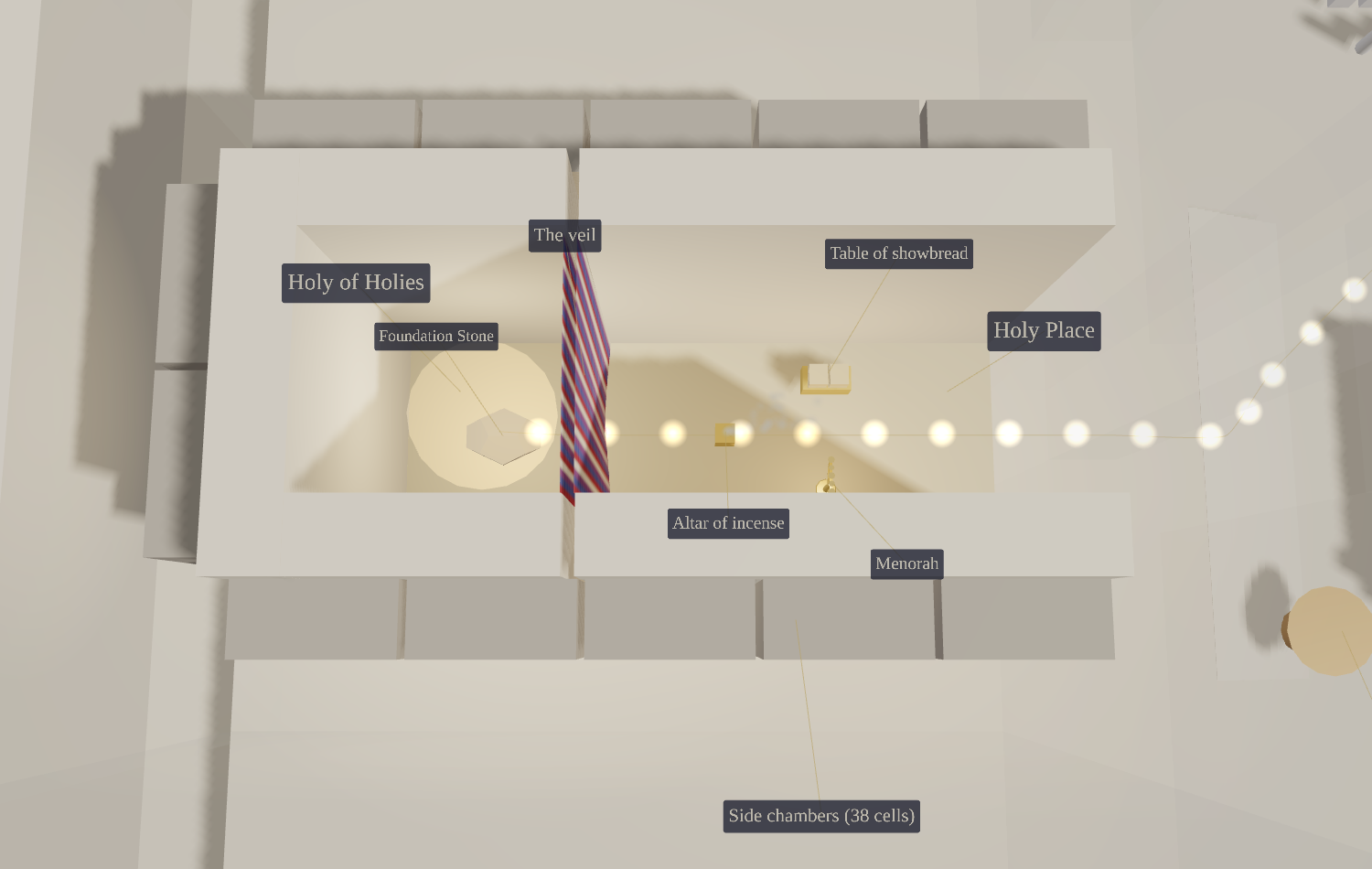
What Troy describes in the Holy of Holies resists summary, and he says so himself: language lies prostrate in the dust. A blood-red cascade, then light that seems to be alive. A string of “I am” sayings that knock him back like the soldiers in Gethsemane. Belief that stops being an idea and becomes being. Then his central image: power and love dancing like lovers, with wisdom as the song that joins them, “a wheel within a wheel.” He comes to beside a stream. His first thought is Lord, is all that glory really inside me? A meadowlark sings an answer.
What Ra Says
Troy’s meditation is unapologetically Christian, and he acknowledges that ours is not a specifically Christian group. Still, several of the evening’s movements have close neighbors in the Ra Material.
The structure of the whole journey, a door opened through stillness onto an ordered interior, is how Ra opens its teaching on mental discipline:
“The prerequisite of mental work is the ability to retain silence of self at a steady state when required by the self. The mind must be opened like a door. The key is silence. Within the door lies an hierarchical construction you may liken unto geography and in some ways geometry, for the hierarchy is quite regular, bearing inner relationships.”
Ra, 5.2
That is a fair description of the Temple: a geography, regular and ordered, entered through silence.
The hidden storeroom is shadow work, and Troy’s response to it (“Yes, Lord, this is my flesh … have mercy on me”) is the posture Ra asks for in the very next breath of the same answer:
“The mind contains all things. Therefore, you must discover this completeness within yourself. The second mental discipline is acceptance of the completeness within your consciousness. It is not for a being of polarity in the physical consciousness to pick and choose among attributes, thus building the roles that cause blockages and confusions in the already-distorted mind complex.”
Ra, 5.2
The barricaded door is a good picture of what Ra calls a blockage: something the self has walled off instead of accepting. And Tim’s Snickers story belongs here too. Hiding is the first thing the unaccepted self does.
Troy’s movement from the receptive stillness of the women’s court to the strength summoned at the Nicanor Gate, which he insists both belong to every person, echoes Ra’s description of the two principles:
“In a more general sense, that which reaches may be seen as a male principle; that which awaits the reaching may be seen as a female principle.”
Ra, 92.20
In the same early session where it describes the disciplines of the mind, Ra puts the point about every person plainly: “each biological male is female; each biological female is male” (Ra, 5.2).
What We Heard
When Troy brings us back, the responses come slowly.
One member is struck by the central move of the whole evening: these descriptions of courts and gates and rooms are descriptions of an inward journey, of how each of us is built.
Another is drawn in by the questions Jesus keeps asking. At first they seem too big to answer. By the end, the seeker has found the answers through his own experience along the way.
A third takes two reminders home. The women’s court calls her back to receptivity and to holding space, for others, for herself, for the world, at a time when that has been hard to sustain. And Troy’s observation that it is easy to feel close to God when things are beautiful names her ongoing practice: staying close when they aren’t. Troy adds that both Greek and Christian philosophy honor beauty as one of the voices of God. I offer the definition I’ve come to love from process thought: beauty is packing as much intensity into a single moment as it can hold without breaking its unity, pressing right to the edge of bursting while holding together.
A guest that evening, a friend visiting from South Africa, hears echoes of Teresa of Ávila’s Interior Castle and then turns the whole picture around. The movement in the old Temple, he says, ran from the outside toward the Holy of Holies. Since the Incarnation and the torn veil, the primary movement runs the other way: from the Holy of Holies toward us. God is always reaching out, always yearning for us, and our task is to become conscious of how much of that yearning is already coming our way.
I find that I can hold both directions at once, and Ra helps me do it:
“The action of the upward spiraling light drawn by the will to meet the inner light of the One Infinite Creator may be likened to the beating of the heart and the movement of the muscles surrounding the lungs and all the other functions of the parasympathetic nervous system. The calling of the adept may be likened to those nerve and muscle actions over which the mind/body/spirit complex has conscious control.”
Ra, 73.8
My proposal: Troy’s ascent through the courts is the conscious calling, the climb we choose. The inner light moving out to meet us is the heartbeat, steady and involuntary, happening whether we notice it or not. Our guest is right that the second movement comes first. Troy is right that the first one is ours to make.
As for me, I find myself in two places during the meditation. The archetypal imagery is powerful. I can see the whole of the classical spiritual path in it, the purgative, illuminative and unitive ways, laid out in stone and smoke. But the Johannine language (“I and the Father are one”) and the masculine pronouns carry a lot of exclusivist freight for me, and part of me resists. I can only follow Troy into the glory by surrendering back into the archetypal layer, the picture beneath the doctrine. So my evening is a dance between resistance and surrender. I suspect that dance is part of the journey too.
Where the Analogy Bends
A few honest limits, for readers who want to keep the history and the reading apart.
Troy’s meditation draws freely on more than one Temple. The ten tables of showbread and the pillars Boaz and Jachin belong to Solomon’s Temple. Herod’s had one table and one menorah, and the Ark was long gone by Jesus’s day (Troy acknowledges this inside the meditation itself). The “Beautiful Gate” of Acts 3 is still debated: some scholars place it at the eastern entrance to the Court of the Women, as Troy does, and others identify it with the Nicanor Gate.
The Temple’s courts also encoded real exclusions: Gentiles stopped at the soreg on pain of death, and women stopped at the fifteen steps. Troy names this directly and offers a reading that finds the feminine and the masculine in every soul. That reading opens something valuable. It doesn’t erase the history.
And the language of the meditation is Christian through and through. For those of us who come to the Temple from the Law of One, or from the edges of the Christian tradition, the archetypes may carry more than the doctrine does. That seems to me a feature of good contemplative writing, not a flaw: it gives each reader a door.
Explore the Model
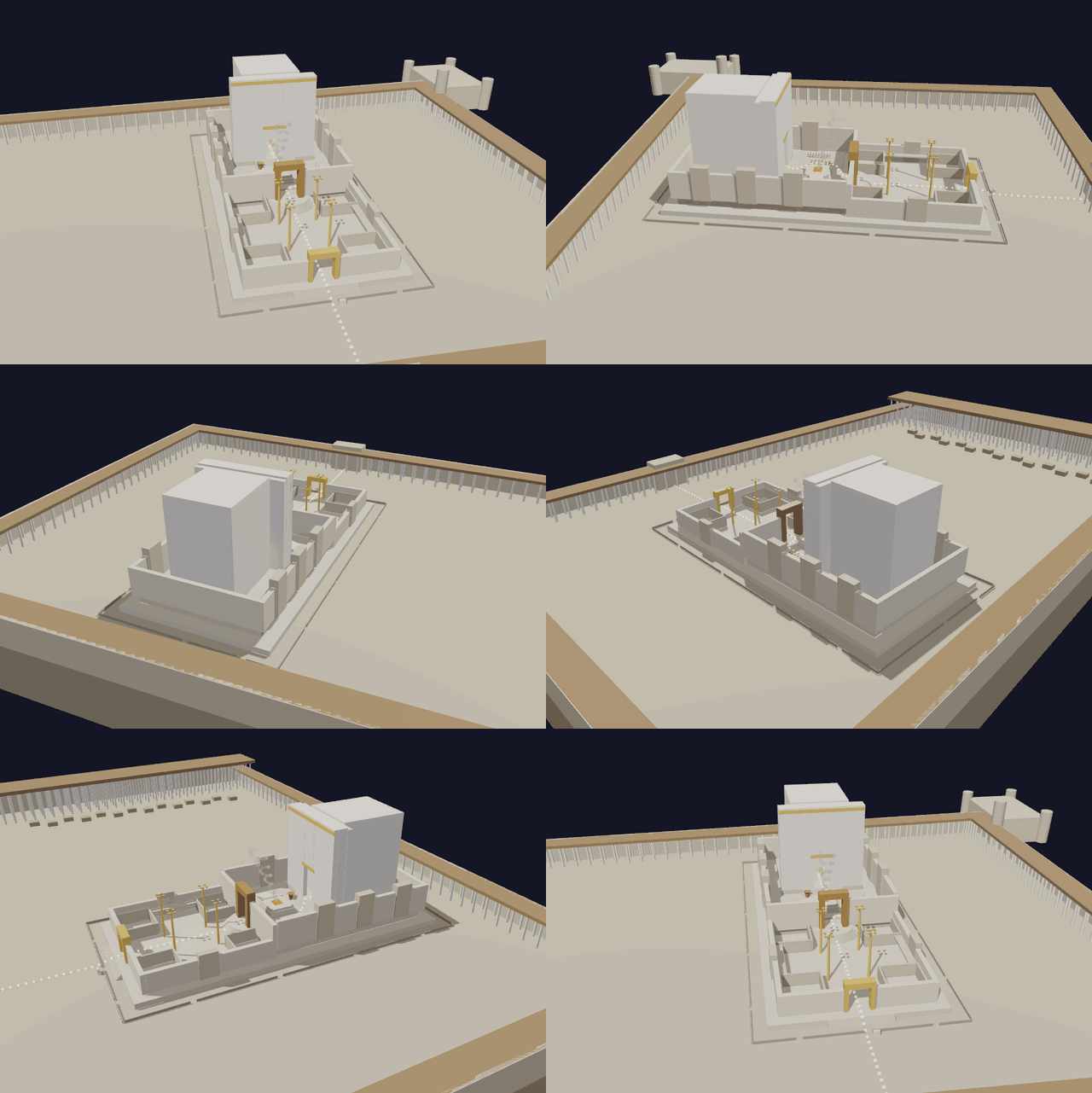
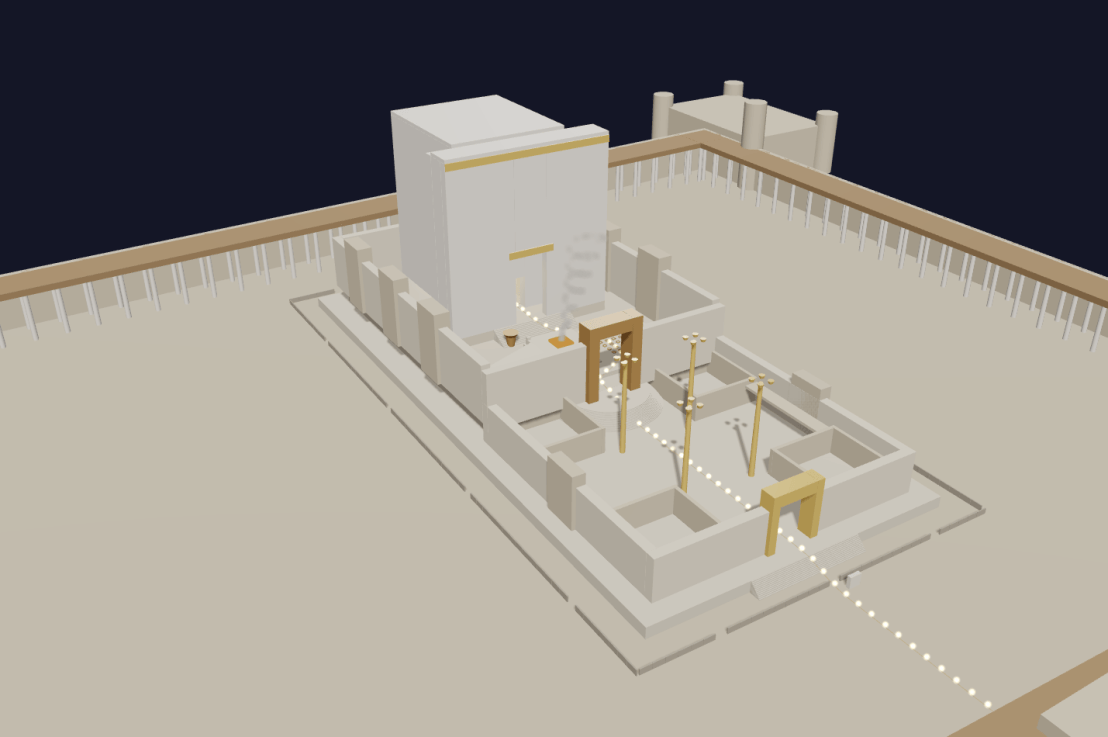
Turn on the psyche overlay to see Troy’s mapping, cut away the sanctuary to see the furnishings and the side chambers, and follow the pilgrim’s way from the eastern gate to the Holy of Holies.
The model also has a Walk Through Journey: a first-person walk at eye level through seventeen stations of Troy’s meditation, from the eastern gate past the market and the warning stone, through the Court of the Women and up the fifteen steps, into the hidden storeroom, and finally through the veil. You set the pace, moving from station to station when you’re ready, with his story beside the view. Begin the journey.
Troy’s book, Adventures in Soul Making, is available through troycaldwell.com, and Tim leads a monthly study group on it. I’m offering these thoughts for what they are worth.

