
By Doug Scott, LCSW
Before I get to thanksgiving itself, I want to borrow a word from the Ra Contact: complex. Ra speaks of mind/body/spirit complexes and social memory complexes, and says one may readily see “entities as vibratory complexes and groups as harmonics within vibratory complexes” (71.21),1 and names, for Ra, are “vibratory sound complexes” (8.6) while words are “sound vibration complexes” (99.5). When Don asked what Ra meant by saying the Significator Archetype of Mind (the choice-making self) must become a complex, the answer was simple: “To be complex is to consist of more than one characteristic element or concept” (79.19).
As I understand it, a complex is made of nested things that, together, become a new thing in itself. A molecule is a complex of atoms. An organism is a complex of cells, organs and systems, and it is something none of those parts is on its own. Whitehead called his scheme the philosophy of organism; we could just as well call it a philosophy of complex.2
The American holiday of Thanksgiving is itself a complex. It’s woven of myth and history, family custom, and more than one agenda, and not every strand is one we’d choose. Yet the whole it has become is something like this: remembering blessings, gathered in solidarity, and giving thanks for mercy, the way the story depicts the Native peoples showing mercy to the English settlers in their time of need.
Ra is correct: words are complexes, too. Each English word arrives carrying older words nested inside it, and those parts come together into meanings none of them held alone. In that sense words are organisms, living things with a history, and it helps greatly to see how they were formed.3 So I want to listen to the roots of a handful of them: thanksgiving, gratitude, gratefulness, grace, mercy, forgiveness and acceptance. And when I set those roots beside the Ra Contact, something comes into focus for me: thanksgiving is a way of seeing, and that way of seeing is itself a protection.
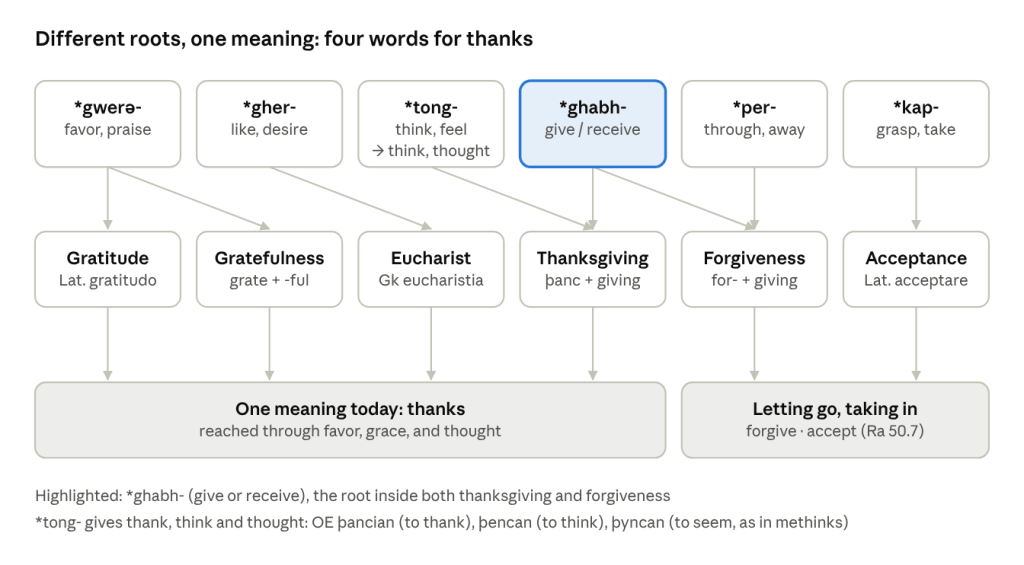
Three different roots (favor, grace, and thought) all arrive at the same modern meaning, thanks. One root, *ghabh- (give or receive), abides within both thanksgiving and forgiveness.
Thanking Is a Gesture of Honor within the Spaciousness of the Heart
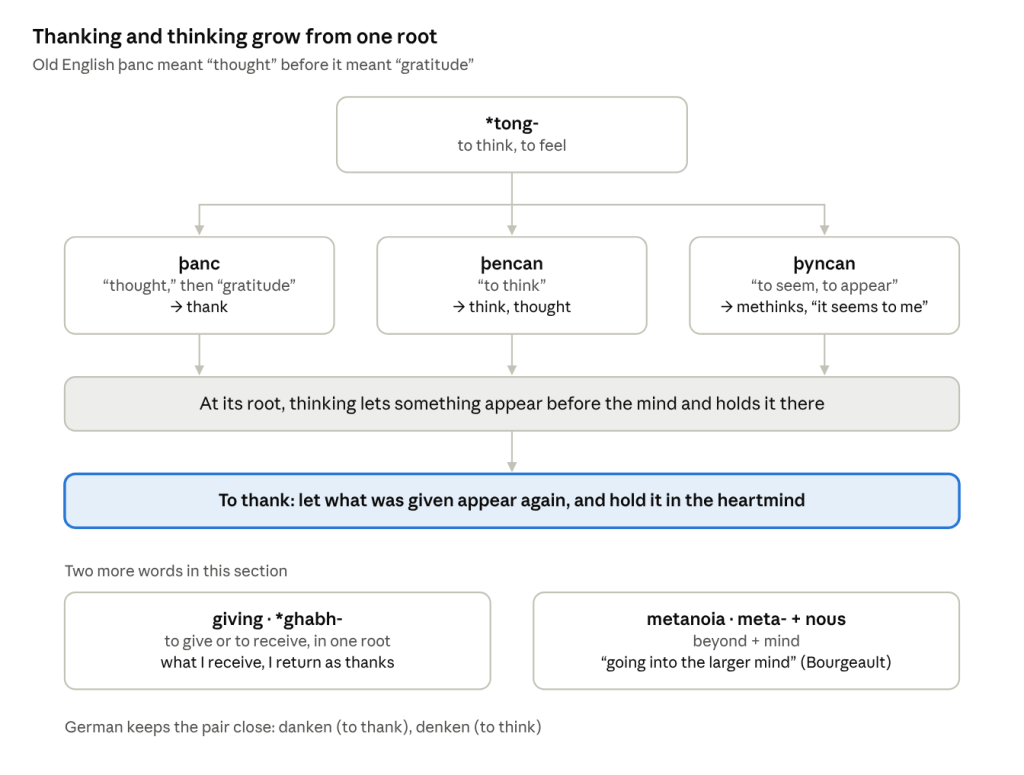
The Old English þanc meant “thought” before it meant “gratitude.” Thank, think and thought are three branches of one root, *tong- (German still keeps them close: danken, denken). Old English also had two verbs for thinking: þencan, “to think,” and þyncan, “to seem, to appear” (it survives in methinks, which means “it seems to me”). In other words, at its root, thinking is letting something appear before the mind and holding it there. To thank, then, is to let what was given appear to us again and to hold it in the heartmind.
By mind here I mean something wider than the reasoning intellect. In today’s psychospiritual landscape, to think tends to mean analysis, the rational mind working over and against the intuitive one. The early Christian contemplatives had a larger word, nous: the mind as the faculty that perceives directly, the eye of the soul. Their great practice was bringing that mind down into the heart. Cynthia Bourgeault calls “putting the mind in the heart” an “ancient and venerable desideratum of the Western spiritual path,”4 and she describes the heart itself as “an organ for the perception of divine purpose and beauty.”5 In other words, the mind that gives thanks is the nous at home in the heart, what I call the heartmind. It remembers with the whole self, and what it holds in mind it also holds in love. And nous sits at the center of another word, metanoia, usually translated “repentance”: meta- (beyond, after, change) plus nous. Bourgeault reads it as “going into the larger mind.”6 In other words, metanoia is the nous moving out of the small, calculating mind and into the heartmind. Each word that follows, I’ve come to see, is a doorway into that larger mind.
The giving half of the word is just as telling. It comes from an ancient root, *ghabh-, which meant to give or to receive. Our linguistic ancestors didn’t draw a hard line between the two. So thanksgiving names a circuit: what I’ve received, I hold in mind, and that remembering becomes my return gift. The Christian Tradition has a word for this, anamnesis, the remembering that happens at every altar, where giving thanks and calling to mind are one act.
When Don asked how the group might protect itself, Ra pointed to Carla:
“This instrument thought upon the Creator in its solitude, and in actions with other-self continually praised and gave thanksgiving to the Creator for the experiences it was having. This, in turn, allowed this particular entity to radiate to the other-self such energies as became a catalyst for an opening and strengthening of the other-self’s ability to function in a more positively polarized state. Thus we see protection being very simple. Give thanksgiving for each moment. See the self and the other-self as Creator. Open the heart. Always know the light and praise it. This is all the protection necessary.” (32.1)
Thanksgiving comes first in that list, and I’ve come to read the four movements as one gesture: to give thanks for the moment is to see the Creator in it, which opens the heart, which knows the light. Near the end of the contact, Ra’s counsel to the group is the same: “Continue in thanksgiving and gratitude for all things” (102.2). Thanksgiving held in the heartmind is already metanoia in miniature: the mind turns from what seems missing toward what has been given.
Grace Given, Grace Received, Grace Acknowledged, Grace Returned in Loving Gesture
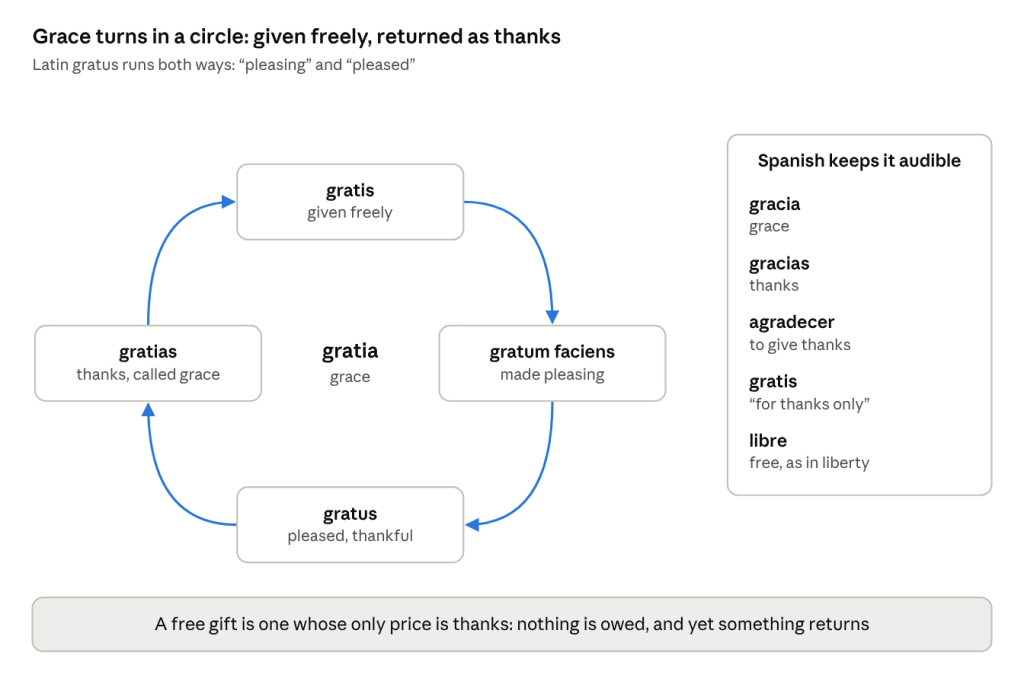
Grace comes from the Latin gratia, built on gratus, a word that runs in two directions at once: “pleasing” and “pleased.” To be welcome and to be thankful share a single word. The family is large (gratis, gratitude, gratuitous, congratulate), and it carries a circular shape. Favor is given freely (gratis); it makes the one who receives it pleasing (gratum faciens, as the scholastics said); that person becomes thankful (gratus); and the thanks itself is called grace (gratias). When we “say grace” before a meal, we are, at the root, saying thanks.
Spanish keeps the whole circle audible in everyday speech. Gracia is grace, gracias is thanks, and agradecer is to give thanks. And when something costs nothing, it is gratis, from the Latin gratiis, “for thanks only.” Spanish keeps another word, libre, for free in the sense of liberty; gratis is free in the sense of given. In other words, a free gift is one whose only price is thanks. That is the economy of grace in a single word: nothing is owed, and yet something returns.
The Greeks arrived at the same insight with a different word. Eucharistia is eu- (“good”) plus charis (“grace, gift”). In both languages, the gift and the thanks for it are one substance.
I read this circle as a small picture of the rhythm of being: the Creator pouring forth, the creation receiving and becoming, and that becoming returning as praise. Ra says that “the Creator does not properly create as much as It experiences Itself” (82.10). In my own framework, that means gratitude is how the circle closes. When I give thanks, the Creator tastes the Creatorself through me, and the gift comes home. The heartmind is where this circle is felt. The calculating mind can’t earn grace; it can only be received, and receiving it changes the one who receives (gratum faciens). That change of mind is metanoia.
Love, the Greatest Protection
When the group asks how to care for the instrument, Ra answers: “As always, love is the greatest protection” (64.21). And elsewhere: “there is no protection greater than love” (75.2). Notice what Ra links it with. “We commend the continual fidelity of the group to the ideals of harmony and thanksgiving. This shall be your great protection” (91.38).
I read “love” here at its widest, something far larger than warm feelings sent toward a problem: the recognition and embodiment of unity, of wholeness. And thanksgiving is how that recognition practices itself, moment by moment. Fear contracts the self around what it might lose. Gratitude opens the self toward what it has been given. In other words, the grateful heart is already standing in the wholeness that fear says has been broken. Fear is the small mind keeping watch; love is the nous seeing wholeness. To move from the one to the other is metanoia.
The Pitch of Light
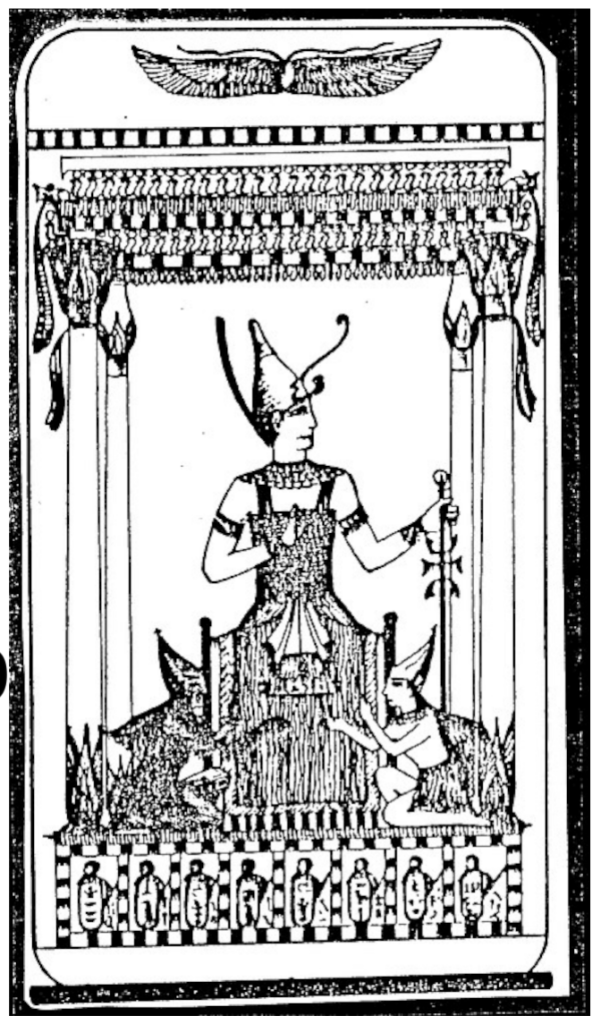
One of Ra’s most beautiful images comes late in the contact. Don asks whether one who has chosen the positive path purely becomes impervious to the catalyst of the negative path, and Ra answers:
“There is no outward shelter in your illusion from the gusts, flurries, and blizzards of quick and cruel catalyst. However, to the pure, all that is encountered speaks of the love and the light of the One Infinite Creator. The cruelest blow is seen with an ambiance of challenges offered and opportunities to come. Thusly, the great pitch of light is held high above such an one so that all interpretation may be seen to be protected by light.” (95.24)
Ra promises no shelter from the storm. What Ra offers instead is a canopy of interpretation, a tent of light under which even the cruelest blow can be seen for what it may yet become.
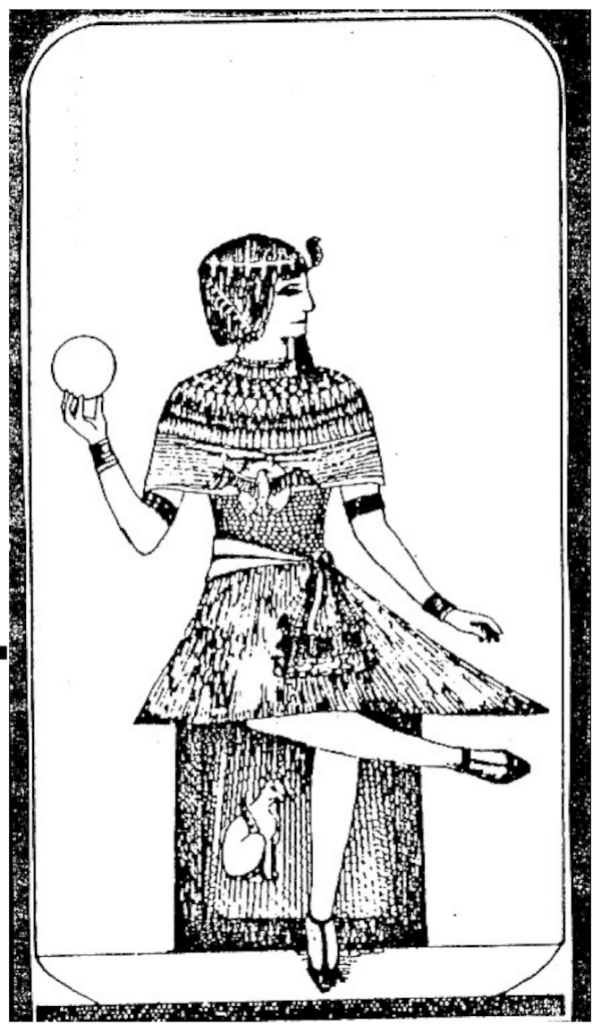
Two sessions later, discussing Card Five, the Significator of the Mind, Ra offers something that turns our usual accounting upside down:
“The nature of polarity is interesting in that those experiences offered to the Significator as positive frequently become recorded as productive of biases which may be seen to be negative, whereas the fruit of those experiences apparently negative is frequently found to be helpful in the development of the service-to-others bias.” (97.16)
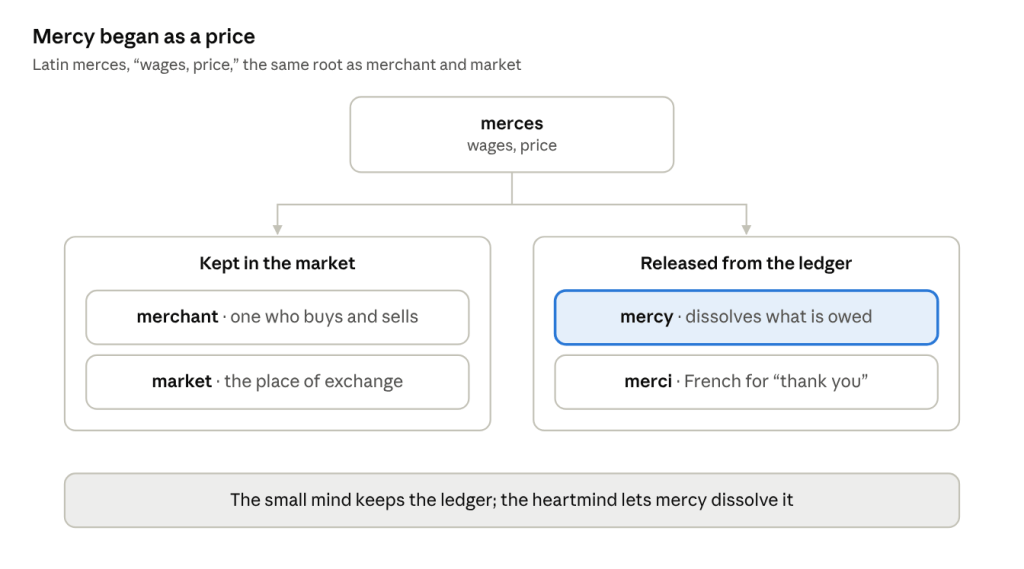
Here’s where the word mercy earns its place. It comes from the Latin merces, “wages, price,” the same root as merchant and market. Mercy begins inside an economy of exchange. And that is how most of us tally our days: the pleasant counts as profit, the painful as loss. Ra’s remark about the Significator dissolves the ledger. What we booked as gain may harden into bias; what we wrote off as loss may bear the fruit of service. The small mind keeps the ledger. The heartmind lets mercy dissolve it, and that letting go is metanoia, a change of mind about what counts as gain and what counts as loss.
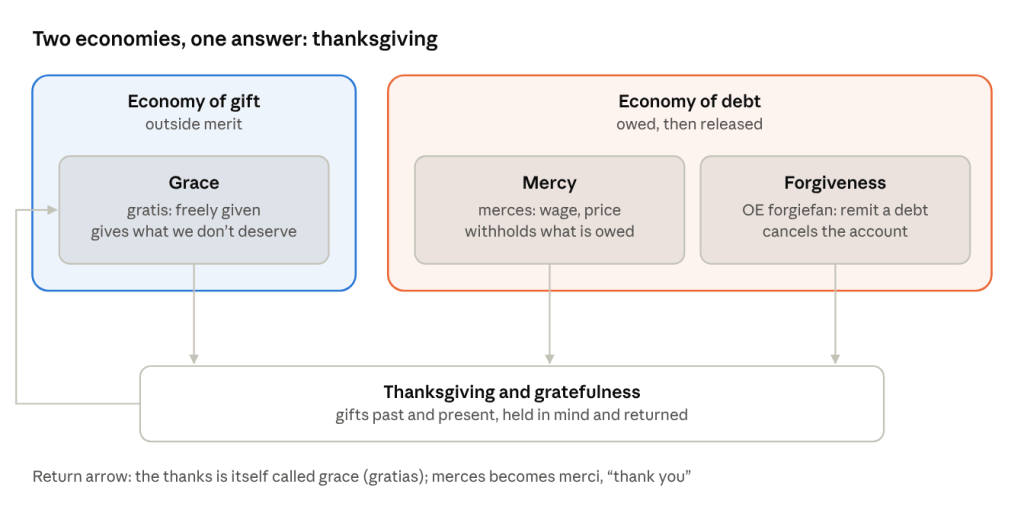
Grace lives outside the economy of merit; mercy and forgiveness enter the economy of debt and dissolve what is owed. Thanksgiving answers all three. Thanks is no payment, since nothing is owed; it too is given freely, and so the thanks itself becomes grace returned.
I see the Significator of the Mind as the agentic self, “that dynamic entity which absorbs, seeks, and attempts to learn” (79.37). Gratefulness is what happens when that self chooses to hold every catalyst under the pitch of light. And notice the word itself: grate-ful-ness, the condition of being full of favor. Gratitude names a quality; gratefulness names a fullness of the whole person. This gratitude never papers over pain. It gives thanks for the Creator who meets us inside the pain, and for what the cruelest blow can become. Said differently, as David Steindl-Rast reminds us, we can’t be grateful for everything, but we can be grateful in every given moment “for the opportunity,” and even in what is terribly difficult, we can “rise to this occasion and respond to the opportunity that is given to us.”7
The Rules of the Game
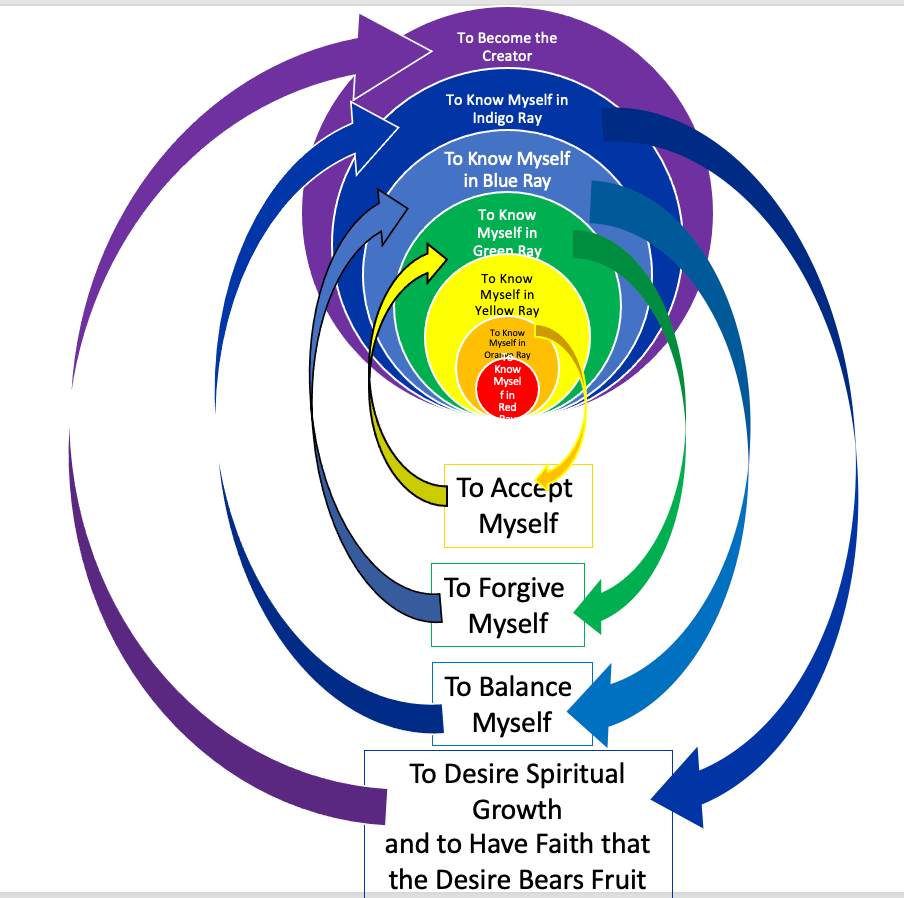
In Session 50, Ra likens the incarnation to the longest poker game imaginable. The cards are dealt and re-dealt, and we can’t remember our hand, the other players’ hands, “perhaps even the rules of this game.” Then:
“This game can only be won by those who lose their cards in the melting influence of love… This is the game: to know, to accept, to forgive, to balance, and to open the self in love.” (50.7)
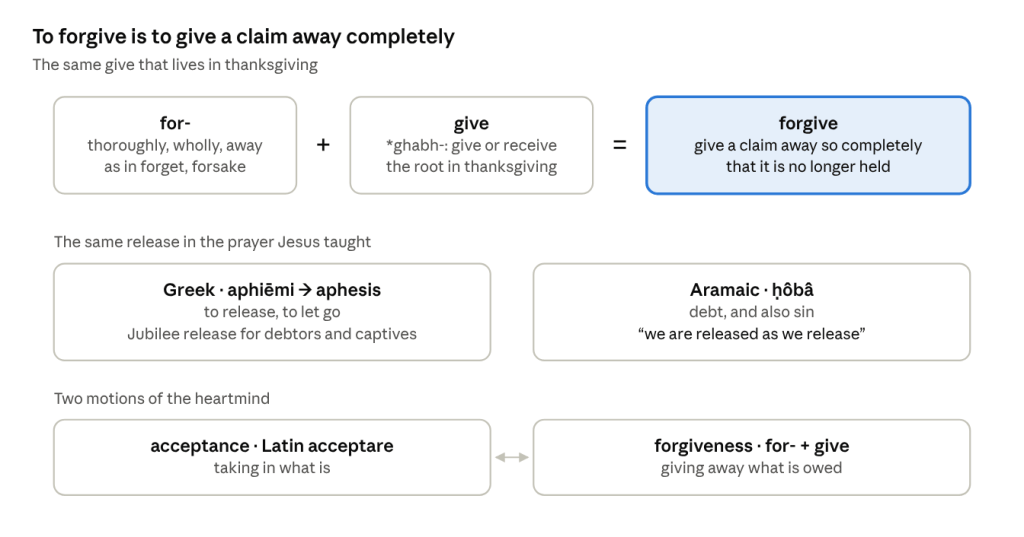
I teach these as five steps: desire to know the self, accept the self, forgive the self, balance the self, and open the self to more love. At the center sits forgiveness, and here the etymology is lovely. Forgive is for- plus give, the same *ghabh- that lives in thanksgiving. The prefix means thoroughly, wholly, away (as in forget and forsake). To forgive is to give a claim away so completely that it is no longer held.
Ra describes karma as inertia and says, “This stoppage of the inertia of action may be called forgiveness” (34.4). And Ra adds: “Forgiveness of other-self is forgiveness of self” (18.12). Forgiveness is the one kind of giving that leaves the giver without the thing given (the grievance, the right to repayment), and through that old root, forgiving and being forgiven are a single motion seen from two sides.
The prayer Jesus taught says the same thing in the language of the marketplace. In Matthew’s version we ask to be forgiven our debts (opheilēmata) as we forgive our debtors (Matthew 6:12).8 Luke has “sins,” yet keeps the economic shape: we forgive “everyone indebted to us” (Luke 11:4). Scholars widely note that the Aramaic word for debt Jesus likely used (ḥôbâ) also meant sin.9 And the Greek verb for forgive, aphiēmi, means to release or let go, and its noun, aphesis, carries the Jubilee sense of release for debtors and captives (Leviticus 25).10 So “forgive us as we forgive” turns out to be one gesture: we are released as we release.
Thanksgiving and forgiveness are siblings. One releases what was received into praise; the other releases what was owed into freedom. Both let go of the cards. Seen this way, Ra’s five movements (knowing, accepting, forgiving, balancing, and opening the self in love) are the steps of metanoia, the nous coming home to the heart one movement at a time. Acceptance, from the Latin acceptare, is the heartmind taking in what is; forgiveness is the heartmind giving away what is owed.
The Moment Contains Love
When Don asked for exercises that would accelerate a seeker toward the Law of One, Ra’s first answer was this:
“The moment contains love. That is the lesson/goal of this illusion or density. The exercise is to consciously seek that love in awareness and understanding-distortions.” (10.14)
Then come the others: “The universe is one being. When a mind/body/spirit complex views another mind/body/spirit complex, see the Creator.” “Gaze within a mirror. See the Creator.” “Gaze at the creation which lies about the mind/body/spirit complex of each entity. See the Creator” (10.14).
I hear thanksgiving as Exercise One lived out. Gratitude finds the love the moment already holds. The other three exercises widen the circle of that seeing: the other-self, the self in the mirror, and the creation all around. That last one reaches all the way to what is on the plate. The Bread and the harvest belong to “the creation which lies about” each of us (10.14), and so they, too, are the Creator. In other words, the food we eat is the Creator offering itself up for the Creator, and every meal received with thanks becomes a small eucharist. See the Creator. See the Creator. See the Creator.
The calculating mind can’t do this kind of seeing. The nous at home in the heart can, and each time it sees the Creator in a face, a mirror or a meal, a small metanoia takes place.
Taken, Blessed, Broken, Shared, Embodied, Transformed
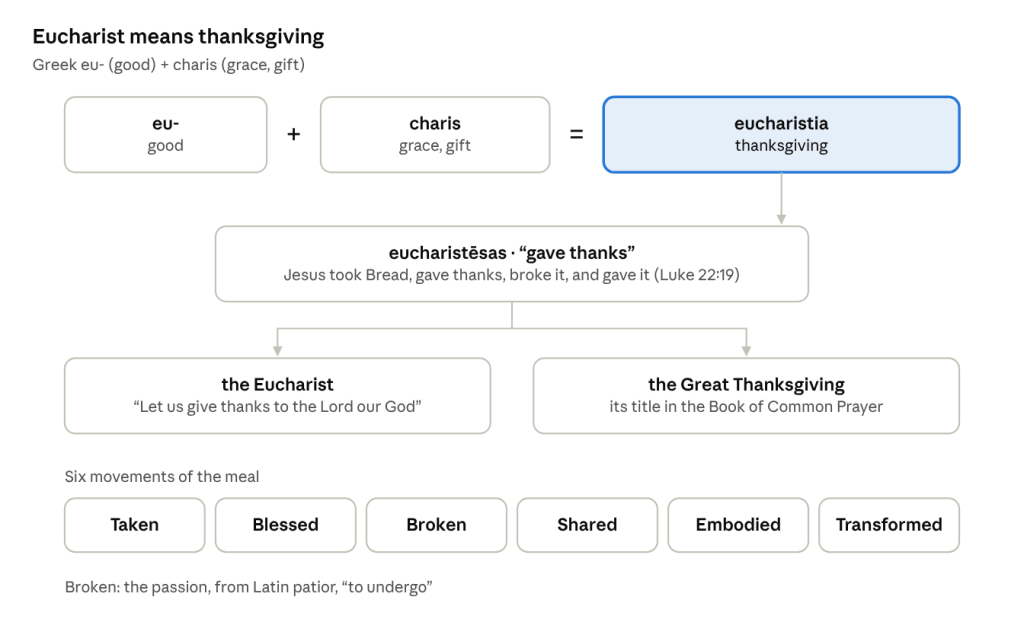
Eucharist simply means “thanksgiving.” In the earliest accounts of the Last Supper, Jesus took Bread, gave thanks (eucharistēsas, Luke 22:19; 1 Corinthians 11:24), broke it, and gave it. The Mass keeps that thanks at its center. The Church calls the Eucharistic Prayer “the prayer of thanksgiving and sanctification,” and it opens with the priest’s invitation, “Let us give thanks to the Lord our God,” answered by “It is right and just.” The Preface follows: “It is truly right and just, our duty and our salvation, always and everywhere to give you thanks.” When the Supper is retold in the Roman Canon, Jesus takes the bread “and with eyes raised to heaven to you, O God, his almighty Father, giving you thanks, he said the blessing, broke the bread and gave it to his disciples.” And the people frame the whole liturgy with their own “Thanks be to God,” spoken after the readings and again at the dismissal.11 In the Anglican Book of Common Prayer, the same prayer is titled simply the Great Thanksgiving.12 I find deep architectural truth in this ritual, a pattern I’d name in six movements. The first four are the verbs of the Supper itself (taken, blessed, broken, given), which Henri Nouwen read as the shape of every beloved life.13 Some years ago I traced the same four as the shape of a life of thanksgiving.14 Here I carry them two steps further.
Taken. Before anything is blessed, it is taken up and received. In that earlier article I called this taking in: life is a gift held within a larger love, and the moment, as Ra says, “contains love” (10.14). This is acceptance, the heartmind taking in what is, the hard along with the sweet.
Blessed. The Bread, once taken, is blessed. Before anything else happens, it is made gratum, pleasing, welcome. So are we. Our story begins in grace.
Broken. Bread cannot be shared while it stays whole. This is the catalyst, the cruelest blow, the passion (from patior, to undergo). Under the pitch of light, the breaking is the beginning of the gift.
Shared. The broken Bread is given, and here *ghabh- comes home: giving and receiving in one motion. No one at the table receives without someone giving, and the giver is fed by the giving.
Embodied. The Bread is taken in. It becomes flesh. Ra says that without a disposition toward meditation, contemplation, or prayer, the data “will not sink down into the roots of the tree of mind, thus enabling and ennobling the body and touching the spirit” (10.14). Gratitude is how the lesson moves from concept into marrow.
Transformed. Then the strange reversal. In the Confessions (7.10.16), Augustine hears the Lord tell him that he will not change this food into himself, as he does ordinary bread; he will be changed into it.15 We become what we eat. Ra’s own image is close kin: cards lost “in the melting influence of love” (50.7). This is metanoia at its fullest: being changed into what we receive with thanks.
I see this shape at every order of magnitude. In my own work I hold that the Creator, too, is blessed in its own outpouring, enters the brokenness of veiled third-density experience, shares itself among the many, takes that experience in, and is changed by it, since the Creator “experiences Itself” (82.10). The Eucharist is a small, sacred enactment of that rhythm, and so, in its humbler way, is a family passing the Bread around a November table.
At the Table
So this year, when we bow our heads, I’m going to try to say grace with all of this in mind. Thanking is thinking: I’ll hold in my heartmind what has been given. Grace returns: I’ll let the thanks close the circuit. Love is the greatest protection, and thanksgiving is how love keeps watch. Under the pitch of light, even the hard year can be seen with “an ambiance of challenges offered and opportunities to come.” And whatever I’m still holding against anyone, myself included, I’ll try to give away.
All of these words, then, live in the heartmind. Thanksgiving remembers, grace receives, mercy and forgiveness release, acceptance takes in, and love holds the whole. Together they turn the small mind toward the larger one. That turning is metanoia, and Thanksgiving, at its truest, is a feast of it.
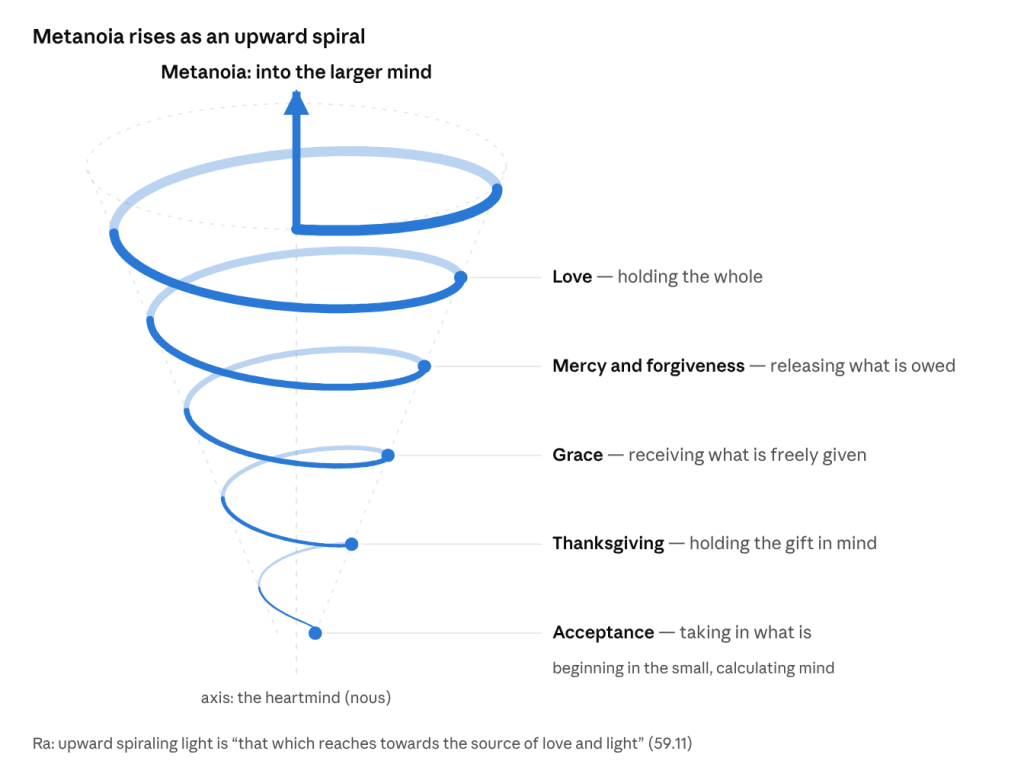
Each turn returns to the same center, the heartmind, a little higher than before. Ra’s own image fits: “upward spiraling” light names “that which reaches towards the source of love and light” (59.11).
Give thanksgiving for each moment. See the self and the other-self as Creator. Open the heart. The moment contains love.
I’m offering these thoughts for what they are worth. Happy Thanksgiving.
Further reading on this site: my 2019 article, Living a Life of Thanksgiving: A Law of One Perspective, where I first traced the four movements; Cosmic Christ: Christianity and the Law of One, for the larger framework; and The Angelic Realm, Part Two, which also takes up the pitch of light.
Notes
- Don Elkins, Carla L. Rueckert, and James McCarty, The Ra Contact: Teaching the Law of One, 2 vols. (Louisville, KY: L/L Research, 2018). Subsequent quotations from the Ra Contact are cited in the text by session and question number (e.g., 32.1).
- Alfred North Whitehead, Process and Reality: An Essay in Cosmology, corrected ed., ed. David Ray Griffin and Donald W. Sherburne (New York: Free Press, 1978), xi.
- Etymologies throughout are drawn from Douglas Harper, Online Etymology Dictionary, s.v. “thank,” “think,” “give,” “forgive,” “grace,” “grateful,” “gratis,” “mercy,” “accept,” “Eucharist,” and “metanoia,” accessed October 27, 2026, https://www.etymonline.com.
- Cynthia Bourgeault, “Centering Prayer and Attention of the Heart,” CrossCurrents 59, no. 1 (March 2009): 15–27.
- Cynthia Bourgeault, The Wisdom Way of Knowing: Reclaiming an Ancient Tradition to Awaken the Heart (San Francisco: Jossey-Bass, 2003), 34.
- Cynthia Bourgeault, The Wisdom Jesus: Transforming Heart and Mind—A New Perspective on Christ and His Message (Boston: Shambhala, 2008), 62–66.
- David Steindl-Rast, “Want to Be Happy? Be Grateful,” TED talk, TEDGlobal 2013, June 2013, https://www.ted.com/talks/david_steindl_rast_want_to_be_happy_be_grateful.
- Scripture quotations are from the New Revised Standard Version Updated Edition (NRSVue) and are cited in the text by book, chapter, and verse.
- Daniel J. Harrington, The Gospel of Matthew, Sacra Pagina 1 (Collegeville, MN: Liturgical Press, 1991), 95.
- “859. aphesis,” Bible Hub, accessed October 26, 2026, https://biblehub.com/greek/859.htm.
- The Roman Missal, English translation according to the third typical edition (Washington, DC: United States Conference of Catholic Bishops, 2011), Order of Mass and Eucharistic Prayers I–IV; General Instruction of the Roman Missal (Washington, DC: United States Conference of Catholic Bishops, 2011), no. 78. Thanks or thanksgiving is spoken at every stage of the Mass:
- Gloria: “we give you thanks for your great glory.”
- After the first and second readings: “Thanks be to God.”
- Preface Dialogue: “Let us give thanks to the Lord our God.”
- Preface: “It is truly right and just, our duty and our salvation, always and everywhere to give you thanks”; Eucharistic Prayer IV has its own preface, “It is truly right to give you thanks, truly just to give you glory.”
- Eucharistic Prayer I (the Roman Canon), over the bread: “giving you thanks, he said the blessing”; over the chalice: “once more giving you thanks, he said the blessing.”
- Eucharistic Prayer II, over the bread: “giving thanks, broke it”; over the chalice: “once more giving thanks”; after the consecration: “giving thanks that you have held us worthy to be in your presence and minister to you.”
- Eucharistic Prayer III, over the bread and the chalice: “giving you thanks he said the blessing”; after the consecration: “we offer you in thanksgiving this holy and living sacrifice.”
- Eucharistic Prayer IV, over the chalice: “he gave thanks.”
- Dismissal: “Thanks be to God.”
- The Book of Common Prayer (New York: Church Publishing, 1979), 333, 361.
- Henri J. M. Nouwen, Life of the Beloved: Spiritual Living in a Secular World (New York: Crossroad, 1992).
- Doug Scott, “Living a Life of Thanksgiving: A Law of One Perspective,” Cosmic Christ (blog), November 26, 2019, https://cosmicchrist.net/2019/11/26/living-a-life-of-thanksgiving-a-law-of-one-perspective/.
- Augustine, Confessions, trans. Henry Chadwick (Oxford: Oxford University Press, 1991), 7.10.16.
Bibliography
Augustine. Confessions. Translated by Henry Chadwick. Oxford: Oxford University Press, 1991.
Bible Hub. “859. aphesis.” Accessed October 26, 2026. https://biblehub.com/greek/859.htm.
The Book of Common Prayer. New York: Church Publishing, 1979.
Bourgeault, Cynthia. “Centering Prayer and Attention of the Heart.” CrossCurrents 59, no. 1 (March 2009): 15–27.
Bourgeault, Cynthia. The Wisdom Jesus: Transforming Heart and Mind—A New Perspective on Christ and His Message. Boston: Shambhala, 2008.
Bourgeault, Cynthia. The Wisdom Way of Knowing: Reclaiming an Ancient Tradition to Awaken the Heart. San Francisco: Jossey-Bass, 2003.
Elkins, Don, Carla L. Rueckert, and James McCarty. The Ra Contact: Teaching the Law of One. 2 vols. Louisville, KY: L/L Research, 2018.
General Instruction of the Roman Missal. Washington, DC: United States Conference of Catholic Bishops, 2011.
Harper, Douglas. Online Etymology Dictionary. Accessed October 27, 2026. https://www.etymonline.com.
Harrington, Daniel J. The Gospel of Matthew. Sacra Pagina 1. Collegeville, MN: Liturgical Press, 1991.
The Holy Bible: New Revised Standard Version Updated Edition. Washington, DC: National Council of the Churches of Christ in the USA, 2021.
Nouwen, Henri J. M. Life of the Beloved: Spiritual Living in a Secular World. New York: Crossroad, 1992.
The Roman Missal. English translation according to the third typical edition. Washington, DC: United States Conference of Catholic Bishops, 2011.
Scott, Doug. “Living a Life of Thanksgiving: A Law of One Perspective.” Cosmic Christ (blog), November 26, 2019. https://cosmicchrist.net/2019/11/26/living-a-life-of-thanksgiving-a-law-of-one-perspective/.
Steindl-Rast, David. “Want to Be Happy? Be Grateful.” TED talk, TEDGlobal 2013, June 2013. https://www.ted.com/talks/david_steindl_rast_want_to_be_happy_be_grateful.
Whitehead, Alfred North. Process and Reality: An Essay in Cosmology. Corrected ed. Edited by David Ray Griffin and Donald W. Sherburne. New York: Free Press, 1978.

