Doug Scott, LCSW
On Tuesday evening, October 6, I gave the second part of my talk on the angelic realm to our Building 4th community. What follows is a cleaned-up version of what I said, set between the slides I was showing, with some of our discussion at the end. One of our members opened us with a lovely riff on the Welcoming Prayer, and another closed us in prayer.
As before, this is my careful reading of several sources: mostly the Ra Contact, along with Daskalos, Q’uo and the Christian scriptures. It’s distorted as it will be. These are simply my thoughts, after ten or fifteen years with this topic, and I’ve tried to mark which parts come from Ra, which from Daskalos, and which are my own synthesis. Part One is here.
I wanted to begin with an overview of last time, approached in a different way, so it isn’t the same slides. If you missed Part One, or you’re coming to this one first, you won’t be lost.
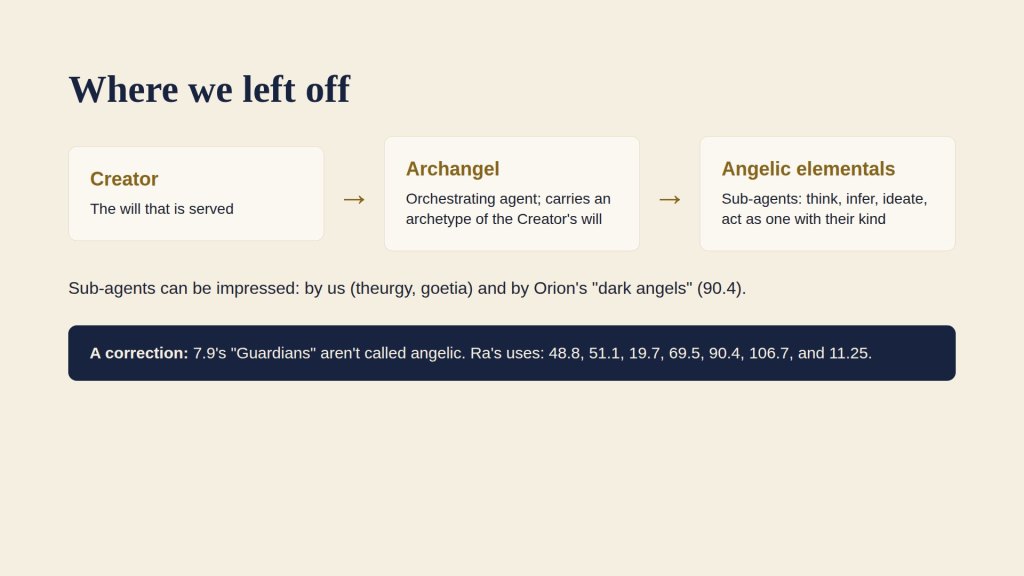
Last week I offered a working theory that angels work something like algorithms, or a little like AI. The archangel would be the orchestrating agent, carrying an archetype of the Creator’s will. The angelic elementals (sometimes called thoughtforms or logismoi, three words for the same thing) are its sub-agents. And sub-agents can be impressed by whoever reaches them. That includes us.
I also want to make one correction. Last week I cited 7.9 as angelic. That passage is actually about the twenty-four who back the Council of Nine, and Ra doesn’t call them angelic. I made a mistake there, and I’ve corrected it in the Part One post.
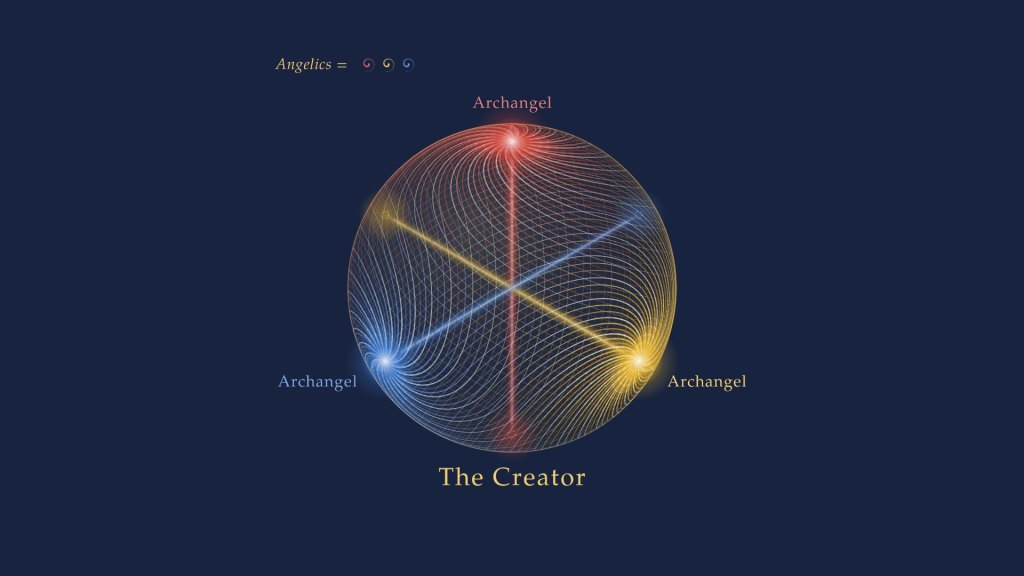
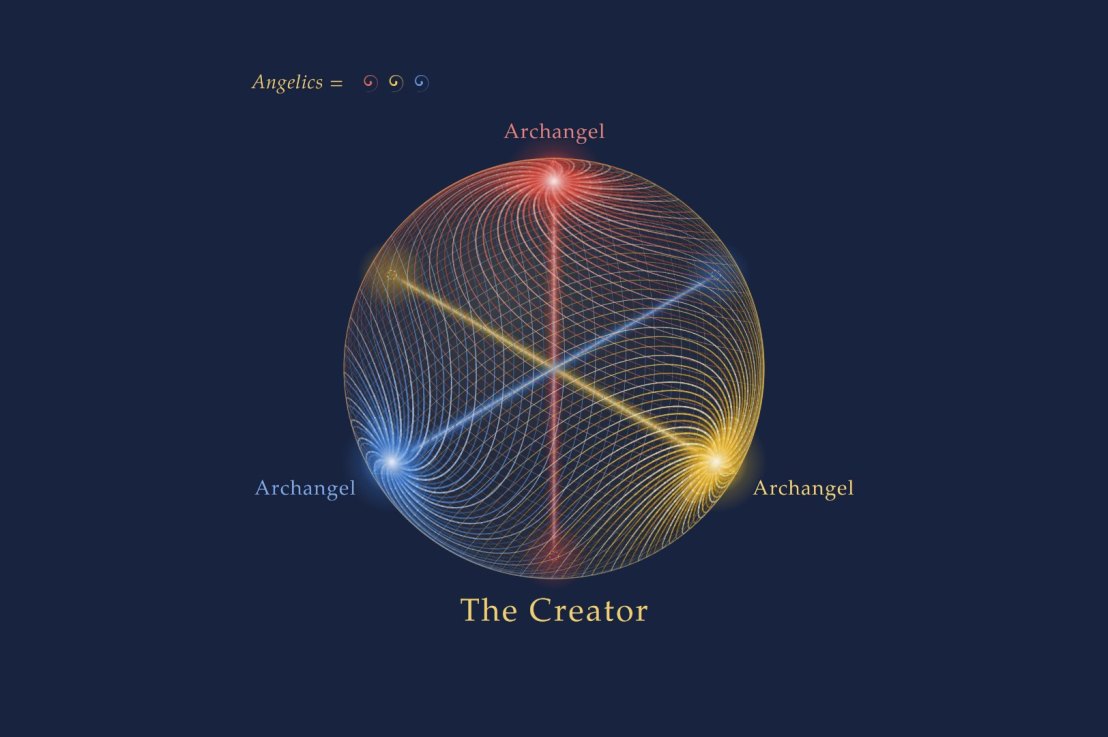
Here is one way I understand the archangels. Think of the entire sphere you see as the Creator, all of it. Inside the Creator there are certain focal points. These focal points don’t seek to know themselves the way a Logos would. They’re more like involuntary muscles, working so that you and I can ideate and make conscious decisions. In other words, they’re the energetic framework within creation.
For simplicity I’ve drawn a red archangel, a yellow archangel and a blue archangel, each one an epicenter. From each epicenter, spirals go all the way around, reverberating across the sphere of the Creator. They mingle with the others, yet each keeps its own integrity; they don’t blend together. If the epicenters are the archangels, then the spiraling rays are the angelics. They’re part of the lattice, the matrix of creation.
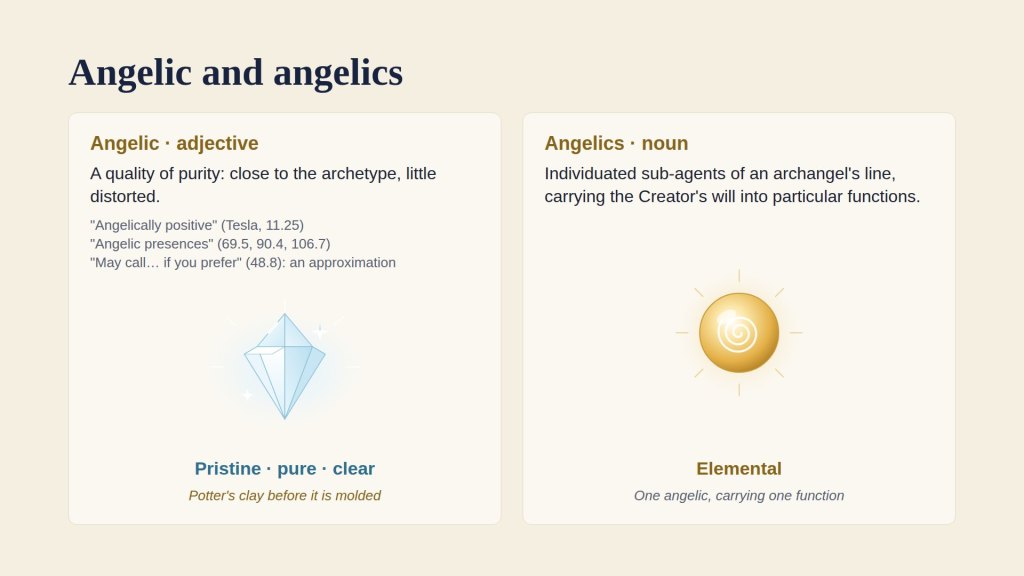
On a careful reading of Ra (and again, this is my distortion, and I own it), I see two subtle uses of the word. The first is an adjective: a quality of purity, very close to an archetype, little distorted. Ra once described Tesla as angelically positive (11.25). Angelic presences (69.5, 90.4, 106.7) might be the noun, but it could also mean pure presences.
Another time, Ra speaks of the guides who attend us during harvest, including our higher self, and says we may call them angelic “if you prefer” (48.8, 51.1). I take that as an approximation. Human language makes this hard, especially English; other languages may have a more nuanced way to say it. So when Ra says we may call them angelic if we prefer, I don’t hear the pure angelic. It’s somewhere on the spectrum.
The second use is the noun. Angelics are individuated sub-agents of an archangel’s line, carrying the Creator’s will into particular functions. They operate as functions, interfaces with the whole. Another way to picture it: think of a triangle. Each corner is an archangel, and the line that runs from one archangel to another is an angelic, almost a sub-archangel. On the slide, I’ve pictured the adjective as a clear crystal (pristine, pure, clear) and the noun as an orb, an elemental.
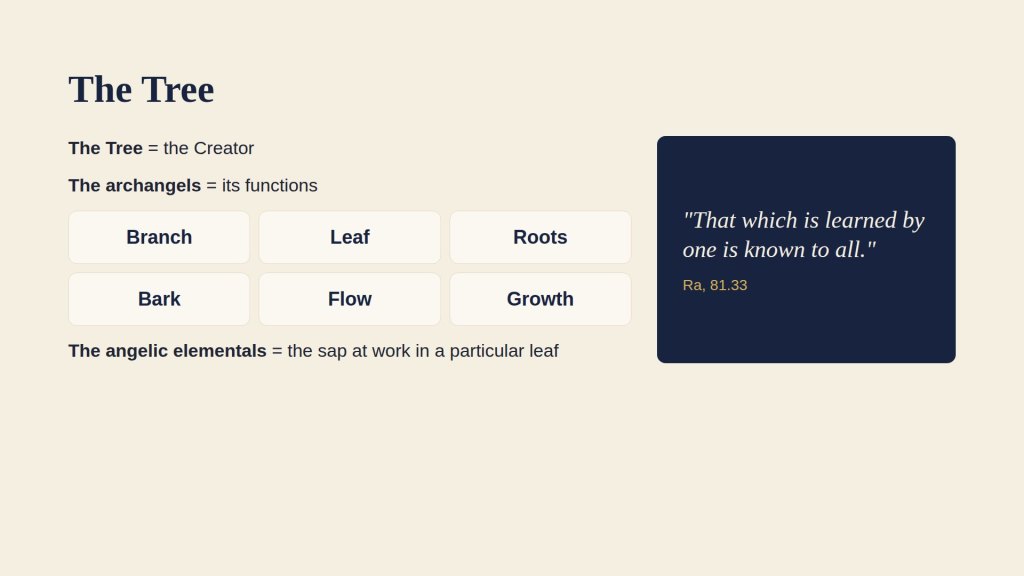
Another way I’ve tried to think about it is a tree. If the tree is the Creator, then we have a branch, a leaf and roots. We have bark, we have flow, we have growth. And inside each of those are the angelic elementals that do the work.
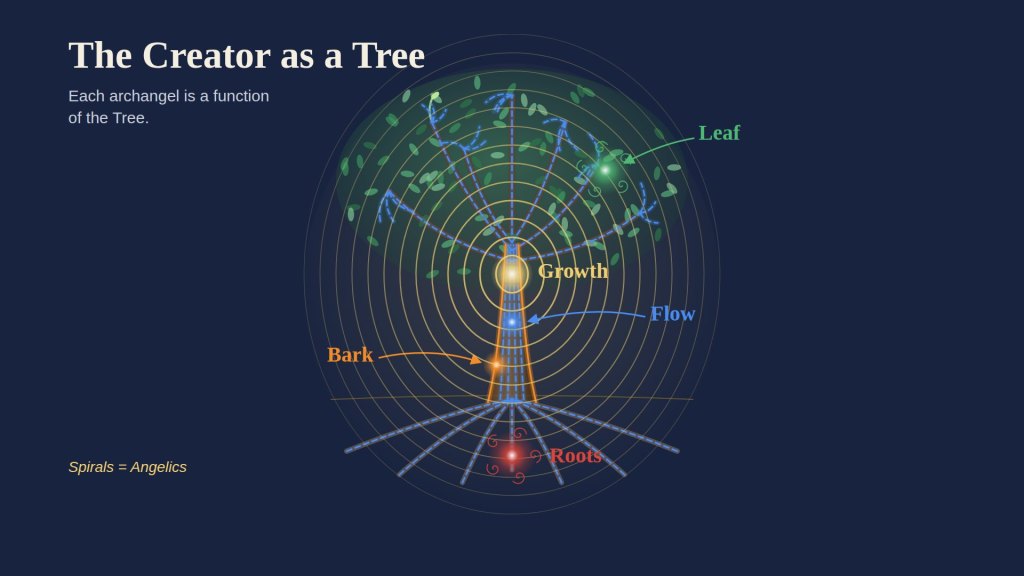
Here is the tree. The whole tree is the Creator, but different archetypes are at play. (I’m making this up, of course.) There’s a leaf archetype, and a leaf is different from the bark archetype. There’s a roots archetype, an archetype responsible for the flow, and an archetype responsible for growth throughout the whole. Each of these archetypes would be an archangel, in the sense I think Ra means and that other material, Daskalos for example, describes. Then the particular things happening within the bark, the leaf or the roots (the tree’s muscles, if you like, that make flow and growth possible) would be the elementals belonging to that particular archangel.
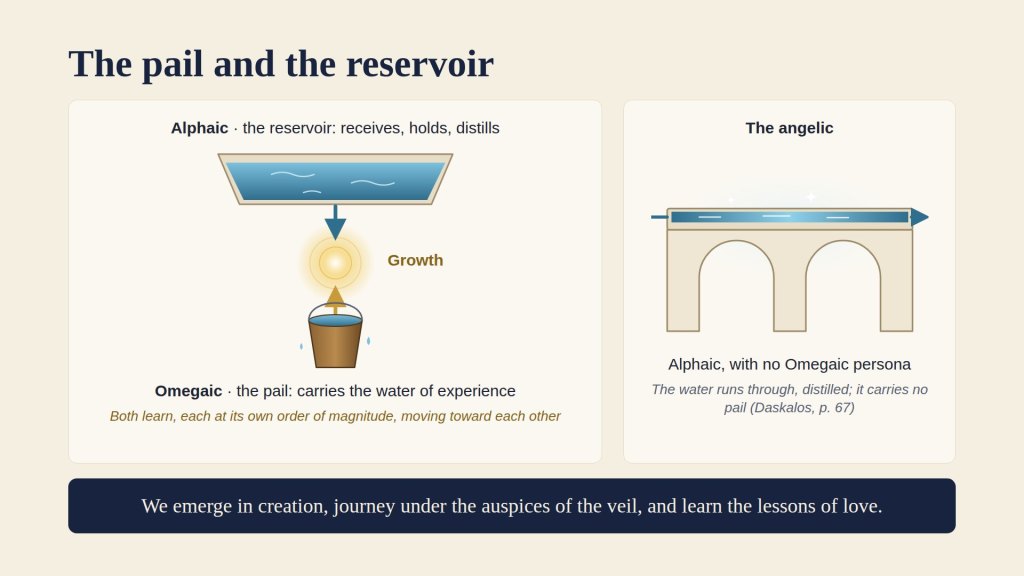
I introduced this a while ago and talked about it again last week, so here’s another image to illustrate it. It’s been easier for me to understand much of the Law of One’s metaphysics with two terms, the Alphaic and the Omegaic, alpha and omega.
Think of the Alphaic as a reservoir. Picture our higher self as the Alphaic to our third-density Omegaic line. The Omegaic (you and me) is the pail. It carries the water of experience, and that water is emptied into the reservoir of the Alphaic, where it’s held and distilled. The Alphaic and Omegaic personas are analogs of each other. Each is sentient in its own way, and each develops at its own order of magnitude. The point is that the Alphaic depends on the Omegaic for experience. Moment by moment, we’re giving our higher self an experience of itself. And our higher self has a yearning to connect with itself in third density. So the way they both grow is toward each other, in this yearning, this desire for unification.
The angelic, on the other hand, doesn’t have an Omegaic persona, as I see it. It’s Alphaic, but it has no counterpart providing it with experience, because it isn’t learning in that way; it’s part of the infrastructure. To me, the angelic is more like an aqueduct that carries the water forward. (Daskalos says something close to this: the experience of plants and animals returns to the archangel that represents them, which holds and distills it without growing from it.)
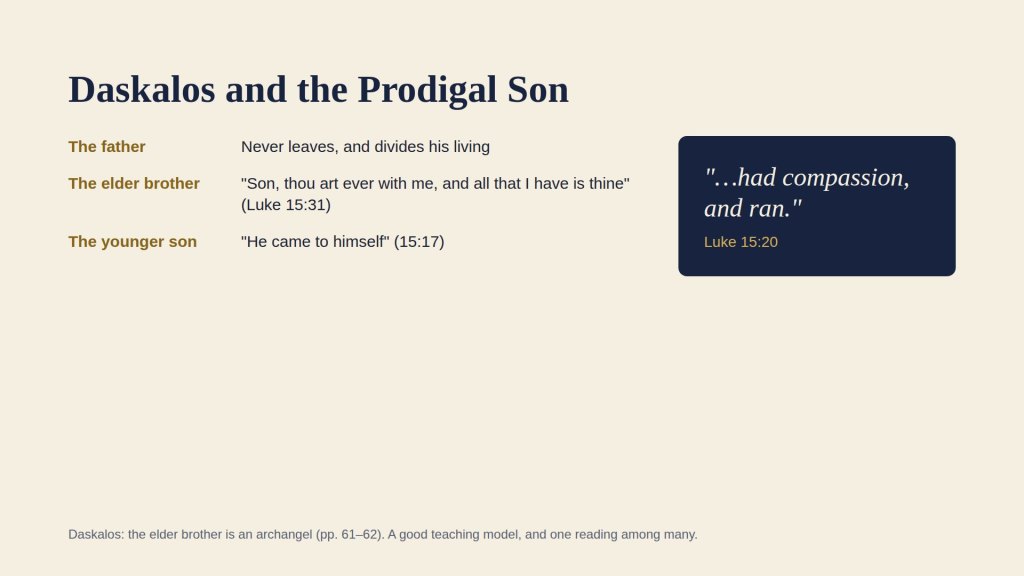
Daskalos uses the Prodigal Son to make this same point. It’s one interpretation, and a good one for this particular dynamic; there are other teaching models built on the parable that I like for different domains. (I’ll use the masculine, the prodigal son, though it could just as well be the prodigal child. I don’t think it matters at all.)
The elder brother, the one who never left the father’s side, would be like the archangel. In Luke, the father says to him, you are always with me, and all that I have is yours. The younger son is us. He takes his share of the father’s estate, goes to a far country, and spends it according to his own desires. At some point catalyst catches up with him, and he “came to himself.” Maybe that realization is akin to what Ra calls making the choice of polarity, that is, learning that there is such a thing as spiritual evolution. At that point, Daskalos says, the prodigal starts to come home, having gained much more than any archangel could, because archangels and their elementals aren’t experiencing things for their own growth.
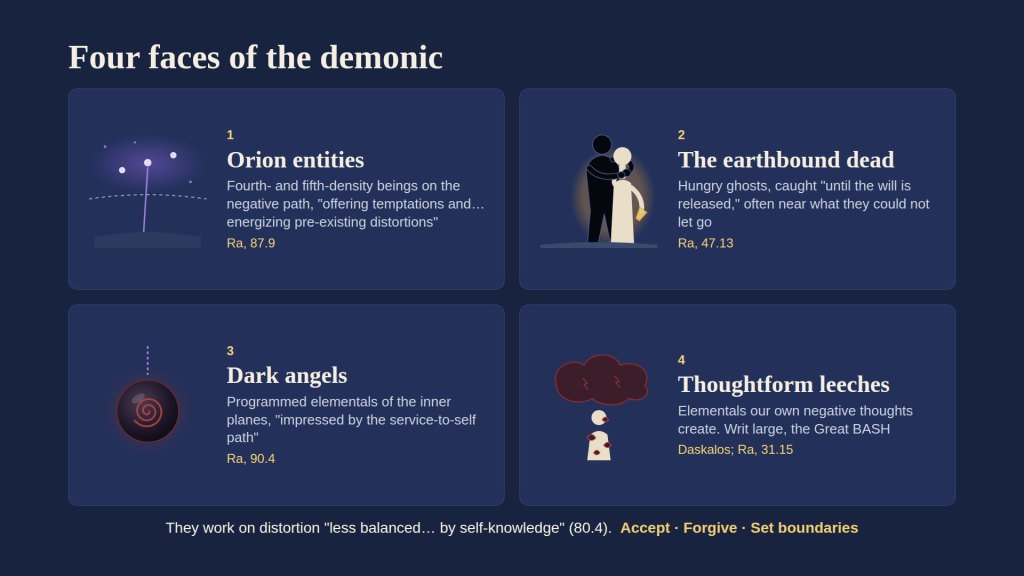
Last week I also tried to introduce four ways I understand the demonic. Picture a spectrum running from the pristine, working toward wholeness, to what we’d call demonic, working toward separation. Some demonics are types of angelics. As far as I can see, there are four main types.
The first is the Orion entities: fourth- and fifth-density beings on the negative path, offering temptations and energizing pre-existing distortions. Ra says that in 87.9.
The second is the earthbound dead, the hungry ghosts, caught “until the will is released” (47.13). They often put themselves close to what they could not let go of. In this image I’ve got a person who is drunk, and a hungry ghost, a kind of shadow person, holding them in a chokehold. It connects to the energetics, the aura, of that incarnate third-density person and feels the effects vicariously. In doing so, it wants that person (who may have an addiction or something along those lines) to keep on in the addiction, because that gives the hungry ghost what it’s looking for and can no longer get on its own, since it’s no longer incarnate here in space/time.
The third type is the dark angels. Ra does talk about these: programmed elementals of the inner planes, “impressed by the service-to-self path” (90.4). Here’s how I picture it. If there’s a framework of sacred geometry, and the nodal points are the archangels, then the lines connecting them would be the angelics coming from the archangels. It seems to me those lines can be programmed. One of our members added here that this is what survivors of satanic ritual abuse regularly have to contend with: occult groups try to create these dark-angel kinds of things through ritual, then attach them to people as a means of control.
The fourth type I like to call thoughtform leeches, etheric or energetic leeches. These include the elementals of our own negative thoughts. The great thoughtform leech we’ve all created together is what I call the Great BASH, a huge thoughtform we sustain through our inefficient use of the catalyst of bellicosity.
All four types work on distortions that are already there, and they can make them much worse. I see them as especially vicious toward people who don’t have much self-awareness. Self-knowledge is an antidote to imbalance (80.4): when we notice ourselves becoming imbalanced, we can use good psychospiritual techniques to regain balance, something along the lines of acceptance, forgiveness, setting boundaries, and opening ourselves to more love.
But when we’re negative in general, and we think about other people in negative ways, even subtly othering them to get a sense of being better than, we’re operating in the ethos of separation. I’m not saying it’s easy to avoid. It’s very easy to do. But even subtly, when we do it, our negative thoughts (I would hold) get attached to the people we’re thinking about, and they also stay with us. Like moths to a flame, they can attract other negative entities of like vibration, which then come onto us too and make whatever negativity we’re feeling even worse.
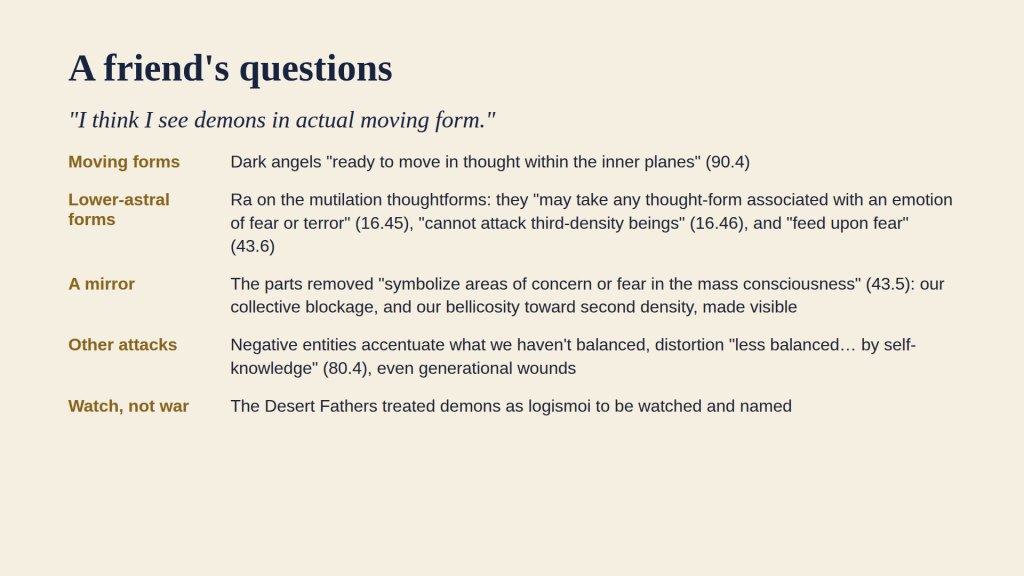
A while ago a friend reached out by email with some thoughts, and I thought it would be good to take them on here. These are my best attempts at answers; I’m not saying they’re right.
One thing my friend said was, “I think I see demons in actual moving form.” I haven’t seen shadow people, though I know some people talk about them. I have seen lights, or non-human shadows, in a room, and when I prayed I’ve seen those shadows shrink back. Especially when I’m in fear and I pray for wholeness and protection, I’ve seen shadows move back. Was it a trick of my eyes? Maybe. But maybe not. And I know some people are capable of seeing more clearly through the veil. Ra does say, in 90.4, that dark angels are ready to move in thought within the inner planes.
Among the lower astral forms, Ra talks about the mutilation thoughtforms. They “may take any thought-form associated with an emotion of fear or terror” (16.45). These particular lower astral forms, involved in cattle mutilation and the like, don’t attack third-density beings directly (16.46). They do feed on fear, though (43.6).
I’ve been thinking about why Ra says they attack second-density cattle. (The word cattle is related to chattel, the word for property, and for slaves.) The mutilations tend to happen in symbolic places, often the areas of the lower energy centers. Borrowing from Ra, the parts removed are like a mirror: they “symbolize areas of concern or fear in the mass consciousness” (43.5). They really represent our collective blockage. They also show the bellicosity we have toward second density (cattle, for example, especially when they live inhumane lives because we demand the meat). They’re mirrors for seeing what we’re doing. And they create more fear when people see them, which serves the lower astral forms well, because they feed on fear.
Other attacks by negative entities accentuate what we haven’t balanced. When we’re less balanced and don’t have much self-knowledge (80.4), these attacks can accentuate our problems, even generational wounds, the wounds that aren’t seen, acknowledged and taken on.
The early Christian Desert Fathers and Mothers talked about these demons as logismoi, elementals or thoughtforms, to be watched and named. They weren’t to be taken on in the spirit of bellicosity, or cast out in that sense, because if you give them energy, that very bellicosity might get rid of some simple demons and yet ensnare us in larger demonics. I’d add that the logismoi the Desert Fathers called demons could also very well be inner imbalances bubbling up from the unconscious. Today we might call them intrusive thoughts, or even OCD-type thoughts (“Pure O,” as they say, pure obsession). Good old-fashioned counseling techniques can help with them, CBT or ACT (acceptance and commitment therapy), for example. We’ll touch on that in a minute.
(Someone asked me to define the Desert Fathers. When Constantine made Christianity the state religion, many mystical women and men who had been living in the cities wanted a more radical life of contemplation. Once Christianity was everywhere, and perhaps co-opted some, they went out to the desert and formed small communities, beginning around 320 AD. There are still desert fathers and mothers today, but it’s the early ones we’re talking about.)
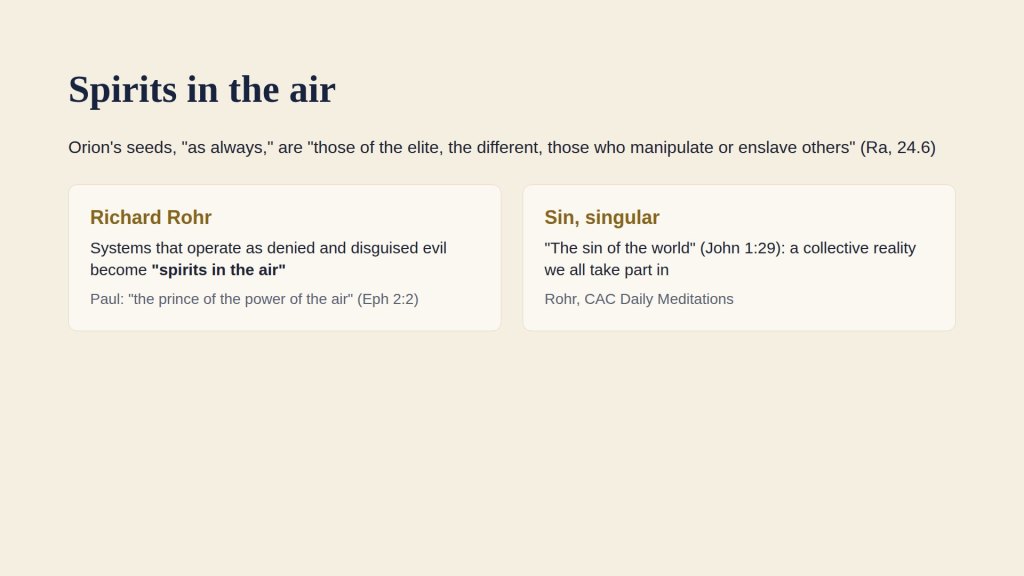
The other thing my friend brought up is so important. How do the demonics play into oppression, racism and other systems of separation?
First, Ra says Orion’s seeds, as always, are those of the elite, those who see themselves as different and better (24.6). These are thoughtforms of superiority, and again, they can be accentuated.
You know my mentor and friend Richard Rohr. He reads Paul’s “principalities and powers” as the corporate evils of our own day. When the systems of the world operate as evil that is denied and disguised, Rohr says, they become “spirits in the air.” Paul calls the ruler of that realm “the prince of the power of the air” (Ephesians 2:2). Why the air? You can’t see the air. You breathe it; it’s all around us. These spirits are invisible, unaccountable, and doing immense damage. This is systemic evil, and we often call it good.
People, especially privileged people, often operate within such systems. Capitalism, communism, and many other systems, when they lack compassion and don’t regard the oppressed, absolutely take this on and, I think, become mouthpieces for this spirit of the air. I would argue these spirits are indeed connected with the demonic, with the Great BASH I’ve talked about.
Rohr also points out that John the Baptist called Jesus the Lamb who takes away the sin of the world (John 1:29), singular, not the sins of the world. We usually think of sins in the plural, but biblically speaking there is really one Sin, singular, and it’s the collective reality we all take part in. Again, I think that’s the Great BASH: we created it, and it creates us.
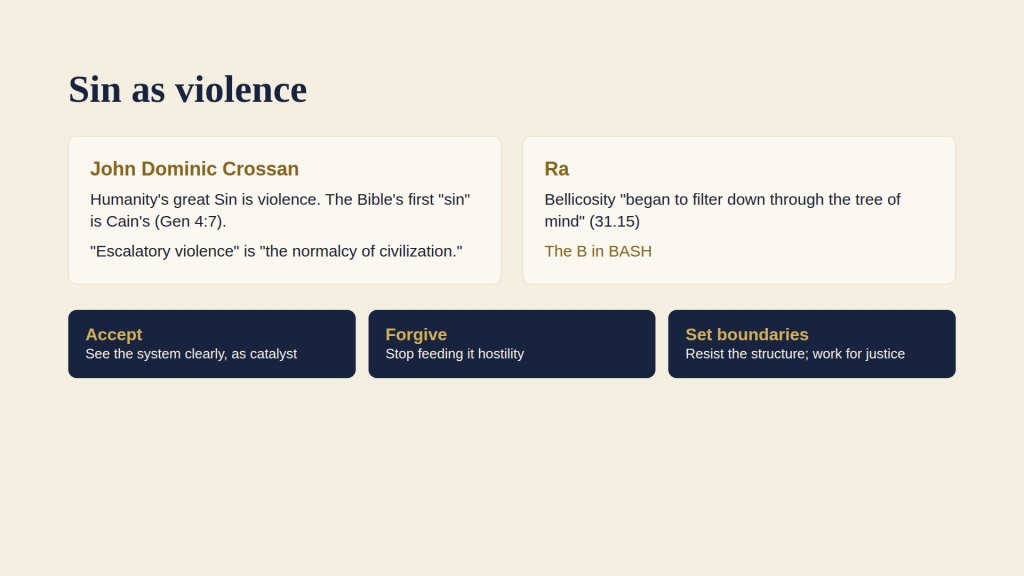
Another well-known theologian, John Dominic Crossan, has spent a lifetime studying the scriptures in their original languages, and he concludes that humanity’s great Sin is violence. The Bible’s first “sin” is Cain’s: he kills his brother Abel (Genesis 4:7). Crossan speaks of violence that keeps escalating, until this myth of redemptive violence has become the normalcy of civilization. As far as I’m concerned, this is the bellicosity Ra speaks of, the distortion that “began to filter down through the tree of mind” (31.15).
So again, the Great BASH: B is Bellicose attitude. A is Aggressive actions. S is Scarred and scared. H is the false Hope through hostility.
Applying what Ra offers as antidotes, the first is to accept the system, that is, to see it clearly as catalyst. The second is to forgive: stop feeding it hostility. I’m including the violence we do to ourselves, the shame we don’t need to carry. The third is to set boundaries: resist the structure and work for justice.
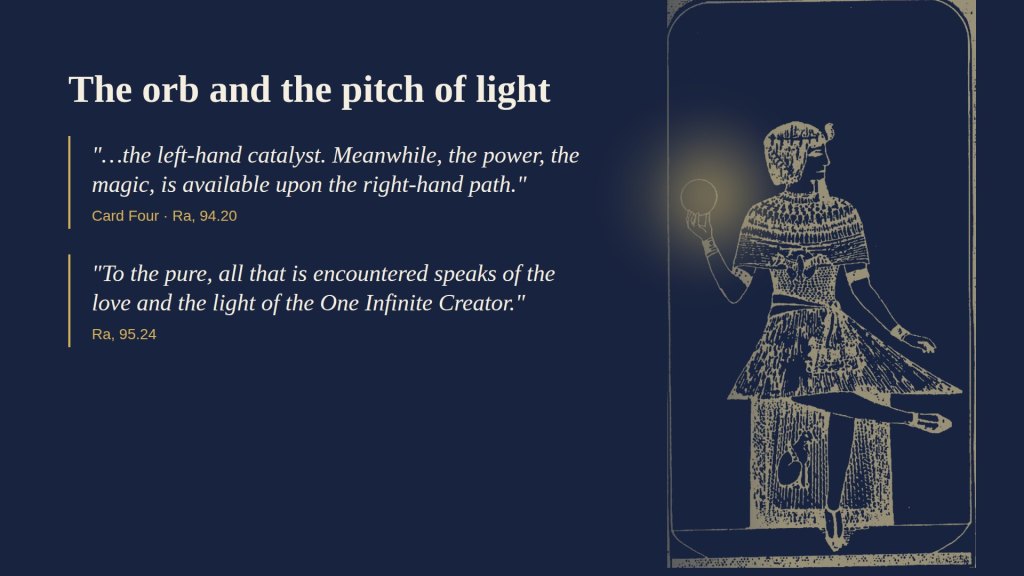
Ra talks about the orb and the pitch of light. In the image, Card Four from the Ra Contact’s archetypes, the Experience of the Mind, look at the figure’s left side. The skirt there is sharp and piercing, and it’s located right at the root chakra. As I read it, that’s because to walk the left-hand path you need a constant bellicosity; you have to use bellicosity efficiently for the negative, to keep driving wedges between people.
Meanwhile, on the right: “To the pure, all that is encountered speaks of the love and the light of the One Infinite Creator” (95.24). The power, the magic, is available upon the right-hand path (94.20), holding up the pitch of light. Wholeness has its own luminosity.
Ra, Don and Carla all speak of it clearly: love is the greatest protection (64.21). And in 32.1 Ra says, in effect: give thanks for each moment, see the self and the other-self as Creator, open the heart, always know the light and praise it. This is all the protection necessary.
Here I’m talking about protection. I’m not talking about the action needed to help balance imbalances writ large, in the macro scheme. I mean protecting ourselves from negative entities, be they Orion, hungry ghosts, programmed dark angels, or the elementals of negative thoughts. The way is to give thanks for each moment, in the spirit of Eucharist. (The Catholic instinct to call communion the Eucharist names it as an act of thanksgiving.) And to see the self and the other-self as Creator.
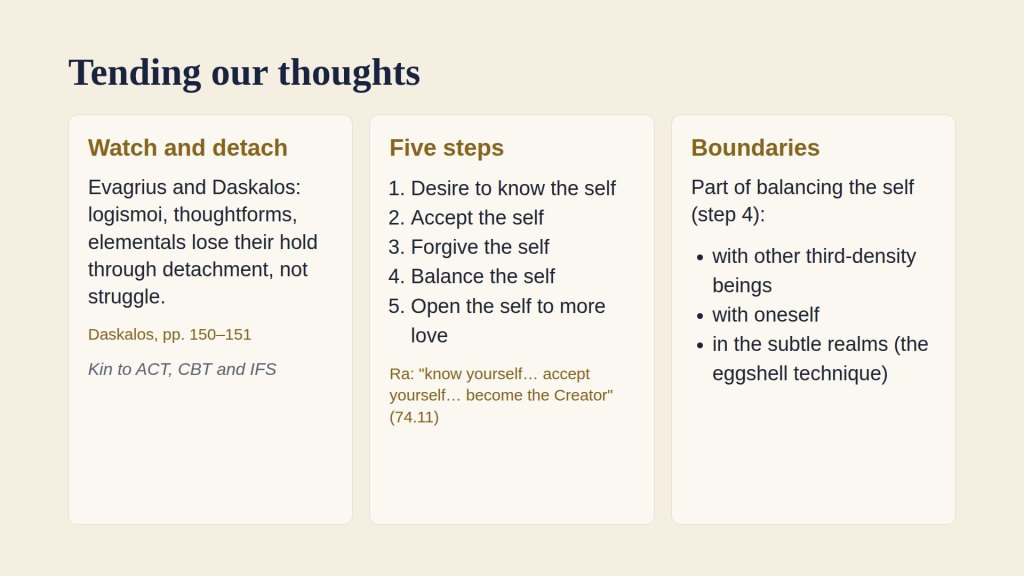
We want to watch and detach. Evagrius Ponticus, like Daskalos, invites us to de-energize these logismoi, thoughtforms or elementals through detachment, which isn’t unlike good psychospiritual techniques such as ACT, CBT and IFS.
The five steps I teach come from Ra, and I find them very efficacious. Ra pictures the incarnation as a poker game in which we can’t remember our own hand, the other players’ hands, or even the rules: “This is the game: to know, to accept, to forgive, to balance, and to open the self in love. This cannot be done without the forgetting” (50.7). When we feel we’re being attacked in some way, instead of focusing on the attack, could we use it as catalyst? One, I desire to know myself more. Two, I accept that I’m going through a hard time right now. Three, I forgive myself for not knowing everything, and maybe even for actions I recognize as belonging to the ethos of separation. Four, I balance the self, setting boundaries within myself or with other people if I need to. And five, I open myself up to more love. This is metanoia, the enlarging of the mind.
Setting boundaries can also include the subtle realms, through something like the eggshell technique, which one of our members led us through later. You create an orb of love and light around you and invite only the highest and greatest good to pass through, like a semi-permeable membrane, so any other energy that comes to you is reflected back. It’s a particular kind of high white magic.
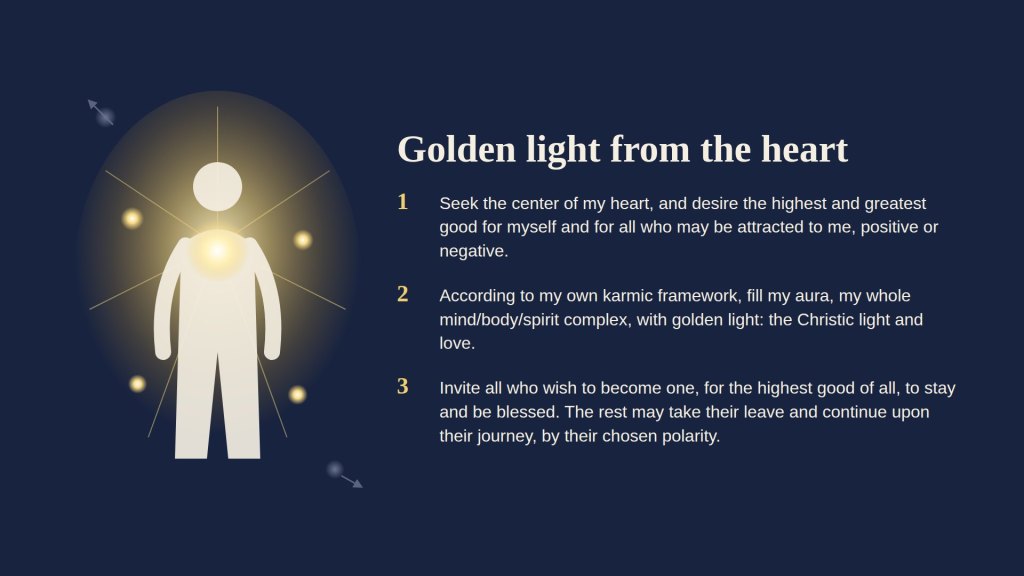
As a close, I’d like to offer my own way of dealing with it when I feel I’m having entity attachments, because we all do. (You should all see yourselves; you’re just full of leeches. That’s a joke.) I’m not saying there’s no time or place for casting out. But in my own way (and maybe I’m naive), I don’t know how to see that as belonging to wholeness itself.
So here is what I do. I picture golden light in my heart. I seek the center of my heart, and my desire is for the highest and greatest good for myself and for all who may be attracted to me, positive or negative, entities or people. Then, according to my own karmic framework, I fill my aura, my whole mind/body/spirit complex, with this golden light, the Christic light of love, the highest and greatest good. (You can think of the word Christ as a metaphysical code word for wholeness incarnate.)
Then I invite all those entities attached to my aura to become one with this light, for the highest and greatest good of all, and to stay and be blessed by this Christic golden light. Those entities that are of this Christic consciousness will stay; I’ll be blessed by them, and I’ll bless them. Those that are less than wholeness, or find it impossible to stay within such bright light, will take their leave, and I wish them well as they continue upon their journey according to their chosen polarity. These are ways to deal with intrusive thoughts and, I’d say, with entities we can become aware of.
From the discussion
Someone asked about the eggshell technique, so one of our members led us through it, as learned from a first teacher who called it a shamanic technique and used it with people who are especially permeable to outside influences. In brief: picture a beam of pure white light coming down into the top of your head and radiating from the center of your being out into the space around you, pushing out all that is unwanted, until it reaches as far above, beside, behind and below you as you can reach. Then thicken its outer surface into an eggshell, thin when things are calm and thicker when you expect to be around difficult people. Like a cell’s semi-permeable membrane, it lets in what nourishes and keeps out what poisons. Cover the outside with tiny mirrors that reflect negative thoughts back to their makers, and a nonstick coating so negative emotions slide off, while love, affection and appreciation come right through. Inside, open a one-way trap door at your feet and shovel out the mental trash (outdated ideas, fears, resentments), keeping and polishing what you value. Repair the shell each morning.
Another member shared her own variation. She wants to stay accountable when someone is disappointed or hurt by her, and to use that as catalyst to grow. So as she cleaned house inside the egg, she built an altar, let difficulties through the membrane as awareness and acceptance of what is, and lit a candle whose flame transmuted them into light and growth. I loved that.
Someone asked whether I’d said that self-knowledge can get in the way. If I said that, I misspoke. I definitely think self-knowledge makes us much more immune to the exacerbations of negative entities. The same person shared that this past week he’s found it helpful to imagine negative angelics landing on his skin, and to know he can shake them off; he doesn’t have to let them in.
Another member has been practicing the banishing ritual each morning, and finds it more efficacious as his mind’s eye sees the light more clearly. He asked whether these techniques improve with time. In my own experience, I don’t distinguish much between what’s external and what’s internal, and I don’t call feelings good or bad. They’re catalyst. I do honor the difference between comfortable and uncomfortable, but I won’t call anger, shame or anxiety bad; they belong, as catalyst for me. What I know is that whenever I make myself whole with this glowing love, and become a vessel of the Christic light instead of repelling outward, offering entities the chance to stay or go, I feel cleaner and lighter. Whether it’s my own mental delusion or it’s real doesn’t matter to me. I’m more able to respond to the present moment in a way that honors my emotions, even the uncomfortable ones, without the added weight of negative attachments. Use the one I offered, or make up your own, and maybe ask your higher self to guide you. But I think it’s most efficacious when we take Ra’s words to heart: love is its own protection. Hold up that pitch of light, swallow it up, and shine.

