Doug Scott, LCSW
Audio:
On Tuesday evening, September 29, I gave a talk to our Building 4th community on the angelic realm. What follows is a cleaned-up version of what I said, set between the slides I was showing. My primary source is the Ra Contact; Daskalos’s The Esoteric Teachings is my major secondary source, and Q’uo appears only as a supplement.
Part of this is my own working theory, and I’m open to being wrong about it. I’ve tried to mark which parts come from Ra, which from Daskalos, and which are my own synthesis, so you can weigh each for yourself. We ran out of time partway through, so this post covers the first half of the talk. The rest follows next week.
This talk grew partly out of a conversation some friends were having about what the angelics might be, and especially about the demonic. As far as I’m concerned, there is a type of demon that is angelic, so I wanted to gather my thoughts together.
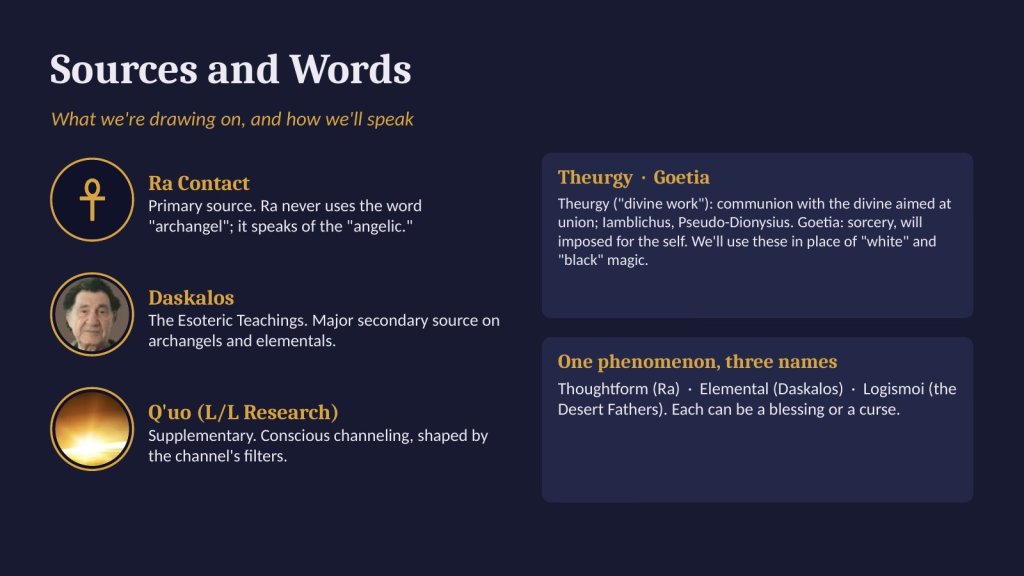
My primary source is the Ra Contact. Ra never uses the word archangel. In fact, Ra speaks of the angelic and doesn’t use the word angel at all. There isn’t a lot there, but there’s enough to follow the breadcrumbs.
My second source, and one I lean on heavily, is Daskalos. I discovered him around the same time I discovered the Law of One. Daskalos was a Cypriot mystic who grew up in the Greek Orthodox tradition and claimed to remember all of his past lives. He was a holy man, reportedly able to be present in more than one place at a time, and his esoteric teachings have been very fruitful for me. I might word things differently than he did (he was informed by Greek philosophy, certainly not process philosophy), but his teachings on the angelics in particular have helped me. My third source, more of a supplement, is the conscious channeling of Q’uo through L/L Research.
Two terms are worth knowing, though you don’t need to memorize them. The first is theurgy, which means “divine work.” It’s traditionally called white magic: communion with the divine, aimed at union. The second is goetia, which is sorcery, that is, the will imposed for the service to self. These matter because the English word magic gets watered down, and the tradition actually has more precise theological terms.
The other thing I want to say up front is that we’re talking about one phenomenon with three names. Ra often uses the word thought-form. Daskalos speaks of elementals, so thought-form and elemental are synonyms. And logismoi is a term from the Greek Orthodox tradition that some contemporary Christians use as well (Cynthia Bourgeault, for example). Logismoi are usually understood as passions that get in the way of unity, but I think the broader meaning is simply elemental or thought-form. If you recall, Ra says that in green-ray time/space, thoughts are beings (50.9). So a thought-form is a being, an elemental is a being, a logismos is a being — one that we create, or that an archangel creates. We’ll get into that.
[A note on the audio: In the recording of this talk, linked from Podbean, I show a single slide at this point, and it cites 7.9. On a closer read, 7.9 is about the twenty-four who back the Council of Nine, and Ra doesn’t call them angelic there. So in this post I’ve replaced that slide with two corrected ones, 3a and 3b, and the paragraphs beneath them reflect the correction. What you hear in the audio here won’t quite match what you read.]
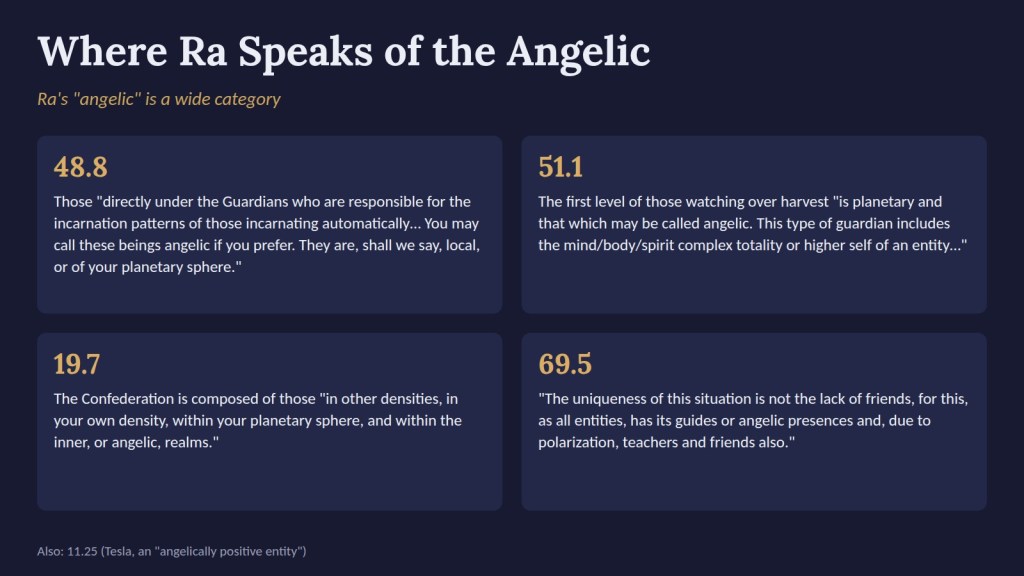
For Ra, angelic is a wide category. In 48.8, Ra says that those directly under the Guardians who are responsible for the incarnation patterns of entities who incarnate automatically may be called angelic, if we prefer. In 51.1, Ra says the first level of those watching over harvest is planetary, together with what may be called angelic — and that includes the higher self. In 19.7, Ra says the Confederation includes those in the inner, or angelic, realms. And in 69.5, Ra says every entity has its guides or angelic presences. Ra even describes Nikola Tesla as an angelically positive entity (11.25).
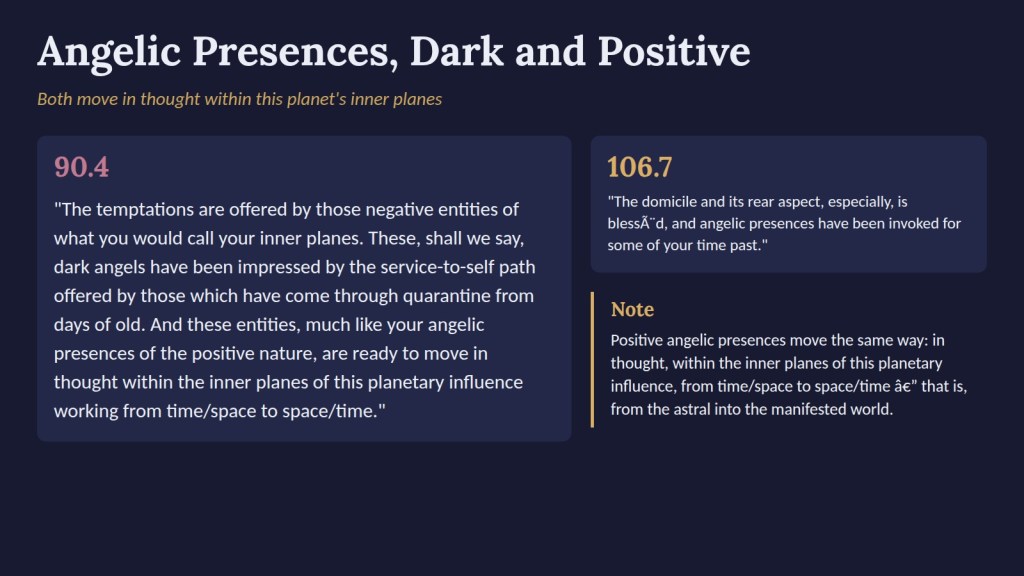
In 90.4, Ra speaks of what we might call dark angels, who have been impressed by the service-to-self path — and then says that these, much like our angelic presences of the positive nature, move in thought within the inner planes of this planetary influence, working from time/space to space/time. In 106.7, looking over the house the group was considering, Ra says angelic presences had been invoked there. Notice Ra’s phrase: angelic presences. We’ll come back to that.
A tangential point first: I’ve often seen the Law of One as a very wide net, and the Daskalos material fits inside it. It often spells out, in its own way, what the Law of One illuminates.
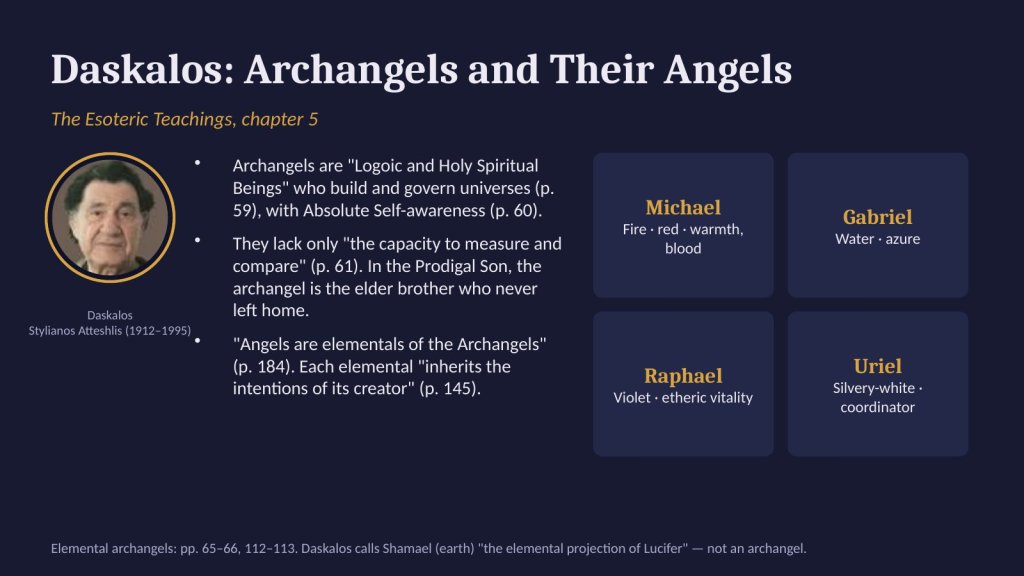
Chapter five of The Esoteric Teachings is all about angels. Daskalos describes them as logoic and holy spiritual beings who build and govern the universes, with absolute self-awareness — and the self-awareness he means is the Creator’s own. What they lack is the capacity to measure and compare. In the parable of the prodigal son, the archangel is the elder brother who never left home. One way I understand that: they have never gone through the veil, and never would. It’s a different line of being, a different domain, if you will.
Daskalos also teaches that angels are the elementals of the archangels, and that each elemental inherits the intentions of its creator. That will become clearer later on. He associates Michael with fire, red, warmth, and blood (you might think of the red ray); Gabriel with water and the color azure; Raphael with violet and etheric vitality; and Uriel with silvery white, as a kind of coordinator of the other three. That’s his Christian esotericism. I’m not saying other traditions with different colors and functions for the archangels are wrong. I think we’re all trying to touch the elephant.
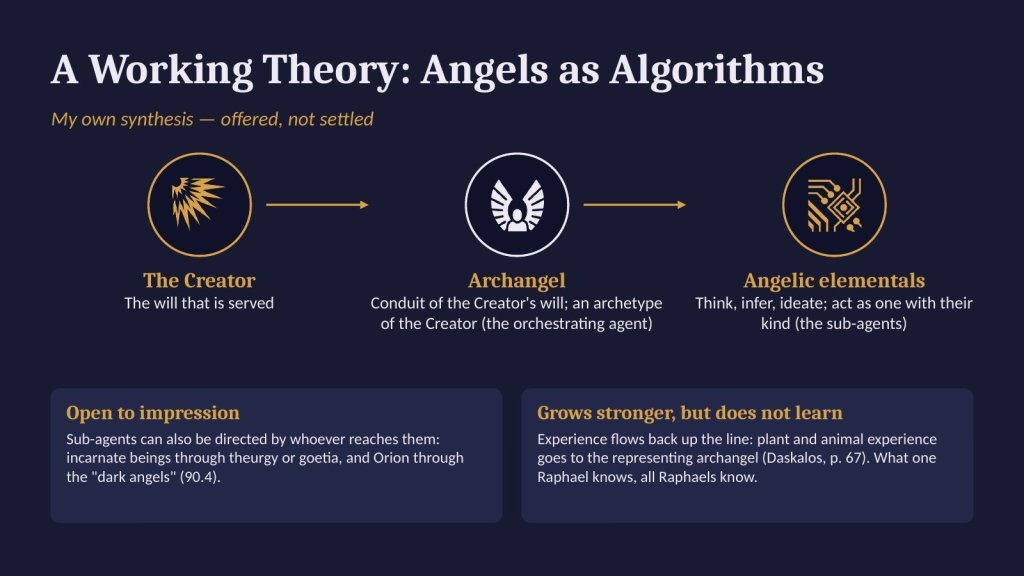
I’ve thought about this topic for years. I’ve written about it before, but this was my first chance to present it. My working theory — my own synthesis, offered as that — is that angels can be seen as something like algorithms.
As we know from Ra, there is only the Creator; we are the Creator having the experience of you and me. What is served is the Creator’s will. An archangel is a conduit of that will — an archetype of the Creator, an orchestrating angel. It carries a particular ingredient of the Creator, this and not that: power, say, or water, or fire, whatever those represent metaphysically (maybe water is flow). The archangel is the particular conduit through which the Creator moves its will.
I really do see these as something like AI. The archangels can create angelic elementals as needed, and these elementals can think, infer, and iterate. They act as one within their kind, like sub-agents. Here’s the comparison. You can program an AI agent and give it a large task, and that agent can then create sub-agents to do particular pieces of the work. My programming of the orchestrating agent is like the Creator throwing its will into it. The orchestrating agent then works as a conduit of my intention, and it creates sub-agents — elementals, if you will — to do specific tasks.
Ra talks about dark angels that were impressed by Orion. Daskalos agrees, though in his own terms and without the word Orion. These sub-agents, the angelics, are open to impression. They’re directed by whoever can reach them. Whether it’s white magic or black magic, it works something like programming an AI agent to do a task. You might even think of the angelics as personifications of an algorithm or an archetype — more an interface than a person with a personality. We can’t create them, but we can impress them, imprint them. That’s what the dark angels are: within the infinite creation, there is light that has been impressed with the power of separation. (Ra does mention dark light.)
These angelic elementals can grow stronger, but they don’t learn the way an incarnate being learns. Experience flows back up the line. The experience of plants and animals goes to the archangel that represents them, yet the archangel itself doesn’t grow. Say there are angels that protect plants. Some people can see them; some say fairies are plant angels, and people report sensing them while taking certain plant medicines. There may also be domains of angels representing the archetype of a dog or a cat, and people have reported seeing and interacting with these too. My guess is that these beings funnel the experience of the embodied plant or animal back up the line as information — information about what is happening, rather than incarnational wisdom. It’s a bit like an AI. An AI doesn’t incarnate and feel the way you and I do, but it can certainly receive information and pass it back to the orchestrating agent.
Daskalos also says that what one Raphael knows, all Raphaels know. That reminds me of how Ra describes the galactic and solar logoi — like cells in a body, where communication is instant and universal. When one cell experiences something, it’s immediately known throughout. It’s a little like quantum entanglement: you can have a million Raphaels, each one individual, and all of them part of the same archetype.
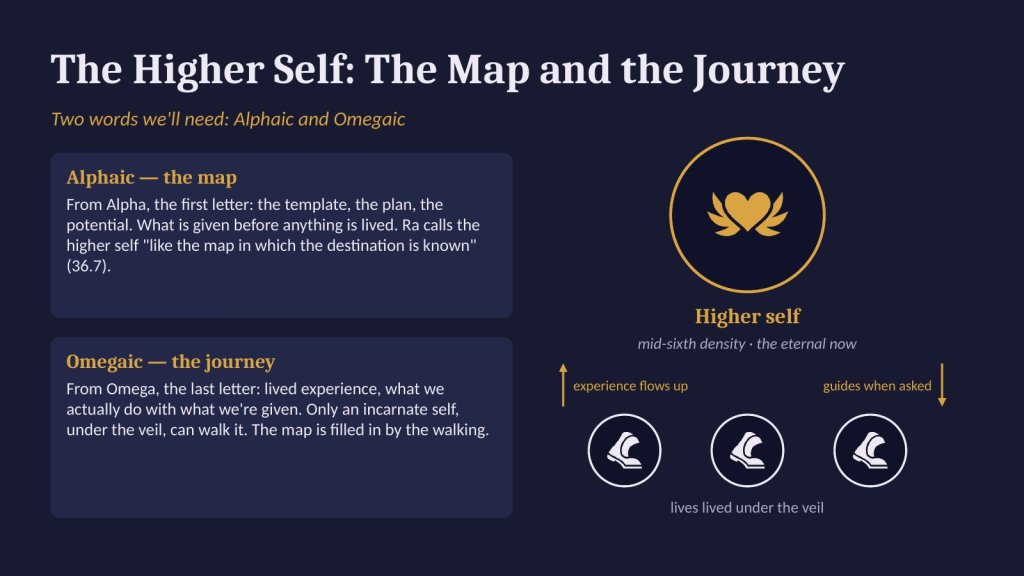
Ra speaks of the higher self as one of the angelics, present between lives and also at harvest. Here I’d like to differentiate a bit more, to show how the angelic realm differs from the incarnational realm. I’ve shared this in other presentations, but it bears going over again. The two words we need are Alphaic and Omegaic.
Take the higher self — yours or mine. It’s a mid-sixth-density being. It exists in the eternal now, and its identity is unity. It knows nothing except complete unity; as I conceive it, it doesn’t know the veil. I’d call the higher self an Alphaic persona. It’s the map: the template, the plan, the potential, what is given before anything is lived. Ra describes the higher self as being like the map in which the destination is known (36.7).
The Omegaic is you and me in space/time — third density, on this side of the veil. It’s the journey, the lived experience, what we actually do with what we’re given. Under the veil, the incarnate self can walk the journey, and the map is filled in by the walking. So the higher self is the map and knows itself as the map, as potential. It’s the Omegaic self — you and I — that experiences, and that experience flows back up to the higher self. It becomes the higher self’s experience, though the higher self has no experience of its own until all of its Omegaic selves (our past lives, this one, and the lives from here to mid-sixth density) catch up. There, the Omega arrives and unifies with the Alpha. The higher self is actualized and activated, because our evolving self has reached mid-sixth density. That’s the unification of Alpha and Omega at the level of this octave.
Why bring this up? Because the Alphaic domain, again, only knows itself as unity. The solar logos is another Alphaic persona, and so is the galactic logos. Their maps are completed by the Omegaic journey, which they need for incarnational wisdom. On its own, the Alphaic has an identity of unity and a sense of persona, but it isn’t very wise in the incarnational sense.
So here is what an angelic is, in my opinion: an Alphaic line that has no Omegaic line. To put it plainly, when Ra says the higher self is angelic, it’s a type of angelic, because like the other angels we’re discussing, it lacks incarnational wisdom. It knows itself as unity, and it’s instantly connected with the other angelics of its order of magnitude. The difference is that archangels, and the other angels we’ll talk about, have no Omegaic counterpart filling in experience. So your higher self isn’t angelic in the sense we’ve been describing. Ra’s word angelic is a wide category, and it holds some subcategories. That will become clearer in a minute.
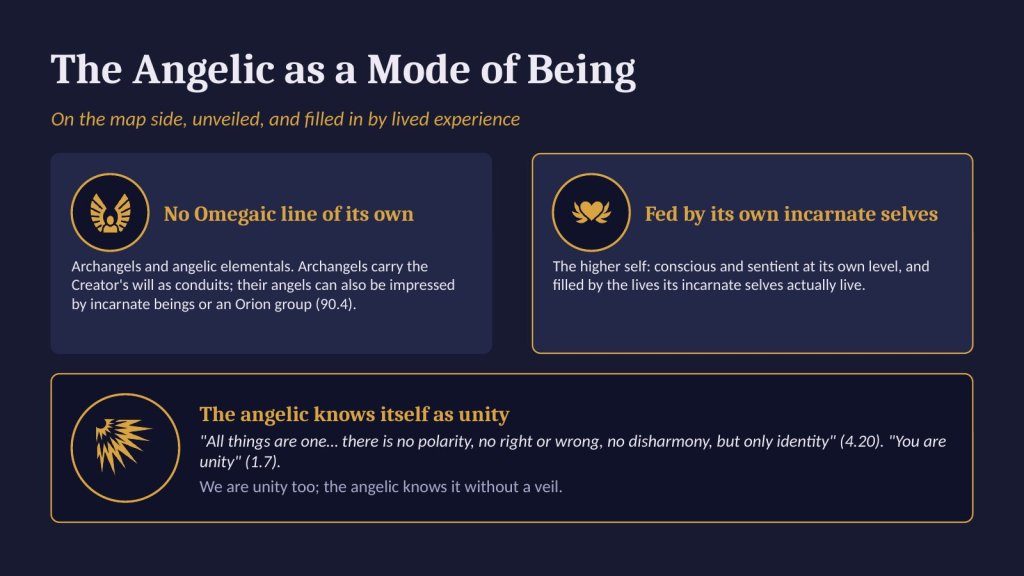
The angelic is a mode of being. It’s on the map side, and unveiled, with no Omegaic line of its own. Archangels carry the Creator’s will as conduits. Their angels can also be impressed by incarnate beings — an Orion group, say, or you and me. The higher self, on the other hand, is fed by its own incarnate selves. It’s conscious and sentient at its own level, and it’s filled in by the lives its incarnate selves actually live.
Let me bring it to a human level. It isn’t exactly the same, but it’s close. Say someone thinks they’d like to be a parent someday. That idea remains a potential — Alphaic, in a sense — until they actually have a child. In the relationship with that child, the parent actualizes being a parent. Everything they go through with their child becomes incarnate experience that never would have happened otherwise. Without it, they’d have remained a potential parent.
And the angelic knows itself as unity. All things are one; there is no polarity, no right or wrong, no disharmony, only identity. You are unity. We are unity too, and the angelic knows it without a veil.
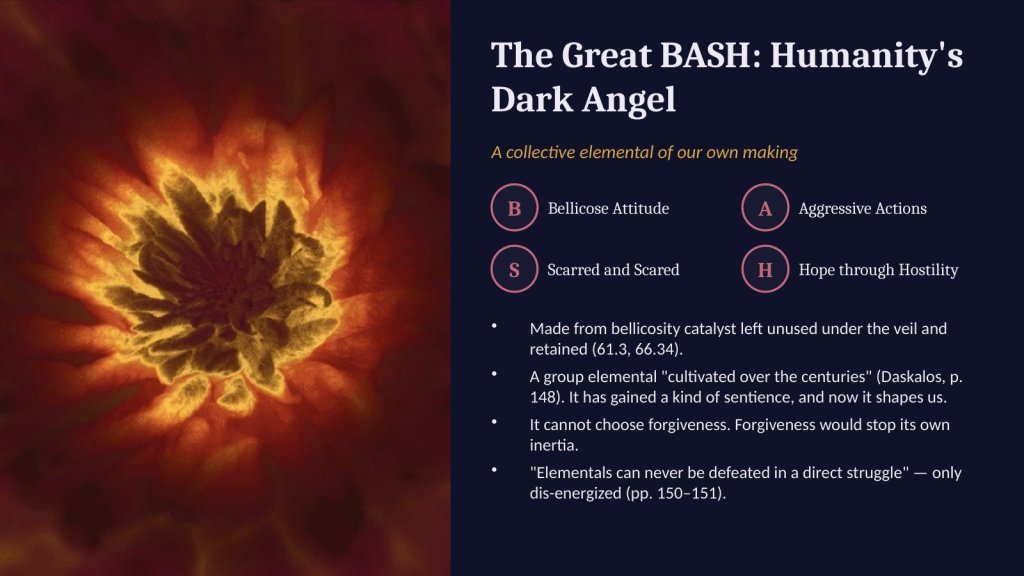
Now we move a little into our own world. I’ve talked about this before: the Great BASH, humanity’s dark angel, a collective elemental of our own making. B is Bellicose attitude. A is Aggressive actions. S is Scarred and scared. H is the myth of Hope through hostility: if we’re just more hostile, let’s hope the hostile act gains us what we want. In other words, the myth of redemptive violence.
It’s made from the catalyst of bellicosity, left unused under the veil and retained (Ra, 66.34 and 31.15). It’s a group elemental cultivated over centuries, which the Daskalos material supports. It has gained a kind of sentience, and it knows how to shape us. Think of social media: we created it, and in some ways it has become a mirror that creates us. As far as I can see, the Great BASH cannot choose forgiveness. It has no free will in that sense, since forgiveness would stop its own inertia — and as we know from Ra, the one thing that stops inertia is forgiveness. Daskalos says elementals can never be defeated in a direct struggle; they can only be de-energized. From Ra, I’d add: through acceptance and forgiveness.
So what I’m saying is that we have created a dark angel. It’s sentient and ever-present, and because we’re largely unaware of it, individually and collectively, it operates through us. A lot of what’s going on in the world right now is, I’d argue, the Great BASH having its way.
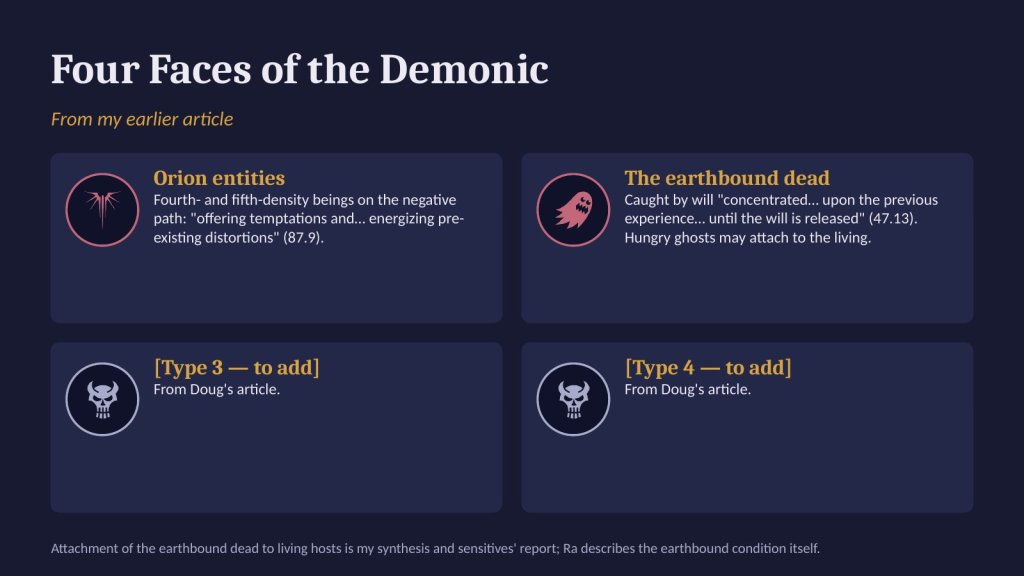
Now for the demonic. Some of these are types of angels. (Types three and four aren’t on the slide — I forgot to add them before the talk — so I’ll describe them here.)
The first type is the Orion entities: fourth- and fifth-density beings on the negative path. According to Ra, they offer temptations and energize pre-existing distortions. These are incarnate beings. The fifth-density being that plagued the L/L Research team — Carla, Jim, and Don — during the Ra contact was able, in a sense, to be in two places at once. While its body remained in a harsh cave on whatever planet it came from, it projected its time/space body through the quarantine and interfaced directly with the energetics of the three of them. It attacked Carla most, because she was physically the most vulnerable, though psychologically and spiritually she was the strongest. If you read the material, you’ll see it had a hard time of it. It wasn’t able to depolarize the group very well, except maybe toward the very end. That’s a topic for another day.
The second type is the earthbound dead, what the Buddhist tradition calls hungry ghosts. According to Ra, these are caught by will, concentrated upon the previous experience, until the will is released. There’s a lot of literature across traditions about people who die with such a strong will not to part from something — perhaps an addiction. Sensitives often speak of sensing hungry ghosts in bars and other places where there’s a lot of addiction. These beings can’t physically drink, to use that example, but they can attach themselves to the aura of those who do and offer temptations.
The third type is the elementals we’ve talked about — the dark angels, programmed specifically for a certain kind of negative task. Ra does speak of these beings.
The fourth type is related to the Great BASH; in fact, the Great BASH is this type writ large. In my own experience, past traumas and negative thoughts create things, especially when we’re not conscious of them — and we often do create at a subconscious level. Ra says that in green ray, thoughts are things, beings. I see them as little leeches. A negative thought about somebody, or about yourself, is like a small etheric leech. It comes out of you or me and may attach to the aura of the person we’re thinking about. But because of something like quantum entanglement, it’s also still your creation. Whatever negativity I throw onto someone else’s aura stays stuck and enmeshed there, pumping negativity into them, and through that energetic cord it pumps the same negativity back into me.
All four types of the demonic are opportunistic, like a virus or bacteria.
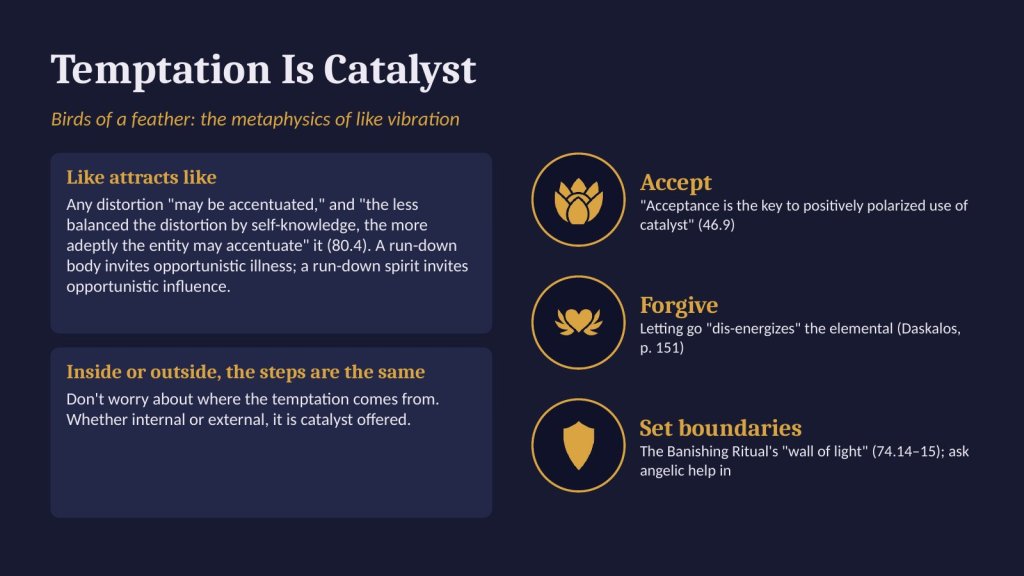
Temptation itself is catalyst. Whichever of the four is at work, it will offer a kind of temptation — maybe to despair, or to anger. I’m not saying anger is bad. It isn’t negative or positive; it just is. The temptation is to enhance it for the purpose of othering people, making them less than, even subtly, against us.
You’ve heard that birds of a feather flock together. That’s a metaphysical truth too: like vibration attracts like. Ra says any distortion may be accentuated, and the less a distortion is balanced by self-knowledge, the more adeptly the negative entity can accentuate it. A run-down body invites opportunistic illness; a run-down psycho-spirituality invites opportunistic influence — even under the guise of doing good. That’s why I’ve written so much over the years about the truther and disclosure movements. People who think they’re doing good by exposing these esoteric things have, almost all of them, buckled under the conspiratorial attitude. When you think there’s a demon behind every rock, there will be a demon behind every rock, because that becomes your focus. All of that is the arch-demon, the Great BASH, and it can lead us into despair.
So here’s the thing. Whether the separation is internal (trauma can split the subconscious and unconscious even further) or external, such as an Orion entity or another thought-form attached to your aura, the steps are the same. Don’t worry about where the temptation comes from. Either way, it’s catalyst offered.
As far as I can tell — borrowing from good Law of One wisdom as well as the perennial truth, in my case informed by Christian esotericism — acceptance is the key to the positively polarized use of catalyst. Acceptance doesn’t mean rolling over and taking it. It means it is what it is. It’s happening now, I’m experiencing it, and I’m not going to deny it. I accept it as fully as I can, including my own participation in it.
Then, forgive. To forgive is to let go of the debt, to give up retribution and seek restoration. People who think they’re into restoration are often really into retribution, myself included, so the difference matters. To forgive is to thoroughly let go of the debt: forgive us our debts, as we forgive our debtors. This de-energizes the elementals. Nothing is lost, though. Once a curse or a demonic exists — a thought, a hungry ghost, whatever it is — it will always exist. The question is whether you energize it.
Think of the habits you wish you could let go: smoking, drinking, whatever it may be. Any habit we’re not free not to do is, in some way, an elemental we are creating, and it’s gathering friends from other people in the collective. If you want to let it go, learn to forgive it — the demon. Forgive yourself for having the addiction. Forgive yourself for it being so hard. Pray for guidance and strength; the positive waits to be asked, and then it’s there one hundred percent.
Lastly, set boundaries — the banishing ritual, for example, or the wall of light. You can certainly ask the angelics for help. Ra says every entity has a myriad of aid always with it; all that’s needed is to ask, and help will be given. And don’t ever forget what Ra said many times: love is the greatest protection.
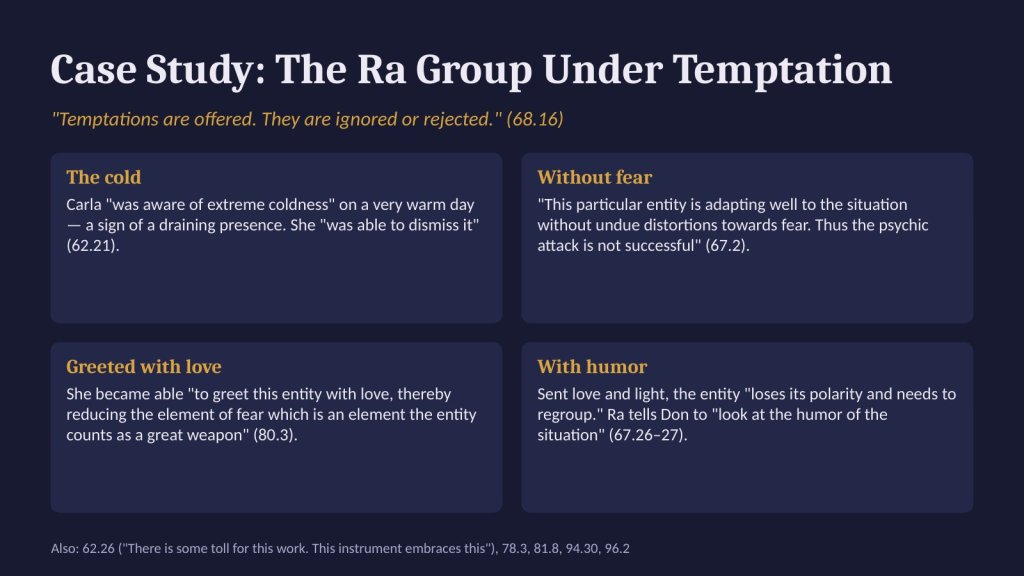
A quick case study: the Ra group under temptation. Temptations were offered, and they were ignored or rejected. That kept happening. The fifth-density being and the fourth-density Orion beings kept offering temptations, and the group kept ignoring or rejecting them.
Cold. Carla noticed extreme coldness on a very warm day, a sign of a draining presence, and she was able to dismiss it (62.21).
Without fear. Ra says the instrument was adapting well to the situation without undue distortion toward fear, so the psychic attack was not successful (67.2).
Love. Carla became able to greet this entity with love, reducing the element of fear, which the entity counts as a great weapon (80.3).
Humor. Ra says Carla sent love and light to the entity, so it lost polarity and needed to regroup. Ra had a very dry sense of humor — I’m talking Arizona at noon, 120 degrees, zero humidity. Ra would point to the humor of the situation. You have the one Creator, unity, and inside it two polarities. One is trying to manipulate the other, and the other won’t be manipulated, and the one that won’t be manipulated offers the power and love of unity to the one trying to manipulate it.
Wholeness is blinding in its light and love. Those who choose the path of separation choose darkness. It’s a conscious choice not to let the eyes adjust to the fullness of light — like going through life knowing there is light, yet covering your eyes and letting in only a sliver. So when you offer the pitch of light and wholeness to an entity that wants to defeat you, it must perforce leave, because it can’t handle the light. And Ra thinks that is just freaking hilarious.
We ran out of time here, so I stopped for discussion. The rest of the talk — a friend’s questions, the demonic as a system, the orb in the hand, and the pitch of light — will be continued next week.


One thought on “The Angelic Realm: Angels, Elementals, and the Pitch of Light”