A discussion between Doug Scott and Carys
Carys joins Doug from England to discuss how the US election is an opportunity for Americans to look in the mirror and really ask ourselves, “Who are you?” “What do you want?” “What is your sacred yes?”
Other topics include:
- efficiently processing bellicosity in our own lives is a type of service to others
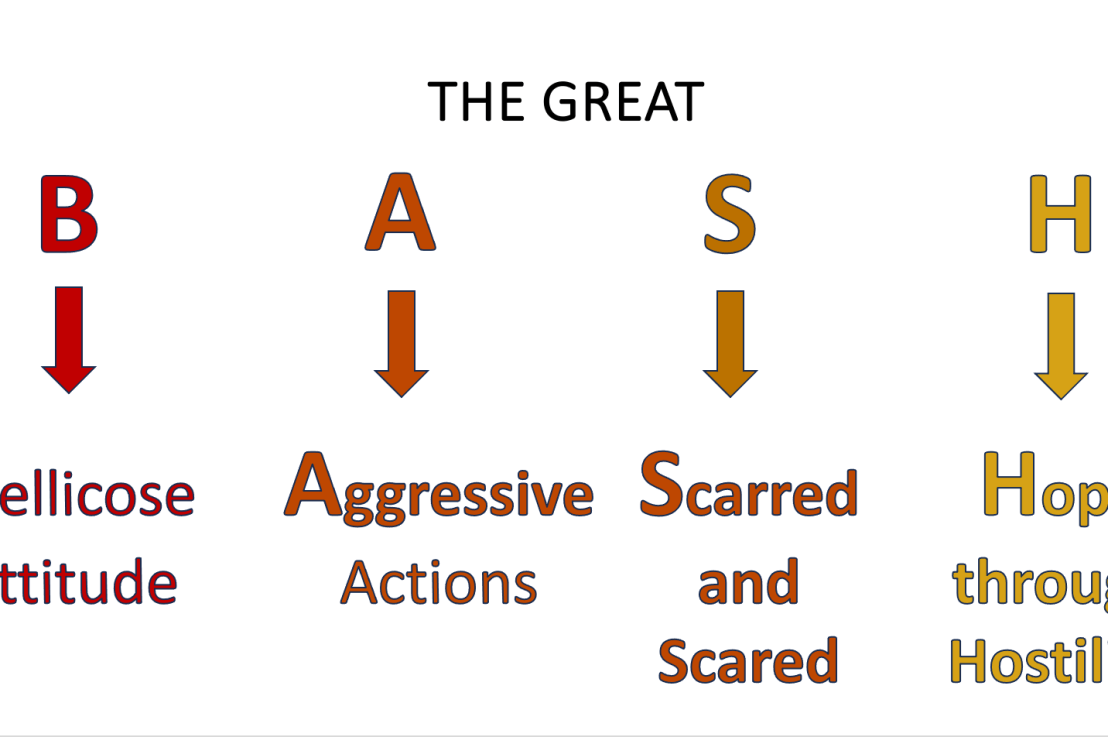
- The Collective Thoughtform of Bellicosity, or what Doug calls, “The Great BASH,” is a type of psychospirital sentient being that was created, and has been nourished, by Earth’s 3rd Density spacetime planetary entity, whose consciousness membrane is the noosphere.
Audio:

Trump’s “Trump” as Archetypal Personification of the Collective Bellicosity Thoughtform – The Building 4th Podcast
Transcript and Images:
Now, what kind of tea did you choose?
This is important.
Builders tea.
We call it, I don’t know, I know we’ve got different kinds of terms for it in England.
So you can call it just the brew.
Do you know that?
Like a brew.
I’ve heard it, yeah.
And a builder’s tea is just your kind of bog standard.
You know, like PG tips, you know, Tetley, you know, that kind of thing.
And then you can kind of got your posh teas, you know, like El Grey and, you know, sort of very English and stuff.
So yeah, I’ve got a classic builder’s tea.
But your builder’s tea, won’t this make you not sleepy with the caffeine, or are you just so British that it doesn’t bother you?
No, I’m fine with it actually.
It doesn’t affect me.
I won’t, this will be kind of the last tea that I have.
But it is, yeah, it’s one of those things.
I tend to drink tea around this time.
Yeah, it’s very sort of very British.
You know, everything is based around tea here.
I love it.
I think it’s, in fact, side note, I was watching a show on YouTube last year on special forces, like the different special forces, military forces in different countries.
So the United States having the Navy SEALs or the Delta Force.
And then there’s the British version, which is super elite soldiers.
And they were showing these elite soldiers like in battle while they were drinking tea.
I’m sure they would say it’s like a weapon of war or, you know, they need to feel fortified before going into the battle.
And, you know, that would be a cup of tea.
Yeah, I mean, it’s just…
It’s amazing.
You know, not well, I mean, you know, it’s kind of, you know, something joyous is going on in your life, have a cup of tea.
You know, something tragic is going on in your life.
Do you want a cup of tea?
You know, it’s just like a way of life here.
I love it.
So here’s, I’ve thrown up some slides and I figured it would be kind of a neat thing to go over with some slides and some ideas as a way to dialogue, if that’s okay.
Yeah, absolutely.
And they’re not super well thought out.
I tend to fill up a lot of images because for me, images are archetypal, like we can unpack them as we talk.
And the first thing I’ll say though is how the general feeling is here, especially in Texas.
So in Texas, it’s in the south of the United States, and typically Texas is fairly conservative.
Some of the cities are more liberal, but the suburbs and the rural areas are all very conservative.
So to point, I just drove to Denver, actually Albuquerque first, where I met and hung out with my spiritual pops, Richard Rohr, which is really cool.
But on the way there, it was Trump land, man.
I mean, everything was Trump, Trump, and Trump and Jesus.


God, I saw, these are some, these are some stickers on the back of big trucks that I saw, and it was God, guns, and grit.
I saw several of those.
I saw something along the lines of Trump’s, Jesus’ anointed, and it was alluding to Trump.
You had a lot of packaging.
How does that make you feel as somebody who is a lover of Jesus as well?
I mean, how do you respond to that?
Like, what’s your reaction to that?
I know obviously you then can unpack it yourself and think about it on a wide scale and things, but what’s your reaction to that?
It hurts me.
I mean, for me personally, honestly, it makes me, I do feel like tears that kind of come to me when I, you know, when I hear sort of people talking about Trump in a kind of Messianic, using Messianic language, and, you know, it’s the Saviour, the Anointed One, or all of that, all that kind of language.
I have like a really sort of emotional, or I don’t know, the reaction to that, or whatever it is, but it sort of really hurts.
I think it hurts my heart.
I think my heart hurts.
And not only does it hurt my heart, but it hits very close to home, because these are my people, in terms of my family members, my neighbors, people that go to school with my kids, their kids, it’s pervasive.
Like if you were to walk up and down my street right now, mostly there’s not signs on our particular neighborhood, but certainly over a little bit, just a little bit, it’s like everybody’s in a war with how many signs can you put, you know, Trump versus Kamala and back and forth.
And what it does when I see the word Jesus and then connect with Trump and the Messianic stuff, it’s not different than what I’ve had to deal with for a long time, particularly in my family.
So whenever I went to Nicaragua for two years, it changed my life.
I understand, I understood Christianity from a very different perspective.
That was what I hope is closer to what maybe Jesus was doing, and that is a preferential option of the poor.
Looking, trying to look at things from the bottom.
And coming back here, this was back in 2000, coming back here, I realized that as a missionary, I thought I went to Nicaragua to be a missionary.
But the truth is, I’m still a missionary to my own people.
You don’t become a real missionary until you come back to where you’re from.
Hold the tension there.
So it’s nothing new that I haven’t dealt with, but it brings me sadness in the sense of how far we have missed the point.
Yeah, yeah.
So weeping is a good response, and we’re gonna get to that.
So this is called Metaphysics of the Election, but I also think I’m hoping that it’s not just about the election, but it’s gonna be a little bit of a look at where we are as a collective, in terms of our humanity, particularly where we are, where my country is.
But I honestly think there’s an excitement here too.
And I actually spoke to Richard about this.
I think people who feel called to be actually Christian or some kind of force for wholeness.
And I’d like to stop using force for good, because good and evil, these kinds of labels are just as, oh man, loaded, culturally loaded as say, sin or God or things.
Maybe it might be interesting to change some of our vocabulary to things like wholeness versus separation, those kinds of things.
Yeah, I would love to offer this.

This is from John Dominic Croson, and it’s from his book, How to Read the Bible and Still Be a Christian, Struggling with the Divine Violence from Genesis Through Revelation.
I’m gonna read the whole thing here.
It’s not too long.
And then this will launch us into the discussion that is already unfolding between us, seeing the metaphysics behind it.
Because I think this is, we’re tracking together, and this is developing nicely.
So here it goes.
First off, I’ve titled this as Sten Equals, quote, bellicosity, or warfare, or what John Dominic Croson calls willed violence, willed violence.
So here we go.
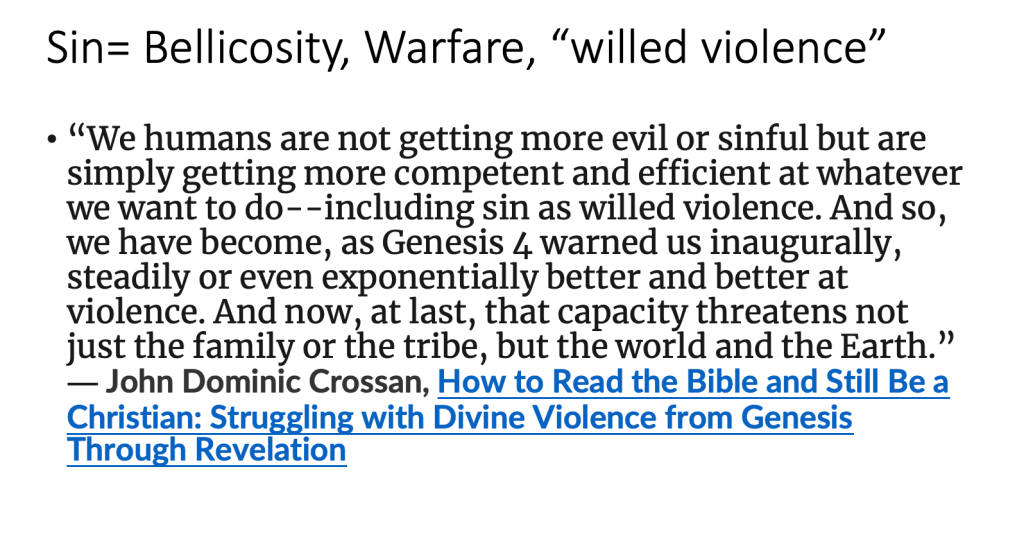
We humans are not getting more evil or sinful, but are simply getting more confident and efficient at whatever we want to do, including sin as willed violence.
So there he is defining sin, and he’s done it in different places too, defining sin as willed violence.
I’m going to come back to that.
And so we have become, as Genesis 4 warned us, steadily or even exponentially better and better at violence.
And now at last, that capacity threatens not just the family or the tribe, but the whole world and the earth.
Okay.
So this is a man who’s, I think he’s 300 years old.
I’m just kidding.
He is getting close to like mid-90s, and he has more energy than me.
I want to be him when I grow up.
He has studied scripture, a scripture scholar for I think 60, 70 years.
And this is this type of guy.
He’s considered one of the foremost scripture scholars in the world.
And from his perspective, he’s boiled down or distilled down.
What is the primary concept, the biblical concept in both the Hebrew scriptures and the Christian scriptures for what Paul later calls the sin of the world, not sins, but sin from which all the sins emanate.
And Dominic Croson says willed violence or warfare.
This attitude or worldview of war.
The law of one, the Ra material, is very similar in that, stating that from this group’s perspective, so it’s an esoteric material that speaks of a kind of collective, unified society that is in the angelic realms, say.
And when they view the world, they’re viewing the world and seeing where the great blockage is unprocessed bellicosity.
Unprocessed bellicosity.
That bellicosity is a war-like or warfare-like attitude.
So I wanted to launch that.
But first, let’s look at what wholeness is doing.
So really, this is how we want to understand, I think, the metaphysical, spiritual implications of this season and the humanity.
Wholeness is always trying to break in.
Wholeness itself is the very nature of what we might call the Creator, or God, or the ground of being.
It’s this holistic, unified field of love that is attempting to experience itself through an infinite variety of expressions of itself, and not only expressions of itself, but the relationships that form between the different expressions.
You know, so for example, in this conversation, I as God trying to experience God’s self as Doug, is speaking and creating something new with you, who is God trying to experience God’s self as you.
And then this dialogue, this dia logos, logos meaning word, this dialogue that’s forming between us, this relationship here, friendship and whatnot.
This is also a way for God to experience God’s self as something that is created as you and I are co-creators in this, as we create something new.
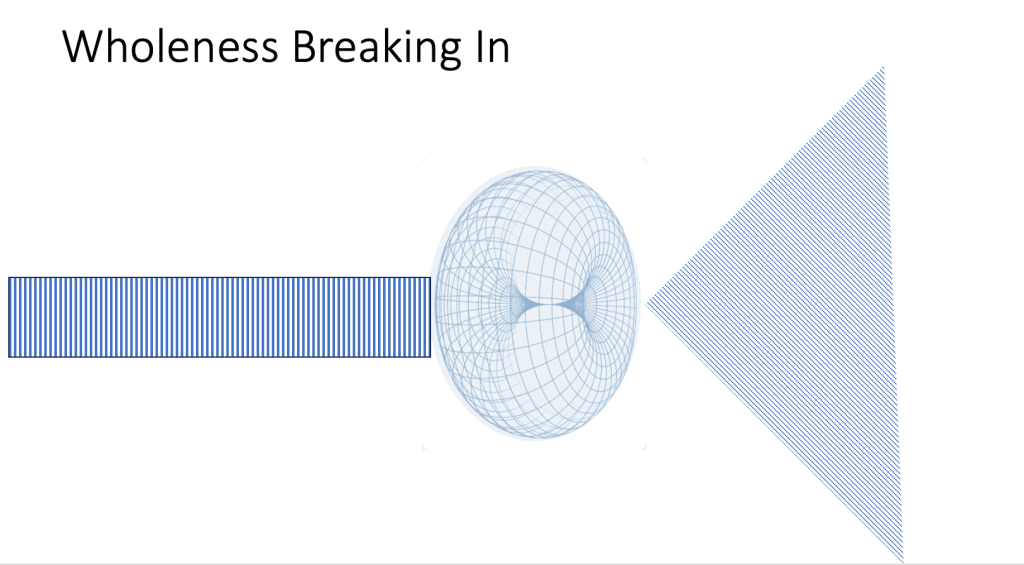
So wholeness, the way I envision it, and it’s not just me, I’m borrowing from others, especially Alfred North Whitehead in Process Theology, is that there’s this sense of an infinite potential that is, has one urge.
It’s really an instinctual urge, and that is to be brought into manifestation, brought into.
And the only thing that can bring what Whitehead called eternal objects, this is this field of potentiality.
What brings this in are entities on this side of manifestation, you and I.
We bring in through our decisions, we collapse the wave and bring it in to our concrete reality.
And then what follows, in other words, what we call history, are now immortal, they’re immortally passed, immortally part of this great trajectory, great deposit of experience, and becomes a part of the collective whole.
So wholeness wants to break in, wholeness unpotentiated, or potential wholeness wants to break in, becomes actualized through us.
So we are the agents that actualize this.
And then wholeness made manifest is what follows when the wave is collapsed and becomes particles.
So this is quantum physics a little bit, but it’s also I’m trying to borrow from people who are looking at quantum physics at bigger scales.
Go ahead.
Would you say then that there is that wholeness, like wanting to kind of break through and actualize in entities such as ourselves and human beings?
So assuming then that there would be blocks to receiving that sort of wholeness with some entities and all of us, in fact, you know, like, you know, we that that wave kind of breaking in, you know, I can imagine that it doesn’t always just break in and actualize and then and then kind of pass through into the kind of, you know, material world or however, in terms of actions and things that we have to somehow, is there some intention of receiving it?
Yes.
Now, now you’re getting it.
This is, this is how important we are as humans.
This is the great vocation of the human, because whatever is received, whatever we pull in and actualize is a direct indication of the psycho spiritual development that we enjoy.
So for example, if my primary consciousness without knowing it is couched in this field of the bellicose, this field of warfare, willed violence, if that is my worldview, and even more so if I’ve constructed institutions, i.e.
certain ways to understand Christianity even, or different religions, huh?
If I construct institutions inside of the energetics of bellicosity, then even if I succeed, you know, I’m the best Christian there is, and I go to church every day, da-da-da, even if I succeed inside of that institution, I’m still inside of the overall field of bellicosity, versus if I’m able to bring in feeling bellicosity as well as forgiveness and love and seeing people holistic, you know, if my field of vision is big because I’ve desired it and I’ve worked for that, and then, like right now, you and I are seeing so much bellicosity in the world and in ourselves, but can we hold Trump in love?
Can I hold my neighbors in love?
Can I hold myself, the parts of me that are still entrapped inside of bellicosity with a kind of green ray love?
Well, if I can do that, then I am, in a sense, sacramentalizing, making the moment a sacrament, I’m bringing the moment and honoring it and facilitating its highest and greatest active manifestation.
And is that a kind of mental thing that you’re doing, or is that a psychological thing or a spiritual thing?
So I only think, my perspective, for example, and the biggest challenge in that sense, where I recognize my bellicosity is sometimes with my children.
And that really, I find that everything, all the identity that I thought I’d formed around who I was, can be completely collapsed with how I can sometimes deal with my children.
But the way it comes to me is not so, sometimes when I’ve been in those moments, I can then feel this almost like it’s like a, sometimes it will come out as tears, but they feel more like, it feels more like, you talked about forgiveness and love.
It feels like that’s coming to me and comforting me and consoling me in the moment where I recognize that I bellicose, and I feel bad about it.
And then suddenly there’s this feeling of, it doesn’t seem to come from me necessarily, but I sort of say it’s described as God coming in and kind of wrapping me up in a sense of this consoling kind of, and that’s the start of me then being able to work through and cycle through these feelings.
So that’s just how that works for me on a personal level.
Is that sort of what you’re talking about then?
But notice, yes, and notice what you’ve done though, implicit in what you’ve just described, and thank you for being so honest.
I had the exact thing happen to me on Monday, which I’ll mention in a second with my kid.
But you were, when you call it God, a grace that is beyond your capacity.
It is still you saying yes to your need for something bigger than the lower chakra.
So the lower chakras or the lower energy centers of each person, these are the bandwidths of consciousness that are of the purview of surviving and of the purview of identity, who am I, and competitiveness.
These things aren’t bad.
Thomas Keating and Richard Rohr would call them the false self.
They’re interested in power and prestige and possessions and all of these things.
Not a bad thing.
But there’s a semi-permeable membrane between the energy centers of the lower three and the heart.
And that semi-permeable membrane is there because it requires our yes.
It requires our capacity for vulnerability.
And then when that happens, great love, great suffering.
Of course, great love is great suffering in a sense.
Like when you say yes to a child and you have a child, you’re automatically blessing yourself with an incredible amount of love and condemning yourself simultaneously to experience suffering and pain.
Are you not?
We are.
I know I am.
Yeah.
And so this is our capacity for vulnerability is the, what I call the Mary’s yes.
The bringing from the biblical standpoint, we are invited every moment to step inside of that archetype of Mary, where we are being presented in the form of the moment that’s coming to us.
We are being presented as Gabriel is in the story, where Gabriel comes to Mary and says, do you want to bear Christ?
Christ for me would be a word symbolizing the wholeness of the one infinite creator in a singularity.
And so packaged in a moment.
So every moment for us is there potential, but our yes allows it to come in, and we midwife Christ through our actions.
But that’s what happens when you say, I felt bad about it.
The way we often describe stuff is saying, I felt bad about it or I felt guilt.
The metaphysics of that is actually, I think, where the yearning of the higher centers, it’s like a vacuum and it’s pulling upward from the heart up.
It’s pulling hard.
And the yearning of the lower energy wants to come in and mate, connect with that downward streaming.
The upward streaming wants to mate in the heart.
That is the telos of the downward streaming coming up, wants to mate there in the heart.
And when it hits that semi-permeable membrane, when it hits that membrane, it can’t go through like water and oil.
When it doesn’t, the way that feels effectively, so psychologically, the way that you and I would say that feels is either guilt or shame or bad or anger or fear.
That’s how it feels.
But really what it is is that it’s, there’s a blockage there and that blockage is simply there to inform us that we are allowed at that moment, we are being visited by Gabriel.
And Gabriel is saying, do you want to birth the Christ in this moment?
And if we say yes, I’m wanting to feel an openness, it floods in and there’s a mating that happens in the heart where we are able in that moment to have units of consciousness and see our actions and see our children’s actions as part of being human, not bad, but that it wasn’t the highest and greatest good, the highest and greatest wholeness.
And in that moment, we are given the opportunity to provide a balance of that imbalance.
Yeah.
And I find sometimes that it requires a surrender, doesn’t it?
In order for that, you start saying, like, mating to happen.
Because, I mean, sometimes when I’m not able to do that, it’s usually because I am in a more of a warfare mindset where it’s about winning.
And so it’s about justifying why I’ve done certain actions and why I can’t admit that I made a mistake or things like that.
And then that will kind of almost suck me back down into the kind of the lower chakra energy sort of thing.
So I guess the way it works with me is that I kind of have to surrender for that mating kind of to take place in order to be able to, I guess, integrate it, and to be able to kind of move on and let it go sort of thing.
You know, in the act of grace, is that sort of part of the process?
Yeah.
And when people, including myself, when we have a hard time even saying, I surrender because we’re so triggered, we can ask the universe, you know, help me to surrender for I can’t on my own.
And that is even a surrender to be able to surrender.
Yeah, that’s good.
So I’m going to move on.
What I would like to say here is that there is a sense of a cosmic law at play.
It’s the cosmic law of three.
Cynthia Bourgeau talks a lot about this.
Richard Rohr kind of mentions this a few times too, but I think it’s important to really understand what’s going on in the metaphysics, the spiritual metaphysics, behind the election is really the fruit of the law of three.
And it’s a holy law because it is precisely how experience happens.
Process happens through evolution.
There’s something evolving.
And the way it’s evolving is through the building of contrast.
Though we have one way to understand this is there’s a status quo force, sometimes called the affirming force, the status quo force.
So for example, this is how we’ve always done it.
Or if there’s a trajectory, in other words, let’s say, if you’re driving on a road, you’re going forward, it’s like, this is the status quo.
I’m affirming the direction I’m going.
But all of a sudden, we have a contrasting force, sometimes called the denying force.
And it creates almost an immediate, perpendicular contrast.
You can see that and feel that.
So for example, with my kid, this was on Monday, we were supposed to leave for a piano recital, of which he knew about.
But I think all teenagers have some kind of brain damage.
Just kidding.
The brain.
But clearly he forgot about it, and it took me a while to get him into the car.
But he was really angry because I was angry, and I was angry because he wasn’t dressed in his recital clothes for the piano recital, of which he knew about, you see?
And so I yelled because I’m feeling we had to leave five minutes ago to get there on time.
And he runs in there, and he was in his shorts, and he didn’t even have a shirt on.
And so I’m like, what are you doing?
And I screamed.
This was absolutely lower chakra.
This has all to do with power and prestige.
I wanted to be seen in good image, and have a good possessions, a good son.
Very low, low chakras.
But he immediately reacted, and yelled out, you didn’t tell me I had to change.
And so there was tit for tat.
He was a direct mirror.
He transmitted through the perfect degree my bellicosity that I projected upon him.
But inside what I’m feeling is the status quo is we’ve got to get out of here, and we’re ready to go.
Everybody’s in the car, just getting Jonah, status quo, blah, blah, blah.
I recognize all of a sudden here, Jonah is my son who’s not ready.
This creates a perpendicular, and it creates a contrast.
And the contrast, all conflicts, I think, in our life is really, we really feel them as conflicts, but they’re really contrasts that we have put meaning on, see?
But what we’re feeling as conflicts are contrasts of two forces colliding.
And the purpose of the contrast is actually to create potentiation for consciousness.
And so, in my opinion, there are basically two stages, and I don’t want to get too hung up on this.
This is based on a presentation I did that I went into a lot of detail.
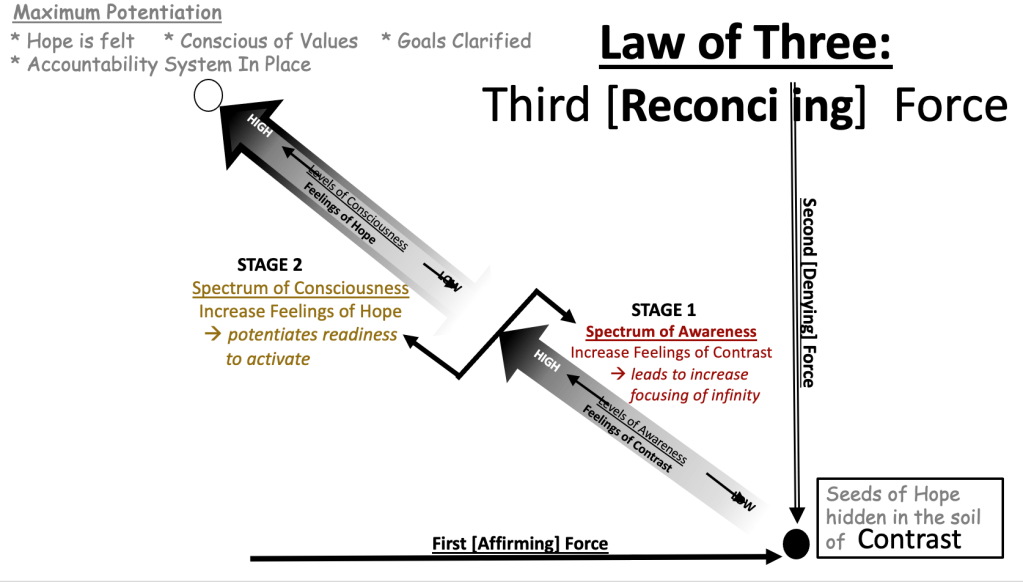
But just for sake of brevity, I see that there’s two stages of becoming conscious.
First, we have to become aware.
And so, there’s a spectrum of I’m not aware at all.
I feel a contrast, but I’m not aware.
And then I become more aware.
And then finally, it ends when I’m aware that there’s a problem.
And then, that’s the birth of the second phase, which is the levels of consciousness, where I’m beginning to be conscious.
Conscious means not only am I aware of a problem, but I’m becoming conscious that I can do something about it.
So, for example, awareness.
Say somebody is struggling with alcoholism, okay?
And they aren’t aware that they have a problem, so they’re in denial.
Yet inside of them, they feel intuitively that there’s a contrast, because they want to drink, but they keep having problems, whether they’re marriage or something like that.
They’re keeps having this.
The contrast is there, and it’s meant to begin the spectrum of awareness to where we can start to say, hmm, maybe I do have a problem.
Give me that tequila.
But then eventually it’s like, yeah, I’m aware, I’m aware.
But that doesn’t mean we’re conscious yet.
Doesn’t mean we’re conscious of why we might choose numbing out.
We’re not conscious yet of what we can do about it.
We’re not conscious yet of how our actions might affect others and our family.
That is the stuff of higher levels of consciousness, but none of that awareness come to consciousness and that consciousness come to action.
None of that would have happened if there weren’t a contrast.
So, the thing is, is that in my example with Jonah, I became immediately aware of the contrast.
So, there was an immediate awareness of that contrast.
I didn’t have to wait around.
I was not in denial that we’re going to be late because of him.
Where I wasn’t conscious, though.
I made an immediate reaction.
So, boom, he reacts against me.
No one’s conscious here.
We’re just instinctual at this point.
And it wasn’t until we got into the car, because I’ve done some inner work, I realized, oh my God, this is an opportunity for me to put into practice the bellicose stuff, you know.
So I recognized where it was inside of me, and I didn’t hate it.
I just simply became aware of it and said, it’s understandable.
It’s okay.
But I want to make a preferential option for connection over correction.
So the lower chakras is always correction over connection.
I have to be right, and you have to be wrong.
The upper chakras is the beginning and the connection over correction.
And so with him, what I said to him was, as we’re driving, and he’s huffing and puffing, in fact, he yells out to me, I mean, I am, my problem is because of you.
Like he just direct projection, screamed it.
At that point, I was enough in my heart to where I received it and actually received it as a responsibility on my end.
I didn’t speak back to him.
All I simply said is, man, I can really see that this is hard.
Why don’t we talk about, you and I have a nice discussion after the piano recital.
You’re not in trouble.
I’m just curious about some things.
And that was my way of responding in a conscious way to the initial invitation of the contrast that I felt about 15 minutes earlier.
So what do you think about this law of three as it might fit in?
Yeah, no, I totally get it.
I mean, I’m interested as well, because it sounds that you were able to get to that place quite quickly.
And you said about doing the inner work.
So is that part of it, then?
As in you were able to, rather than holding on to, you know, those reasons and continuing that, obviously you did for a little bit, but you were able to fairly quickly get to a space of, you know, that more higher level of consciousness fairly quickly.
So would that be a kind of a little sign then that, because assuming that if you hadn’t, you know, got to that level, then you’d still be having that, and that would proceed and maybe you might get to a point later on, or maybe not at all.
But you were able to like cycle through that quite quickly and get to that point.
So that’s the fruit of a lifetime of spiritual work.
I mean, I’m embarrassed to say it took me 15 minutes.
It could, you know, should have maybe even taken me less.
But the point I want to make here is pivotal.
Actually, what you made is pivotal.
And that is, most of the time, we humans do not recognize that when we are holding on to resentment and anger in the moment, because we are preferring correction over connection, most of the time that is hurting us and not the person we’re angry at, you know?
And also, it’s just a transmission of the same problems.
Like if people who are actually signing up in this lifetime to be instruments of peace, the St.
Francis make me an instrument of peace, the prayer of St.
Francis might say.
If we’re actually desiring to do that, then it behooves us to be the change agents that we’re hoping happens in the world.
It’s going to happen organically, and it happens in every moment that our own bellicosity is triggered.
And the reason why it’s so hard is that it feels instinctually wrong to hold it long enough so that it opens the heart.
Like the pain and the desire to make it right.
You have to hold it long enough, and desire to foreground connection, that opens the heart.
But it’s not, it feels counterintuitive, because everything about our world, especially in these times, would say that’s folly.
Yeah, yeah, yeah, yeah, absolutely, yeah.
Yeah, definitely, for sure.
I’m just wondering, one thing came to mind as well.
Is it kind of, so again, I can only really relate it on a personal level.
I wonder whether you can then expand that.
So sometimes what I might notice as well is like a witnessing presence when I’m in that bellicocity.
So it’s kind of like there is some part of me that is witnessing what’s going on.
And it’s not necessarily kind of judging in a kind of pointed teacher type way at what’s going on, but it is aware of what’s going on.
It’s looking in on what’s going on.
And I kind of can be aware of that as well.
At the same time as going, I can’t get there yet.
Yeah, I’m not, I am indulging in this bellicocity.
I’m aware of that witnessing presence, which is maybe a higher level of consciousness that is witnessing what’s going on.
But I can’t in this moment get there.
What is that part of that as well?
Yes, it’s brilliant.
You’re saying exactly, I think, metaphysically true.
The experience of that witnessing presence might be where it is a kind of seventh chakra or even sixth chakra, adept level, Gandalf level, if you will, Jesus level, type of consciousness that is witnessing what’s going on with the eyes of a knowing and compassion.
Yeah, but there’s no judgment.
It’s simply there waiting just as you are when you’re looking at kids playing recess.
Have you ever just watched kids play recess and you’re just witnessing them?
No judgment.
I said, what’s recess?
Oh, good God.
Sorry.
That’s funny.
In elementary school, there in Great Britain, what do you call it whenever people go out and play during the school day?
Oh, like a break?
Like a break time?
Break time?
Okay, sorry.
Okay, yes.
Yeah.
Not funny.
We call it recess.
I don’t even know why we call it recess.
Well, anyway, at least we don’t call it regression.
No, but whenever you are able to stand back and watch your kids have fun in the pool.
Yeah.
You’re witnessing that.
So here’s the trick.
Going back to you and this witnessing presence, but then you actually acting.
That witnessing presence is the highest and greatest good that desires, remember this yearning, it desires to be made manifest.
Wholeness desires to break in.
What we have to do is create a bridge.
And are creating a bridge in that moment is to learn.
I’m going to say it this way because this is the only thing that comes to mind about how it works for me.
Not that I do it perfectly.
But just as much as it is an instinct to react and really foreground aggressiveness to get to dominate correction over connection, just as that is an instinctual reaction, I have had to learn through habit.
So habits training, pilots train so much so that if something goes wrong, they don’t think it becomes an instinct.
So this is training.
I’ve had to train to have an instinctual level of awareness so that when I react that way, I automatically instinctually know that I’m at best half wrong.
Likely, I’m way more than half wrong.
Because if I’m real sure that I’m right, then what I’m doing is making an absolute of a small piece of the puzzle and saying this is how it is, not taking the consideration that the other person, in this case, my son Jonah, had his own world view.
He didn’t remember, okay, I’ve been that way.
Also, yeah, I have screwed up many times.
I mean, I’ve been forgiven by my wife for how many times I have forgotten things, you know, or how many times have I been given mercy by people?
How many times do I know that I’ve run red lights?
Like, why am I going to get angry at the person who’s run that red light?
If I’m going to point fingers, I at least have to point one at my heart too.
So I’ve learned to be instinctual about when I am certain I am right, I have to feel out and come down on, but I know I can’t see the full picture.
And because I can’t, I need more information.
And the only way I can do that is to connect with the person I’ve just hurt.
And the only way I can do that is to hold them and myself in my heart.
Yeah.
It’s an instinct that you have to train yourself.
Yeah, yeah, yeah, interesting.
And would you say as well that there’s different levels of it in the sense of, you know, certain things you can do that quite quickly with?
I don’t really suffer from road rage that much, you know, that’s something I can kind of get over quite quickly.
But I used to.
Allowances, make allowances for people.
And there’s lots of things that I can make allowances for people.
And yeah, it doesn’t.
But then there’s some things which are real triggers.
And would you say that that is then, you know, that is your work?
You know, that is really something about you that is, you know, and therefore requires more attention.
Would you say that?
Not only is it our work, it is a grace to be shown in stark relief what our work is.
But you’ve said it beautifully.
So think, can I ask you a question then?
Can you think of something right now in your life, you mentioned road rage, that you don’t have that issue.
I mean, when I was a kid, a young teenage driver, and up until maybe mid-20s, I did, but I was modeled that by my dad.
I was modeled that by everybody else I saw.
And I really felt it.
I felt angry and I would project everything on the other driver and whatnot.
I don’t have that anymore.
So that’s an example for me that I’ve moved past that.
But I have clients that struggle with that a lot.
But can you think of something that you did earlier on have struggles with and then have moved past to where it almost doesn’t emerge now as a problem?
I wouldn’t say it’s like something that I’ve moved past, but perhaps something that I may be a bit more at ease with.
And I think that is probably more being…
Like, it’s not that if someone tells me off, okay, because that’s…
But I am super sensitive to any form of, you know, me having done something wrong.
And this is more so in a work capacity.
So, professional kind of work, anything in those sorts of…
that sort of realm.
So, if I…
Whatever I perceive as, I’ve done something wrong, someone’s telling me off, even though that’s always been a real kind of, like, sore spot for me.
Something that really can take a long time for me to get…
to kind of work through.
I would say that I’m definitely getting better at that.
So, I think that there’s progress in that area.
So, I think that’s probably the one that I would identify as progress being made.
But, it’s not.
It’s very much worth in progress.
Yeah, thank you for sharing that.
Except for narcissists, Trump being one of them, people really do feel triggered when they’re seen by somebody else.
You know, even a critique, a healthy critique can be often received as a criticism.
Well, you know what?
I should say, narcissists actually take…
I was wrong about that.
Narcissists are very, very sensitive to…
It’s anti-social personality disorder who don’t give a shit.
The psychopaths and whatnot, the sociopaths.
But what I would say here is, if you were to look at your life, then you would probably be able to identify a few times early on in the home that you emerged from.
You’d probably identify times when, not in a malicious way, but the message you got was shame for not achieving a certain level of standard perfection or however it was modified.
Talked about it, and it may not have been overtly talked about it, but it was covertly given and received as this is the standard that allows you to be proud and is your ticket to belong.
Oh, yeah, definitely.
I mean, I think I’ve done it.
Yeah, I mean, I can identify those points in my life, I’ve completely failing.
I mean, we have like a sort of 11 plus type thing, failing that, overhearing my parents talk about me failing that.
My friends passing that, you know, the impact of that, that internalizes sense of, you know, I’m not good enough, I’m not clever enough.
And then my response to that being, I need to overcompensate now.
I went to like a kind of, I did go to the school, but my parents like had to pay, I didn’t get the scholarship.
So there was always that sense of I shouldn’t really be here.
And now that I’m here, everyone else is much better than me.
So I have to work, I have to overwork in order to, like, prove myself.
So that’s kind of that.
So that then kind of feeds in that, that sort of overcompensating, overworking, people pleasing, that follows me all through my life.
So that is, for me, that is my thing that I have, it’s come up now, you know, so it bubbles up and I can see it, I can witness it.
In my 20s, I had a breakdown at work, so I was really ambitious at work, but, you know, I was masking a lot of the time, that actually I was feeling this deep kind of anxiety about how good I was or how effective it was at work.
And so it led to a point, which now I can reflect and look on as being actually what I needed, but of a breakdown, which then I had to kind of build up from there and look at like, look at all this stuff and do work on it.
And, you know, and I would not say that I’ve overcome that, but I, you know, like you say, include and transcend.
I feel like that process is happening a bit now.
And redefining my ideas about what success looks like is, you know, the understanding of vulnerability and all those things as being.
So all of that has kind of come in and helped me to deal better with situations along those lines.
But yeah, it’s kind of come up for me to be able to see.
Let’s look at, oh, there’s some solicitors here.
And they see me with the, they’re going to say, come here, but I’m not going to come there.
We’re going to wait till they leave.
So, I’m going to put up, we’re going to, I mean, for the sake of the podcast, this is the part that I’ll cut out.
But let me say at this point, so, okay, sit.
Thank you.
Thank you, guard dog.
You’re so vicious.
I’m so glad to hear that there is imposter syndrome everywhere.
Oh, God, yeah.
It sounds like you actually got a PhD in imposter syndrome, you know, in your school.
Oh, my God.
I massively, yeah, huge.
And that is what happens here, too.
I would say that the fact that you had that breakdown, as you say, you weren’t even aware.
Notice that you felt the contrast inside of you.
The desire to feel smart at not working out.
So the affirming force is like, I’m a good student.
The contrasting force is whatever the grades you got.
This creates this contrast, okay?
It’s contrast.
And then from there starts this journey of consciousness to where you can use the very contrast as a way to deal with your psycho-spiritual work.
So it started out in no awareness at all.
And then over time, after the breakdown, you became aware that you had things to look at.
And then at some point, it birthed a sense of consciousness to where not only do I have things to work out, but I know what they are more, and I can consciously with an agency work at them.
Yeah, all I would do is go ahead.
Yeah, no, I would just say it was interesting though, is what I’m being called to look at as well, when I talk about my triggers now more, is that actually there is still a lot more work to do on that, but in a different way, because it’s almost like my children, so especially my eldest son, is almost the opposite of what I was like when I was younger.
So he’s not conscious at all.
He struggles a lot with his academics.
He’s got various different learning barriers.
He doesn’t care about, he’s not in any way people-pleasy.
He’s that kid when he was little, who’d be tearing around, pulling things off shell, that sort of child.
So it was massively feeding into a lot of my triggers still, a lot of my wounds.
And like you mentioned about prestige.
So that’s a thing for me still.
That’s a thing for me still.
And my son is really exposing that for me.
So yeah.
And I would say this is very similar to what the law of one talks about as the balancing technique.
This was their way of, I guess, psychotherapy.
But it is when whenever you are feeling an intense feeling, become very mindful of it in your body, and then bring to visualization and imagination the polar opposite of that, and then feel what that feels like, and then hold the two together and say, both of these are me.
I am all things.
Both of these are me.
And I get to choose therefore, how I actually want to respond to the given catalyst versus react.
So, given the balancing technique that was described by Ra, and listening to what you just said, you’re actually given by virtue of, I don’t know, pre-incarnational contracts or something.
You’re given your polar opposite.
Manifested as your son.
So, it’s like, here you are almost an archetype of a certain kind of instinct for perfection.
And then, if you were to imagine the exact opposite of that, it would look like your son.
Yeah, yeah, yeah.
And the truth is that it is really hard.
But both of those are are archetypes.
And the truth is, is you can at the same time embrace both of them because we’re all trying to be human, trying to figure this out.
And then you move into forgiveness and understanding of yourself, self-care, whatever boundaries you need to set for yourself and all of that.
And you give him boundaries that he needs for his care, but also give him the sense of like, your behavior isn’t tied to who you are.
You’re a good person who’s making choices that are life-limiting, say.
But there’s a reason why you’re making these choices and let’s talk about that.
So you’re giving him space to learn the difference between responding and reacting.
Let me see.
But that is the balancing technique.
Instead of internalizing in one person as an internal technique, you’re actually seeing it between you and him.
But because you’re the one that’s more conscious, the law of responsibility is that you do the inner work and then gift him this higher level of consciousness through your connecting versus correcting or overcorrect, you know, the preface in connecting overcorrection.
Yeah, it’s not easy.
I mean, this is the hardest work ever.
But you are definitely given in every moment as I am, the exact way forward.
So whatever is in the way becomes the way, you know.
Just moving on here really quick.
And I can go until 4.30.
I want to check in with you though.
How are you?
I can go for another 20 minutes.
What does that look like for you?
Yeah, that’s good for me.
Okay.
So here I want to talk about, we talked about bellicosity internally.
I want to talk to you about this concept called thought forms.
Have you ever heard of that term?
I think I’ve had you talk about it before.
I have listened to some of your podcasts.
So I’ve heard the thought forms, but I could do with you reminding me.
Thought forms are thought feelings.
So every thought has a feeling fragrance and every feeling has a thought fragrance.
So sort of two sides of one coin.
And they take on an almost substantial reality in and of themselves.
So for example, according to some material that I would trust, like the Law of One, more esoteric, certainly.
But every thought that we have is actually at some plane of existence, what Ra would call time space, is an actual being, it’s an entity.
That at a rudimentary level desires to feed, because all things desire to survive.
So, our thoughts have a kind of quanta, it’s almost a packet of substance.
It’s an event, it’s an actual event of becoming that has a beginning and an end, and its own substance, its own ontology.
Every thought does.
And often what happens is, let’s just pretend that I’m thinking a bad thought about somebody.
Well, that thought is connected to that person’s aura, because that’s who I’m thinking about, but it’s still connected to me, because I’m the creator.
Therefore, the more I think badly about that person, the more that person is going to be fed that energy from which it’s coming inside of me.
And if they’re susceptible, in other words, if they have the energetic equivalent of a low-grade cold, they could get infected by the bellicosity that I’m giving them.
But regardless of whether they’re affected or not, I’m affected because that energetic cord for us coming back to me.
But let’s say that I’m thinking bad thoughts about them, then they’re turning around and feeling bad thoughts about me.
Now we’re having a feedback loop that this thought form is just growing and growing between us.
And it becomes a sentient, its own sentience that at some level of awareness, thought forms begin to have a desire and knowledge, instinctual knowledge about how to create from its creators, how to get more of the energy it needs.
So for example, we are the creators of social media, humans are the creators of social media.
But isn’t it also true now that social media is creating our own world view?
Yeah, it’s an AI.
I’m not saying AI is wrong or that it’s neutral, but we create thoughts, and then at some point the thoughts start creating us.
And if we’re not aware of them, this kind of reciprocity begins to grow, and we can have what’s called entity attachments all over our aura of our own making and not know it.
And then if you and I are having a down day or something, it would be kind of like having viruses and bacteria on our skin all the time.
But if my immune system is down, then all of a sudden what is usually kept out is not being able to resist and we become infected.
Does this make sense?
Yeah, yeah, it does really make sense.
Yeah.
Yeah.
Okay.
So what I want to say is that there is a great, a great bellicosity thought form that humans have created since the beginning of third density.
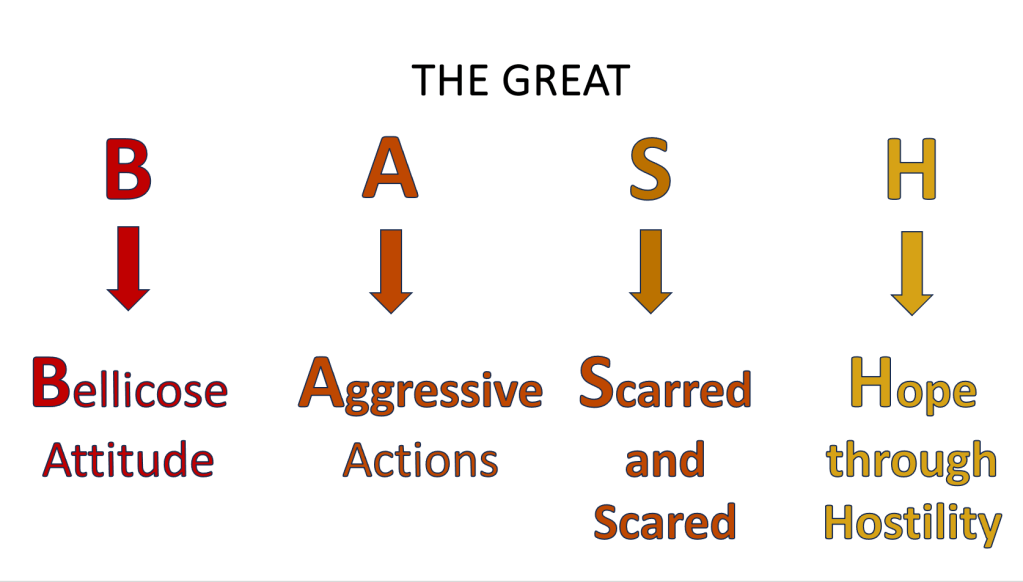
I call it, this is something I came up with today, and I may not have it tomorrow because I might be stupid, but I just I’m playing around with it, but I call it the great bash.
The thought form, I call it the great bash.
But it’s supposed to be punny in a way, because when you can talk about like, was that a fun night?
Yeah, man, it was like an awesome bash.
Almost an event that was intense.
We talked about it was have a bash or have a…
But I don’t know if that’s often used in England.
But the point here is bash, to bash someone, to hit someone, to bash them upon the head.
To have a bash is also something where something is very intense, an event.
The great bash is my name for the great collective bellicosity thought form that we have created through willed violence, but we are incapable, it seems, until we are.
But as hard as it is for you and I, who are trying to do this, to recognize the bellicosity inside us and then transmute that into love and understanding, that is very hard to do on the collective.
And so what we do is we create this bellicosity, which at this point is got to be, it’s super sentient, it’s like a super sentient AI that then starts to create us.
And even the institutions that we often create, humans create, are actually manifested in the same energy of that bellicosity.
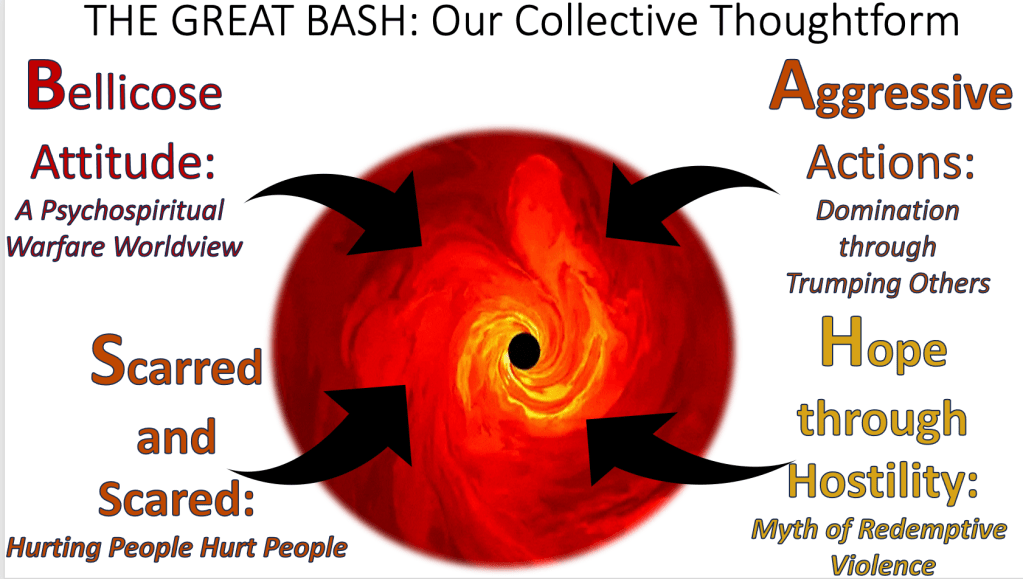
So what BASH might stand for is, this is something I’ve brought up, is bellicose attitude.
The B is bellicose attitude.
Again, this whole world view of a warfare.
I know it’s going to be a fight, and I’m just gearing up for it.
And everything is a fight, and I have tunnel vision, so everybody is trying to have an agenda over me or over us.
Secondly, the A in bash is aggressive actions.
This is where I take that attitude and manifest it through actions.
Not loving actions, but aggressive.
The S in bash is scarred and scared.
Scarred and scared.
So we might have traumatic, we might have had traumatic events, or even chronic events that have become traumatizing for us.
Like you said, that when you learned about your score, and you heard your parents, and I have many of these too, it scars us.
And then we are scared to, there’s a fear underlying all of that, you know?
And we don’t want to be hurt anymore.
We bear the scars of that wound.
But until we wash the wound out and clean it, and just realize, hey, falling down and scraping your knee is a part of life.
Until and unless we do that, we are going to remain in this sense of deep fearful state and feel the wounds, but we don’t want anybody else to see the wounds.
That’s part of this bellicosity, this great bash.
And lastly, the H is, is ironically hope through hostility.
So notice when people like even Trump’s big MAGA slogan is, make America great again.
There’s a hope, a sense of hope, that if we can have redemptive violence, the myth of redemptive violence, that violence, if we beat up this person, that’s what bullies do, you know, if I beat up this person, I will subdue them to passivity.
But there is no such thing as actual redemptive violence.
It always begets more violence.
But the hope, we always keep hoping that things will get better if we just bash this person.
And it never does.
Yeah.
Yeah.
Yeah.
So what does this create?
Well, in my imagining, here’s what it is.
So if you can picture, if humanity is, let’s just say, if you can picture a big web, and at the epicenter of this web is this great bash, our collective thought form, it would be a swirling vortex.
Like in Ra calls it, the energy of bellicosity is kind of a red, orange, yellow, muddied, it’s sort of like almost plasma substance, in a way.
And it’s the stuff of fire and rage and passion.
Not necessarily passion, or like I’m passionate about something, but more of just an urgency to be in war.
Yeah, so we have again, bellico’s attitude, a psycho spiritual warfare worldview.
A is aggressive actions, again, and I wrote very specifically, domination through trumping others.
Aggressive actions, domination through trumping others.
And I’m leaving trumping there, because this is the final part of what I’ll be talking about, is how it brings it back to Trump.
I think he’s an archetype.
Scared and scared is hurting people hurt people.
We’ve heard that before, hurting people hurt people.
And lastly, hope through hostility.
And that is keeping alive the myth of redemptive violence.
So the Great Bash is basically a sentient, energetic AI, artificial intelligence or sentient intelligence, a thought form that we contribute to have created.
It creates us.
And now there’s this symbiotic relationship that the more that we engage in bellicosity, especially when we’re given the opportunity to feel it through our kids or our political affiliations, we can, most of the time, we will choose to continue to transmit it.
But if we can stop and surrender through love, obviously being open to suffering, if we can do that, our Marys, yes, then forgiveness simply evaporates the bellicosity.
But that’s not where we’re at, because, in my opinion, Trump is the…
If you were to take the universal, to this planet, at least the universal energetics of the Great Bash, if you were to take that and bring it to a singularity, and almost an archetypal icon, what would that look like?
In my opinion, that is Donald Trump.
Yeah, absolutely.
I mean, he just embodies all of that completely.
He embodies everything that the Law of One talks about in terms of bellicosity and bellicose actions.
On the spiral dynamics side of things, if those of us who aren’t familiar with that, he is absolutely an embodiment of the red level, which is that warrior, it’s pre-modern warrior-like attitude.
Tribal kind of.
Oh, hostile, yeah, tribal.
Well, not just tribal, but it’s tribal over others.
It’s tribal in the sense that my tribe is going to dominate.
Yeah, yeah, yeah.
And Trump, even the name Trump, huh?
I mean, can you get him a more perfect archetypal icon into a singularity?
And if you look at Trump, I mean, it’s not hard to see that he is a narcissist.
And people who have personality disorders, we all have traits of all the personality disorders, but people who actually have them usually are working from, they’re trying to solve adult problems, say, from the psycho-spiritual developmental stage of much earlier, even as early as three or four.
And so that’s why you get a lot of infantile behavior from these kinds of folks that it’s clear, he’s just throwing a toddler temper tantrum, because that is his world view, and the fact that he can’t see it, affirms this notion of a personality disorder.
But he of himself is, he’s approaching the archetype, which means it’s a one-dimensional type of existence.
He is a hammer, everything is a nail.
So he’s the archetype of a hammer.
And so the depth beyond that, you’re not going to find it.
But because, so in a way, he is our collective mirror.
And I’ll finish by saying what the raw group and the law of one says, is that when they are able to view humanity as a whole, because they see us as one organism, we are all cells in one organism.
And what they see is that around us, the cosmic environment that we are in is green ray 4th density love and understanding.
Because our particular solar system, the body of our local logos, the sun, the heliosphere, has moved into a galactic section that has activated it to, at least on our planet, to move into 4th density.
Because we’re ready for, in terms of time schedule, say, or how things are moving, we are ready for 4th density work.
The planet is embodied inside of 4th density.
But the planet itself, and we are the consciousness layer of the planet.
So just like the human has the prefrontal cortex and the frontal cortex, and we’re able, you know, this often distinguishes us from higher levels of second density animals like apes and gorillas and so on.
We, that prefrontal cortex and frontal cortex is actually making up the planetary conscious mind.
And so we’re, Teilhard Deschardin called it the noosphere.
And it’s this film, this membrane of sentient membrane around the planet, because the planet is an organism of which we are its consciousness.
And our collective consciousness is not only not ready for green ray energy to be in fourth density, but we’re actually fairly remedial yet.
So what they said is that we have, they see us as a green ray entity with heavy orange ray overlays.


And it’s orange ray because orange is the color of identity, personal identity.
And it’s always asking who are you and what do you want?
And we, as a collective individual, cells in one body have not yet, because individually we have not yet, in a deep way saying, I am a force for good or a force for wholeness, and I want to steward wholeness in my immediate environment.
We’re not doing that.
What we’re doing is we’re scapegoating others and attacking others.
And so until and unless we can see ourselves clearly enough to say, I’m done, just like you’re doing with your child when he’s acting a certain way, and just like I try to do whenever I, I’ve been triggered that way too.
We are now invited, you and I, to look at Trump, not in a hostile way, because if we do, aren’t we just contributing to the great bash?
We want to bash him, we become the bash, the bashfuls.
Yeah.
Instead, the only way that we can move forward, and it’s going to be person to person to person, is to tap what’s already happening inside of you, which is the great work of transmuting bellicosity into love and understanding and wisdom and unity.
We have to do that individually, especially when we’re triggered by what’s macro coming at us.
Yeah.
Yeah.
And so Trump is a mirror, we created him.
He is the personification of this, the great bash, this great collective bellicosity.
So if we hate Trump, we’re really just pointing a finger and hating ourselves.
And that’s just going to continue escouncing us inside of this great collective thought form.
Yeah.
Wow.
That really does make sense.
Yeah.
Thank you so much for sharing that.
And what I mean, I don’t think you should change the great bash.
The great bash, I think, it just, you know, that really just like Trump kind of, you know, very much.
Has bashes.
The great bash, it says what it does on the tin.
Yeah.
I’m a fan of the great bash, but that’s been really helpful in me kind of understanding that.
There’s just one thing, and it’s kind of related a little bit, but you know you mentioned the green energy that’s kind of like a membrane.
So is that, you know, I don’t know, just like on a personal level, you know, feeling very like, you know, sometimes I will just get, it happens during the night, at night time, sometimes I just wake up with just a lot of like pulsating energy.
Like, I really noticed this kind of pulsating energy and stuff that’s like coming, you know, coming through.
Is that part of, you know, it feels kind of vibrational.
So, is that sort of, is that that sort of that energy?
Because I sometimes wonder what it is.
So, this is one of the things that I do as a psycho spiritual counselor and coach.
It’s my vocation, is to the degree that I can do this inside of myself and offer this gift to others.
It is simply this, to affirm that, especially for those who signed up in this lifetime to be basically washing machines, alchemists, to transmute base metals into gold.
Gold being the representation of wholeness on this side of the veil.
You are one of these.
It’s clear.
And there’s millions and millions and millions of people this way, who, again, this is a speculation.
I mean, those who don’t believe in this kind of thing absolutely don’t have to.
So, but my belief based on my own personal experience, but also all of one and other sources is, is that many people are here right now who are actually already green ray entities.
They’re already folks who either on other planets, or in this, on this planet, third density natives that are already fourth density.
And so their heart activated and higher.
But they’ve chosen as their act of loving service to incarnate before the quantum jump into fourth density proper.
They are, they incarnate here to actually be part of the midwifing team to help midwife the yeast that’s in the loaf, as Jesus would say, to raise up the loaf into fourth density.
And it’s always going to be people who are super empathic, who have a really deep sense and innate desire, because they know it doesn’t have to be this bellicose here.
They have an innate desire to assuage this ethos of separation.
But they are, because we’re not mirrored and affirmed and validated, saying it’s no wonder why you’re feeling this way, it’s okay.
Now what do you want to do about it?
Because you can do something inside yourself.
When you don’t have that, we get lost.
And then we get overcome by depression.
We get overcome sometimes by becoming activists in things like conspiracy theories.
In the name of breaking humanity out, we actually participate in the great bellicosity, the great bash.
Yeah, you can see that actually happening.
So you, for example, in my opinion, you are absolutely, because of your marries, yes, because you’re taking this lifetime very seriously, you’re going to notice three things.
Okay, this is my speculation, so check it on your own experience.
The first thing is you’re going to notice that you’re being invited very quickly to rectify or reconcile karmic imbalances in your own life.
So when you are acting, not from the heart, but from the lower chakra as I am, you’re going to almost immediately see how that wasn’t your highest and greatest self, and you’re immediately going to be invited into course correction to rectify that imbalanced.
Yeah, definitely, definitely for sure.
And it’s an honor.
This is good.
This is not a bad thing.
This is a sign of your marries, yes.
Number two, number two is you’re going to feel like you’re a freaking conduit.
You know, whereas before, maybe we were Commodore 64s, you know, early developed computers, and we were being given an upgrade for a Mac, you know, 2024, a Macintosh computer, 2024.
Well, a Commodore 64 doesn’t even have the infrastructure to receive said upgrade.
But when you and I can do our work into the heart, that is the equivalent of having a hardware upgrade, so that then we can receive the software.
And so that you’re feeling so much energy, the only thing I would invite you to do, because you can also feel the energy of the bellicosity too.
The more you say yes, the more you open yourself up to love and suffering.
So what I would invite you to do is say your yes, and whatever is received, you bless it, whether it’s already of high fourth density or whether it’s the bellicosity, but you bless it and say, I bless all that is coming in to me and I use whatever I receive intentionally for the highest and greatest good of the collective, including myself.
And then all of a sudden, you’re just going to feel this explosion of really, it’s going to feel almost like ecstasy and even that don’t get attached to.
Just say, I bless this too.
Yeah.
And the last thing you’re going to see, I said there were three things, is you’re going to feel a strong desire to play more like a kid, to find joy in small things.
That old, intense experiences no longer have their pleasure but rather presence, depth.
But you’re going to find yourself given the opportunity whether you take it or not, it’s your choice, my choice.
But it’s going to be, can you play again?
Because people who are doing their work will reach a certain level where it is actually a great bat.
It’s just your third density.
I mean, it really is joyful.
It’s fun.
Even the hard stuff is actually the caresses of love, in a way, from a certain point of view.
So we smile more, we laugh more, we giddy, you know, if you’re like me, you enjoy toilet humor even worse.
Maybe that’s an indictment of me being stuck down there.
Yeah, I mean, I feel like I’m quite a long way off from that, if I’m honest.
So, you know, there’s still a lot of…
Yeah, I think I’m being invited, really, with that second part a lot right now.
So, and I think the energy is kind of like accelerating it almost, you know, sort of…
Yeah, like I definitely, when you said about recognizing it quite quickly, that, you know, course correction, that is, you know…
Yeah.
So, lastly, I’ll say, here’s how you pivot into it being done unto you, and then you doing it.
And that is, you are going, I’m just letting you know, you’re going to be used as a nodal point where high energy is coming in, and then being dispersed into the collective.
Because that’s what wanderers do.
Through their embodiment, they’re the hardware that is needed to then bring up, to give humanity collective the opportunity to say yes to forgiveness.
Okay.
But what I’m saying is, when you’re feeling it at night, that’s coming through you, instead of saying, instead of having the posture, which I do too, but having the posture of, what is happening to me?
What’s going on?
I don’t, I actually, there’s something in me that says yes to that.
Good.
Really?
Yeah.
Yeah.
There’s something, when it does happen, and I kind of, in this kind of liminal state really with it, there is a real yearning.
It’s a huge within me to want to go, yes, I take that.
There isn’t, there’s no resistance to that.
So I feel a sense of me wanting to take that energy, like desperately, not desperately to the point of like, you know, but just like willingly.
That’s it, that, then you see, see this instinct is so strong in you to say yes, and you’re, and you’re intuiting it and feeling it.
That is one of your primary vocations in this life, is through your embodiment, and then your yes, you’re allowing it to come through you.
So it’s really a compliment to how much work you have done.
Yeah, I mean, there is still a lot of work, you know, I can, you know, I can see that, you know, regarding the, you know, the, the, the, the mating.
Yeah, yeah.
You know, the heart, the transmuting, the transmuting of it, of some of those lower level chakras.
So, but, but yeah, in terms of that, there is, there does feeling me, and I think there’s always felt in me a strong sense of, so, you know, like service, like kind of, I don’t know, like almost, I don’t know, maybe this is the wrong thing to say, but kind of a little bit like maybe, but maybe this is, maybe this is not that of that, maybe this is of an ego, so I don’t really know, but almost like kind of sacrificial sort of, sort of like side of things, you know, like just like, you know, yeah, like kind of-
I’ll take it for the team?
Yeah, yeah, yeah.
Well, let me say it this way, to affirm what you just said.
We are called to sacrifice, because the word sacrifice means to make holy.
Faced, to make, and sacra, holy.
And so a sacrifice is to make something a sacrament.
And so when you receive this energy, a sacrament is something that’s always and everywhere true, which is wholeness in the potential.
A sacrament is saying what is always and everywhere true must be celebrated in one place at one time.
That’s what a sacrament is.
So, for example, when someone is baptized, that’s a sacrament, we call it a sacrament, but it’s true that you’re always anointed.
But we humans, we need to be, we need to participate in the celebration of what is always and everywhere true.
You are holy, you are God having an you experience.
You see, that’s a sacrament.
But when we have these rituals, we are expressing for all to see a manifestation that this is holy, this moment.
But it’s not because before you weren’t anointed.
It’s just that now it is celebrated and honored.
So always and everywhere is this wholeness trying to break in.
And you, your yes, is allowing consciousness to come through so that other people in the human space-time continuum will begin to awaken to the sacramental nature of everything, even our hard stuff.
So thank you for your service to the collective.
Thank you, Doug.
Thank you so much.
I’m so pleased because I’m so pleased you finally, not this time around, but I remember the first time I got in contact with you on the Richard Roar and I sent you a message and you didn’t check it for ages.
And then I’d forgotten all about it.
And then you contacted me and then that led to kind of the group and stuff.
And so I very much appreciate you checking Messenger again, because that’s really everything you’ve described there.
You know, it’s really it just there’s something, there was a kind of receptiveness to what you were saying.
There was something, some transmission to what you were saying that felt and resonated and vibrated.
You know, so, yes, thank you.
Yeah.
And likewise, what I couldn’t say what I have said, and we couldn’t have this dialogue, if you weren’t the catalyst to bring that to manifestation, because that’s what happens is two or more people, when two or more are gathered, there is Christ, Christ is wholeness, you see.
And so it took us to dig in, you’ve inspired the questions.
I did my best to respond, but the creative act allowed for a dialogue where we could see it play out in our own life.
And if one or two people are touched in some way by our conversation, then that is precisely how the whole thing is enlightened.
The planet becomes more light just through a small acts like this.
So thank you for participating in dancing.
So I’m going to create this into a podcast and with your permission, and I will send it out.
I’m excited about it.
So thank you.
And let’s keep chatting.
Definitely.
I mean, it’ll be really interesting to hear.
Well, I mean, I guess things don’t change whether he gets in or not, but in terms of the conversation we’ve been having here.
But yeah, I’d love to kind of dialogue again later on.
But thank you very much.
All right.
Well, tell your husband, thank you for letting us hit chat and that he took.
No, no, no.
That’s great.
I got out of doing the bedtime routine.
So, you know, and had some tea.
And you had your tea.
What was tea now?
I’m going on to the herbal.
I’ve got to go to my herbal tea.
Just before I go to bed.
All right.
God bless.
We’ll talk to you later.
 Building 4th Cosmic Christ