by Doug Scott
Cosmology: Why, How, and Who of Eternal Becoming?
Whitehead
Alfred North Whitehead (1861-1947) emerges as one of the most profound philosophical minds of the 20th century, whose journey from mathematics to metaphysics carved new pathways for understanding the deep nature of reality. Born in Kent, England, Whitehead’s early career focused on mathematics and logic, culminating in his collaboration with Bertrand Russell on the groundbreaking Principia Mathematica. However, it was his later philosophical work, particularly during his tenure at Harvard University (1924-1937), that would transform our understanding of existence itself.
The heart of Whitehead’s contribution lies in his philosophy of organism, a revolutionary vision that sees the universe not as a collection of static substances, but as an interconnected web of dynamic, living events. At the core of this understanding is the process of concrescence – the moment-by-moment becoming of actual entities, which Whitehead understood as the fundamental units of reality. Each actual entity, in its process of becoming, prehends or feels its entire past world, integrating these feelings with novel possibilities presented by the divine nature, ultimately achieving its own unique satisfaction.
This process reflects a profound spiritual understanding: every moment of experience involves the many becoming one, and being increased by one. The universe thus appears as a vast symphony of becoming, where each actual occasion inherits the entire past while reaching toward new possibilities. This inheritance is not merely passive but involves active selection and creative integration, as each entity shapes itself through its response to both the given past and the lure of future possibilities.
Through Whitehead’s lens, we glimpse a cosmos alive with creativity and purpose, where even the smallest occasion of experience participates in the grand adventure of the universe. His vision offers a deeply spiritual understanding of reality that bridges the apparent divide between matter and mind, science and spirituality, the temporal and the eternal. In this way, Whitehead’s philosophy continues to illuminate our understanding of existence, offering profound insights into the nature of consciousness, creativity, and the divine presence within the ongoing process of cosmic evolution.
The Ra Contact
The Ra Contact is a process philosophy laid out by Those of Ra, whom I will refer as Ra. The Ra Contact and Whiteheadian metaphysics are remarkably congruent, even as the former offers a wider lens while the latter presents greater detail. Here, I describe the overall cosmological picture as best as I can. I will begin by saying this: The One Infinite Creator is all three of the cosmological questions indicated in the heading above–why, how, and who are not three categorically separate questions but for Ra, the fundamental ontological position is that why, how, and who constitute a plural singularity which Ra refers to as “unity.” Unity is being.
Both Ra and Whitehead see being as the process of becoming.
Both Ra and Whitehead hold that the nature of becoming is the process of beautification.
Both Ra and Whitehead insist that the process of beautification creates experience.
Ra and Whitehead demonstrate that the aim of experience is gnosis – lived experiential knowledge.
Thus, the purpose of one experience of the One Infinite Creator is to gain gnosis of what it means to be the One Infinite Creator. Ra says that the process of increasing gnosis of the Creator by the Creator is the Way of One, also called, “The Law of One.”
In other words, the Law of One is the cosmological mechanism by which the Creator’s increasing gnosis Itself unfolds as an eternal refinement of beauty – wherein maximum diversity is harmonized into subjective experience that strains toward, but doesn’t break, its capacity for integration, creating an ever-expanding field for development.
Undergirding the Law of One is the Law of Three
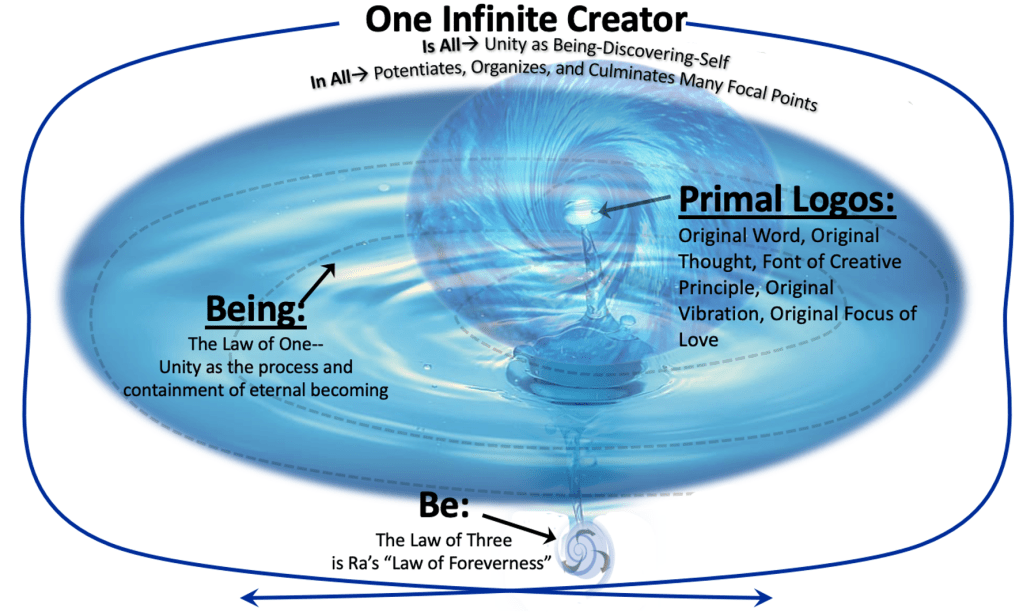
There is a more fundamental Law or Way embedded within the fabric of unity providing the spark–the eternal primal élan vital–which empowers the Law of One, the process of beautification. The Law or Way of Three is the “be” in “being,” the “unit” in “unity,” the “one” in “oneness.” For those who study the Ra Contact, I think that the Way of Three is what Ra entitles the “Law of Foreverness.” Note also, even here at Daskalos’s Absolute Be-ness1, there is no uniformity, but only diversity.
Buzzing Be Flowering Beauty
Ra admits that they could not see into the depth of the mystery-clad heart of being. They describe the fundamental nature of being, or unity, as “rhythms” (S27:Q7) which are “unexplained, inarticulate, mystery-clad” (S1:Q10)[…] [and] “undistorted” (S27:Q7). Further, they similarly describe the next phase of evolution which awaits them as also shrouded in mystery” (S78:Q10, (86.16). Actually, “mystery” is quite a good term if we look at it as not something we cannot understand, but as something that is endlessly understandable! Quoting my spiritual father, Richard Rohr2, “[Mystery] is multilayered and pregnant with meaning and never totally admits to closure or resolution.”3 At the heart of fundamental being hidden in mystery is the buzzing ‘be’ of the Law of Three.

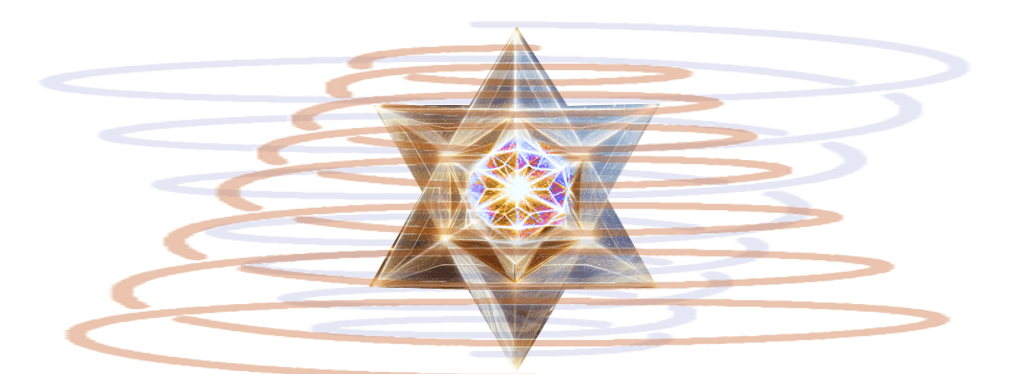
Simply stated, the nature of the Way of Three holds that every contrast potentiates tension, every tension potentiates resolution, and every resolution potentiates a higher order of contrast. If the nature of the Law of One (the Way of Unity) is the process and containment of eternal beautification, then the Law of Three is the eternal spark, the lifeforce, thrusting the unfolding of ever intenser beauty.
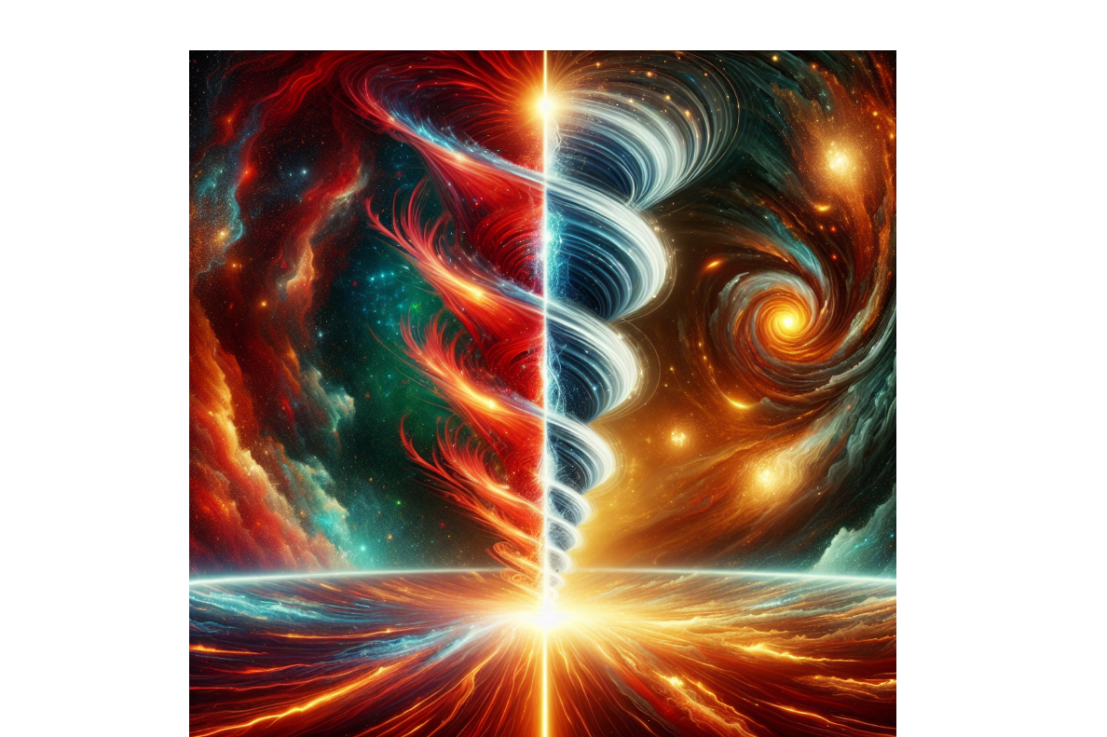
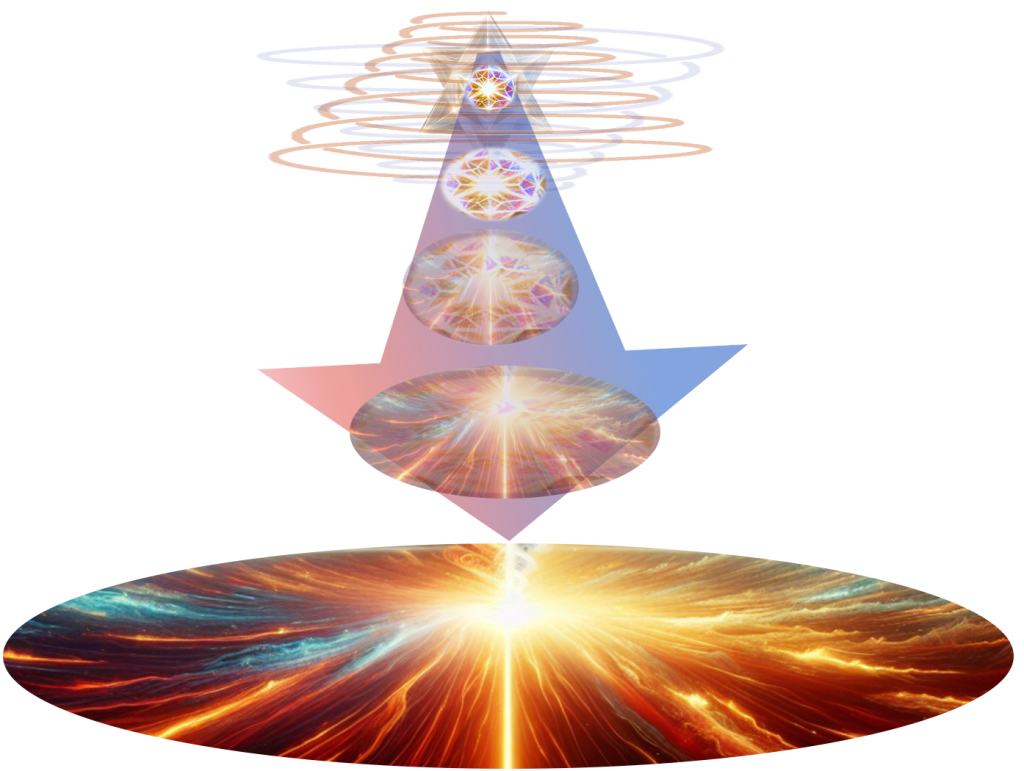
Process philosophy, of which the Ra Contact is a form, suggests that creation does not emerge ex nihilo4, as something arising without precedent. There is no ultimate void, no total emptiness at the center of centers. In response to (Ra Contact’s questioner) Don Elkins’ use of ‘void,’ Ra suggests replacing it with ‘plenum’ (S82:Q6): “[C]onfusion lies in the term, ‘void’. We would substitute the noun, ‘plenum’” (S82:Q6). In another exchange, Ra metaphorically describes the darkness of unintelligent infinite plenum as being pure charged chaos. From within darkness of pure undistorted chaotic plenum, arises the dawn of awareness. In the dark hidden depth, potentiated light breaks through the ‘be’-‘being’ barrier5 catalyzing a singular locus of infinity to organize in spiral fashion towards a clear focus of will.
“The concept of the white light […] being prismatically separated and later, at the final chapter, being absorbed again is basically correct. However, there are subtleties involved which are more than semantic. The white light which emanates and forms articulated [logoi] has its beginning in what may be metaphysically seen as darkness. The light comes into that darkness and transfigures it, causing the chaos to organize and become reflective or radiant. Thus the dimensions come into being.” (S41:Q1)
The chaotic and inarticulated plenum is living bubbling potentiation–a quantum primordial field whose nature is simply the power of generativity, itself: contrast-potentiating-tension-potentiating-resolution-potentiating-higher grade contrast.
The Law of Three is always present in every entity no matter how grand or infinitesimally small. In fact, every iota of creation is an expression of, operates from, and ushers forward this foundational ontological dynamism. It is hidden because it is always and everywhere operating. It should not surprise us, then, that Ra never mentions the Law of Three, nor does the esteemed process philosopher, Alfred North Whitehead, for that matter. Nevertheless, both assume its presence and rely on its function for their interpretations of metaphysics.
In contemplating this fundamental principle, I let my imagination have fun in trying to intuit how the Law of Three feels if I were imbedded inside. See what you think, and maybe you can come up with some good ones, too:
- infinite churning plenum poised at the brink of more;
- fundamental-frictionless motion longing to heat up,
- absolute-nonviscous flow wanting to grasp;
- intangible joy yearning for touch.
- active yeast waiting for sugar and water
- tensionless tension seeking release
Principle of Teleopotentiation
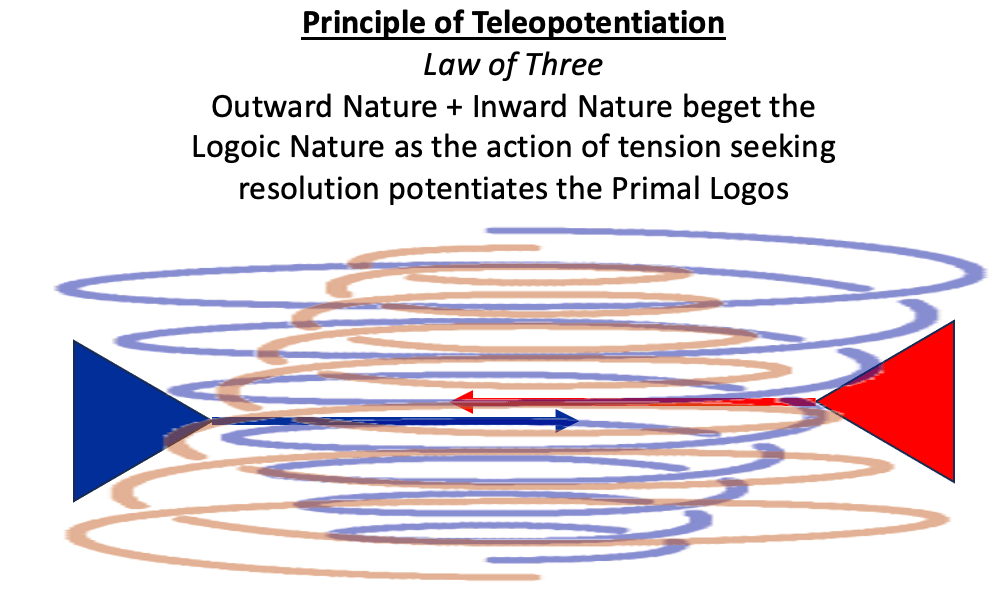
Because the Way of Three undergirds and gives rise to the Way of Unity (the Law of One), it is the fundamentum of fundamental principles–the single and original metaphysic from which all metaphysics derive. The Law of Three is not only pure potentiation but a potentiation which is generative, organizing, and directed towards completion. From the buzzing be being ensues. Heretofore, I refer to this original principle – Ra’s unexplained, inarticulated, shrouded mystery at the heart of being – as the principle of teleopotentiation.
The principle of teleopotentiation captures the fundamental metaphysical dynamic described in both Ra’s and Whitehead’s cosmologies, where reality emerges through an intrinsic process of purposeful becoming. Just as Whitehead sees reality as a creative advance where “the many become one and are increased by one,” and Ra speaks of the “Creator” as the Experiencer of the One Eternal Event of infinity becoming increasingly knowledgeable of itself, teleopotentiation names that mysterious generative force through which contrast potentiates tension, tension potentiates resolution, and resolution potentiates higher-order contrast.
The term combines “telos,” the Greek concept of natural unfolding toward completion, with “potentiation,” the Latin-derived notion of power seeking to become actualized, to describe how this threefold dynamic serves as the primal spark or élan vital that drives Ra’s “Law of One” and for Whitehead, creativity, itself. Teleopotentiation embodies both Whitehead’s process of concrescence—where actual occasions integrate contrasts to achieve more complex unities—and Ra’s understanding of unity as an infinite field that both generates and contains all becoming, enabling intelligent infinity to experience itself through ever-increasing intensities of manifestation. In sum, for Whitehead and Ra, the principle of teleopotentiation operates as the hidden engine of becoming, the fundamental dynamic through which reality eternally unfolds toward greater complexity, harmony, and self-knowing.

The intelligent infinity discerned a concept. This concept was discerned due to freedom of will of awareness. This concept was finity. This was the first and primal paradox or distortion of the Law of One. Thus the one intelligent infinity invested itself in an exploration of many-ness. Due to the infinite possibilities of intelligent infinity there is no ending to many-ness. The exploration, thus, is free to continue infinitely in an eternal present (S13:Q12).
The One Infinite Creator
Who or What, then, is the Creator, according to Ra? Here are pivotal quotes from the Ra Contact which help illuminate the mystery:
- […] the Creator is all that there is (S18:Q13)[…]
- The Creator is the focusing of infinity as an aware or conscious principle called by us as closely as we can create understanding/learning in your language, intelligent infinity (S13:Q7).
- […] creation is infinity (S13:Q5) [and] is itself a form of consciousness which is unified (S82:Q12) […].
- The Creator does not properly create as much as It experiences Itself (S82:Q10).
- The Law of One […] may be approximated by stating that all things are one, that there is no polarity, no right or wrong, no disharmony, but only identity. All is one, and that one is love/light, light/love, the Infinite Creator (S4:Q20).
- The basic rhythms of intelligent infinity are totally without distortion of any kind. The rhythms are clothed in mystery, for they are being itself. From this undistorted unity, however, appears a potential in relation to intelligent energy (S27:7).
- [Love or Intelligent Energy] must be defined against the background of intelligent infinity or unity or the One Creator with the primal distortion of free will. The term Love then may be seen as the focus, the choice of attack, the type of energy of an extremely, shall we say, high order which causes intelligent energy to be formed from the potential of intelligent infinity in just such and such a way. This then may be seen to be an object rather than an activity by some of your peoples, and the principle of this extremely strong energy focus being worshiped as the Creator instead of unity or oneness from which all Loves emanate (S27:Q12).
- Intelligent infinity has a rhythm or flow as of a giant heart beginning with the central sun as you would think or conceive of this, the presence of the flow inevitable as a tide of beingness without polarity, without finity; the vast and silent all beating outward, outward, focusing outward and inward until the focuses are complete. The intelligence or consciousness of foci have reached a state where their, shall we say, spiritual nature or mass calls them inward, inward, inward until all is coalesced. This is the rhythm of reality (S27:Q6).
- Let us remember that we are all one. This is the great learning/teaching. In this unity lies love. This is a great learn/teaching. In this unity lies light. This is the fundamental teaching of all planes of existence in materialization. Unity, love, light, and joy; this is the heart of evolution of the spirit (S52:Q11).
- There is unity. This unity is all that there is. This unity has a potential and kinetic. The potential is intelligent infinity. Tapping this potential will yield work. This work has been called by us, intelligent energy. The nature of this work is dependent upon the particular distortion of free will which in turn is the nature of a particular intelligent energy or kinetic focus of the potential of unity or that which is all (S27:Q5).
- This energy is intelligent. It is hierarchical (S3:Q8).
- Only up to a very short point. After this point, the many-ness of distortions are equal one to another. The first distortion, free will, finds focus. This is the second distortion known to you as Logos, the Creative Principle or Love. This intelligent energy thus creates a distortion known as Light. From these three distortions come many, many hierarchies of distortions, each having its own paradoxes to be synthesized, no one being more important than another (S15:Q21).
- There is the same difference between love/light and light/love as there is between teach/learning and learn/teaching. Love/light is the enabler, the power, the energy giver. Light/love is the manifestation which occurs when light has been impressed with love (S15:Q:22).
- A very great deal of creation was manifested without the use of the concepts involved in consciousness, as you know it. The creation itself is a form of consciousness which is unified, the Logos being the one great heart of creation. The process of evolution through this period, which may be seen to be timeless, is most valuable to take into consideration, for it is against the background of this essential unity of the fabric of creation that we find the ultimate development of the Logoi which chose to use that portion of the harvested consciousness of the Creator to move forward with the process of knowledge of self. As it had been found to be efficient to use the various densities, which are fixed in each octave, in order to create conditions in which self-conscious sub-Logoi could exist, this was carried out throughout the growing flower-strewn field, as your simile suggests, of the one infinite creation (S82:Q12).
Unpacking these quotes is fun but tedious. I first encountered the Ra Contact in September 2013 and was mesmerized by the depth, nuance, and mystery. Since then, I have increasingly deepened my engagement finding layers upon layers of meaning which uncover a way of viewing the world from both a universal metaphysical lens – viewing the whole cosmological map and seeing how the parts fit together – and a singular participative lens – viewing the map from the inside by participating in the unfolding of the whole through the parts becoming actualized. What follows is my attempt at translating Ra’s quotes above into synthesized concepts that I hope foster some clarity while maintaining the mesmerizing mystery. Whitehead will help me.
One Unity, Three Natures of the One Infinite Creator
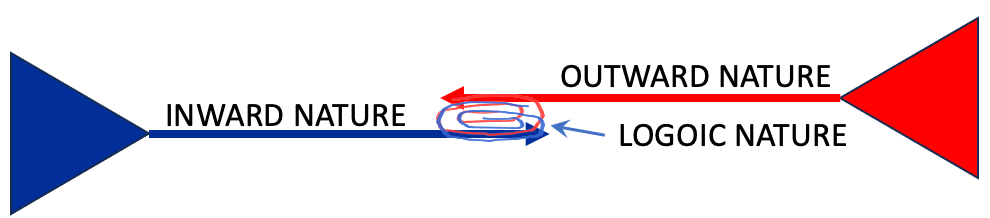
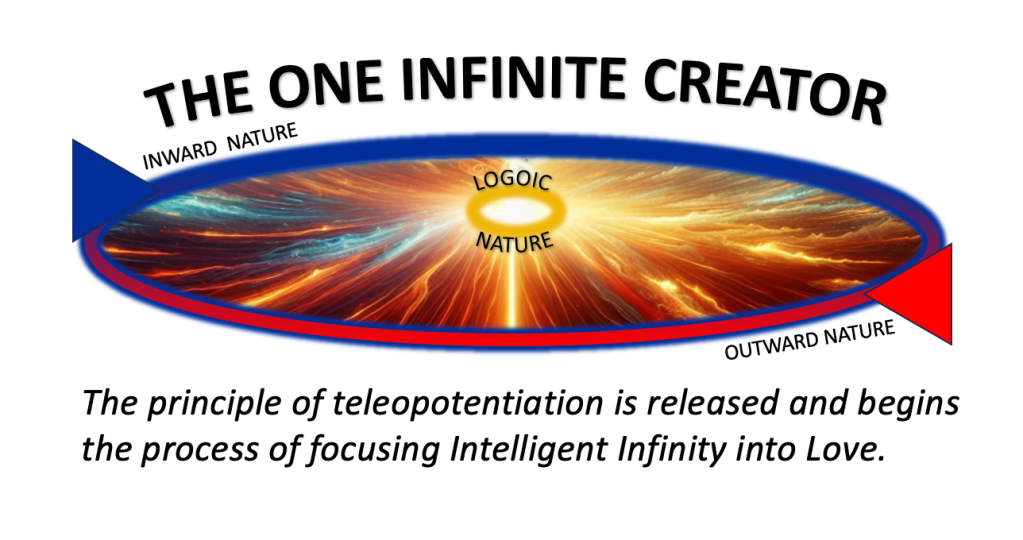
In Christianity as well as in some other spiritual traditions, God is understood to be One and Three. Ra infers this metaphysic as well. Simply put, the One Infinite Creator – or God – is Unity. In Unity there are three Natures. These Three Natures together give rise to the One Experience which is contained inside of unity. I have labeled these divine natures as the Outward Nature, the Inward Nature, and the Logoic Nature.
Let us remember that we are all one. This is the great learning/teaching. In this unity lies love. This is a great learn/teaching. In this unity lies light. This is the fundamental teaching of all planes of existence in materialization. Unity, love, light, and joy; this is the heart of evolution of the spirit (S52:Q11).
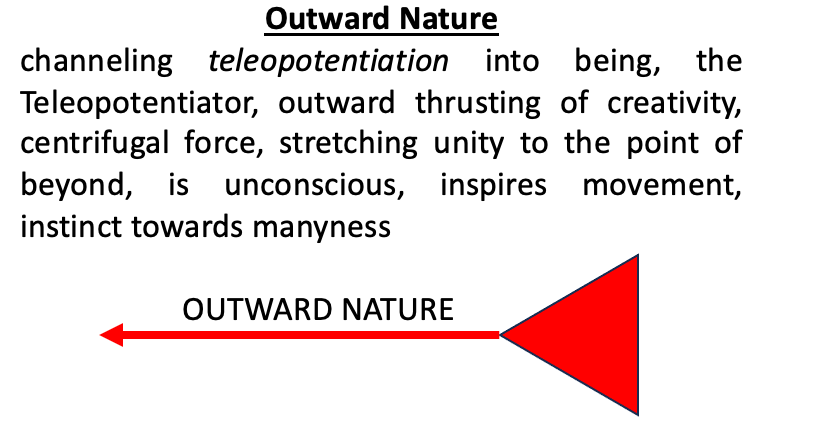
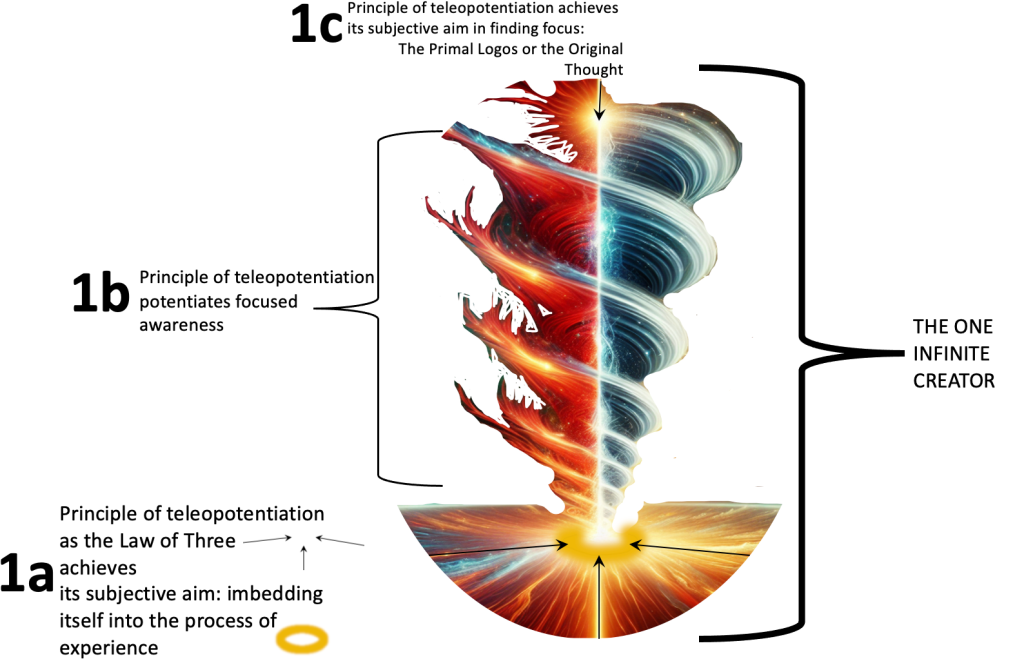
Rather than viewing these natures linearly, as they appear here, we must attempt to conceive them as three loci, or “poles,” if you prefer, working together to create one experience. This one experience is for the sole purpose of deepening the Creator’s gnosis of Itself. The Outward Nature and the Inward Nature are two polarities inside of the field of unity. The Logoic Nature is located in the middle and is that nature which evolves. Powered by the principle of teleopotentiation (the Law of Three), the Outward Nature and the Inward Nature create the contrast which potentiates the emergence of the Logoic Nature borne from tension and aiming towards resolution.
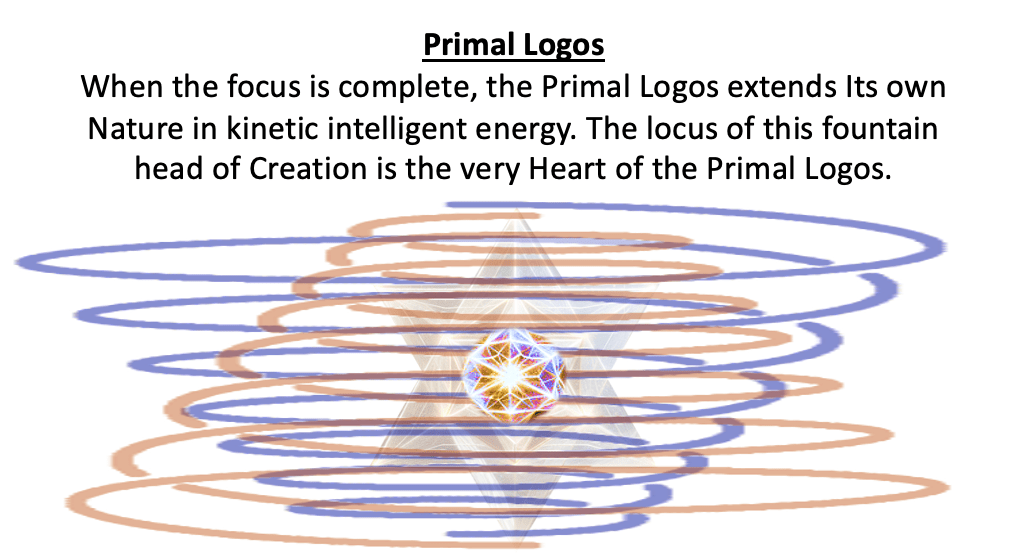
The tension produced by the Outward and Inward Natures inaugurates the process of focusing, and then intensifies the process until awareness of both the tension and the desire to resolve it focuses itself into a singular idea poised on the edge of action. Ra calls this focused idea the Original Thought. Thus the Primal Logos is begotten.
In the beginning was the Primal Logos, and the Primal Logos was with the Creator, and the Primal Logos was the Creator. The Primal Logos was in the beginning with the Creator. All things came to be through the Primal Logos and without the Primal Logos, nothing came to be (Gospel of John 1:1-3)
The Primal Logos, according to Ra, is “a protean6 entity which grows and learns upon the [ultimate] macro scale” (S78:Q22). Throughout the Ra Contact, Ra gives multiple nuanced descriptions of the Primal Logos, including: the Original Thought (S1:Q0; S1:Q10; S82:Q10), the Original Word (S82:Q10), Love (S13:Q7), the Original Vibration (S54:Q8), the Primal Co-Creator (S27:Q13), the Creative Principle (S15:Q21), the Second Primal Distortion (S27:Q12), the [singular origin of] Infinite Strength (S27:Q15), the One Frequency (S27:Q15), and the [singular origin of] Infinite Energy (S13:Q7).
Creative Principle
This paragraph is a bit of a restatement of my words above. Remember, mystery is not something which we cannot grasp, but something that we can never exhaust the myriad of ways to approach it. Here is another attempt to engage with this mystery-clad reality of being from another angle. The Outward and Inward Natures give rise to the Logoic Nature as a novel phenomenon within Intelligent Infinity called by Ra, “Intelligent Energy.” This first emergence of Intelligent Energy, also called Love, is an apparent “finite” particularity that is intelligent, desires to create, and possesses the means to do so. All of this nuance within the Godhead is the Law of Three (the principle of teleopotentiation) turned until the click of leveling up a higher-grade order of awareness is marked. The Primal Logos as Love is like a fully plumed dandelion about to release itself into the world: primed with teleopotentiation and ready with the desire to explore. This potentiated state is what Ra calls the “Creative Principle.”
What follows is the business of unpacking all of the layers of meaning from what it means to be being. The image of Mary Poppins unpacking her seemingly bottomless suitcase comes to mind.

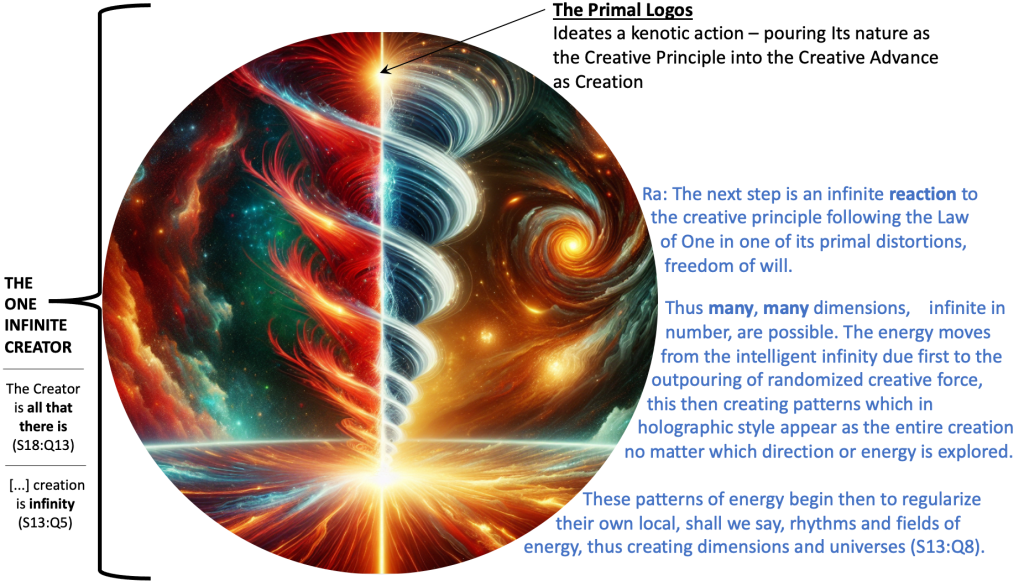
There is no end to this eternal beauty-producing stratagem. The Primal Logos sings Itself forward – an “Om7” of outward kenosis8. This action of outpouring Love stretches the fabric of unity to the maximal limit while simultaneously catalyzing the Creator’s Inward Nature to react in equal and opposite fashion. Rather than nullifying the original “Om,” the inward reaction fractalizes the outward motion into new complexities – emergent events of the Creator – brought through the Primal Logos, to advance the Creator’s gnosis of Itself.
How can infinite awareness know itself? It first must desire to know, then ideate a way to know, then enact this way. The way is that of the holy illusion of finitude and the subsequent reaction of emergent “finite” events of the Creator relating with each other, complexifying, and evolving.
The next step is still at this space/time nexus in your illusion achieving its progression as you may see it in your illusion. The next step is an infinite reaction to the creative principle following the Law of One in one of its primal distortions, freedom of will. Thus many, many dimensions, infinite in number, are possible. The energy moves from the intelligent infinity due first to the outpouring of randomized creative force, this then creating patterns which in holographic style appear as the entire creation no matter which direction or energy is explored. These patterns of energy begin then to regularize their own local, shall we say, rhythms and fields of energy, thus creating dimensions and universes (S13:Q8).
More About the Divine Natures
The following represents my own adventures of ideas.9 See if they inspire you, or perhaps, perplex you into your own adventures.
Outward Nature: channeling teleopotentiation into being, the Teleopotentiator, outward thrusting of creativity, Centrifugal force, stretching unity to the point of breaking, is unconscious, inspires movement, instinct towards manyness
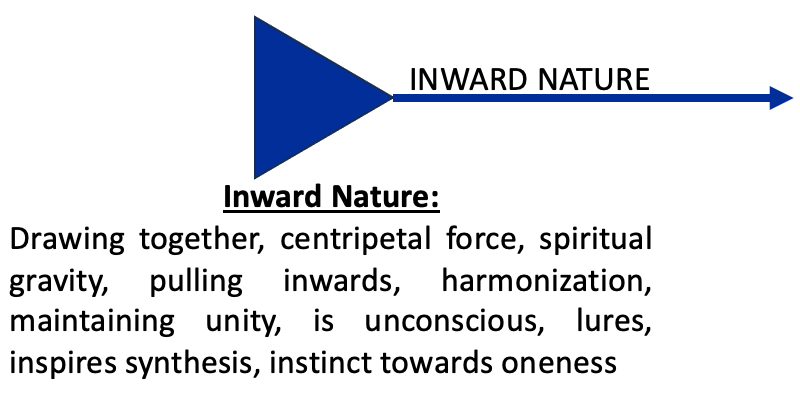
Inward Nature: Drawing together, Centripetal force, Spiritual Gravity, Pulling Inwards, Harmonization, maintaining unity, offers potentials, is unconscious, lures, inspires synthesis, instinct towards oneness
Logoic Nature: learns, grows, complexifies, nuances, refines, moves, thinks, feels, gives, receives, structures, and becomes conscious, chooses, processes, significator.

References
- Atteshlis. S (1992). The Esoteric Teaching: A Christian Approach to Truth. The Stoa Series, Cyprus. In the teachings of Dr. Stylianos Atteshlis—known to his students as Daskalos, the gentle mystic of Cyprus—Absolute Be-ness represents the ineffable source from which all existence emerges.
Daskalos describes Absolute Be-ness as the ultimate reality beyond all forms, beyond all qualities, beyond even being and non-being. It is the primordial ground of existence—unmanifested, unbound, and undifferentiated. Unlike the personal God of many traditions, Absolute Be-ness transcends personality entirely, existing as pure potentiality and infinite consciousness.
This concept flows from Daskalos’ esoteric Christian mysticism, blending elements of Gnosticism and Neoplatonism. For him, Absolute Be-ness is not merely an abstract philosophical concept but the living foundation of reality itself—that which eternally breathes life into all creation through divine emanation.
What makes Daskalos’ understanding particularly profound is how he positions Absolute Be-ness as both utterly transcendent yet intimately connected to all existence. From this limitless ocean of pure consciousness emerge the waves of manifestation—the Holy Trinity, the divine realms, and eventually our material universe—all while never diminishing or becoming separate from their source. ↩︎ - http://www.cac.org ↩︎
- Rohr, R (2008). Things Hidden: scripture as spirituality. https://www.goodreads.com/book/show/2225798.Things_Hidden ↩︎
- The phrase “ex nihilo” comes from Latin, literally meaning “out of nothing” or “from nothing.” It combines “ex” (from/out of) with “nihil” (nothing). This phrase is commonly used in philosophical and theological contexts, particularly in discussions of creation or original ideas emerging without precedent. ↩︎
- a play on the blood-brain barrier ↩︎
- Taken from an AI search for the definition of “protean”: Protean means highly versatile, variable, or able to take on many different forms or meanings. It comes from Proteus, a Greek sea god who could change his shape at will. For example, you might describe an actor with great range as “protean” for their ability to transform into vastly different characters, or call someone’s artistic style “protean” if it constantly evolves and changes. The word can also describe something that’s hard to pin down or define because it keeps shifting or has many different aspects. ↩︎
- In spirituality, “Om” (also spelled “Aum”) is one of the most sacred sounds and symbols. It holds profound significance across several Eastern spiritual traditions, particularly in Hinduism, Buddhism, and Jainism.
The meaning of Om includes:
* The primordial sound of the universe – Often described as the sound that was present at the creation of the universe and the sound from which all other sounds emerge.
* A representation of ultimate reality – In Hindu philosophy, Om represents Brahman, the ultimate reality or universal consciousness.
* The three states of consciousness – The three sounds (a-u-m) are sometimes interpreted as representing the three states of consciousness: waking (jagrat), dreaming (swapna), and deep sleep (sushupti).
* Unity of mind, body, and speech – When chanted, Om is believed to align these three aspects of being.
A meditative tool –
* The vibration produced when chanting Om is thought to resonate with the natural frequency of the universe, helping practitioners reach deeper states of meditation.
* In practice, Om is often chanted at the beginning and end of yoga sessions, prayers, and meditation practices. It’s considered both a sound to connect with the divine and a tool for focusing the mind and creating inner harmony. ↩︎ - Kenosis comes from the Greek word κένωσις (kénōsis), meaning “emptying” or “emptiness.”
Etymology:
Derived from the Greek verb κενόω (kenóō), meaning “to empty out” or “to deprive of content”
The root word is κενός (kenós), meaning “empty” or “void”
The suffix -σις (-sis) in Greek forms abstract nouns of action or process
The term has significant theological meaning, particularly in Christian contexts:
In Christian theology, kenosis refers to Christ’s self-emptying or relinquishment of divine attributes in the incarnation
This concept comes from Philippians 2:7 in the New Testament, where Christ “emptied himself” (ἑαυτὸν ἐκένωσεν, heauton ekenōsen) by taking human form
The doctrine of kenosis addresses how divinity and humanity coexist in the person of Jesus
Beyond theology, kenosis has been adopted in philosophical and psychological contexts to refer to:
The emptying of the self or ego
A state of selflessness or self-renunciation
In some Eastern spiritual traditions, concepts similar to kenosis refer to emptying oneself of attachments
The word entered English usage in the mid-19th century, primarily in theological discussions. ↩︎ - Whitehead, Alfred North. Adventure of Ideas. Free Press, 1967.
“Adventure of Ideas” is one of Alfred North Whitehead’s major philosophical works, published in 1933. The book examines the development of civilization through the lens of the “adventures” of ideas throughout history. Whitehead explores how certain fundamental concepts have evolved and influenced human society, culture, and thought.
The book is structured around four main sections:
Sociological – examining how ideas shape societies
Cosmological – exploring the development of scientific and metaphysical concepts
Philosophical – investigating truth, beauty, art, and adventure
Civilization – synthesizing these threads into a vision of human progress
Whitehead argues that civilizations advance through the interplay of “adventure” (the exploration of new ideas) and “peace” (the harmonious integration of these ideas). He presents a sweeping historical narrative that traces how concepts like freedom, equality, and democracy emerged from ancient Greece and Rome, developed through Christianity, and evolved into modern Western civilization.
A central theme is Whitehead’s process philosophy, which views reality as dynamic and interconnected rather than static. He emphasizes that ideas are not abstract concepts but living forces that actively shape experience and society.
↩︎
 Building 4th Cosmic Christ