by Doug Scott, MA, MSW, LCSW
Abstract
This essay explores the principle of teleopotentiation as embodied in the Law of Three—a ternary framework that transcends binary thinking to reveal how transformation occurs through the creative interaction of opposing forces. The essay examines the three essential phases of developmental processes: contrast (the encounter with difference), tension (the dynamic energy created by opposition), and resolution (the transformative synthesis that transcends the original opposition). Rather than following a circular pattern, this process creates a developmental spiral where each resolution opens possibilities for more sophisticated growth. The essay integrates perspectives from the Ra Contact (Law of One material), revealing how teleopotentiation serves as the purposeful thrust behind cosmic evolution through the primary distortions of Free Will, Love, and Light. Connections to Whiteheadian process philosophy demonstrate how concrescence—the integration of contrasting elements into unified wholes—exemplifies teleopotentiation as the driving force behind reality’s evolution toward greater complexity, consciousness, and joy. The framework offers practical applications across multiple domains, from personal development to social transformation, providing a methodology for working with opposition not as a problem to eliminate but as a necessary component of growth. By understanding teleopotentiation as the fundamental principle underlying all evolutionary processes, we gain both theoretical insight and practical tools for navigating complexity and fostering genuine transformation.
Keywords: Teleopotentiation, Law of Three, Contrast-Tension-Resolution, Developmental Spiral, Reconciling Force, Binary Transcendence, Process Philosophy, Ra Contact, Concrescence, Unity-Love-Light, Whiteheadian Metaphysics, Consciousness Evolution, Cosmogenesis, Transformative Synthesis, Raian Perspective, Ambivalence, Polar North, Spiritual Development, Social Transformation, Holistic Integration
Introduction: Beyond Binary Thinking
Imagine standing at a crossroads where two paths diverge. Conventional wisdom often tells us we must choose one path or the other—this or that, right or wrong, us or them. Our world increasingly reinforces this binary thinking, creating polarization and division. But what if there is another way? What if the most transformative path is not choosing between the two but discovering a third way that transcends and includes both?
This is where the principle of teleopotentiation offers its extraordinary insights. Rather than seeing development as the result of opposition where one side must prevail, it reveals a ternary (three-part) process where transformation emerges through the creative interaction of different forces.
In binary thinking, we often conceptualize progress as the victory of one side over another: light overcomes darkness, good defeats evil, truth dispels falsehood. This approach seeks to eliminate one pole of a duality in favor of the other.
The Law of Three offers a fundamentally different understanding. It recognizes that opposition is not something to be eliminated but a necessary component of growth. Progress comes not through victory but through transformation—specifically, through the introduction of a third force that changes the relationship between opposites.
As Cynthia Bourgeault explains, “the problem will never be solved through eliminating or silencing the opposition but only through creating a new field of possibility large enough to hold the tension of the opposites and launch them in a new direction.”¹ This represents a radical shift in how we understand change and development.
The Three Essential Phases: A Unified Framework
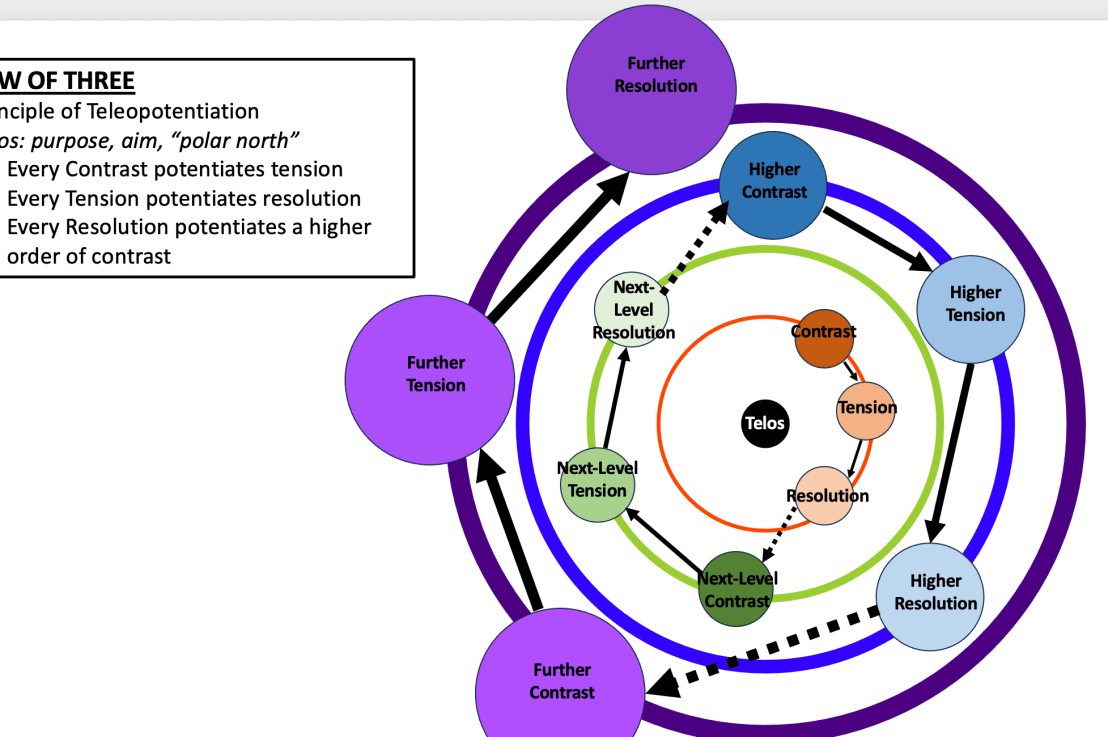
At the heart of the Law of Three are three distinct phases that form the basis of all developmental processes: contrast, tension, and resolution. Understanding how these phases interact and build upon each other is key to grasping the full power of this framework.
Phase 1: Contrast – The Beginning of Possibility
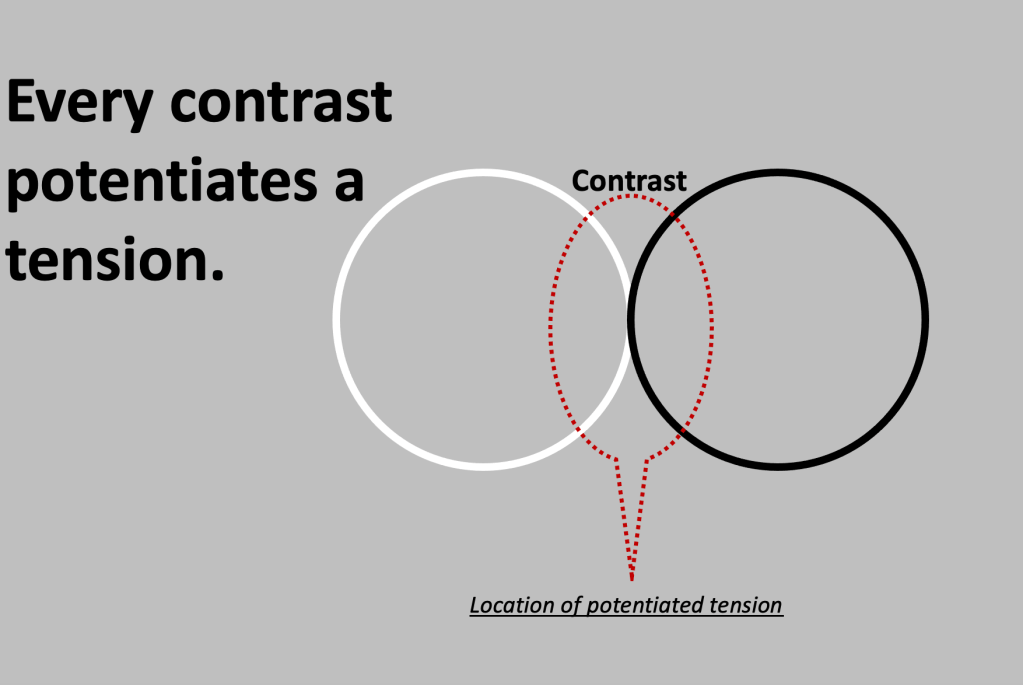
Contrast occurs when we encounter difference or opposition. Imagine two different perspectives, values, or forces that stand apart from each other. These differences are not problems to be solved but the necessary starting point for development.
In learning, contrast might appear as the difference between what you currently know and what you need to learn. In relationships, it might be the difference between your perspective and another person’s viewpoint. In nature, it could be the difference between a seed and the environment it needs to grow in.
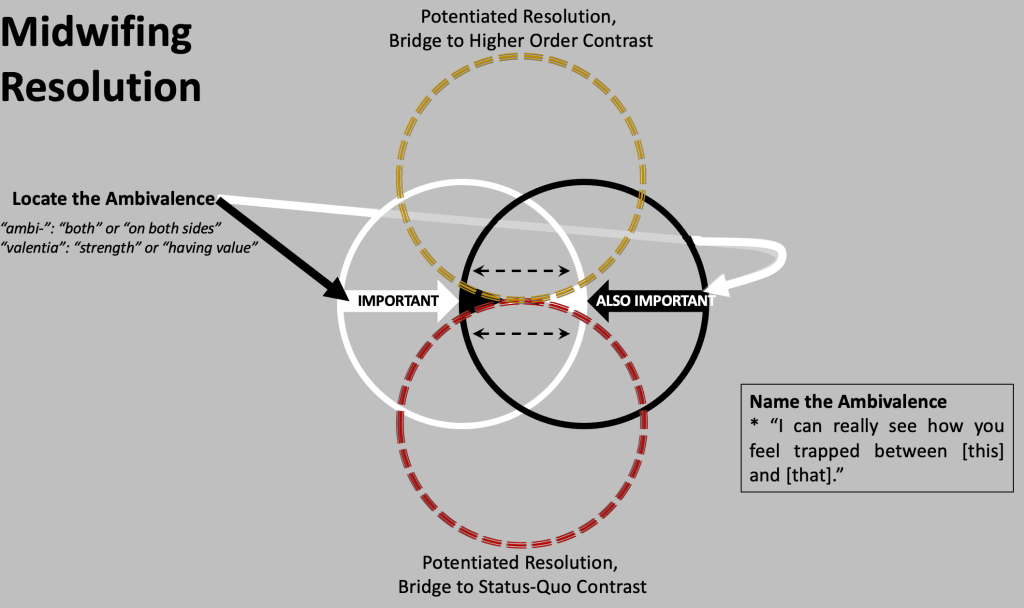
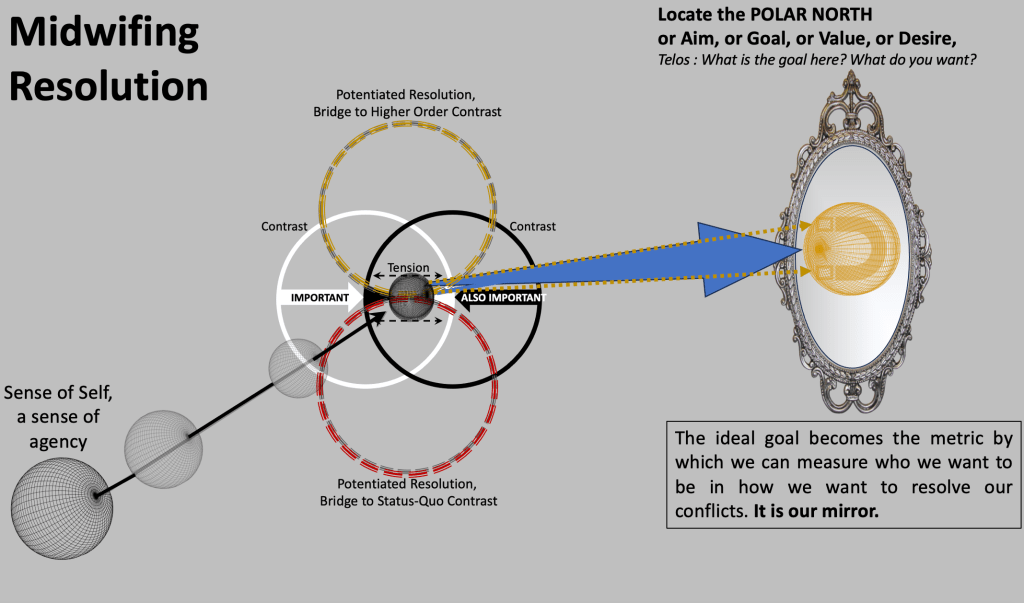
Visual representations of contrast often show two distinct circles—one white and one black—representing different elements that stand in contrast to each other. The area where these contrasting elements overlap creates the “location of potentiated tension.”
Phase 2: Tension – The Dynamic Energy
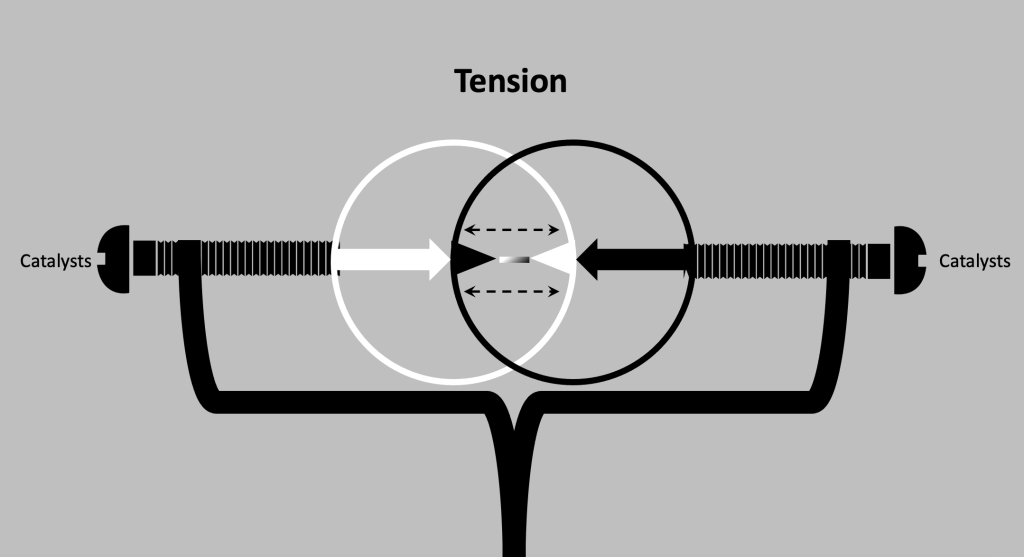
When contrasting elements interact, they create tension—the dynamic energy that emerges from difference. This is not necessarily negative; it is simply potential energy, like a stretched rubber band or a compressed spring, containing the possibility for movement and change.
In learning, tension might manifest as the discomfort of not understanding something yet. In relationships, it could be the friction that arises when different viewpoints encounter each other. In nature, it is the pressure a germinating seed exerts against its shell and the surrounding soil.
Mechanical representations of tension often show overlapping circles with opposing forces creating pressure at their intersection. Bidirectional arrows within the overlap zone indicate that tension creates a vibrant, energetic field with movement and potential. This helps us visualize tension as a dynamic force rather than a static state.
Phase 3: Resolution – The Transformative Synthesis
Resolution occurs when tension transforms into a new synthesis that transcends the original opposition. This is not about one side “winning” or compromising but about the emergence of something genuinely new that could not exist without the preceding contrast and tension.
In learning, resolution might be the “aha moment” when understanding dawns. In relationships, it could be finding a perspective that honors both viewpoints while opening new possibilities. In nature, it is the seedling breaking through the soil, neither just a seed nor just soil, but a new living entity.
The resolution phase presents not one but two potential pathways:
- The upward spiral path leading to developmental growth (often represented by a golden circle in diagrams)
- The path maintaining the current level of development (often represented by a red circle)
This reveals that resolution presents a choice point. We can resolve tension in ways that either maintain our current level or elevate us to a higher level. The quality of how we engage with resolution determines whether it becomes transformative.
The Developmental Formula
These three phases follow a predictable sequence that we can express as a formula:
- Every contrast creates potential for tension
- Every tension creates potential for resolution
- Every resolution creates potential for a higher-level contrast
This sequence does not merely return us to where we started but advances us to a new level where we encounter more sophisticated forms of contrast. This creates not a circle but a spiral of development, where each turn brings us to a higher plane of experience and understanding.
The Developmental Spiral: Beyond Simple Cycles
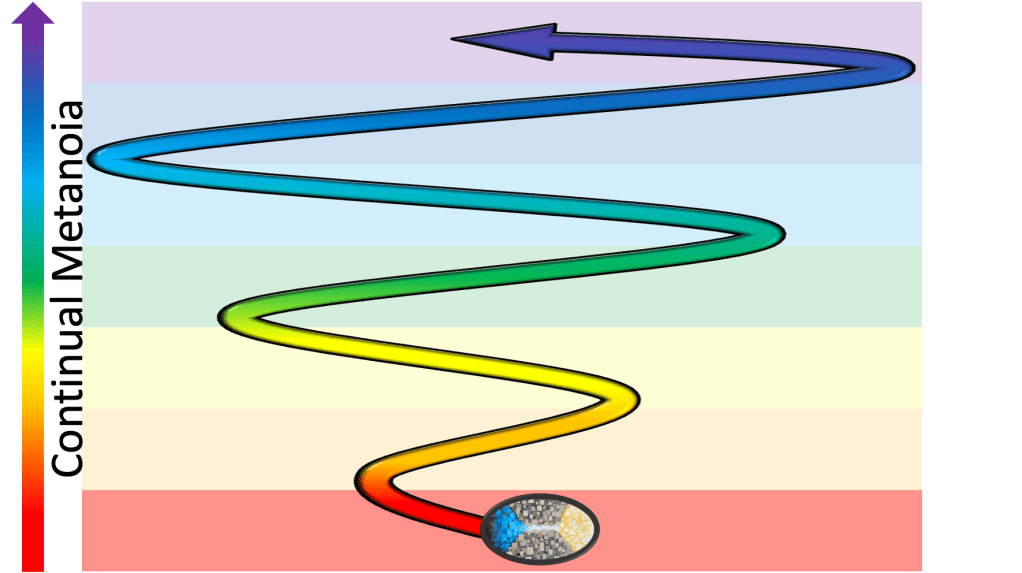
One of the most significant insights of the Law of Three is that development follows a spiral pattern rather than a circle or simple cycle. To understand this distinction, consider the difference between walking in a circle and climbing a spiral staircase.
When we walk in a circle, we eventually return to the exact same point where we started. Nothing has fundamentally changed; we have simply completed a loop.
When we climb a spiral staircase, however, each complete turn brings us to a point directly above where we started. We are in a similar position in terms of our orientation, but we have advanced to a higher level with a broader perspective.
Each level of the spiral encompasses greater breadth and depth than its predecessor, becoming more holistic and expansive. We can see this in how a child’s understanding of fairness evolves over time, becoming more nuanced and contextual while still building on earlier, simpler conceptions.
The Resolution Process in Detail
Resolution—where transformation actually occurs—involves several key steps that determine whether we actually advance to a higher level:
- Accepting the contrast: Acknowledging the reality of difference without attempting to eliminate it
- Acknowledging the tension: Feeling and recognizing the dynamic energy created by opposition
- Balancing oneself: Finding equilibrium amidst competing forces without being pulled entirely into one or the other
- Choosing to release the identity formed at the previous level: Letting go of attachment to our current understanding and self-concept
- Opening oneself to greater love: Expanding our capacity for integration and harmony
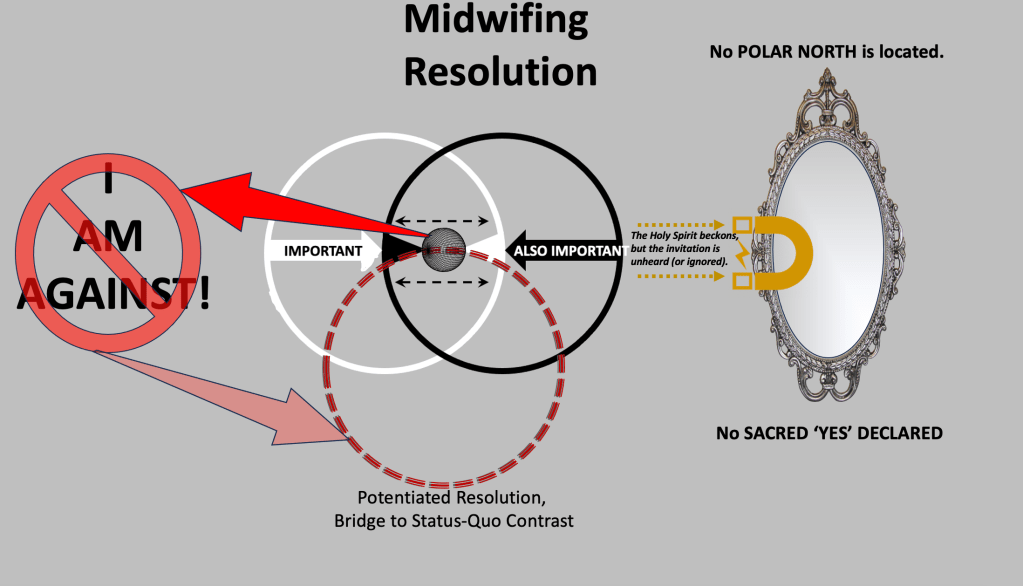
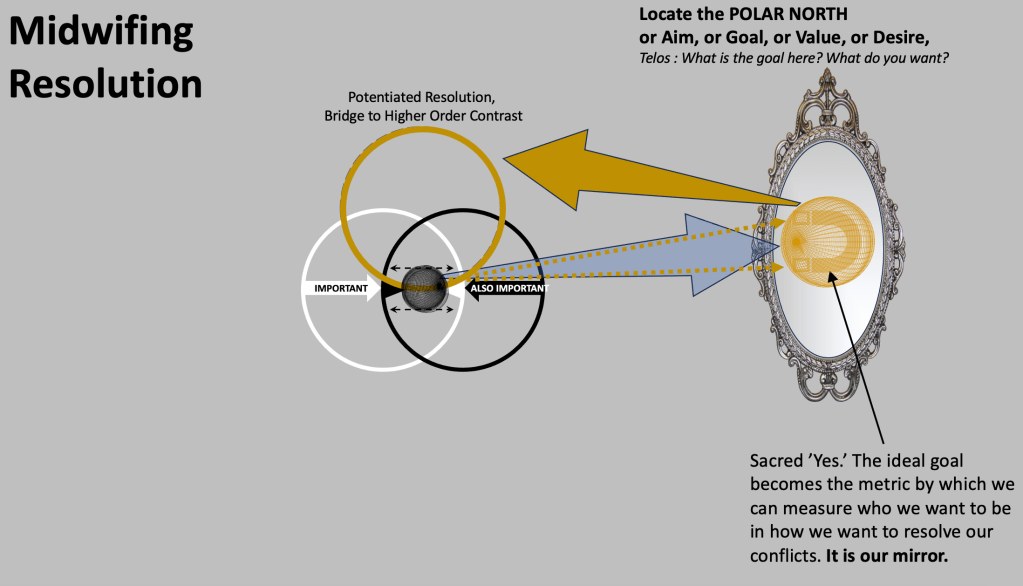
Resolution also involves establishing or reaffirming what the framework calls a “polar north”—a guiding orientation or highest aim that provides:
- Orientation in the developmental process
- A metric for evaluating progress
- Guidance for future directions
This “polar north” is not static but evolves as development proceeds, becoming more refined and comprehensive at each level of the spiral.
Resolution concludes when:
- Lessons have been integrated into our understanding and way of being
- New wisdom has been distilled into a coherent framework
- Previous experiences of contrast, tension, and imbalance are embraced with gratitude
- We feel prepared for rebirth into a new cycle of growth
These sub-phases mark the graduation from one order of experience to a higher one, representing not just intellectual understanding but embodied wisdom that transforms how we engage with the world.
The Ra Contact and Teleopotentiation: Illuminating the Unity Principle
The principle of teleopotentiation finds powerful expression in the metaphysical system presented in the Ra Contact, also known as the Law of One material. This channeled material presents a cosmology that aligns remarkably with the Law of Three, offering a complementary perspective on how reality evolves through purposeful transformation.
The Cosmogenesis of Unity
The Ra Contact describes a cosmology beginning with infinite unity—what Ra terms “intelligent infinity.” This unified consciousness becomes aware of itself at an instinctual level and reaches for experience by focusing into “intelligent energy” or “Logos,” which Ra equates with Love. This self-aware infinite unity then diversifies into countless individuated holons, each embarking on a journey of exploration and evolution.
As Ra states in Session 13: “The intelligent infinity discerned a concept. This concept was discerned due to freedom of will of awareness. This concept was finity. This was the first and primal paradox or distortion of the Law of One. Thus the one intelligent infinity invested itself in an exploration of many-ness.”
This cosmogenesis mirrors the teleopotentiating process: unity (thesis) creates diversity (antithesis), generating tension that potentiates a higher synthesis—what Ra calls “The Creator knowing itself.” The driving force behind this entire process is not random but teleological—purposefully oriented toward greater awareness, complexity, and joy.
The Three Primary Distortions: A Raian Law of Three
The Three Primary Distortions: Nested Resolutions in Raian Cosmology
The Ra Contact presents three primary distortions that structure reality, but a deeper analysis reveals that each distortion represents not merely a stage but a resolution of a prior contrast-tension dynamic, creating a sophisticated recursive pattern of teleopotentiation:
Free Will as Resolution
The first distortion emerges as the resolution of the tension between primordial non-awareness (Mystery-Clad Primordial Light, the Be state) and the nascent impulse toward self-knowledge. This contrast between undifferentiated being and the potentiality for experience creates a fundamental tension. Free Will resolves this tension by manifesting as the primal agency that seeks focused intention—the movement from static Be to dynamic Be-ing. As Ra describes it, the intelligent infinity discerned a concept, and this concept was discerned due to freedom of will of awareness. Free Will thus represents the first teleopotentiating resolution, establishing the foundation for all subsequent creation.
Love as Resolution
The second distortion emerges from the contrast between the process of focusing intention (enabled by Free Will) and the absence of kinetic energy to actualize this intention. This creates tension between potential and manifestation—between the will to experience and the capacity to fulfill that will. Love resolves this tension by emerging as the Primal Logos, the singular focus of Intelligent Light that receives the Creator’s will-pleasure and transforms it into actual creative impulse. Love becomes both the first individuated intelligence and the kinetic force that drives further creation, thus resolving the inherent limitations of Free Will operating alone.
Light as Resolution
The third distortion emerges from the contrast between the Primal Logos’s desire for diverse experience through individuated intelligences and the absence of vehicles for such experience. This creates tension between the will for expanded gnosis and the means to achieve it. Light resolves this tension by manifesting as the medium through which Prime Movers can arise and recapitulate the original creative act. Light is Primordial Light impressed, or programmed with Love’s programming to recapitulate the Infinite Creator’s original will-pleasure to express Its nature outwardly in order to gain gnosis. Light thus enables the proliferation of co-creative intelligences that fulfill the Creator’s desire for expanded self-knowledge.
This nested structure of resolutions demonstrates how teleopotentiation operates recursively throughout Ra’s cosmology. Each distortion not only builds upon but emerges from the previous through its own contrast-tension-resolution cycle. This creates a cosmogenesis that advances through successive resolutions, each creating the conditions for new levels of complexity and experience. The ultimate expression of this process manifests as Joy—the discovery that within unity, there can be two or more locations of intelligences that commune together, offering back to the Creator the sheer delight of being alive.
The Octave of Densities: Evolutionary Teleopotentiation
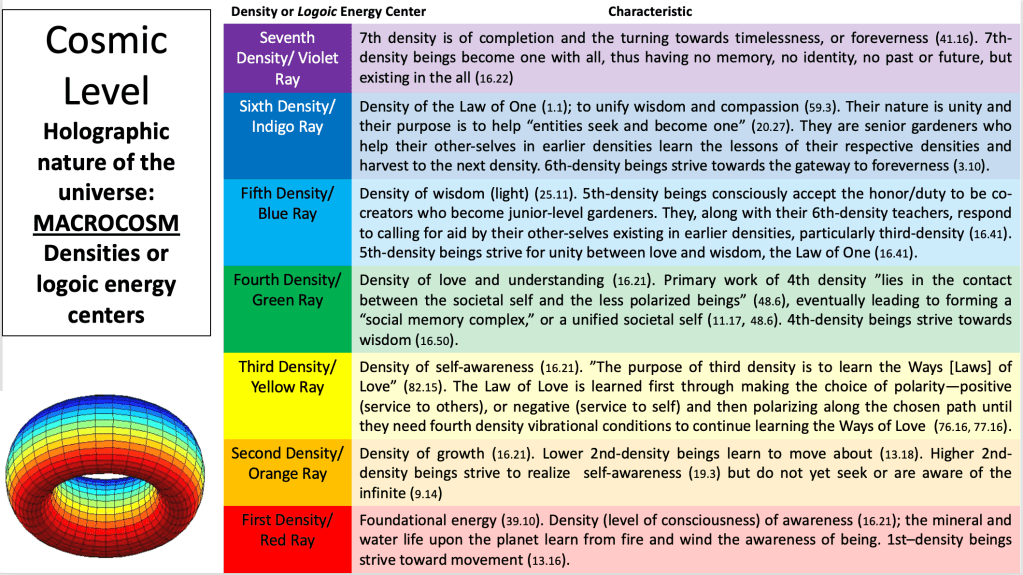
The Ra Contact describes reality as organized into an “octave” of densities, representing stages of consciousness evolution. Each density presents its own lessons and catalysts (tensions) that must be resolved to progress to the next level. This octave model exemplifies teleopotentiation as an evolutionary spiral:
- First Density: Awareness of elements (earth, air, fire, water)
- Second Density: Movement and growth (plant and animal consciousness)
- Third Density: Self-awareness and choice (human consciousness)
- Fourth Density: Love and understanding (social memory complexes)
- Fifth Density: Wisdom and balance
- Sixth Density: Unity consciousness
- Seventh Density: Gateway to the next octave
- Eighth Density: Return to intelligent infinity
Each density involves contrast (new lessons), tension (catalysts and challenges), and resolution (growth and harvest), with each resolution opening the way to a more complex level of consciousness. This parallels exactly the teleopotentiating spiral of development described in the Law of Three.
The Veiling and Catalyst: Teleopotentiation’s Mechanism
One of the most fascinating aspects of the Raian cosmology is the concept of “the veil”—a limitation on consciousness that creates the contrast necessary for accelerated growth. Prior to the veiling, entities experienced slow development precisely because there was insufficient contrast and tension.
As Ra explains, “Consider, if you will, the tendency of those who are divinely happy, as you call this distortion, to have little urge to alter or better their condition.” Without contrast and tension, there is insufficient impetus for growth.
The veiling creates the conditions for teleopotentiation by introducing contrast (separation, forgetting), which generates tension (catalyst, challenges), which when properly processed leads to resolution (polarization, harvest). This is the mechanism by which evolution accelerates.
The Heart of Spiritual Evolution
Perhaps the most direct expression of teleopotentiation in the Ra Contact comes in this powerful statement that encapsulates the essence of spiritual evolution:
“Let us remember that we are all one. This is the great learning/teaching. In this unity lies love. This is a great learn/teaching. In this unity lies light. This is the fundamental teaching of all planes of existence in materialization. Unity, love, light, and joy; this is the heart of evolution of the spirit” [Session 52, Question 11].
This statement reveals the teleological nature of evolution—it is purposefully oriented toward unity, love, light, and joy. These are not merely byproducts but the very purpose and direction of evolutionary development. The teleopotentiating thrust moves all creation toward this fulfillment.
The Raian perspective illuminates how the teleopotentiating process operates at a cosmic scale, driving the evolution of consciousness through increasingly complex iterations of contrast, tension, and resolution, all oriented toward greater unity, love, light, and joy.
Whiteheadian Process Thought and Teleopotentiation
Understanding Concrescence
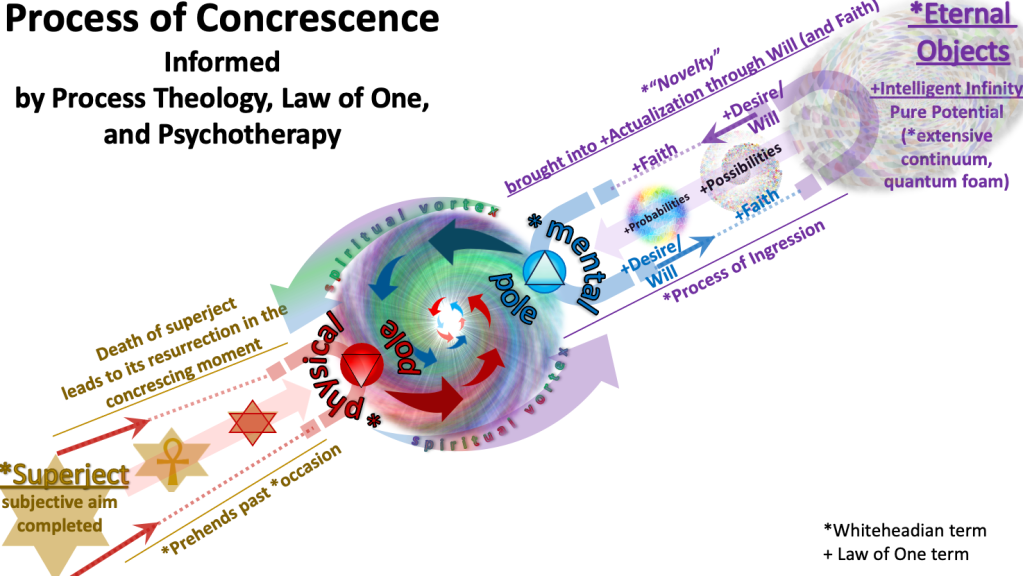
Alfred North Whitehead’s process philosophy offers a metaphysical framework that deeply resonates with the principle of teleopotentiation. At the heart of Whitehead’s thought is the concept of “concrescence,” a term he coined to describe the process by which a new entity—what he calls an “actual occasion” or “actual entity”—comes into being.²
Concrescence literally means “growing together” and refers to how disparate elements are integrated into a unified whole. In Whitehead’s framework, reality is not made up of static substances but of dynamic events or processes of becoming. Each actual occasion is a momentary instance of experience—not necessarily conscious experience, but a more fundamental kind of feeling or prehension that characterizes all entities in the universe, from electrons to human beings.³
What makes Whitehead’s vision so compatible with teleopotentiation is that each instance of concrescence follows a pattern remarkably similar to the Law of Three:
- Prehension of data (Contrast): Each new actual occasion begins by “prehending” or taking in the data of its world—the multiplicity of past actual occasions that form its environment.⁴
- Integration of contrasts (Tension): The actual occasion then engages in a process of integrating these diverse and often contrasting elements, guided by what Whitehead calls its “subjective aim.”⁵
- Satisfaction (Resolution): The process culminates in “satisfaction”—a fully determinate unity that represents the completion of that actual occasion’s becoming.⁶
After reaching satisfaction, the actual occasion perishes as a process of becoming and transforms into “objective immortality”—becoming data for future occasions in an ongoing cycle of creation.
The Teleological Nature of Concrescence
What drives the process of concrescence is fundamentally teleological—guided by purpose or aim. Each actual occasion has what Whitehead calls a “subjective aim” that guides how it integrates the data it prehends. This aim is not arbitrary but is derived from what Whitehead calls the “primordial nature of God,” which provides each occasion with its initial aim.⁷
This directly parallels the “teleo” component of teleopotentiation. The process is not random or mechanistic but purposefully oriented toward greater integration, harmony, and complexity. Each actual occasion aims to achieve the optimal balance between:
- Intensity of experience (maximizing contrast and diversity)
- Harmony of experience (integrating that diversity into a coherent unity)
As Whitehead scholar David Ray Griffin explains, this process aims at “the production of intense experiences of intrinsic value.”⁸ The ultimate telos or purpose is the intensification of experience throughout the cosmos.
The Whiteheadian and Raian perspectives, while employing different terminology, describe remarkably similar processes. Both emphasize how reality evolves through purposeful integration of diversity, with each level of resolution opening possibilities for more complex forms of experience. These complementary frameworks offer a comprehensive understanding of teleopotentiation as the driving force behind cosmic and personal evolution.
Psychological Dimensions: Consciousness and Growth
The Law of Three has significant implications for understanding psychological development. By examining how this framework operates at different levels of consciousness, we gain valuable insights into why some tensions lead to growth while others leave us stuck in repetitive patterns.
The Consciousness Spectrum
Using the familiar iceberg metaphor, we can understand how tension manifests at different levels of consciousness:
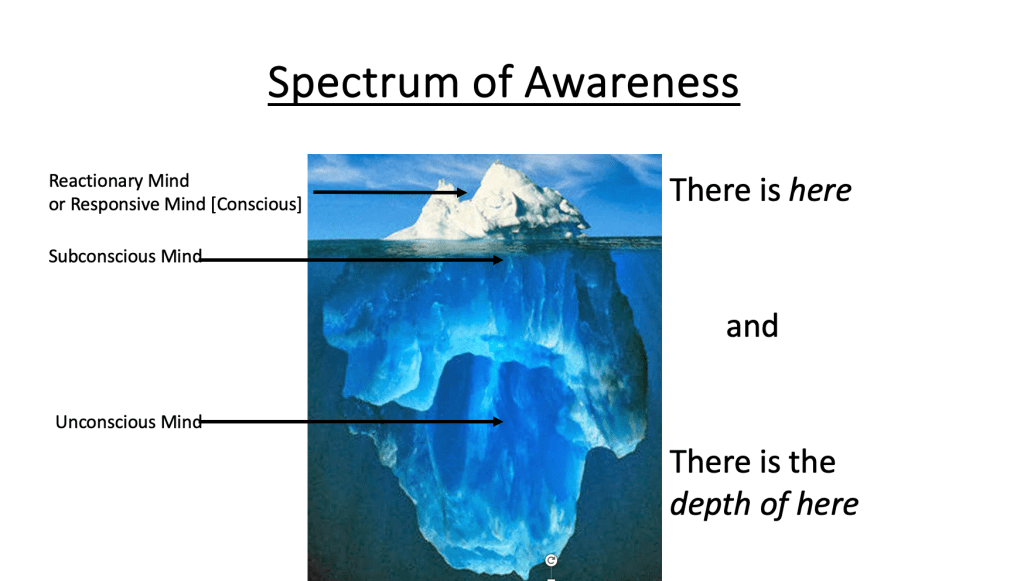
- The tip of the iceberg, visible above water, represents the conscious mind—thoughts, feelings, and perceptions we are aware of
- The waterline area represents the subconscious mind—material that is not currently in awareness but can be accessed
- The vast bulk below the surface represents the unconscious mind—material that significantly influences behavior but remains outside normal awareness
The zone of tension often corresponds to the boundary where the conscious and unconscious minds meet. This suggests that psychological tension frequently emerges at threshold points in our awareness.
For instance, when we feel inexplicably triggered by someone’s behavior, the tension we experience may be occurring at the boundary between our conscious perceptions and unconscious patterns or wounds.
The Consequences of Unconscious Tension
When tensions operate entirely outside our awareness, several important consequences follow:
- Developmental stagnation: Without awareness of tension, we cannot engage with the resolution process that leads to growth. We may believe ourselves to be “very awake” or enlightened, but without acknowledging the tensions in our unconscious, we remain developmentally asleep.
- Pain transmission rather than transformation: Unable to recognize and work with their tensions, individuals tend to transmit their unresolved pain to others rather than transforming it into wisdom. This creates cycles of suffering that perpetuate across relationships and generations.
- Victim mentality: Without the ability to recognize their role in tension, individuals often experience themselves as perpetual victims of external circumstances, unable to see how their unconscious material shapes their reality.
- Resistance to self-awareness: The deeper tensions remain in the unconscious, the less desire a person typically has to explore self-awareness, creating a self-reinforcing cycle that makes growth increasingly difficult.
The materials also help us understand the distinction between unconscious and subconscious tension:
- Unconscious tension remains completely outside awareness, making transformation impossible
- Subconscious tension creates a felt irritation or discomfort—”like an itch that cannot be scratched”—that may manifest as anxiety, restlessness, or aggression
This subconscious irritation, when unacknowledged, often leads to projection and “othering”—where we attribute our discomfort to external sources rather than recognizing its internal origins.
The Crucial Role of Ambivalence
One of the most insightful concepts for working with tension is what the framework calls “midwifing resolution.” This process highlights the importance of ambivalence—not in the colloquial sense of indecision, but in its original meaning of “having both strengths” or recognizing value on both sides.
Working productively with ambivalence involves:
- Recognizing that both sides of the contrast have legitimacy and value
- Understanding ambivalence as “both” or “on both sides” plus “strength” or “having value”
- Naming the ambivalence by acknowledging how one feels caught between competing values
For example, a person might feel ambivalent about a career change, recognizing the value both in security (current job) and fulfillment (new opportunity). Rather than seeing this ambivalence as weakness or indecision, the Law of Three framework recognizes it as a necessary part of the developmental process.
Resolution is not about eliminating one side of the contrast or declaring a “winner”—it is about holding the tension between opposing forces and recognizing the validity of both. The midwife metaphor suggests that resolution is something we help bring forth rather than something we impose.
Applications Across Multiple Domains
The Law of Three provides practical guidance across numerous domains of human experience. By understanding how contrast, tension, and resolution operate together, we can approach challenges with greater awareness and skill.
Personal Development
By recognizing the necessary role of contrast and tension in development, we can approach personal challenges with greater awareness and intentionality:
- Identifying contrasts: Rather than avoiding differences or oppositions in our lives, we can recognize them as opportunities for growth.
- Working with tension: Instead of seeing tension as a problem to eliminate, we can learn to hold and explore the energy it creates, developing the capacity to stay present with discomfort.
- Facilitating resolution: By consciously orienting toward our highest values and remaining open to new possibilities, we can participate actively in the resolution process, looking for “third ways” that transcend either/or thinking.
- Orienting toward higher development: Using our “polar north” as a guide, we can evaluate whether potential resolutions lead toward greater integration and wisdom or merely maintain the status quo.
For example, someone experiencing tension between their desire for individual achievement and their value of connection with others might initially see these as contradictory. Through the resolution process, they might discover ways of achieving that actually strengthen connection, reaching a higher-order understanding.
Social and Political Transformation
In a world increasingly characterized by polarization and division, the Law of Three offers a compelling alternative to binary approaches to conflict. This perspective fundamentally reframes how we approach difference:
- Instead of seeing opposing viewpoints as enemies to be defeated, we can recognize them as necessary partners in a developmental process.
- Rather than seeking to silence or eliminate opposition, we can look for reconciling forces that might transform the relationship between opposing perspectives.
- Instead of expecting resolution to come through compromise (where each side gives up something), we can seek creative solutions that actually transcend the original positions.
As Bourgeault notes, “One can only imagine how greatly the political and religious culture wars of our era could be eased by this simple courtesy of the Law of Three: (1) the enemy is never the problem but the opportunity; (2) the problem will never be solved through eliminating or silencing the opposition but only through creating a new field of possibility large enough to hold the tension of the opposites and launch them in a new direction.”⁹
Virtue Development and Character Formation
The Law of Three can also be applied to virtue development and character formation. One fascinating application explores how confronting mortality can serve as a catalyst for virtue development.
When we confront mortality, we are often prompted to reflect on what truly matters in life. This confrontation creates a powerful contrast between life and death, generating tension that can be resolved through greater virtue awareness and embodiment.
The process might involve:
- Identifying aspirational values (“What three virtues do you really hope they say about you at your funeral?”)
- Defining and clarifying these values (“What does integrity/compassion/courage mean to you?”)
- Translating values into concrete behaviors (“What actions would you do to embody these virtues?”)
This methodology aligns with the “midwifing resolution” concept. It helps us consciously work with the tension created by mortality awareness to transform it into something constructive—greater virtue embodiment and hope.
Practical Application: Working with the Law of Three
A Step-by-Step Approach
How might we actually work with the Law of Three in our daily lives? Here is a practical approach:
- Identify the contrast: Begin by clearly identifying the opposing elements, perspectives, or forces at play. What are the different positions or energies that seem to be in opposition? Try to articulate each side as clearly as possible, recognizing the legitimacy of both.
- Acknowledge the tension: Allow yourself to feel and recognize the dynamic energy created by this contrast. Where do you feel the tension in your body? What emotions arise? Instead of trying to eliminate this tension, observe it with curiosity and openness.
- Orient toward your “polar north”: Reflect on your highest values or aims in this situation. What truly matters most to you? What would represent genuine growth or development? This orientation helps ensure that resolution leads upward rather than merely resolving discomfort.
- Look for the reconciling force: This is often the most challenging step. What third element might transform the relationship between the opposites you have identified? This might be a new perspective, an unexpected resource, or a different way of framing the situation entirely.
- Facilitate resolution: Once you have identified a potential reconciling force, actively engage with it. This might involve letting go of attachment to either of the original positions, trying new behaviors, or articulating a new understanding that transcends the original contrast.
For example, imagine a parent experiencing tension between maintaining discipline (setting boundaries) and nurturing connection (being responsive). Rather than seeing these as contradictory approaches that require compromise, they might discover that the reconciling force is presence—being fully present allows them to both set boundaries clearly and respond to needs compassionately.
Common Obstacles and How to Address Them
Several common obstacles can hinder our engagement with the Law of Three:
- Binary thinking: Our minds naturally gravitate toward either/or thinking, making it difficult to perceive third ways. Practice looking for the “both/and” possibility in situations where you initially see only “either/or.”
- Unconscious material: Tensions that remain outside awareness cannot be transformed. Develop practices of self-reflection and possibly work with a therapist or spiritual director who can help you recognize patterns you might miss on your own.
- Lack of a clear “polar north”: Without orientation toward our highest values or aims, resolution may lead to regression. Take time to clarify your deepest values and what truly matters to you, revisiting and refining these regularly.
- Resistance to ambivalence: Our culture often treats ambivalence as weakness. Practice naming and honoring the valid aspects of both sides of a contrast, developing comfort with complexity rather than rushing to premature resolution.
- Fear of letting go: Moving to a higher level of development requires releasing attachment to our current identity. Notice when fear arises in the face of potential change, and develop compassion for this natural resistance while gently inviting growth.
Signs of Successful Resolution
How do we know when we have successfully completed a resolution process? Several signs indicate that genuine transformation has occurred:
- Integration of lessons: The insights gained have been incorporated into our understanding and way of being, not just intellectually grasped but embodied in our responses.
- Emergence of new wisdom: We have developed a new perspective that transcends our previous understanding, allowing us to see with greater clarity and nuance.
- Gratitude for the process: Rather than resenting the contrast and tension we experienced, we feel grateful for the growth they made possible.
- Readiness for new challenges: We feel prepared to engage with more complex situations, having developed greater capacity through this process.
- Expanded ability to hold complexity: We can now hold and harmonize a greater range of perspectives and experiences without being overwhelmed or resorting to oversimplification.
These signs reflect not just cognitive shifts but transformations in our emotional capacity, relational abilities, and overall way of being in the world.
Conclusion: The Transformative Potential of the Law of Three
The Law of Three offers a framework for understanding growth and transformation that transcends binary thinking. It reveals how development occurs not through the elimination of difference but through the creative integration of opposites via a reconciling force.
This principle manifests across multiple domains—from natural processes to spiritual traditions to personal development—suggesting it may represent a fundamental pattern of how transformative change occurs in complex systems. Its spiral pattern shows how each resolution creates the possibility for engagement with more sophisticated contrasts at higher levels of complexity and integration.
The most powerful aspect of this framework may be how it reframes our relationship to opposition and difference. Rather than seeing contrasts as problems to be eliminated, we can recognize them as necessary components of growth. Rather than avoiding tension, we can learn to hold it consciously until transformation emerges. And rather than settling for resolutions that merely maintain the status quo, we can orient toward the higher possibilities that await when we engage fully with the developmental spiral.
Teleopotentiation represents the purposeful thrust behind all evolution and growth. Whether viewed through the lens of Whiteheadian process philosophy, Raian metaphysics, or practical psychology, this principle reveals how reality unfolds not randomly but purposefully toward greater complexity, consciousness, and joy. By understanding and working with this teleopotentiating force, we participate consciously in the evolutionary impulse that drives all development—cosmic, cultural, and personal.
In a world that often seems trapped in cycles of polarization and conflict, the Law of Three offers not just theoretical insight but practical hope—a way of engaging with complexity that leads not to simplistic answers but to genuine transformation and growth.
Notes
¹ Cynthia Bourgeault, The Holy Trinity and the Law of Three: Discovering the Radical Truth at the Heart of Christianity (Boston: Shambhala Publications, 2013), 24.
² Alfred North Whitehead, Process and Reality: An Essay in Cosmology, Corrected Edition, ed. David Ray Griffin and Donald W. Sherburne (New York: Free Press, 1978), 21.
³ Whitehead, Process and Reality, 18-20.
⁴ Whitehead, Process and Reality, 219. Whitehead defines prehension as “the way in which the antecedent world enters into the constitution of the actual entity in question.”
⁵ Whitehead, Process and Reality, 25-26.
⁶ Whitehead, Process and Reality, 84-85.
⁷ Whitehead, Process and Reality, 244-247.
⁸ David Ray Griffin, Whitehead’s Radically Different Postmodern Philosophy: An Argument for Its Contemporary Relevance (Albany: State University of New York Press, 2007), 93.
⁹ Bourgeault, The Holy Trinity and the Law of Three, 207.
Bibliography
Bourgeault, Cynthia. The Holy Trinity and the Law of Three: Discovering the Radical Truth at the Heart of Christianity. Boston: Shambhala Publications, 2013.
Center for Action and Contemplation. “The Law of Three.” Daily Meditations, June 5, 2018. https://cac.org/daily-meditations/the-law-of-three-2018-06-05/.
Griffin, David Ray. Whitehead’s Radically Different Postmodern Philosophy: An Argument for Its Contemporary Relevance. Albany: State University of New York Press, 2007.
Scott, Doug. “How Practical Knowledge of the Law of Three Can Transform Your Relationships with Yourself, Others, and God.” Cosmic Christ (blog), March 20, 2025. https://cosmicchrist.net/2025/03/20/how-practical-knowledge-of-the-law-of-three-can-transform-your-relationships-with-yourself-others-and-god/.
Whitehead, Alfred North. Adventures of Ideas. New York: Free Press, 1967.
Whitehead, Alfred North. Process and Reality: An Essay in Cosmology. Corrected Edition. Edited by David Ray Griffin and Donald W. Sherburne. New York: Free Press, 1978.
 Building 4th Cosmic Christ