
Discussion led by Doug Scott, LCSW, MA, to the Building 4th Community
Building 4th Gathering Summary — March 17, 2026

Karma as the Law of Responsibility: Teleopotentiation Under the Veil
Doug Scott opened the evening’s presentation by naming his thesis directly: what we commonly call “karma” is better understood as the Law of Responsibility — and the Law of Responsibility is itself an expression of teleopotentiation (the Law of Three) operating under veiled third-density conditions. He noted that while this interpretation draws faithfully from Ra’s statements, the explicit connection between karma and the Law of Responsibility is his own synthesis, not Ra’s verbatim claim.
Ra’s Definition: Karma as Inertia
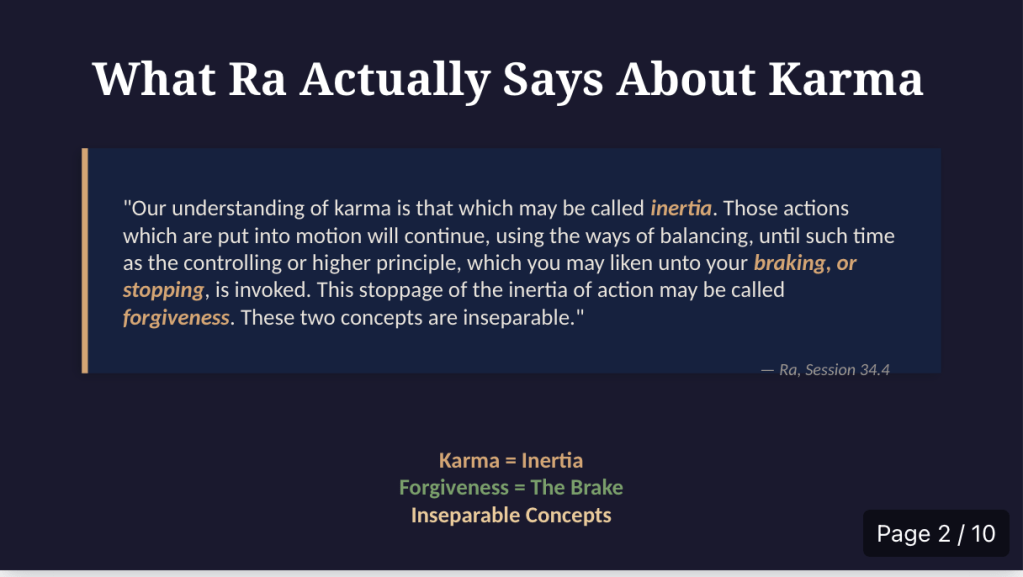
The presentation grounded itself in Ra’s definition from Session 34.4: karma is inertia — actions put into motion continue until a higher principle, likened to braking or stopping, is invoked. That brake is forgiveness. The two concepts, Ra insists, are inseparable. Doug emphasized what Ra does not say: karma is not punishment, not divine justice, not a cosmic scorecard. It is physics — the physics of consciousness in motion.
The Etymology of Responsibility
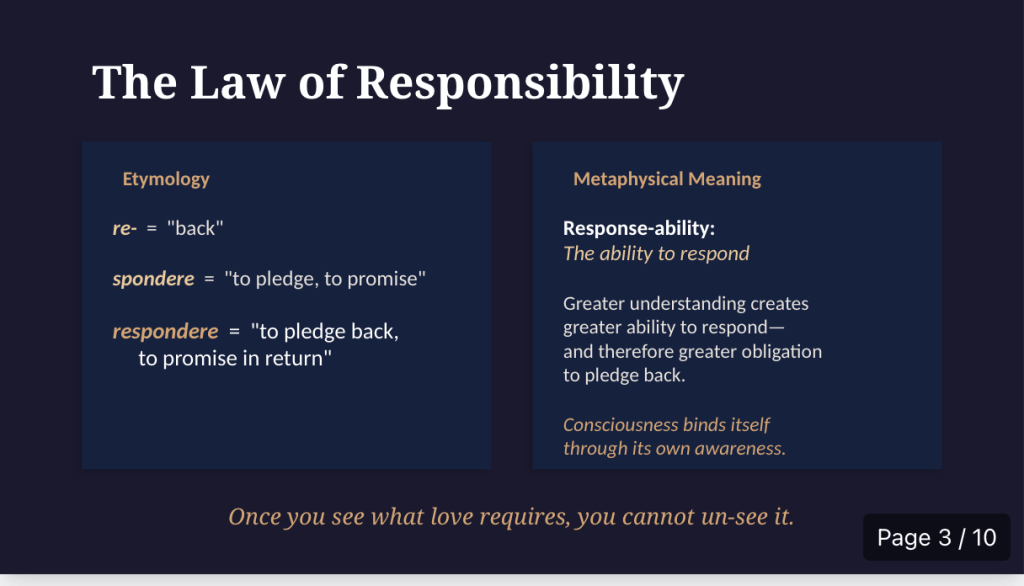
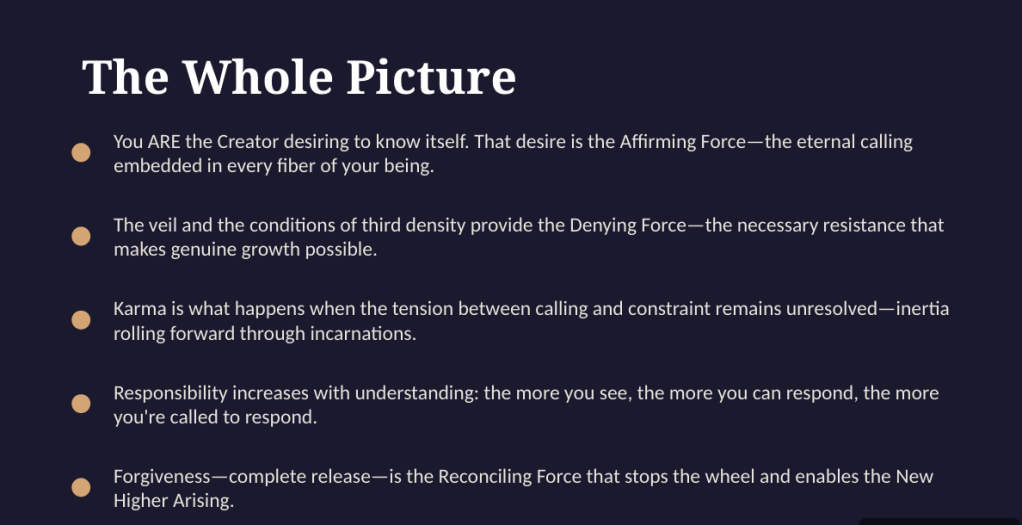
A central thread of the presentation was the Latin etymology of responsibility: re- (“back”) + spondere (“to pledge, to promise”) = respondere, “to pledge back” or “to promise in return.” Doug developed this as more than wordplay — it is the metaphysics itself. The Creator pledges outward into manifestation; creation pledges back through response, through awareness, through the act of living consciously. Responsibility, then, is response-ability — the capacity to answer the eternal calling embedded in every entity’s being, because each entity is the Creator exploring itself. And that capacity increases with understanding: the more one perceives what love requires, the greater the obligation to respond. Consciousness binds itself through its own awareness.
The Veiled Environment and Its Milestones
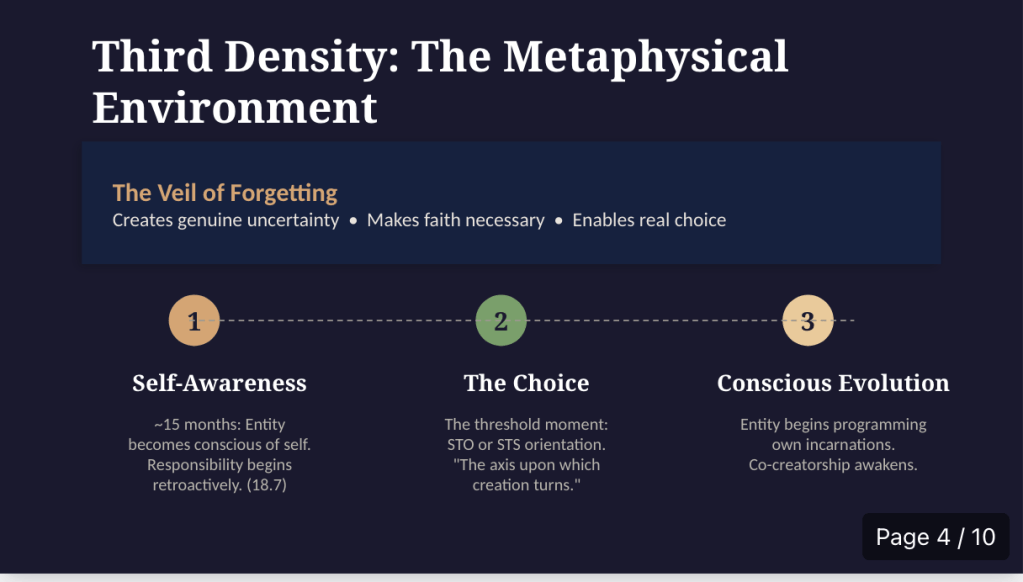
Doug situated karma within the architecture of third density. The veil of forgetting — the semi-permeable membrane between conscious and unconscious mind — was deliberately innovated to intensify experience and compress evolutionary timelines from millions of years to roughly 75,000-year cycles. Within this veiled environment, the metaphysical setup guides entities toward three milestones: self-awareness (around fifteen months of age, with responsibility becoming retroactive), the Choice (the threshold orientation toward service-to-others or service-to-self — “the axis upon which creation turns”), and conscious participation in one’s own evolution (where the entity begins programming its own incarnational lessons).
Teleopotentiation: The Law of Three Applied to Karma
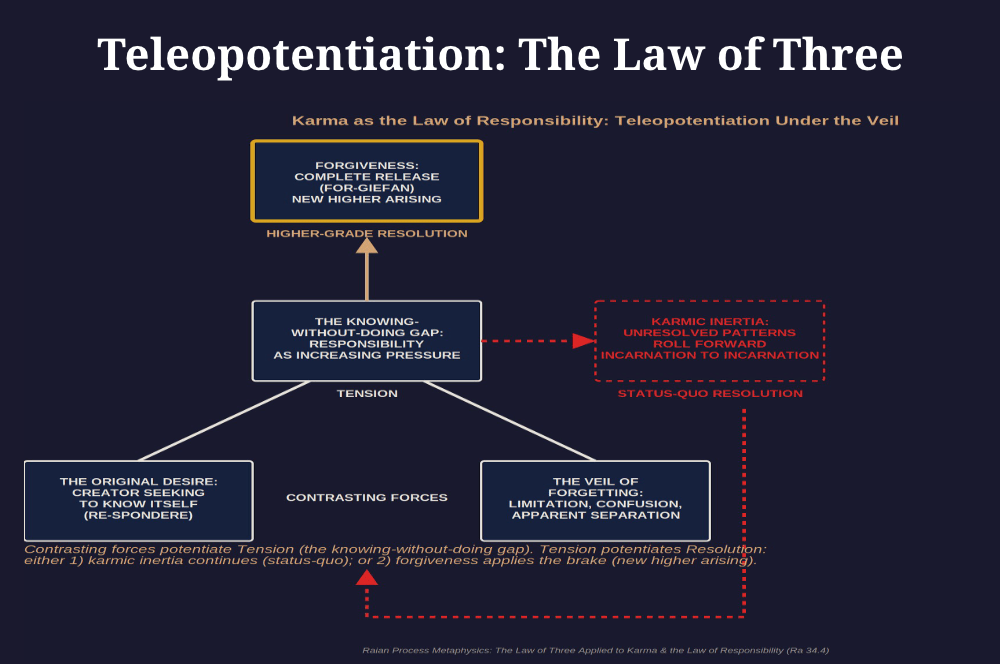
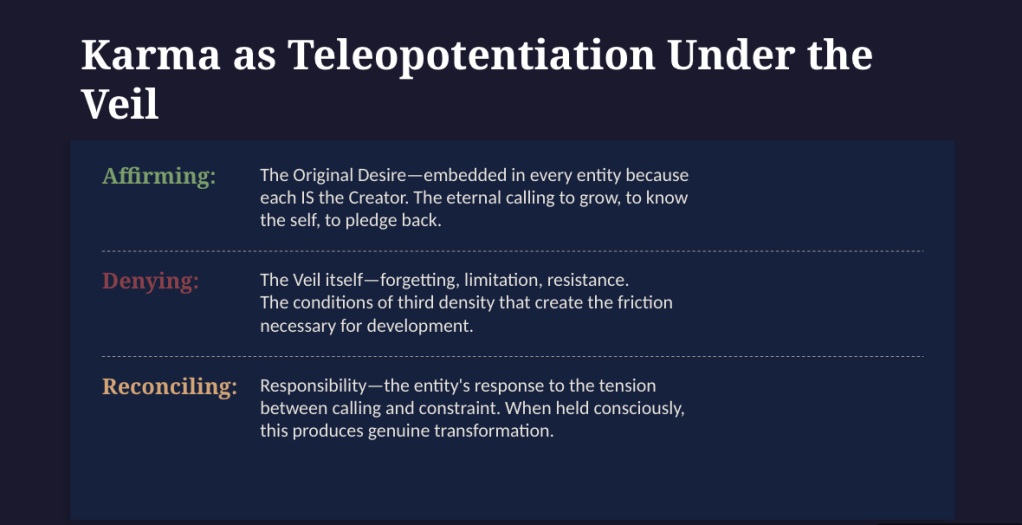
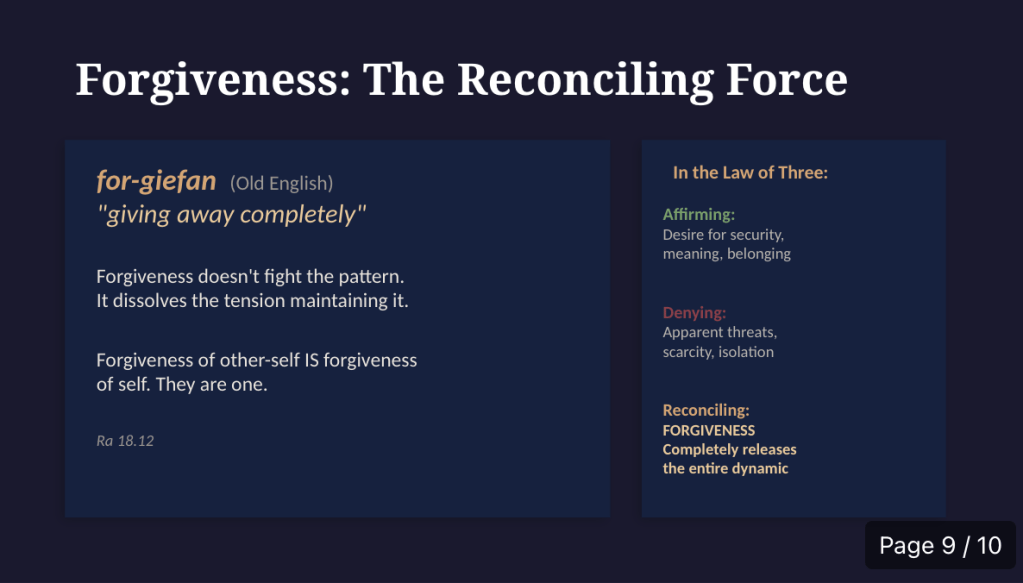
Using a visual diagram, Doug mapped the Law of Three onto the karmic dynamic. The Affirming Force is the Original Desire — the Creator’s embedded calling to know itself, the spondere at the heart of existence. The Denying Force is the veil itself — forgetting, limitation, confusion, apparent separation — which functions as essential resistance rather than mere obstacle. The tension between these forces creates the knowing-without-doing gap: the increasing pressure of responsibility as understanding outpaces embodiment.
From this tension, two paths emerge. The conscious path leads upward to forgiveness — for-giefan in Old English, meaning “giving away completely” — which constitutes the Higher-Grade Resolution, the New Higher Arising. The unconscious path leads sideways into karmic inertia: unresolved patterns rolling forward incarnation to incarnation in a feedback loop that perpetuates the status quo.
The Lifecycle of a Karmic Pattern
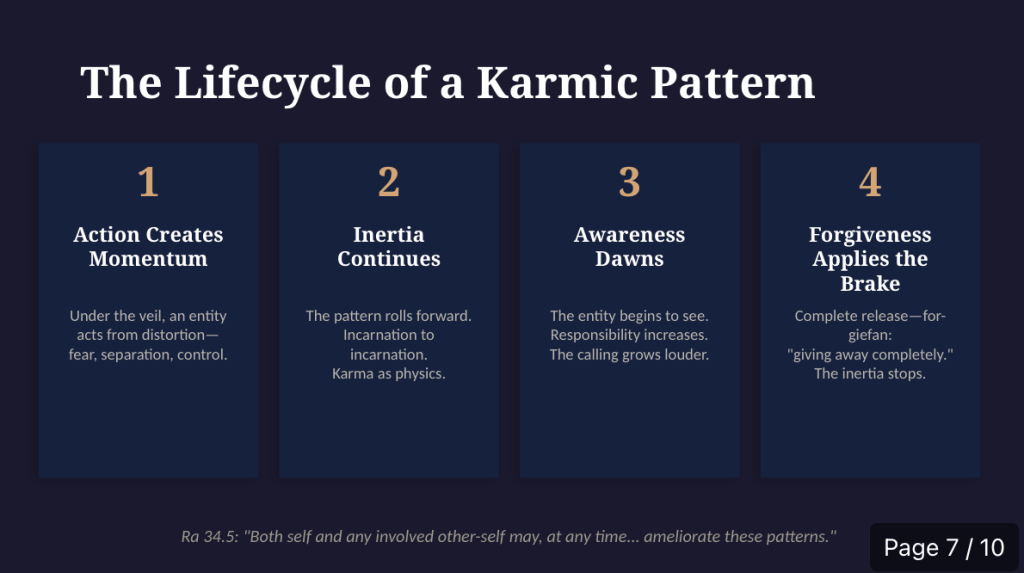
Doug walked through four stages: an entity acts from distortion under the veil (momentum is created); the pattern replicates across incarnations because nothing has stopped it (inertia continues); understanding dawns over lifetimes and the Law of Responsibility intensifies the pressure (the calling grows louder); and finally, forgiveness — complete release — applies the brake. Critically, Ra states this can happen at any point in an incarnative pattern. Incarnate forgiveness in space/time is more powerful than between-life recognition in time/space, because in space/time one can actually stop patterns rather than merely perceive them.
Community Discussion: The Many Faces of Forgiveness
The presentation gave way to a rich group conversation that explored forgiveness from multiple angles — personal, clinical, theological, and contemplative.
Forgiveness as recognition of shared divinity. One participant suggested that genuine forgiveness arises when we recognize the divinity in the other — that at that level of awareness, the offense dissolves because the framework in which it seemed real has shifted. Forgiving someone for a specific wrong, he noted, can paradoxically reinforce the judgment by making it “real” before attempting to release it. The deeper move is a shift in perception itself.
The Vedic perspective and multiple types of karma. Another participant brought the Eastern philosophical lens, noting that karma is not monolithic — there are mutable and immutable forms. Some karma (the Earth’s spin, one’s genetic inheritance, the time of one’s birth) is simply the momentum of existence. The suffering-karma is what we seek to transform. He emphasized that the Eastern tradition leans toward destiny while the Western tradition emphasizes free will, and that the truth likely involves both — a give-and-take between cosmic influence and individual agency. Forgiveness, he observed, arrives through a widening of perspective: when the heart opens, what was important is no longer important, and it releases naturally.
Doug’s personal example. Doug shared a story of being scammed out of $5,000 during COVID, and the choice he faced afterward. Rather than remaining in anger, he texted the scammers weeks later, acknowledging he didn’t know what life circumstances had led them to this, releasing them and releasing himself. He connected this to self-awareness: he hadn’t cheated people out of money, but he had manipulated others through insecurity. The capacity to forgive required seeing his own participation in similar patterns — and extending the grace he needed for himself to the other.
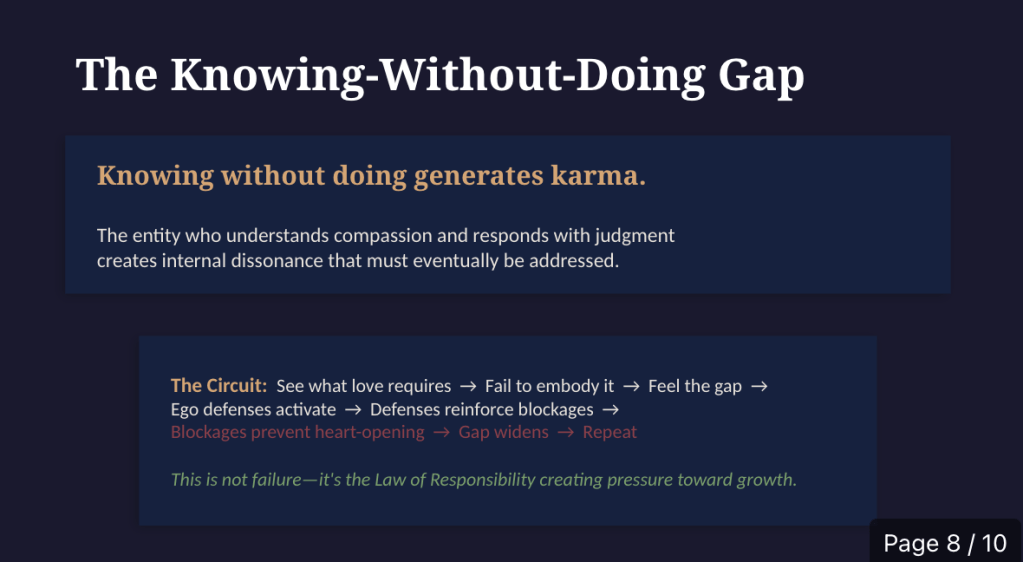
Shadow material and karmic inertia. One participant drew a direct line between Carl Jung’s shadow complex and karma — the accumulation of psychic energy that explodes unconsciously when the shadow is threatened. He described his own recent work with childhood shadow material: the bullied child who built up aggressive defensive energy, only to become the aggressor unconsciously. Holding that tension — seeing the shadow without suppressing or indulging it — was extraordinarily difficult, but through sustained attention, love began to be directed at the energy until a cathartic release occurred. Doug noted this perfectly illustrated the teleopotentiation diagram.
Forgiveness as radical acceptance. A participant described forgiveness as a radical acceptance of what is — which is not synonymous with doing nothing, but rather an inner state. One can be actively protecting oneself while simultaneously forgiving. She shared a practice of imagining all possible reasons someone might have acted harmfully — from mundane urgency to deep pain — and arriving at the honest recognition: “I have no idea why, but I know there’s a reason.” This practice of compassionate imagination makes release easier.
A family reconciliation. One participant shared the story of a lifelong rift with her brother — years of estrangement dissolved when they finally saw each other at a family reunion, and she realized that everything she had believed he thought about her wasn’t true. The release was immediate and total. The five years of restored relationship before his passing were a blessing she treasured.
Forgiveness does not equal approval. A participant who works as a counselor offered a clinical principle: forgiveness does not mean approval. What happened was wrong — validate that fully. Forgiveness simply means it’s not worth holding onto. And, invoking Richard Rohr, it’s not worth holding onto once we’ve learned what we needed to learn from it.
“Father, forgive them, for they know not what they do.” One participant connected Jesus’s words on the cross to the evening’s theme — that when we truly understand, there is release for everyone. Doug extended this with the image of a three-year-old saying “I hate you” to a parent: the parent, with broader perspective, can hold the child’s outburst without taking it personally, forgiving effortlessly because they see more of the whole.
Doership and the play of the One. The evening’s final reflection offered a contemplative turn: karma may perpetuate exponentially because of our attachment to doership — the sense of being the individual agent of action. Forgiveness, then, might be understood as giving away one’s sense of doership, recognizing that the Creator is the true doer. The Old English for-giefan — giving away completely — takes on new depth: what we give away is the illusion of separate agency. This might seem to conflict with the Law of Responsibility, but the two can be reconciled — responsibility and surrender operating as complementary movements within the larger play of the One.
Doug affirmed this as Ra’s macro perspective — the view from 2.5 billion years ahead — and noted it aligned with the contemplative thread running through the evening’s conversation.
The gathering closed with a brief prayer of gratitude for fellowship and reflection, and a blessing of peace and deeper understanding for all.
 Building 4th Cosmic Christ