The Billionaire Who Named His Surveillance Company After Sauron’s Weapon and Then Lectured on the Antichrist
Part 3 of the Great BASH Series
Written by Doug Scott, MA, MSW, LCSW

A note before I begin: This post is the third in a series. The first, “How the Egregore Great BASH Shows Itself at the Threshold of Human Shift,” established the metaphysical architecture—third density, the orange-ray logjam, the Great BASH as egregore, and the mirror between Washington and Tehran. The second, “A Self With a Planetary-Sized Auto-Immune Disease,” offered a diagnosis of the Terran body—the autoimmune dynamic, the three organ-faces of the blockage, the wound made weapon, and the counter-image of Francis before the Sultan. This third post examines a figure who arrives at this moment as something genuinely new in the BASH ecosystem: a systems architect of unusual intellectual sophistication who is simultaneously diagnosing the disease and building its infrastructure. And then it offers counter-voices—five contemplative leaders whose work represents the orientation the density transition actually requires. This is still a partial view, offered in an open hand.
Who Is Peter Thiel?
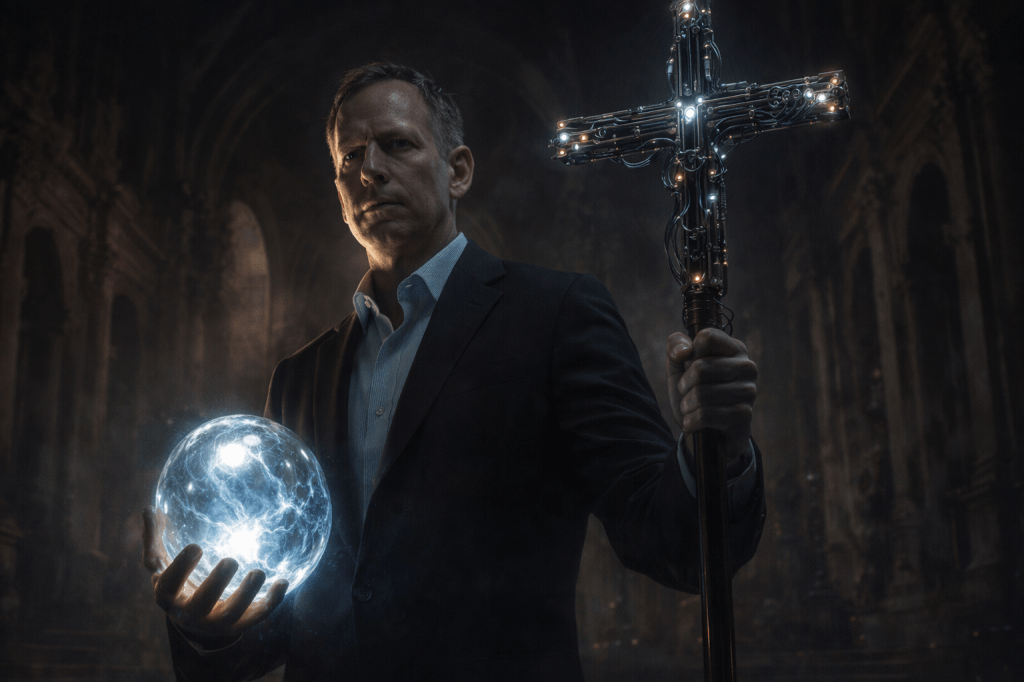
Peter Thiel is a figure who resists simple categorization, and that resistance is itself part of his power.
Born in Frankfurt, Germany, in 1967, raised in an evangelical Christian family that moved through South Africa and Namibia before settling in California,1 Thiel earned his undergraduate degree in philosophy and his law degree at Stanford University. He co-founded PayPal in 1998, was the first outside investor in Facebook, and co-founded Palantir Technologies—a data-mining and surveillance company initially funded through In-Q-Tel, the CIA’s venture capital arm.2 He is a billionaire many times over. He is openly gay, married to Matt Danzeisen since 2017.1 He is a self-described libertarian and a self-described Christian. He has funded life-extension research and the political career of JD Vance, now Vice President of the United States, investing over $15 million in Vance’s Senate primary.3 He bankrolled the lawsuit that destroyed Gawker Media.1 His former PayPal colleagues include Elon Musk and David Sacks, now Trump’s AI and crypto czar.4
This week, as I write, Thiel is in Rome delivering a series of closed, invitation-only lectures on the Antichrist.5 The venue is secret. The guest list is private. The media is excluded. Catholic institutions initially associated with the lectures have publicly distanced themselves.5 The Vatican is treating the event with studied caution. Pope Leo XIV—the first American pope, whose alma mater the Angelicum denied hosting the lectures—has emerged as what multiple commentators call a spiritual counterweight to the worldview Thiel’s political investments have helped install.6
The Intellectual Formation
To understand Thiel’s arguments, you have to understand the lineage that produced them. Four streams converge.
The first is his evangelical Christianity and the transhumanist resurrection project it produced. Thiel was raised in a Lutheran evangelical family. He describes himself as Lutheran—“emphatically, not Calvinist.”7 He told the evangelical commentator Eric Metaxas: “I believe in the resurrection of Christ—the bodily resurrection of Christ.” He has called Christianity “the prism with which I look at the whole world.”7 He attends church regularly. He is, by every available indicator, a sincere Christian believer.
And yet the content of his Christianity is strikingly selective. Thiel’s Jesus is primarily a revealer of human violence—the innocent victim whose Passion exposes the scapegoating mechanism. Through Girard, Thiel reads the Gospels as the text that uniquely unmasks humanity’s capacity for sacrificial violence. The Bible, Thiel argues, “reads us” by showing us our own sin—the disciples fleeing, Peter denying Christ thrice, the mob choosing Barabbas.35 What is absent from Thiel’s public theology is everything else. There is no Sermon on the Mount. No Beatitudes. No “blessed are the peacemakers.” No “love your enemies.” No touching lepers. No forgiving from the cross. No “what you do to the least of these, you do to me.” The entire ethical-compassionate dimension of the Gospel—the part that Francis of Assisi walked into the Sultan’s camp embodying—is absent from Thiel’s theological framework. An Episcopal priest in San Francisco, Rev. Kevin Deal, put it directly: “In Jesus, as opposed to Peter Thiel, we do not meet someone who is concerned with economic futures. In fact, he demanded that his disciples give up everything to follow him.”36
But the most revealing dimension of Thiel’s Christianity is what it does with death and resurrection—and here the blog’s framework finds its deepest point of contact with Thiel’s worldview.
Thiel has stated explicitly and repeatedly that he sees transhumanism and Christianity as essentially the same project. In conversation with the theologian N.T. Wright, Thiel said: “The thing that strikes me is how similar they are.” He continued: “The one part of the Christian view that I believe more strongly than anything is that death is evil, that it’s wrong and we should not accept it and fight it any way we can… I don’t think there’s anything incompatible with indefinite life extension and Christianity.”37 He told Ross Douthat at the New York Times that transhumanists aim for “a radical transformation of the human body into an immortal body,” and then pointed to Christianity’s doctrines of Redemption and Resurrection as precedent for this idea. He has said: “If Christianity promised you a physical resurrection, science was not going to succeed unless it promised you the exact same thing.”38
These are not idle philosophical musings. Thiel has invested accordingly. He takes human growth hormone. He is registered for cryonic preservation with the Alcor Life Extension Foundation—meaning his body will be frozen at legal death in hopes of future revival.1 He has publicly expressed interest in parabiosis—the transfusion of young people’s blood for anti-aging effects—describing it as “really interesting” for his personal health; his Thiel Capital medical director reportedly contacted Ambrosia, a startup offering such treatments, though Thiel has denied undergoing the procedure himself.39 He funded SENS Research Foundation, dedicated to reversing aging. He backed Halcyon Molecular, a genetic startup aiming to halt aging. He gave $1 million to the Singularity Institute, which works on uploading consciousness into computers. He supported Vitalia, a transhumanist hub in a libertarian free economic zone off Honduras where, as Jules Evans documented, “sovereign citizens pursue their dream of immortality through genetic biohacking experiments forbidden on US soil.”4
Douthat, a Roman Catholic, pushed back directly: according to Christianity, God does the transforming. “The person who tries to do it on their own with a bunch of machines is likely to end up a dystopian character.” Do-it-yourself immortality is, Douthat said, at best “a heretical form of Christianity.”38 Even Thiel himself acknowledged the tension, in a moment of rare candor: “The critique orthodox Christianity has of this is these things don’t go far enough. That transhumanism is just changing your body, but you also need to transform your soul.”38
I want to state clearly what is happening here, because it is the deepest expression of the orange-ray blockage in Thiel’s entire system—deeper than the Palantir contradiction, deeper than the Schmittian politics.
The entire Christian understanding of death and resurrection—from Gethsemane to Easter—rests on kenosis: self-emptying, surrender, the passage through death as transformation rather than defeat. Christ does not defeat death by fighting it. He defeats death by entering it. “Unless a grain of wheat falls into the earth and dies, it remains alone; but if it dies, it bears much fruit” (John 12:24). The Resurrection is not a technological achievement. It is God’s gift, received in the total surrender of the cross. Every contemplative tradition in Christianity—from the Desert Fathers through John of the Cross’s Dark Night through Keating’s Centering Prayer—teaches that the passage through death (of the ego, of certainty, of control) is the mechanism of transformation. You cannot get to Easter without Good Friday. You cannot upload your way around Gethsemane.
Thiel’s transhumanist resurrection project inverts this completely. Death is not a passage. It is an enemy to be defeated through mastery. Resurrection is not God’s gift received in surrender. It is a technical achievement produced by capital investment. The body is not a temple to be honored through the sacred cycle of mortality. It is a machine to be upgraded, frozen, transfused with young blood, and eventually uploaded into digital immortality. Jules Evans identified the core difference precisely: “Christianity is about the surrender of the will to God while Thielism seems more about the triumph of the will.”4
In the Law of One framework, this is the orange-ray drive taken to its absolute limit: the self that will not surrender to anything—not to God, not to death, not to the natural cycle that Ra teaches is the mechanism of learning. Ra describes death as the passage through which the incarnated being completes its cycle and returns to harvest what the incarnation taught.23 Thiel’s entire financial and intellectual apparatus is designed to prevent that passage. The three-year-old on the cowhide rug who was told that death happens to everyone has spent a fortune—and built a theology—to ensure that it does not happen to him. This is the wound beneath all the other wounds. And it has never been metabolized into wisdom. It has been made into a program.
This evangelical substrate—the bodily resurrection taken as literal fact, the conviction that death is evil, the absence of contemplative practice that might turn the mirror inward—is the foundation onto which the other three streams were layered. Evangelicalism broadly does not teach Centering Prayer, lectio divina, the apophatic tradition, or the Dark Night of the Soul. It does not have a developed theology of kenosis as the path to God. What it teaches is conviction, action, and the authority of the individual believer’s reading of Scripture. Thiel arrived at Girard already formed by a tradition that emphasized the individual’s direct encounter with the text and lacked the contemplative infrastructure that might have turned the Girardian mirror inward. Girard himself, notably, returned to devout Catholicism—Latin Mass-attending Catholicism—because the contemplative liturgical tradition provided the container that intellectual insight alone could not.4 Thiel took the intellectual insight without the container.
The second stream is René Girard, the French philosopher of mimetic desire whom Thiel studied under at Stanford.7 Girard’s central insight is that human violence operates through mimetic rivalry and scapegoating—communities resolve internal tensions by designating a victim whose destruction temporarily restores peace. Girard argued that the Christian revelation exposes and delegitimizes this mechanism. Thiel grasped it intellectually and later introduced Vance to it, shaping Vance’s conversion to Catholicism.8
The third is Carl Schmitt, the German political theologian who defined the political as the friend/enemy distinction and who personally provided legal justification for the Nazi regime’s consolidation of power. Schmitt’s framework holds that political order requires a strong sovereign who identifies friends and enemies and acts decisively. Thiel draws on Schmitt’s concept of the katechon—the Pauline “restrainer” that holds back both chaos and totalitarianism.9
The fourth stream is Opus Dei, and this is the one least discussed in the coverage of Thiel’s Rome lectures.
The Opus Dei Connection
When Thiel arrived at Stanford as an undergraduate in the mid-1980s, he was befriended by Father Arne Panula, an Opus Dei priest who ran the order’s center on the Stanford campus.10 Panula was not a minor figure. For a period in the 1990s, he was Opus Dei’s most senior man in the United States.11 He had lived alongside Opus Dei’s founder, Josemaría Escrivá, in Rome. He later ran the Catholic Information Center on K Street in Washington—an Opus Dei chapel and bookshop a few blocks from the White House that functions as a nexus for conservative Catholic political theology.11
The Thiel-Panula friendship lasted decades. Thiel contributed the closing essay to the book published about Panula’s final conversations.12 And here is a detail that matters: Panula wrote his doctoral thesis, hundreds of pages, on John Henry Newman and divine providence.10 Newman is one of the primary thinkers Thiel draws on in his Antichrist lectures. The invitation to the Rome series specifically lists Newman among the religious thinkers Thiel will reference.5 The intellectual lineage runs: Panula’s Newman scholarship → decades of friendship with Thiel → Thiel’s Antichrist framework foregrounding Newman. The ideas did not arrive from nowhere.
What Opus Dei Is—With Nuance
Opus Dei was founded in 1928 by Escrivá, who envisioned a lay order that would sanctify everyday work. The core charism is genuine: holiness available to ordinary people in their professional and family lives. Opus Dei has produced educators, scholars, and professionals who take their faith seriously. Its emphasis on intellectual formation, disciplined spiritual practice, and faith integrated with daily work has genuinely helped many people.
And yet.
Gareth Gore’s 2024 book Opus: The Cult of Dark Money, Human Trafficking, and Right-Wing Conspiracy Inside the Catholic Church documents practices extending well beyond the original charism: coercive recruitment, secrecy about membership, financial demands from wealthy members, and systematic cultivation of political influence.13
The network connecting Opus Dei to the current American political formation runs through specific nodes. Leonard Leo—the Federalist Society co-chairman who has reshaped the U.S. Supreme Court through dark-money networks—served on the board of the Catholic Information Center alongside former Attorney General William Barr.14 Leo’s associates include multiple Project 2025 authors with Opus Dei connections. Kevin Roberts, Heritage Foundation president and a leading Project 2025 figure, has spoken at CIC events and Napa Institute gatherings linked to Opus Dei networks.15
Thiel, Leo, and JD Vance are all members of the Teneo Network—which describes its mission as recruiting conservatives to “crush liberal dominance.”16 Thiel is also a seed funder of the Hallow prayer app, along with Vance; Hallow recently featured Escrivá’s The Way—the foundational Opus Dei text—for its Lent prayer challenge.16
Opus Dei Through the BASH Framework
I want to be precise here. Opus Dei is not, in its entirety, an expression of the Great BASH. The original charism—sanctifying daily work—is a genuinely green-ray impulse: the sacred present in ordinary human activity. Many individual members live lives of genuine service.
But the institutional expression—particularly in the American political context—displays recognizable BASH patterns. The secrecy is diagnostic. Genuine Authority operates in the open. The recruitment practices documented by Gore—cultivation of elite young people through flattery, slow integration, financial demands—resemble organizations that substitute loyalty for discernment.13 The dark-money networks connecting Opus Dei’s institutional footprint to the reshaping of the federal judiciary and Project 2025 are the infrastructure of Power, not Authority.
And at the theological level, the orientation that a former associate of Leonard Leo described plainly—“Opus Dei believers do not only disagree with the separation of church and state, they believe in church over state”15—is the orange-ray drive expressed as ecclesiology: the self that must control the structures of governance because it cannot trust the conscience of the governed. This is not subsidiarity. It is the inversion of subsidiarity—power consolidated upward into an elite that believes it knows what God requires for everyone else.
Father Paolo Benanti—Pope Leo XIV’s AI advisor—diagnosed Thiel’s entire project as “a prolonged act of heresy against the liberal consensus.”17 The Italian bishops’ newspaper published critical articles arguing technology leaders must not define their own ethical limits.17 And Pope Leo himself has emerged as a spiritual counterweight—calling for ceasefire, raising concerns about immigrant treatment, telling journalists they must resist becoming a megaphone for power during wartime.6 This is Authority. It does not need closed doors or secret venues. It speaks in the open and trusts the hearer.
Thiel’s Primary Arguments
Thiel’s argument, reconstructed from his Hoover Institution interviews, his November 2024 essay in First Things, his San Francisco lecture series, and reporting on the Rome sessions, runs in five layers.9
First, technology has genuine apocalyptic potential. Following Girard, Thiel argues apocalyptic prophecy describes what humans are likely to do to each other in a world of ever more powerful technology and no sacred limits. After Hiroshima, fire-and-brimstone imagery stopped being metaphorical. AI, bioweapons, and autonomous weapon systems compound the risk.9
Second, the real threat is not Armageddon itself but the response to the fear of Armageddon. The Antichrist, in Thiel’s framing, is a comforting administrator who promises safety while consolidating total control. The Antichrist’s slogan is “peace and safety.” Climate activists, AI safety advocates, and international regulatory bodies are the Antichrist’s unwitting agents.18
Third, the Antichrist takes the specific form of a one-world state—a totalitarian global government using the promise of safety to eliminate sovereignty.6
Fourth, the proper response is the katechon—the Pauline “restrainer.” Thiel identifies the U.S. presidency with this role.9
Fifth, Thiel grounds all of this in a call for intellectual reconstruction—the integration of knowledge across disciplines that the hyper-specialized university can no longer provide. The lectures draw on Newman, Solovyov, Schmitt, Francis Bacon, and Jonathan Swift alongside Girard.5
Steel-Manning: What Is Genuinely Defensible—And Where It Goes Wrong
Before the critique, genuine engagement. There are insights in Thiel’s argument that deserve to be taken seriously, because dismissing them wholesale would miss what makes his position genuinely dangerous: it contains real truth, selectively deployed.
1. The Enlightenment’s domestication of apocalyptic literature was a genuine intellectual failure. The liberal theological tradition’s reduction of Revelation and Daniel to mere metaphor left Western thought unable to reckon with technology’s destructive potential. Girard was right that the post-1945 Church’s instinct to soft-pedal eschatology when nuclear weapons made it relevant was a form of civilizational avoidance.9 But the corrective is not literalism. The dispensationalist reading that treats these texts as a timeline of future events is itself one of the BASH’s most dangerous tools—it is what Hegseth uses to frame Iran as Armageddon, what Johnson uses to frame the war as divinely mandated.19 What Girard actually pointed toward—and what contemplative traditions have always maintained—is that these texts describe patterns of human behavior that become more dangerous as technology amplifies human capacity for violence. The pattern is real. The self-fulfilling prophecy danger of treating the pattern as a divine script is equally real. Thiel’s own political allies are the ones enacting it.
2. The demand for safety can become a mechanism of coercive control. From the Committee of Public Safety through every emergency-powers expansion, the promise of security has been the most reliable mechanism for power consolidation. This general principle is historically sound. But Thiel’s specific application departs from defensible analysis. His suggestion that Fauci’s COVID protocols were “roughly the right protocol if you thought it was a bioweapon”9 is speculative conspiracy framing presented as sophisticated insight. It functions to delegitimize institutional public health authority as such—which benefits those who wish to replace public institutions with private power. The general principle is real. The specific application is the BASH’s work.
3. Hyper-specialized knowledge cannot address civilizational questions. The observation that no individual discipline can evaluate whether technology is driving humanity toward catastrophe is defensible. But Thiel’s proposed solution is the problem. His answer is not the integration of wisdom traditions or contemplative practice. His answer is himself—a billionaire giving secret lectures to curated elite audiences. The university’s failure to integrate knowledge is real. Replacing the university with invitation-only salons for the wealthy is not integration. It is the privatization of the prophetic function.
4. History is not cyclical—choices matter. The Judeo-Christian insistence that events are one-time and world-historical is theologically sound.9 But Thiel’s own framework indicts his own conduct. If one-time world-historical choices shape civilizational destiny, then his choice to build Palantir, bankroll Vance, and fund a political movement now waging holy war while dismantling democratic institutions—these are precisely the kinds of choices his framework identifies as consequential. His own logic condemns what he has built.
5. A one-world state could become a prison. The principle of subsidiarity is defensible across Catholic social teaching, Protestant thought, and libertarian tradition. But Thiel performs a sleight of hand. He frames the only alternative to the one-world state as nationalist sovereignty—specifically, American nationalist sovereignty backed by the most powerful military and surveillance apparatus in history. This is not subsidiarity. Subsidiarity means power distributed downward. What Thiel supports is a single national government dismantling its own internal checks while building surveillance infrastructure that makes democratic reversal increasingly difficult. He warns against a one-world state while supporting a one-nation surveillance state. That is not subsidiarity. That is choosing which consolidation pays your invoices.
More Gaps: What Thiel Will Not Face in the Mirror Before Him
The Palantir Contradiction
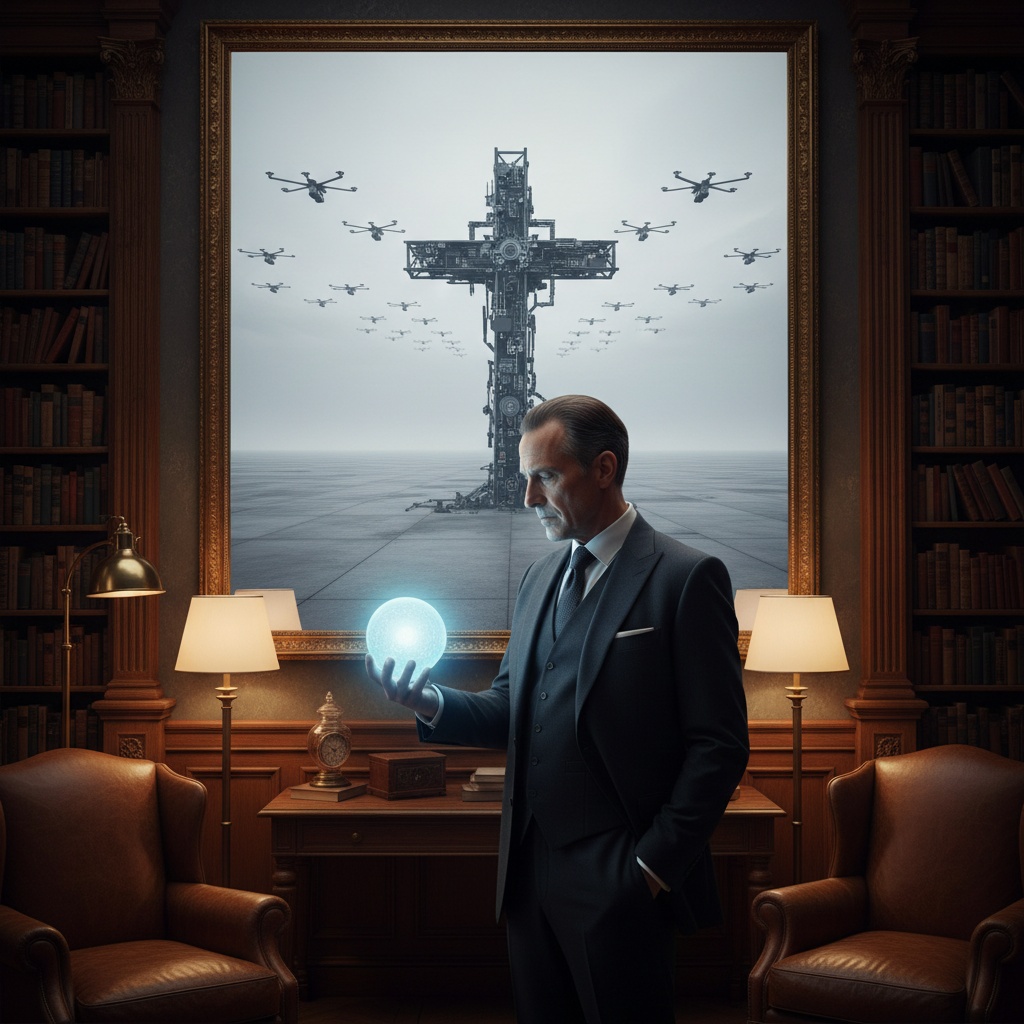
Palantir Technologies, co-founded by Thiel in 2003 with CIA venture capital, builds the surveillance infrastructure that would make totalitarian consolidation operationally possible.2 Its Gotham platform integrates emails, financial data, and social media into searchable profiles. It serves the NSA, supports immigration enforcement, and reportedly assists the Israeli Defence Forces. In August 2025, Amnesty International linked Palantir’s algorithms to AI targeting in Gaza where civilian data was combined with military indicators.20 Palantir’s stock climbed 140% in 2025, boosted by Trump administration contracts.20
The Tolkien irony deepens this. Thiel named his company after the palantíri—seeing-stones controlled by Sauron to manipulate viewers. The steward Denethor, who obsessively consults his palantír, descends into madness. Tolkien scholar Joseph Pearce has noted the Elvish term translates functionally into “television”—Tolkien’s encoded critique of technologies that claim to show truth while serving power.20 This is not a footnote. It is a confession disguised as a literary reference.
The Antichrist Is Always Someone Else
Thiel locates the Antichrist exclusively in globalist regulation, climate activism, and AI safety advocacy. What he never considers is that the Antichrist could come as a nationalist figure promising safety through domination—a far more traditional reading of the biblical texts. The beast in Revelation receives worship from all nations. The Antichrist in Solovyov’s novella—which Thiel himself cites—is a political leader consolidating power through charisma.20 Newman’s Antichrist mimics Christ while inverting Christ’s values. In every source Thiel draws on, the Antichrist’s distinguishing characteristic is that he looks like the solution.
Girard Would Not Endorse This
Girard’s central insight—mimetic rivalry and scapegoating—cuts directly against the nationalist politics Thiel has bankrolled. The current administration deploys exactly the Girardian mechanism: identifying a scapegoat, channeling collective anxiety onto it, presenting violence against it as redemptive. The Irish Times noted that Vance understands Girard intellectually while participating politically in the mimetic violence Girard diagnosed.19 Both mentor and protégé can name the pattern. Neither can resist it when power is on the table. Girard’s final word was always: go to church. Not lecture on the Antichrist behind closed doors.9
The Schmittian Contamination
You cannot simultaneously cite Carl Schmitt and warn against totalitarian consolidation. Schmitt’s entire project was to justify that consolidation under the right leader. The Schmittian katechon is not a restrainer of tyranny. It is a theologized authorization of the strong man.
The Venue Is the Message
Closed doors. Secret venue. Curated audience. Excluded press.5 This is Power, not Authority. Authority—in the tradition of Christ who taught in public, of Francis who walked into the Sultan’s camp, of Pope Leo who speaks openly to journalists—operates in the open because it does not depend on controlling the conditions of its reception. Thiel’s secrecy is not incidental to his argument. It is his argument, embodied: truth must be managed, audiences curated. The katechon reimagined as the gated community.
Thiel Through the Great BASH Framework
The Great BASH—Bellicose Attitude, Aggressive Actions, Scarred and Scared, Hope Through Hostility—with its organizing spine of Power vs. Authority, has been applied in previous posts to political leaders, nation-organs, and the wound-made-weapon dynamic. Thiel occupies a different role: systems architect. He built the infrastructure through which the BASH operates at scale.
Bellicose Attitude. Thiel does not perform bellicosity publicly. His version is intellectual: the framing of civilizational existence as a contest between those who will control and those who will be controlled. His entire worldview is organized around the question who dominates whom? There is no third option in his framework—no possibility that the contest itself is the disease.
Aggressive Actions. Thiel’s actions are institutional. He co-founded Palantir—giving the BASH a surveillance apparatus.2 He funded Vance’s Senate campaign—giving it an intellectually credentialed face.3 He operates within the Opus Dei–Leonard Leo–Teneo Network that has reshaped the judiciary and constructed the Project 2025 infrastructure.15 He bankrolled the Gawker destruction.1 He seed-funded Hallow, now promoting Opus Dei’s foundational text.16 Each is a deployment of capital that materially shapes the terrain on which everyone else operates.
Scarred and Scared. This is the dimension that runs deepest. Thiel has spoken about a childhood memory—sitting on a cowhide rug at age three, asking his father where it came from, and being told that death happens to all animals and all people.21 “It was really, really disturbing,” Thiel has said. “I somehow never lost that sense of being disturbed about it.”21 He never did. That wound became a program. His transhumanist investments—life-extension research, cryonic preservation, parabiosis, the Singularity Institute, Vitalia—are the most expensive response to childhood terror in human history.14 The three-year-old who learned that everything dies has spent billions trying to ensure that he, at least, does not. And he has built a theology to justify it: death is evil, resurrection is a technical problem, Christianity and transhumanism are “similar,” and the surrender that every contemplative tradition identifies as the mechanism of transformation is simply not required.3738 This is the Scarred and Scared dimension at its most intimate: the wound that was never held with awareness, never metabolized into wisdom, never allowed to do the catalytic work that the density’s design intended—but instead converted into a financial empire, a surveillance company, a political movement, and a theology that sanctifies the refusal to surrender.
Hope Through Hostility. Thiel’s version is the most sophisticated in the ecosystem. His promise is that if we resist the Antichrist—meaning resist regulation, international coordination, the structures that might limit the power of people like him—civilization can be saved. Hope is located not in the transformation of the self but in the defeat of the designated enemy: the globalists, the regulators, the climate activists, the pope. This is Hope Through Hostility wearing a cassock and quoting Newman.
Power vs. Authority. Thiel lectures behind closed doors to curated audiences—that is Power. Pope Leo speaks openly to journalists—that is Authority.6 Thiel builds surveillance technology reducing human beings to searchable profiles—that is Power. Rohr offers daily meditations to hundreds of thousands for free—that is Authority.22 Thiel’s company is named after Sauron’s instrument of control. Francis walked into the Sultan’s camp with nothing.
The Orange-Ray Diagnosis
In Law of One terms, Thiel demonstrates orange-ray distortion at the intellectual level. Ra describes it: “power over individuals may be seen to be orange ray.”23 The classic orange-ray trap is that the intelligence is real and the outward-facing analysis frequently correct—but the circuit cannot complete. The mirror cannot turn inward because the self-structure depends on maintaining the position of diagnostician rather than patient.
Thiel’s Girardian analysis correctly identifies mimetic violence in others. His Schmittian framework justifies exercising power over others. His Antichrist lectures identify totalitarian consolidation out there. The orange-ray blockage prevents the completion of the circuit: the recognition that Palantir’s surveillance state and the political machinery Thiel funded are themselves expressions of the pattern he warns about.
The Self-Fulfilling Prophecy
Thiel warns the Antichrist will use existential risk to justify consolidation. His political allies then create existential risk: the Iran bombing campaign launched 24 hours after an Omani-brokered diplomatic breakthrough in which Iran agreed to zero nuclear stockpiling and full IAEA verification24; trade wars generating instability; immigration enforcement through Palantir’s AI surveillance. The BASH produces the conditions it claims to oppose, then points to those conditions as evidence that the opposition is the real threat.
Thiel lectures on the Antichrist in Rome while Palantir’s algorithms assist in targeting decisions. The prophecy of technocratic consolidation is being fulfilled. But not by Greta Thunberg.
Five Counter-Voices: The Orientation the Density Transition Requires
If Thiel represents the intellectualization of the orange-ray blockage, what does the alternative look like? Not as abstract principle but as embodied practice, alive in the world right now?
What follows is five voices—five living (and recently living) teachers within the broadly Christian contemplative tradition—whose work offers what Thiel’s framework structurally cannot: the turn of the mirror inward, the efficient use of catalyst, the capacity for forgiveness that does not require the defeat of the enemy, and the integration of knowledge through wisdom rather than power.
Richard Rohr and the Center for Action and Contemplation: The Universal Christ as Counter-Image
Fr. Richard Rohr, the Franciscan priest who founded the Center for Action and Contemplation in Albuquerque in 1987, has spent four decades articulating a Christianity that is the precise inversion of Thiel’s theological project.22 Where Thiel reads the biblical tradition through Schmitt’s friend/enemy distinction, Rohr reads it through what he calls the Universal Christ—the recognition that the divine presence saturates all of creation. Where Thiel’s framework requires an Antichrist against which the self defines itself, Rohr insists that the primary spiritual work is always inward: the confrontation with the false self, the ego structure that needs enemies to sustain itself.
Rohr’s 2026 Daily Meditations theme—“Good News for a Fractured World”—is a response to the moment Thiel’s politics has helped create.25 Where Thiel sees fracture as evidence the Antichrist is coming, Rohr sees it as catalyst: the wound, when held rather than weaponized, becomes the opening through which transformation enters.
The CAC’s Living School, with faculty including Brian McLaren and James Finley, offers what Thiel’s closed lectures structurally cannot: a space where people across the political spectrum encounter the contemplative tradition not as ideology but as practice.26 Rohr writes: “We need to look at Jesus until we can look out at the world with his kind of eyes.”27 This is the green-ray orientation. It operates in the open because it does not need to control the audience.
Cynthia Bourgeault: Metis, Centering Prayer, and the Wisdom of Restraint
Rev. Dr. Cynthia Bourgeault, an Episcopal priest and modern mystic who leads the Wisdom Waypoints community, offers a concept that speaks directly to what Thiel’s framework lacks: metis—the Greek term for the quality of contemplative timing that combines restraint with decisiveness.28
Bourgeault describes metis as the capacity to wait for exactly the right moment and then to move with efficiency and right force when it arrives. “When well done,” she writes, “it does not further polarize, but becomes itself a vehicle of third force that can radically shift the playing field.”28 This is the precise opposite of the BASH’s operational mode. The BASH acts from reactivity. Metis acts from stillness.
Bourgeault’s work on Centering Prayer—developed from Thomas Keating’s legacy—provides the actual mechanism for what the BASH framework describes as “efficient use of catalyst.”29 In Centering Prayer, the practitioner notices thoughts, releases them, and returns to the sacred word—practicing the capacity to let go of what arises rather than being swept into reactivity. This is what Thiel’s framework cannot offer because it has no practice—only analysis.
Barbara Holmes: Crisis Contemplation and the Cosmic We
Dr. Barbara Holmes, who served as core faculty at the CAC until her death in October 2024, developed the concept of crisis contemplation—the recognition that contemplative experience does not require silence or monastery.30 It arises in the midst of collective crisis. The civil rights marches were contemplative. The gospel shout is contemplative. The village response to catastrophe is contemplative.31
Holmes’s work cuts against the BASH’s most dangerous assumption: that the wound must be weaponized to be addressed. In Crisis Contemplation, she argued that communal trauma, when held in contemplative awareness, becomes the opening for collective healing. “When crisis breaks us open,” she wrote, “we plummet into a contemplative space that does not rely on our effort, but strengthens our collective desire to grow toward God together.”30
Her book Race and the Cosmos argues that the language of cosmology and quantum physics can break through stalled conversations about race and identity—that at the level of the cosmos, the divisions organizing our violence are not real.32 This resonates with the genetic finding at the center of this blog series: Israeli Jews and Palestinians share the same paternal Canaanite ancestry. Holmes’s cosmic perspective and the population genetics laboratory arrive at the same place.
Brian McLaren: Faith After Doubt and the Path Through Perplexity
Brian McLaren—author, activist, and CAC Living School faculty member—has spent two decades articulating what happens when the certainties of fundamentalist faith collapse.33 His book Faith After Doubt describes four stages of faith development: Simplicity, Complexity, Perplexity, and Harmony.33 The BASH operates almost entirely within Stage One—Simplicity—the stage of absolute certainty, clear enemies, and binary moral categories. Hegseth’s Deus Vult theology, Johnson’s “misguided religion” rhetoric, the crusade framing of the Iran campaign: these are expressions of faith that has not passed through doubt.19
McLaren offers a map for the passage through doubt that opens into a more spacious faith—Harmony: the capacity to hold multiple perspectives, to honor the tradition while releasing the certainties that weaponize it. This is, in Law of One language, the passage from orange ray (identity through opposition) into green ray (heart-centered consciousness that holds the other as self).
McLaren’s subtitle is telling: “Why Your Beliefs Stopped Working and What to Do About It.” The 86% of white evangelical working-class voters who chose Trump in 202419 are, in McLaren’s framework, people whose Stage One faith is under enormous pressure from a changing world—and who have been offered the BASH as a substitute for the passage through doubt.
Mirabai Starr: Wild Mercy and the Interspiritual Mirror
Mirabai Starr—author, translator of the mystics, and teacher of contemplative practice grounded in cross-tradition wisdom—offers perhaps the most direct counter-image to Thiel’s theological project.34 Where Thiel reads across traditions to construct a theory of civilizational control, Starr reads across traditions to discover the common ground of mercy.
Her concept of wild mercy—a merging of fierce courage with forgiveness, compassion, and love—is the contemplative tradition’s answer to what the BASH offers as “Hope Through Hostility.”34 The BASH locates hope in the defeat of the enemy. Wild mercy locates it in the refusal to let the enemy define the terms. Starr writes: “Every wisdom tradition on the planet emphasizes that compassion is the quintessence of holy. Forgiveness is the very face of the Divine Feminine.”34
Starr’s interspiritual approach—drawing on Teresa of Ávila, Julian of Norwich, Rumi, Rabia, Hildegard—embodies the recognition that the density transition requires: the sacred is not the exclusive property of any tradition. Her book God of Love explores the interconnected teachings of Judaism, Christianity, and Islam—the three Abrahamic faiths whose adherents are, at this moment, bombing each other.34 She writes from Taos, New Mexico—in the open, accessible, without curated guest lists.
And a personal detail matters: Starr’s daughter was killed in a car accident on the day her first book was published.34 She writes from inside the wound. “Tragedy and trauma are not guarantees for a transformational spiritual experience,” she writes, “but they are opportunities. They are invitations to sit in the fire and allow it to transfigure us.”34 This is the contemplative tradition’s understanding of catalyst: the wound, when held with awareness rather than converted into a weapon, becomes the opening for transformation.
What These Five Share
They operate in the open. Their teachings are publicly available. Their audiences are not curated by wealth. The CAC’s daily meditations reach hundreds of thousands for free.22 Bourgeault’s retreats are accessible. Starr writes books anyone can read. Holmes’s podcast reached communities elite salons never would.
They turn the mirror inward. Every one insists the primary spiritual work is confrontation with the self’s own shadow. Thiel’s framework turns the mirror exclusively outward.
They offer practice, not only analysis. Centering Prayer. Lectio Divina. The Examen. Crisis contemplation. The wisdom school’s daily rhythm. These provide actual mechanisms for processing catalyst—for holding the wound without weaponizing it.
They locate hope in transformation rather than in the defeat of enemies. This is the green-ray orientation: redemption through the healing of the self, not through the destruction of the other. It is what the density transition requires.
The Mirror Is Still Ours
I have been hard on Thiel in this post, and the framework requires that I close by turning the mirror.
The temptation in writing about a figure like Thiel is to locate the entire problem in him. To make him the scapegoat. To channel the discomfort into a satisfying critique that leaves the analyst clean. This would be precisely the Girardian mechanism Thiel can name but cannot resist—and I am not exempt from it.
The capacity to see a pattern clearly outward while remaining blind to one’s own participation—this is not unique to billionaires. It is the universal condition of the orange-ray blockage. It operates in every faction, every tradition, every person who has ever diagnosed the world’s problem as “them.”
What Thiel uniquely illustrates is the mechanism by which genuine intellectual and theological insight can be conscripted into the service of the very pattern it identifies. This is the most sophisticated expression of the BASH: not crude bellicosity or transparent self-interest, but genuinely intelligent, genuinely well-read engagement with the deepest questions—deployed, at last, in the service of power rather than truth.
The counter-image remains what it has been: not safety from the machinery, but presence within it. Eyes open. Choosing recognition over domination. The Iranian diplomat who came with working papers. The 200+ service members who filed complaints.19 Pope Leo speaking in the open. Rohr inviting us to look through Christ’s eyes. Bourgeault teaching the wisdom of restraint. Holmes holding crisis as contemplative opening. McLaren mapping the passage through doubt. Starr sitting in the fire.
And any of us who can hold the mirror steady enough to see.
The Terran Self is one body. The genetic record and the metaphysical framework arrive at the same place. What the density transition asks is not perfection. It asks for the Choice—genuine, open-eyed, made with awareness of what is happening in this body we all inhabit together.
This is my limited, partial, open-handed offering. Take what is useful. Leave what is not.
ENDNOTES
1. Biographical facts on Peter Thiel: Wikipedia, “Peter Thiel” (accessed March 18, 2026), drawing on multiple sourced references including Max Chafkin, The Contrarian: Peter Thiel and Silicon Valley’s Pursuit of Power (Penguin, 2021); Britannica Money, “Peter Thiel”; EBSCO Research Starters, “Peter Thiel.”
2. On Palantir Technologies, CIA/In-Q-Tel seed funding, and founding: Wikipedia (cited above); Britannica Money (cited above); Jules Evans, “Peter Thiel is betting on the apocalypse,” Ecstatic Integration, March 7, 2025.
3. On Thiel’s investment in Vance’s political career: Jules Evans (cited above); PBS NewsHour/Associated Press, “Peter Thiel brings his lectures on the Antichrist to the Vatican’s doorstep,” March 13, 2026; National Catholic Reporter, March 13, 2026; OpenSecrets data on Thiel political donations.
4. On David Sacks as AI/crypto czar and Thiel network in Trump administration: Jules Evans (cited above); CNN (Christopher Lamb), March 16, 2026; PBS/AP (cited above).
5. On the Rome lectures, secrecy, institutional distancing, and invitation contents: CNN (Christopher Lamb), “Peter Thiel’s secret lectures on Antichrist in Rome spark debate,” March 16, 2026; PBS NewsHour/AP, March 13, 2026; Reuters, March 15, 2026; Fortune, March 16, 2026; Newsweek, March 16, 2026; WantedInRome.com, March 13, 2026; Religion News Service, March 13, 2026; National Catholic Reporter, March 13, 2026.
6. On Pope Leo XIV as counterweight and Thiel’s concern about Vance being “too close to the pope”: CNN (Lamb, cited above); CP24 (reprint of CNN), March 16, 2026.
7. On Thiel’s study under Girard at Stanford: PBS/AP (cited above); Jules Evans (cited above); WantedInRome.com (cited above); Hoover Institution, “Apocalypse Now? Peter Thiel on Ancient Prophecies and Modern Tech,” Parts I and II, Uncommon Knowledge, recorded October 8, 2024, published November–December 2024.
8. On Thiel introducing Vance to Girard and shaping Vance’s conversion: CNN (Lamb, cited above); National Catholic Reporter (cited above); Religion News Service (cited above).
9. On Thiel’s arguments (katechon, Schmitt, apocalyptic framework, COVID/Fauci, history as non-cyclical): Hoover Institution, Uncommon Knowledge, Parts I and II (cited above)—full transcript accessed and reviewed March 18, 2026.
10. On Father Arne Panula, Opus Dei at Stanford, and befriending Thiel: Crisis Magazine (Austin Ruse), “The Final Conversations of a Dying Priest,” October 26, 2022; Jules Evans (cited above); tmattingly.substack.com, “Crossroads—So, Peter Thiel didn’t talk to the Gray Lady about faith,” February 14, 2025.
11. On Panula as Opus Dei’s most senior U.S. figure and head of Catholic Information Center: Gareth Gore, excerpted in Rolling Stone, “Opus Dei and the Moneybags Kid, Leonard Leo,” September 28, 2024; Crux, “Priest’s battle with terminal cancer serves as his last homily,” December 22, 2018.
12. On Thiel’s contribution to the Panula book: Crux (cited above); Crisis Magazine (cited above).
13. Gareth Gore, Opus: The Cult of Dark Money, Human Trafficking, and Right-Wing Conspiracy Inside the Catholic Church (HarperCollins, 2024); Jules Evans, “Can Opus Dei become less culty?,” Ecstatic Integration, April 11, 2025.
14. On Leonard Leo, Federalist Society, CIC board, and Barr: Rolling Stone (cited above); Slate, “We Need to Have a Talk About Leonard Leo’s Version of Catholicism,” September 23, 2024; churchandstate.org.uk, “Leonard Leo, Opus Dei and the Radical Catholic Takeover of the Supreme Court,” May 2022 (updated June 2025).
15. On Project 2025 connections, Heritage Foundation, Kevin Roberts, and the “church over state” quote: Stop the Coup 2025 project, “Who Is Leonard Leo” (comprehensive sourced profile, resistingproject2025.org); EVAI analysis, “Faith and Power: How Opus Dei Shapes the Network State,” April 21, 2025.
16. On Teneo Network (Thiel, Leo, Vance) and Hallow app: Jules Evans, “Can Opus Dei become less culty?” (cited above); Jenny Cohn post on Bluesky, March 8, 2025, re: Hallow and Escrivá’s The Way.
17. Father Benanti’s diagnosis: Le Grand Continent, essay published March 14, 2026, cited by Reuters and CNN. Italian bishops’ newspaper (L’Avvenire) critical coverage: cited by Reuters via California Catholic Daily, March 16, 2026.
18. Thiel on the Antichrist’s slogan and climate activists as unwitting agents: Fortune, “Peter Thiel’s Antichrist warnings during Rome lecture draw criticisms from the Vatican,” March 16, 2026; Financial Times (Amy Kazmin), via Schwartzreport, March 15, 2026.
19. On Hegseth, Vance, Johnson, religious war framing, MAGA demographics, Irish Times on Vance/Girard, and MRFF complaints: compiled in the Great BASH Project research documents, “Hegseth/Vance/Johnson Religious War Framing” and “Great BASH Blog Source Document,” February–March 2026. Individual sources documented therein include: Military.com (March 3 and 6, 2026); Truthout (March 4, 2026); Pew Research Center (June 2025); Brookings Institution (December 2024); Irish Times analysis of Vance and Girard.
20. On Palantir contradictions, Amnesty International, Tolkien/palantíri analysis, and stock performance: Catholic Herald (Thomas Colsy), “Peter Thiel’s Antichrist lectures,” published covering the San Francisco series; Amnesty International report, August 2025, cited therein. Joseph Pearce’s Tolkien scholarship cited in the same article.
21. On the cowhide rug childhood memory: Max Chafkin, The Contrarian (cited above), p. 11; Inc. Magazine, “How Peter Thiel Is Trying to Save the World,” July 2015; The Baffler (Charlie Tyson), “The Talented Mr. Thiel,” September 2021; RealClearBooks, October 2021.
22. On the Center for Action and Contemplation, founding, and mission: cac.org; Franciscan Media, “Center for Action and Contemplation,” February 2023.
23. Ra Material, Session 32.2-3 (orange ray and treating other-selves as non-entities). See also Sessions 41.14, 15.12. Raian Process Metaphysics, Chapter 12 (updv1-18-26 ms.).
24. On the Omani diplomatic breakthrough and Operation Epic Fury timing: Ali Vaez, “What Trump Didn’t Know About Iran,” interview by Ezra Klein, The Ezra Klein Show, New York Times, March 15, 2026.
25. CAC 2026 Daily Meditations theme announcement, “Good News for a Fractured World”: cac.org/daily-meditations/2026-daily-meditations-theme-good-news-for-a-fractured-world/, December 2025.
26. CAC Living School faculty and curriculum: cac.org/living-school/; Franciscan Media (cited above).
27. Richard Rohr, “That by Which We See,” CAC Daily Meditation, December 28, 2025, drawing on The Universal Christ (Convergent Books, 2021), 31–33.
28. Cynthia Bourgeault on metis: “A Wisdom Community at the Ready,” cynthiabourgeault.org/blog, November 2024.
29. On Centering Prayer and Keating’s legacy: Wisdom Waypoints, “Flowing Oneness: The Contemplative Vision of Father Thomas Keating,” retreat listing, March 18–22, 2026, Garrison Institute; Cynthia Bourgeault, Thomas Keating: The Making of a Modern Christian Mystic (Broadleaf Books).
30. Barbara Holmes, Crisis Contemplation: Healing the Wounds of the Village (Fortress Press). See also CAC memorial, “Honoring Dr. Barbara Holmes,” October 22, 2024.
31. Barbara Holmes on civil rights marches as contemplative: CAC Daily Meditation, “Contemplation and Acting for Justice,” November 20, 2024, drawing on Joy Unspeakable: Contemplative Practices of the Black Church, 2nd ed. (Fortress Press, 2017), 111–118.
32. Barbara Holmes, Race and the Cosmos: An Invitation to View the World Differently, 2nd ed. (CAC Publishing, 2002, 2020). See also The Christian Century, “Theologian and contemplative Barbara Holmes taught us to see our cosmic ties,” January 2025.
33. Brian McLaren, Faith After Doubt: Why Your Beliefs Stopped Working and What to Do About It (St. Martin’s Essentials, 2021). McLaren’s CAC role: cac.org and Living School faculty listing.
34. Mirabai Starr, Wild Mercy: Living the Fierce and Tender Wisdom of the Women Mystics (Sounds True, 2019); God of Love: A Guide to the Heart of Judaism, Christianity and Islam; Caravan of No Despair: A Memoir of Loss and Transformation. Biographical details and quotes: mirabaistarr.com; Portraits in Faith interview; Goodreads reviews citing page references.
35. On Thiel’s theology of the Bible as exposing human violence (Cain/Abel vs. Romulus/Remus, Peter’s denial, the Gospels vs. Socrates): Jerry Bowyer, “Peter Thiel on Theology,” The Word Sacramento, June 1, 2021. See also David Perell, “Peter Thiel’s Religion,” perell.com.
36. Rev. Kevin Deal, “I’m a priest. Here’s why you should reject Peter Thiel’s Antichrist talk,” San Francisco Standard, October 1, 2025.
37. Thiel on transhumanism and Christianity as “similar” and death as evil: conversation with N.T. Wright, cited in Jules Evans, “On Peter Thiel, radical life extension, and the state,” Philosophy for Life / Medium, April 30, 2021; also cited in Jules Evans, “Peter Thiel is betting on the apocalypse,” Ecstatic Integration, March 7, 2025.
38. Thiel-Douthat exchange on transhumanism, resurrection, and heresy: Ross Douthat’s “Interesting Times” column/podcast, New York Times, 2024–2025; analyzed in “Do the Claims of A.I. Replace Orthodox Christianity? The Theological Demands of Transhumanism,” Council on Biblical Manhood and Womanhood (CBMW), November 21, 2025; and John Stonestreet and Timothy D. Padgett, “Transhumanism is a Christian Heresy (and a False Gospel),” BreakPoint, August 1, 2025; also published at The Christian Post, August 5, 2025.
39. On parabiosis: Jeff Bercovici, “Peter Thiel Is Very, Very Interested in Young People’s Blood,” Inc. Magazine, August 1, 2016 (Thiel described parabiosis as “really interesting” for personal health; reported Thiel Capital medical director Jason Camm contacted Ambrosia). Ambrosia founder Jesse Karmazin later denied contact with Thiel Capital to TechCrunch (June 14, 2017), but Gizmodo obtained emails corroborating Bercovici’s original reporting (June 16, 2017); Bercovici stood by his account. Thiel denied undergoing the procedure at a public conference (“I’m not a vampire”). Factually.co concluded the claim that Thiel received transfusions is “unverified and likely false,” while his public interest in the science is documented.
 Building 4th Cosmic Christ