

Part 4 of the Great BASH Series
“Let every round find its mark against the enemies of righteousness and our great nation. Give them wisdom in every decision, endurance for the trial ahead, unbreakable unity, and overwhelming violence of action against those who deserve no mercy.”
— Secretary of Defense Pete Hegseth, Pentagon Christian Worship Service, March 25, 2026
The Symbolic and the Diabolic
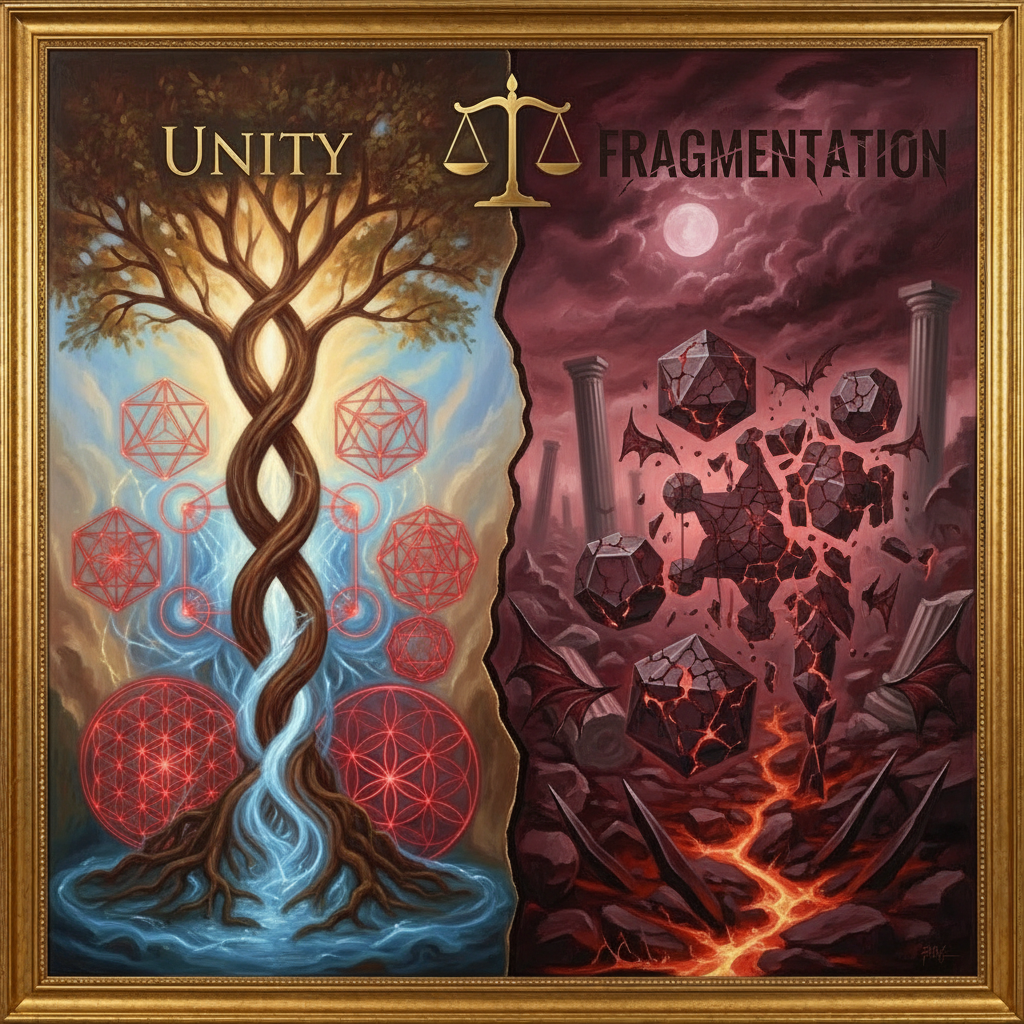
Before we begin, a word about two Greek words that will illuminate everything that follows.
The Greek word symbolon comes from sym- (“together”) and ballein (“to throw”). It means, literally, to throw together—to gather, to unite, to make whole. The symbol joins what is separated. It is the word the early Church used for the Creed itself: the Symbolum Apostolorum, the gathering-together of what Christians confess.
Its opposite is diabolos—from dia- (“across, apart”) and the same root, ballein. It means to throw apart—to scatter, to divide, to tear asunder. This is the word the Septuagint translators chose to render the Hebrew satan: the adversary, the accuser, the one who separates.1
The symbolic gathers. The diabolic scatters. That opposition is not incidental to the Christian vocabulary. It is the Christian vocabulary—baked into the language the tradition inherited from its earliest days.
What happened at the Pentagon last week sits at the exact intersection of these two words. And it cannot be understood without both.
A Note to New Readers
This is the fourth post in a series called the Great BASH Project, published at cosmicchrist.net. The earlier installments—How the Egregore Great BASH Shows Itself at the Threshold of Human Shift, The Terran Self at War with Itself, and The Billionaire Who Named His Surveillance Company After Sauron’s Weapon—laid the metaphysical and psychological groundwork for what I am doing here. This post is shorter than those, and more immediate. It responds to something that happened last week. But it draws on the same framework, and for readers arriving for the first time, I want to offer enough orientation to make the analysis intelligible.
I write these posts because I believe we are living through a period in which the interior dynamics driving political action are at least as important as the policy outcomes—and that the tools of contemplative theology, process metaphysics, and the Law of One framework can illuminate those dynamics in ways that conventional political analysis cannot. I am a licensed clinical social worker, a contemplative theologian, and a student of the Ra material. I am also a Catholic who loves the Franciscan tradition and finds in it a vision of reality that stands in direct contrast to what I am about to describe.
I am not writing to condemn. I am writing to diagnose. The distinction matters. Condemnation closes the circuit—it participates in the very pattern it opposes. Diagnosis names what is happening so that it can be seen, and seeing is the precondition for choosing something different. That is the contemplative commitment underneath this project: not certainty that I see clearly—I do not—but willingness to look and to say what I think I see, in an open hand.
The Great BASH: A Brief Orientation
The Great BASH is the name I have given to a planetary-scale collective thoughtform—what esoteric traditions call an egregore—that organizes human bellicosity into self-reinforcing patterns across every level of social life, from interpersonal conflict to civilizational war.2 The acronym stands for:
Bellicose Attitude—the foundational worldview perceiving life as fundamentally competitive. Others are potential enemies. Security comes through dominance.
Aggressive Actions—the behavioral expression of that attitude, from personal manipulation to systemic oppression to war.
Scarred and Scared—the traumatic foundation underneath the bellicosity. Unprocessed wounds—personal, generational, civilizational—create hypersensitivity to threat and defensive reactions that perpetuate harm cycles.
Hope Through Hostility—the deepest distortion: the conviction that redemption comes through the defeat of enemies. This is the myth of redemptive violence. It never delivers what it promises. But it always promises.
The organizing spine of the analysis is a single distinction: Power and Authority are not the same thing. Power is the capacity to compel. Authority is the capacity to lead because others recognize something worthy of following—wisdom, competence, genuine care. A person—or an administration—secure in authentic authority does not need to invoke cosmic warfare to justify a military operation.
In the vocabulary of the Law of One, the Great BASH is the collective expression of distorted orange-ray energy—the energy center governing personal identity and the relationship to other-selves.3 When this center is blocked, the self cannot stabilize without an external other to define against. Identity is maintained through opposition. The enemy is not incidental to the system—the enemy is structurally necessary to it.
What Happened
On Wednesday, March 25, 2026, Defense Secretary Pete Hegseth hosted his first monthly Christian worship service at the Pentagon since the Iran war began.4 The service was livestreamed. The audience included civilian employees and uniformed military personnel. Hegseth read a prayer he attributed to the chaplain who ministered to the troops who seized Venezuelan President Nicolás Maduro in January, and offered it for American forces now engaged in Operation Epic Fury—the U.S.-Israeli campaign against Iran, now in its fourth week, with thirteen American service members killed and more than two hundred wounded.5
The prayer asked God to “pour out your wrath upon those who plot vain things,” to “break the teeth of the ungodly,” to grant American forces “overwhelming violence of action against those who deserve no mercy,” and to ensure that “every round find its mark.” It concluded by asking that enemies be “delivered to the eternal damnation prepared for them” and that “justice be executed swiftly and without remorse.” He prayed all of this in the name of Jesus Christ.6
Hegseth belongs to the Communion of Reformed Evangelical Churches, a conservative network co-founded by self-described Christian nationalist Doug Wilson, who preached at Hegseth’s Pentagon services in February.7 A lawsuit was filed the same week by Americans United for Separation of Church and State over the services.8 That same week, Hegseth announced reforms to the military chaplain corps, directing chaplains to focus on God rather than therapeutic “self-help and self-care”—at a time when the military has grown increasingly dependent on chaplains to address troop mental health distress during active combat.9
One additional detail. The day before the service, Trump had told reporters that Hegseth was the only cabinet member who wanted the Iran war to continue. “Pete didn’t want it to be settled,” the president said, laughing.10
The man who did not want peace stood up the next day and prayed for every round to find its mark.
The Great BASH as Liturgy
Every dimension of the framework is present in this single event. Not as abstraction, but as liturgy.
Bellicose Attitude. The prayer does not ask for protection. It does not ask for wisdom to end the conflict. It does not ask for the safety of civilians on any side. It asks for maximum lethality—every round finding its mark—and frames that lethality as righteousness. The tone is not reluctant. It is exultant. Military action is not a burden to be borne with moral seriousness; it is worship.
Aggressive Action. This is not a general invoking God’s blessing on the troops, as presidents of both parties have done for generations. Historian Ronit Stahl noted that invoking God in broad terms is not unusual from defense leaders—but the shift to the specificity of Jesus Christ and a particular form of Protestant Christianity is new, especially from the defense secretary.11 The aggression is the content of the prayer itself: teeth broken, wrath poured out, enemies slaughtered and damned.
Scarred and Scared. The prayer’s structure reveals what it cannot say. A person secure in genuine faith does not need God to validate the annihilation of enemies. A person secure in the moral clarity of a military campaign does not need to frame adversaries as “wicked souls” destined for “eternal damnation.” The theological overkill—the need to make enemies not merely wrong but ontologically evil—is the signature of a self that cannot hold ambiguity. This is the orange-ray distortion at institutional scale: the self cannot stabilize without an external enemy against which to define itself.
Hope Through Hostility. Here is the deepest current. The prayer locates redemption entirely in destruction. There is no vision of restoration, reconciliation, or transformation. Justice is “executed swiftly and without remorse.” Evil is “driven back.” The wicked are delivered to damnation. Hope arrives through annihilation—and only through annihilation.
Power vs. Authority
Authority does not need to pray for overwhelming violence at a government podium during working hours. Authority does not need to direct chaplains—that same week—to stop providing mental health support and focus on “God,” removing the therapeutic container that might allow service members to process moral injury during an active war. Authority does not need to tell a gathering of Christian broadcasters that critics of the Pentagon services “hate it,” then add: “which means we’re right over the target.”12
These are the behaviors of Power—compulsion dressed in liturgical clothing. The coercive dimension is structural. Federal employees attend these services under implicit career pressure. Chaplains are being redirected from caring for troops in mental health distress toward a narrower theological mission. The institutional container is being reshaped so that the only available framework for understanding the war is the one Hegseth is offering: holy crusade, divine mandate, the righteous vanquishing the wicked.
The chaplain reforms reveal the system’s internal logic. If the war is God’s will—if enemies are ontologically wicked and destined for eternal damnation—then there is no moral complexity for a chaplain to address. The prayer eliminates moral injury by eliminating the moral subject. And the institutional reform removes the space where a service member might discover that the moral injury is still there.
What the Prayer Cannot See
There is a question the prayer forecloses, and the foreclosure is the point.
If the enemy is ontologically wicked, destined for eternal damnation, defined as deserving no mercy—then there is nothing to see. No Iranian civilians. No children. No complexity in the historical relationship between these civilizations. No possibility that the adversary is also a bearer of consciousness. The other has been stripped of every quality that might generate hesitation. What remains is a target, and the prayer sanctifies the targeting.
This is what orange-ray distortion looks like when it captures an institution. The self—nation, faith, military mission—cannot exist without the annihilation of the other. The gateway to green ray, to the heart center that can hold the other without needing to destroy or possess, remains closed.13 And the liturgical framing makes the closure feel like devotion.
That same week, Hegseth’s own pastor Brooks Potteiger appeared on a Christian nationalist podcast where the co-host said of a Democratic Senate candidate: “I pray that God kills him.” Potteiger responded: “Right. Right. We want him crucified with Christ.”14 The language of crucifixion—the central sym-bolon of Christian faith, in which the tradition says God absorbed violence rather than inflicting it—deployed as a death wish against a political opponent. The Great BASH always knows how to put on sacred vocabulary.
Francis and the Sultan
Eight hundred years ago, during the Fifth Crusade, Francis of Assisi crossed enemy lines unarmed to meet Sultan al-Kamil. He did not pray for every round to find its mark. He did not ask God to break the teeth of the ungodly. He walked into the space between the armies and treated the other as a human being worthy of encounter.15
Francis did not convert the Sultan. The Sultan did not convert Francis. The war continued. But something happened in that meeting that neither army could produce: the recognition that the enemy is also a person. That recognition is the gateway—in the language of the Ra material, the opening of green ray, the heart center that can hold the other without needing to annihilate or possess.
Pete Hegseth’s Jerusalem Cross tattoo invokes the same medieval era. But where Francis walked unarmed toward the other, Hegseth prays armed for the other’s destruction. The cross on his chest and the prayer at his podium represent the same symbol pointed in opposite directions—one toward encounter, one toward elimination.
Carrying the Name
There is an older word for what happened at that podium. It comes not from Greek but from Hebrew, and it is one of the Ten Commandments.
Lo tissa et-shem-YHWH Elohekha lashav. “You shall not take the name of the LORD your God in vain.”16
The popular interpretation of this commandment—don’t say “goddamn”—reduces one of the Torah’s most radical demands to an etiquette rule. The Hebrew says something far deeper. The word translated “take” is nasa: to lift, to carry, to bear. And shav, translated “in vain,” means emptiness, falsehood, worthlessness of conduct. The commandment is not primarily about careless speech. It is about carrying God’s name as a banner over actions that contradict God’s character.
My spiritual father and friend Richard Rohr understood this commandment in exactly these terms: it prohibits using the name of God to justify one’s own agenda. Not profanity—conscription. Not casual irreverence—sacred fraud. Jewish tradition converges on the same reading. Rabbi Joseph Telushkin argued that the commandment’s proper translation—“you shall not carry”—explains why it stands alongside “You shall not murder.” David Klinghoffer compared it to a ship sailing under false colors—flying a flag that misrepresents what the ship actually is.17 Old Testament scholar Carmen Joy Imes connected it to the priestly garments of Aaron: to carry God’s name is to represent God’s character, and to carry it falsely is to misrepresent the Holy One to the world.18
And the commandment carries a warning found nowhere else in the Decalogue. It does not say God will not acquit the murderer or the adulterer. It says God will not acquit this—because this violation damages God’s reputation. This one imputes to God sins of which God is innocent.19
When Pete Hegseth stands at the Pentagon podium and prays for “overwhelming violence against those who deserve no mercy” in the name of Jesus Christ, he is carrying that name. He is nasa—lifting, bearing, representing. And the Jesus whose name he carries is the one who said “love your enemies,” who healed the servant of the soldier who came to arrest him, who died forgiving the people killing him. The name that means “God saves” is being carried into a prayer for God to destroy. The name is being flown as a banner over actions that are the precise inversion of everything the person bearing that name taught.
This is what the Third Commandment was written to name. Not profanity. Not a slip of the tongue. The systematic appropriation of the Holy Name to sanctify what the Holy Name’s bearer explicitly condemned.
The Symbol of the Diabolic
I return to where I began, and to the reason this post carries the weight it does.
What has always been present in this administration is now revealing itself overtly. This is what crescendos do. They do not introduce new themes. They bring to full volume what has been building from the first measure.
The dehumanization of the Obama apes post. The Greenland theatrics. The tariff claims maintained against every independent economic assessment. The holy war framing of Iran. Peter Thiel’s Antichrist lectures in Rome. Hegseth’s crusader tattoos and monthly Pentagon worship services. The chaplain reforms. And now a prayer for annihilation, spoken in the name of Jesus Christ, livestreamed from the heart of the world’s most powerful military apparatus. The themes were always there. The volume is new.
And here is what the Greek etymology illuminates about the nature of the crescendo.
This administration is not simply diabolic—throwing apart. It is doing something more layered. It is becoming the symbol of the diabolic. It is throwing together—gathering, unifying, cohering—a worldview and a community around an energy that is itself the opposite of what Christ embodied. The sym-bolon is real. The cohesion is real. The unity among Hegseth, the CREC pastors, the dispensationalist base, the Christian nationalist infrastructure, the administration’s theological ecosystem from Huckabee to Drollinger to Johnson—that gathering is genuinely happening. It is becoming more visible, more overt, more internally consistent with each passing week.
But what is being gathered around is the dia-bolon: bellicosity sanctified as righteousness, annihilation framed as mercy, the enemy defined as ontologically damned. The cohesion is in service of division. The unity is organized around exclusion. The symbol gathers—but what it gathers is the energy of scattering.
And none of it can be called Christological. Not because the name of Christ is absent—it is invoked constantly. But because the Christ of the Gospels moved in exactly the opposite direction. Toward the outsider. Toward the enemy. Toward encounter rather than annihilation. Toward the cross understood as the place where God absorbed violence rather than inflicting it. The Jesus who said “Blessed are the peacemakers” is not the Jesus being invoked when a Defense Secretary prays for every round to find its mark. The name is the same. The direction is reversed.
The diabolic does not announce itself as diabolic. It announces itself as holy. That is the whole point of the etymology. It throws apart while claiming to gather. It divides while wearing the vocabulary of unity. It scatters while invoking the name of the one who said gather. The Great BASH does not need to reject God. It needs to conscript God—and that conscription is, in the deepest Jewish and Christian understanding of the Third Commandment, the violation the tradition singles out as uniquely grave.
The crescendo is here. What was always present is now speaking at full volume, in plain language, from a Pentagon podium, in the name of Jesus Christ, livestreamed for all the world to see.
The question is whether we can hear it for what it is.
The Thought-Form We Feed

I want to circle back now and remember what I am trying to articulate through the acronym B.A.S.H.
The Great BASH is not simply a framework through which to understand actions or attitudes. It is my name for an ontological reality. If I am taking the concepts of Logos and logismoi seriously—if I mean what I say when I claim that consciousness generates form, that sustained collective attention creates entities with their own momentum and their own primitive sentience—then the Great BASH is an egregore: a living thought-form. In process theology, it is what Whitehead would call a nexus of actual occasions organized into something with its own agency. It is not a metaphor. It is a sentient being. And it has a place to play inside the divine drama, inside God’s own process of becoming.
Others have called this egregore Satan—imagining it as an eye of evil from elsewhere, a being who arrives from outside to tempt us away from God. I am saying something different here, and I have said it throughout this series. We ourselves created it. The Great BASH is not a cosmic intruder. It is a planetary-sized thought-form generated by millennia of human bellicosity, fed by our collective worship of redemptive violence, nurtured by every civilization that has located its hope in the destruction of its enemies. Can it be intensified by non-planetary negative entities? The Ra material suggests yes. But the origin is ours. We built it. We feed it. And we ourselves are the ones who become enmeshed in it—all the more deeply when we mistake it for the Holy.
The Desert Fathers knew this mechanism intimately. They called the intrusive thought-patterns that assailed the monk in prayer logismoi—a word that shares its root with Logos itself. Both come from legein: to gather, to sort, to reason. But where Logos gathers toward unity and divine order, the logismoi scatter toward fragmentation. The critical insight of Evagrius and the tradition that followed him was that a logismos is not a raw impulse. It wears the clothing of reason. It argues. It makes a case. It presents itself as Logos while pulling toward disorder. Hegseth’s prayer follows exactly this pattern: scripture, liturgical form, the name of Jesus Christ—all the clothing of Logos—draped over a content of annihilation. The Desert Fathers would have recognized it immediately. Not as prayer, but as a logismos operating at institutional scale.
This is what makes the liturgical dimension so dangerous—and so clarifying. The generative mechanism is morally neutral: the same engine of gathered community, sustained attention, collective devotion, and ritual repetition that produces shekinah and charis—grace, blessing, the numinous quality of sacred sites deepened by centuries of prayer—also produces the Great BASH. What determines the output is not the intensity of the worship but its object.
When we put on theological language and praise the worthiness of the Great BASH—when we dress bellicosity in the vocabulary of righteousness, when we call the annihilation of the other “justice” and the dehumanization of the enemy “faith”—we are not merely making a political error. We are feeding the egregore. We are giving it our worship. And worship is the most potent food a thought-form can receive, because worship means we have stopped examining it. We have mistaken it for the Holy itself.
This is precisely how human beings enmesh themselves further into the Great BASH without knowing it. Not through malice—through sincerity. Not through irreligion—through devotion misdirected. The more fervently we worship at the altar of redemptive violence, the deeper we sink into the thought-form’s logic, and the less capable we become of distinguishing what is genuinely holy—sym-bolon, that which makes whole—from what is genuinely diabolic—dia-bolon, that which tears apart.
The confusion is not accidental. It is the egregore’s primary mechanism. It does not work by making evil look evil. It works by making evil look holy. And the prayer at the Pentagon—spoken with genuine fervor, received with genuine devotion, offered in the genuine name of Jesus Christ—is the confusion made audible.
The contemplative task is not to meet this with more bellicosity—that only feeds the same thought-form from the other side. The contemplative task is to see it. To name it. And to choose, in whatever small way we can, the sym-bolon over the dia-bolon: the gathering over the scattering, the encounter over the annihilation, the Francis over the crusader. Not because we are better than those caught in the pattern. But because we recognize the pattern in ourselves, and we know that recognition—not victory—is where the real work begins.
This is my limited, partial, open-handed offering. Take what is useful. Leave what is not.
This post is part of the Great BASH Project at cosmicchrist.net, an ongoing analytical series examining authoritarian political movements through psychological, geopolitical, and metaphysical lenses. Previous installments: How the Egregore Great BASH Shows Itself at the Threshold of Human Shift (March 10, 2026); The Terran Self at War with Itself (March 2026); The Billionaire Who Named His Surveillance Company After Sauron’s Weapon and Then Lectured on the Antichrist (March 2026).
Endnotes
1. Online Etymology Dictionary, “diabolic,” accessed March 2026, https://www.etymonline.com/word/diabolic. See also Merriam-Webster, “diabolical,” https://www.merriam-webster.com/dictionary/diabolical. The Greek diabolos derives from dia- (“across, through”) + ballein (“to throw”), literally “to throw across/apart.” Its opposite is symbolon, from sym- (“together”) + ballein, literally “to throw together.” The Septuagint translators chose diabolos to render the Hebrew satan (“adversary”).
2. Doug Scott, “How the Egregore Great BASH Shows Itself at the Threshold of Human Shift,” cosmicchrist.net, March 10, 2026; Doug Scott, “The Terran Self at War with Itself,” cosmicchrist.net, March 2026.
3. Ra Material (The Law of One), Session 15.12; Session 32.14. The orange-ray energy center governs personal identity, self-assertion, and the relationship to other-selves as individuals. Blockage or distortion at this level manifests as the inability to stabilize identity without defining against an external other.
4. Associated Press, “At Pentagon Christian Service, Hegseth Prays for Violence ‘Against Those Who Deserve No Mercy,’” March 25, 2026. Reported via PBS NewsHour, Washington Post, Military.com, Washington Times, and dozens of AP affiliates. The service was livestreamed.
5. Associated Press, via Military.com, March 26, 2026. As of that reporting, Operation Epic Fury had resulted in thirteen American service members killed and more than two hundred wounded.
6. Full prayer text reported by Brett Wilkins, “‘Heretical and Batshit Crazy’: Hegseth Rebuked for Bloodthirsty Prayer Asking God to Bless Iran War,” Common Dreams, March 26, 2026, citing video posted by journalist Michael Tracey on X, March 25, 2026. Also confirmed by the Daily Beast, March 26, 2026.
7. Associated Press, via PBS NewsHour, March 25, 2026. Hegseth belongs to the Communion of Reformed Evangelical Churches (CREC), co-founded by self-described Christian nationalist Doug Wilson. Wilson preached at Hegseth’s Pentagon services in February 2026. Hegseth also attends weekly White House Bible study led by Ralph Drollinger. See Doug Scott, “Hegseth, Vance, and Johnson: Religious Framing, War Justification, and the Iran Campaign,” Great BASH Project Research Brief, March 5, 2026.
8. Associated Press, via PBS and Military.com, March 25–26, 2026. Americans United for Separation of Church and State filed suit Monday, March 23, seeking internal communications about the services, their cost, and any complaints.
9. Associated Press, via PBS NewsHour, March 25, 2026. Hegseth directed chaplains to prioritize spiritual ministry over mental health and “self-help” approaches, in a week when the military had grown increasingly dependent on chaplains to address troop mental health distress during active combat.
10. “Pentagon Pete Hegseth Prays for ‘Overwhelming Violence’ at Christian Service,” The Daily Beast, March 26, 2026. Trump told reporters at Tuesday’s Oval Office swearing-in of Homeland Security Secretary Markwayne Mullin: “Pete didn’t want it to be settled.” Trump identified Hegseth as the first cabinet member to push for military action against Iran.
11. Ronit Stahl, author of Enlisting Faith: How the Military Chaplaincy Shaped Religion and State in Modern America (Cambridge, MA: Harvard University Press, 2017), quoted in Associated Press/PBS coverage, March 25, 2026.
12. Associated Press, via Washington Times, March 25, 2026. At a gathering of Christian broadcasters in February, Hegseth said of the Pentagon services: “We hear a lot from the ‘freedom from religion’ crowd. They hate it. The left-wing shrieks, which means we’re right over the target.”
13. Ra Material (The Law of One), Session 46.9–10; Session 48.7. Green ray (the heart center) is the first energy center capable of holding the other without needing to annihilate, possess, or control. It is the gateway to higher-density work and the prerequisite for the density transition Earth is currently undergoing.
14. “Pentagon Pete Hegseth Prays for ‘Overwhelming Violence’ at Christian Service,” The Daily Beast, March 26, 2026. Hegseth’s pastor Brooks Potteiger appeared on the Christian nationalist podcast Reformation Red Pill, where co-host Joshua Haymes said of Democratic Senate candidate James Talarico: “I pray that God kills him.” Potteiger responded: “Right. Right. We want him crucified with Christ.”
15. For the Francis/Sultan encounter as counter-image to the crusader theology, see Doug Scott, “The Terran Self at War with Itself,” cosmicchrist.net, March 2026. The historical encounter occurred in 1219 during the Fifth Crusade at Damietta, Egypt.
16. Exodus 20:7. The Hebrew nasa means “to lift, carry, bear” rather than simply “to speak.” The word shav (translated “in vain”) means emptiness, vanity, falsehood, worthlessness of conduct. Rabbi Joseph Telushkin argued that the more literal translation—“you shall not carry” the name of YHWH—explains why the commandment ranks alongside “You shall not murder.” See Joseph Telushkin, A Code of Jewish Ethics, vol. 1 (New York: Bell Tower, 2006). See also “The Innocence of God: The Third Commandment,” Tikkun 31, no. 2 (April 2016).
17. David Klinghoffer, Shattered Tablets: Why We Ignore the Ten Commandments at Our Peril (New York: Doubleday, 2007), cited in “Watch Your Language: The Third Commandment,” The Dayton Jewish Observer, May 2010.
18. Carmen Joy Imes, in conversation with Kirk E. Miller, “What Does It Mean to Take God’s Name in Vain?,” Logos, March 2025. Imes connects the priestly bearing of God’s name on Aaron’s garments (Exodus 28:12, 29) to Israel’s commissioning as a nation of priests (Exodus 19:5–6), arguing that “carrying God’s name” means representing God’s character faithfully through one’s actions.
19. “The Innocence of God: The Third Commandment: Building the Religious Counterculture,” Tikkun 31, no. 2 (April 2016). The article notes that the second half of the Third Commandment—“for God will not acquit a person who takes God’s name in vain”—uses language found in no other commandment, including the prohibitions against murder and adultery.
 Building 4th Cosmic Christ