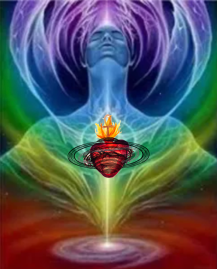
by Doug Esse
I like to borrow from what Richard Rohr says about Scripture [see below]. I have adopted it and redacted the statement to fit my beliefs. I believe that the Bible from the Hebrew Scriptures to the end of the Christian Scriptures portray on a macroscale what is always and everywhere true for the individual person.
In other words, the Bible reveals the process of human development on an individual level which is mirrored in the narrative arc of a people, the Jewish people. The Bible illustrates how we grow in holiness (wholeness) in a remarkable way because it shows how we begin our spiritual journey by seeing God “up there,” and experiencing God’s power as all powerful, sometimes jealous, sometimes wrathful, and sometimes revengeful. By the end of Christian Scriptures in the Bible, God’s very nature is revealed to us. We see a God whose power is marked by God’s tender vulnerability; God is “all vulnerable,” as it were. We see God’s nature is merciful love and God expresses this love through rooted solidarity in the human experience. In the finality of God’s story, we see that God is not “up there,” but rather, “in here,” in the very immediacy of our life situations, and inside each of us through every breath, tear, and delight.
How did we get from God being separate and exclusive to a God who is indwelling and radically inclusive of our humanity? Did God change? Are different gods portrayed by the different scriptures? No. God remains God’s nature, which is love. We, humans, grew up and matured. We started out in concrete thinking and dualistic notions of reality. We ended with a different worldview, one that developed over many thousands of years, which can only be described as unitive consciousness (nondual) that sees the world through the eyes of Christ (no longer I but Christ who lives within me; and mind of Christ). From this Christic worldview, we do not see God over there, but rather we see the world and ourselves from inside God’s own perspective of unity and union.
The Biblical journey, just like our individual journeys, is marked by the three steps forward and two steps back. We get it and then we lose it. But when we lose it, we don’t start at the beginning, but rather we stand upon a little higher ground, and ready ourselves to be taken on our next three-step forward leap into more holistic, expansive seeing and living. In fact, the word, “metanoia,” which we translate as convert or repent, means something like, ” the ongoing process of learning to see and serve from an ever more comprehensive worldview.”
Thus, because the Bible as a whole reveals our human development so clearly and with so much wisdom, despite it being written by several cultures over thousands of years and many, many generations, I affirm its divine inspiration. How else can we account for such a remarkable narrative that validates, challenges, invites, informs, and nurtures our how spiritual journey so well?
I believe that it is inerrant in the sense of its accurate portrayal of human spiritual development and its revelation of God’s nature as love-with-and-in-us. The Bible is a guide, a steady rail, and an arrow pointing to my ultimate destination: unitive consciousness where the eye with which I see God and the eye with which God sees me is the same eye (Meister Eckhart).

That’s the paradox of unitive consciousness. We are not God and we are not other than God. God is all there is and the Universe is God’s Body. Priest and mystic, Raimon Panikkar, tried to describe this paradox, “Not one, not two, but both one and two.”
Through my spiritual journey, I have encountered other spiritual sources and scriptures of other spiritual traditions that offer guidance, sturdy rails, and clear arrows that point to the same slow process of the human learning how to delve deeper and deeper into union and unity with God, and through God, with all things.
How can I not see that what is true in my tradition is also true in other traditions? How can I not validate mature spiritual seekers of other traditions who clearly embody merciful love, compassion, reconciliation, and joy? Is it possible that a tradition’s scripture is a gift to a particular culture at a particular time in order for God to reveal Godself in the most effective way for a given people to slowly awaken and slowly respond to the allure of God’s powerful and vulnerable yearning love for consummate union?
Therefore, my own deep relationship with the Scripture of my faith of origin which has spanned a few decades has led me, as I believe it intended to lead me, to this:
God is everywhere and divine inspiration can be received through any thing. God’s loving nature and the signposts that point toward God’s loving heart are found in all things, and thus, all things can be particular portals into the truly universal nature of God’s divine presence.
Scripture, my own experience, and my own spiritual tradition, are a kind of triune-lens through which I looked at other scriptures, others’ experiences, and other spiritual traditions. What I learned was that who the Other is and who I am are beautiful threads in one seamless relational matrix that has been anointed since the beginning as the Word who was with God, who was God, and through whom all things were made.
 Building 4th Cosmic Christ
Reblogged this on €y€°•°Woπder and commented:
💞”who the Other is and who I am are beautiful threads in one seamless relational matrix that has been anointed since the beginning as the Word who was with God, who was God, and through whom all things were made.” 💞:
LikeLike