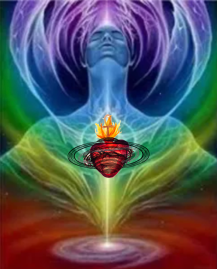
![The Significant Self: “[Possesses] the will to know, but what shall it do with its knowledge, and for what reasons does it seek?” (79.42)](https://cosmicchrist.net/wp-content/uploads/2026/06/screenshot-2026-06-03-at-11.24.11-am.png?w=630&h=737&crop=1)
Presentation by Doug Scott, LCSW
AUDIO
Notes from a Building 4th gathering, where the Ra Material’s “significant self” meets Richard Rohr’s true and false self — and where a model I use with counseling clients finds its way home.
We begin the way we often do, settling into the still point a member introduced to us in an earlier session — that point of quiet underneath the noise, a sea of meaning where you can simply float for a moment. I ask that the conversation be blessed for the good of all of us, and for anyone who might find these words later. Then I share my screen, warn everyone about the sophistication of my fifteen-minute drawings, and admit up front that what follows is a simplification filtered through my own distortions and biases. I ask the Ra scholars in the room to correct me as needed. They oblige, which is part of why these nights work.
The topic is the significant self.
A term Ra uses only twice
Ra uses the phrase “significant self” only twice in all the material — though significator shows up often, as the fifth archetype of the mind. The way I’ve come to hold it (rightly or wrongly) is that the significant self is close to what many traditions simply call the soul: the self that migrates from lifetime to lifetime, carrying something forward.
The clearest anchor for this is the infant question. Don once asked Ra what makes a newborn reach for experience at all — what potentiates that grasping toward consciousness. Part of Ra’s answer is that the spirit complex is not reliably developed in every infant; some are newly minted third-density beings who may not yet have chosen a polarity. And yet the child is not a blank slate. As Ra puts it, the infant’s significant self is “the harvest of biases of all previous incarnational experiences,” offering the child biases with which to meet new experience (Ra, 92.18). A longtime member reads this passage aloud, and it lands for the whole room: we arrive already carrying a deep, mostly forgotten memory of who we have been.
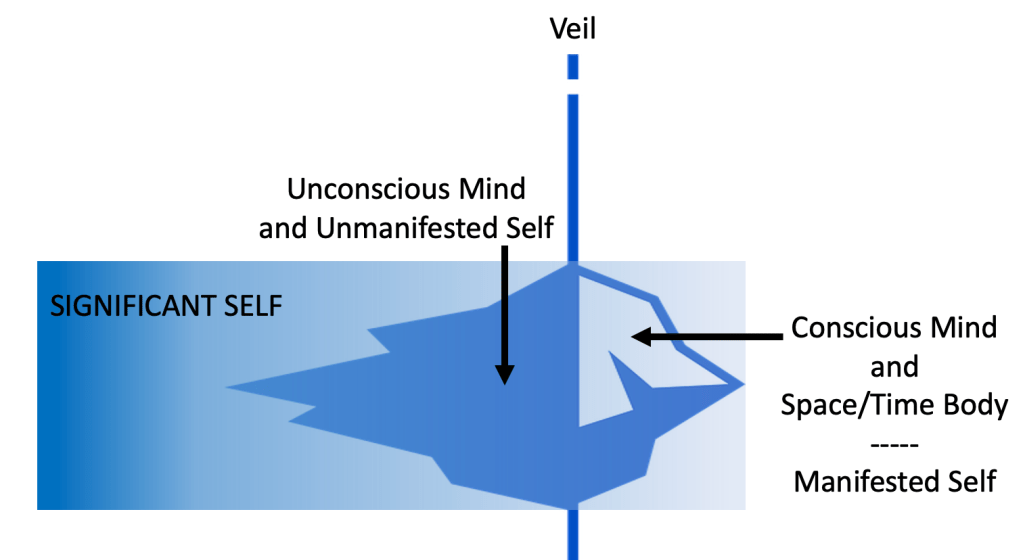
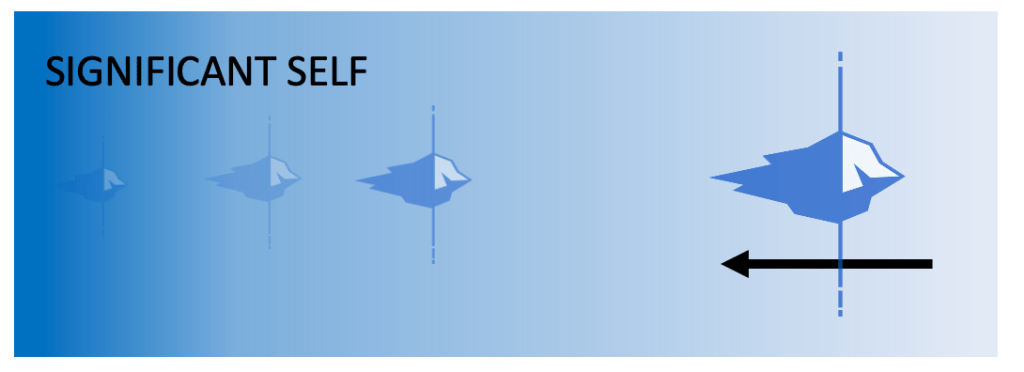
While we are alive, I’d say the significant self holds the whole apparatus — conscious mind, unconscious mind, and the unmanifested self together. Then at death, the division that the veil maintained between conscious and unconscious gets absorbed back into the significant self, and the lessons distill. In my little drawing I render this as a rectangle with a color gradient that deepens over time, darkening as experiences are metabolized and biases crystallize.
That distilling is the work Ra describes as healing and review between incarnations. Each life, Ra says, is “a course in the Creator knowing Itself” (Ra, 82.25) — and each one ends with a kind of review where the biases gained are evaluated and the next incarnation is chosen, sometimes with help, sometimes by the self. The image I reach for is rifling through a book where every page is not words but a memory you re-enter and fully feel — including the way you affected other people. That is the distilling of lessons. The significant self, in this sense, is also the astral body, the form-maker that activates first after the yellow-ray body falls away (Ra, 47.11) — the body of the near-death experiencer, the essence of you, your signature frequency, as particular as a scent.
When a member suggests this sounds like the oversoul, I offer a small correction. Ra reserves “oversoul” for something closer to the higher self, and the higher self lives, in a sense, in our future (Ra, 36.4). The significant self is not the higher self. It is who you are at this present rung of awareness — where I am today, where any of us is today.
What “significant” actually means
One of my spiritual practices over the past few years has been looking up the etymology of words, and significant turns out to be rich. Tracing it back through the Latin and old French, before it blooms into postmodern American English, the root has to do with the making of a sign — a sign that creates an orientation, that draws us to follow. So another way to say it: the significant self is the meaning-making self. It is bound up with our chosen polarity and with how we make sense of the daily catalysts that arrive. (This squares with Ra’s own framing of the significator as the entity that desires to know — the meaning-making system at the center of the archetypal mind.)
A member then reads the passage that ties all this to the architecture of the archetypes — that the Great Way of the Mind, the seventh archetype, is “dependent upon its notable difference from the Significator,” and that the significator is “the significant self, to a great extent,” though not entirely shaped by the lowering of the veil (Ra, 103.11). One of our scholars frames the Great Way as the significator essentially without the veil in the way — the milieu, the whole environment of the archetypal system. And another member offers an insight I keep returning to: the significant self may be our own personal archetypal mind. On the macrocosmic scale, the Creator’s archetypal mind is the harvest of one creation’s experience, used to shape the geometry of the next. On the microcosmic scale, our significant self is the personal repository of past lives that biases how we meet — and metabolize — this one. The significant self as a fractal of the whole. That’s exactly right.
A model from the counseling room: the ocean
Here I ask everyone to cleanse the palate, because the next part comes from years of working with Richard Rohr’s true self and false self. I love that framework, and over time it came to feel incomplete to me — which is when I realized the significant self was the missing piece.
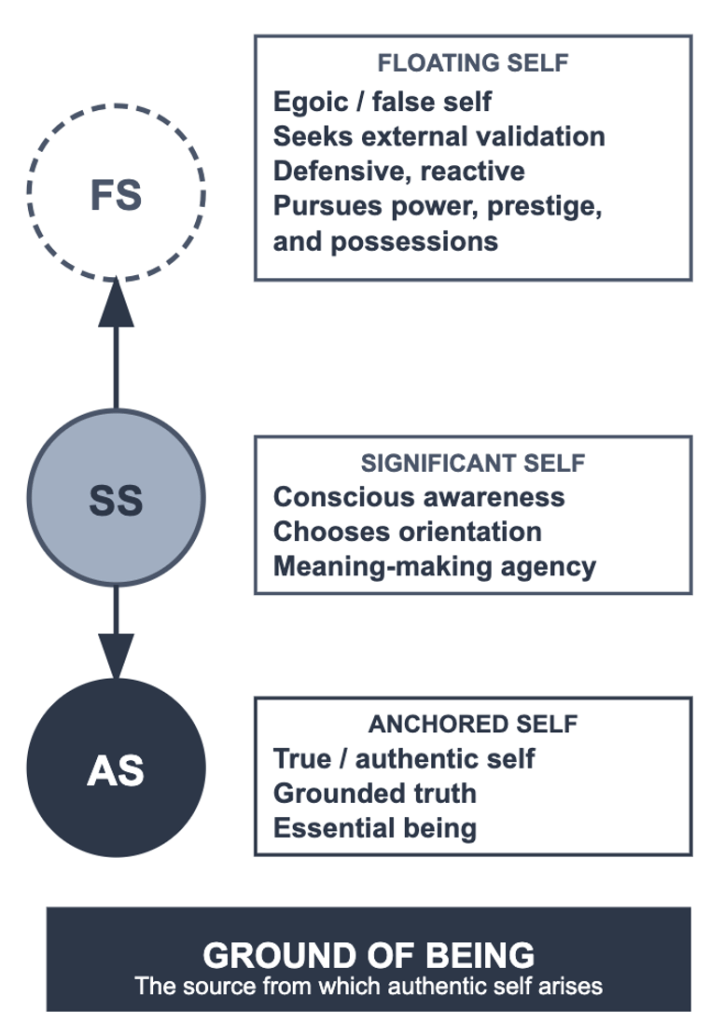
Picture the bottom of the ocean: still, dark, hidden, untouched by whatever storms rage above. That floor is the ground of being. Now picture a mound rising from it — a rock that is not separate from the floor but a unique instance of it, the floor itself coming up to a crescendo. That is the anchored self: your true self, your authentic depth, grafted into the ground of being. It is not other than God, though it isn’t the full ground either; it’s your particular energetic signature, the one that incarnates and grows across lifetimes.
Now picture the surface — a buoy bobbing on top of the water. That is the floating self, what Rohr would call the false self. It runs on an external locus of control. It’s happy one moment, anxious the next; it can have a beautiful day floating up there until a bird comes along and ruins it. The floating self is the ego, the image others see, the self that is large and in charge especially in the first half of life. It plays a subtle game — the pursuit of power, prestige, and possessions (three P’s I’m borrowing from Thomas Keating, who taught Richard Rohr and so many others). When I feel caught in reactive energy, I’ve never once found an exception: it’s tangled up in one of those three. A colleague chosen over me. A neighbor’s new car that suddenly makes mine look tired. The floating self is fragile precisely because it’s hollow — it has nothing solid underneath, so it defends, takes slights, and seeks validation without end.
I want to be clear that the floating self is not the enemy and not the bad self. It becomes dangerous only when it is the only self I think I am. We’ve all seen leaders in churches and in government make the perennial mistake of believing their true self is the degree to which they wield power. That is the floating self with no deeper tether — and that’s where the danger lives.
Connecting the buoy to the anchor is what I call the Holy Tether — a cord running all the way down that is never cut and can never be cut, because both selves are sacred.
And in the middle, able to travel up toward the buoy or down toward the anchor, is the significant self: our conscious awareness, the meaning-maker, the one with agency that chooses an orientation. For most of us most of the time — and I include myself — that self is not really awake. We react instead of respond.
The two doors: great love and great suffering
What wakes the significant self enough to actually choose? Rohr names two doorways, and I’ve tested this against my own life and can’t find a way around it: great love and great suffering. They are two faces of one coin, and the coin is vulnerability. Both involve a loss of power, a powerlessness the ego can’t manage. We break open — and that crack is exactly where the light gets in, and where a new response becomes possible.
When I sit with a couple in counseling, I can usually sense early on whether two anchored selves are present or whether two floating selves are running the show. When it’s the floating selves, the same fight repeats for years, because we keep trying to resolve things at the level of reactivity. We haven’t yet learned from our pain — or from our moments of love.
The love door looks like being seen and embraced more fully than we can see ourselves, forgiven in a way that runs past the transactional, met with a mercy we’re sure we don’t deserve. That kind of unmerited belonging cracks us open, and then — this is the turn — we become that for others. The suffering door looks like finally noticing the ways we’ve participated in our own discomfort: In what ways have I been blind? If we don’t flinch into shame and then anger and attack, if we can stay on the cross of that pain long enough, humiliation matures into genuine humility. I was blind, but now I see. And the next time a catalyst arrives carrying that same frequency, we can meet it with a larger self and respond in a way that keeps the dignity of everyone intact.
I think of the significant self as a car that can drive down and be housed in the anchored self, or drive up and park in the floating self. We get to choose where it lives.
What the room gives back
Then we open it up, and the dialogue is the best part.
One member connects this to the Jesus Prayer — the practice of praying without ceasing, carried through the day, which pulls consciousness out of the floating self into a deeper place and reinforces the anchor to God that’s already there. I know that drop myself; when I pray the prayer of the heart there’s a literal sense of dropping down and in.
Another member describes an ongoing relationship with what he’s been calling the transcendent self — the Christ in each of us, individuated and unique, while at a higher level we’re all in oneness. His emphasis is on embodiment: how do I live this on an ordinary day? What we do here, he says, is the experiential input that loops back to that higher self — a recursive feedback that eases suffering and lowers the odds that I’ll harm someone with my own three P’s. Not a far-off self at all. Relational. An aspect of us that has already taken in so much.
A member works through the model out loud as something she lives daily: she becomes her own observer mid-conversation — oh, there’s that wounded young child again — and chooses not to hand her energy to the reactive self, using tools like the Jesus Prayer to interrupt the reflex. I affirm all of it, and offer one refinement to the pre-life piece: I’d trade the word need for want. We don’t come to a lifetime because we’re assigned a deficit; we agree to the process, wanting to grow, without knowing in advance what the catalysts will be. And no, we don’t consciously remember choosing — but the memory is there anyway, more like metaphysical guardrails. We were launched on a trajectory into infinite possibility, carrying a set of preferences and biases that make it natural for each of us to choose this rather than that.
One member offers a reframe of the ego I appreciate: rather than the Eastern instinct to dissolve it, he sees the false self the way blood needs to coagulate over a cut — there’s a place for it, a role it serves, a tool it becomes. He names vulnerability as the thread he wants to keep pulling: what does it look like to be vulnerable in wisdom, so it doesn’t tip into martyrdom or harden into too much armor? What is godly vulnerability? Since he’s leading next week, I tell him to take that with him — a taste of what’s to come.
And one member brings us home. She tells us about a near-death experiencer who said we are the veil — that it’s our own self doing the blocking — and the word she keeps hearing all night is choice. She’d been on the phone with her sister earlier that day, finding it hard to listen, until she recognized that what she was hearing was her sister’s pain, not an attack on her. “It’s all a choice in how I want to see people, how I want to see the world, and how I want to react.” And then the line that ends the night for me: I am not my feelings.
That’s the whole movement, really. Watch the lower chakras — the red-ray reaction will come, and that’s not evil, just the body having its first go. Let it rise into the heart, the great reception chamber where you get the 360-degree view: this hurts because of an old wound, this hurts because something feels unjust. Don’t blame anyone, including yourself. Just see it. And from the heart you can move into the blue ray and choose a response for the higher good of everyone, to the degree any of us can.
We’re living in an accelerated season of learning on this planet. When we let great love and great suffering break us open, and we course-correct quickly, I think we can bypass whole lifetimes of repetition — meeting next month’s catalyst with an equanimity that six months ago would have undone us.
We close with an invocation, grateful for the time together across great distances, all of us connected by our thoughts and feelings and aspirations. May it ever be so.

