Building 4th Presentation by Tim
Audio:
Slide 1 — Egyptian Mythos and the Law of One
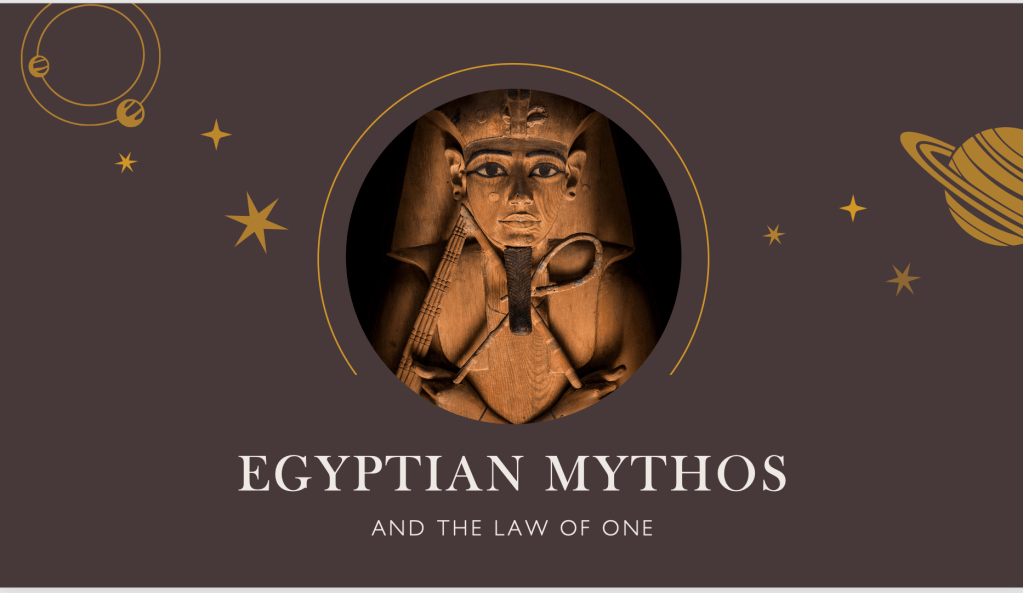
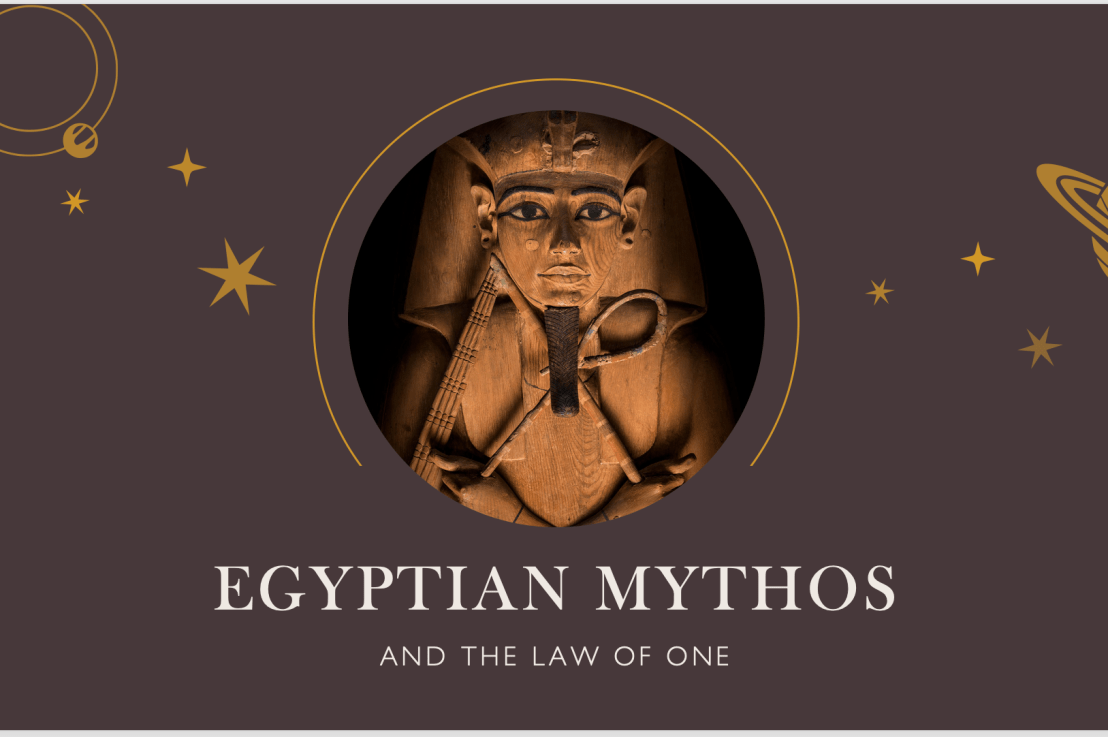
(Title slide: golden pharaonic bust holding the crook and flail, framed by celestial motifs — planets, stars, a crescent moon)
Tim opened with warmth, thanking Russell for last week’s presentation on Unitarianism and noting how grateful he is that the group’s sessions are recorded for those who can’t attend. He shared a story from spring break — a family hike up a canyon that ended in bickering the first day, only to be redeemed the next morning with donuts and a do-over. “No matter how bellicose things appear,” he said, “tomorrow is a new day.”
After his customary lawyer joke — St. Peter congratulating a 44-year-old attorney for being the oldest man to ever arrive in heaven, having evidently added up his billable hours — Tim turned to the evening’s subject. He reflected on the richness and diversity of the group’s recent explorations: DeMarcus on simultaneous time, RuDee on AI, the magical personality, Danny on Mary. “It won’t be far-fetched tonight,” he said, “if we just spend a little bit of time in Egypt.”
He polled the group. James had been to the pyramids and described the experience as magical — especially the lesser-known sites away from Giza, where the crowds thin out and the ancient structures can be encountered in relative solitude. Danny, who had traveled up the Nile, recalled the massive granite monoliths near the Sphinx — perfectly rectangular, perfectly symmetrical, their flat surfaces all in precise alignment. “Something happened here,” Danny said, “far beyond human labor at that time.”
Tim shared his own connection to the region: a year in Jerusalem growing up, a hike up Mount Sinai, but never Giza, never Luxor. He mentioned the Earth chakra hypothesis — the idea that certain sacred sites correspond to planetary energy centers with celestial alignments. The pyramids and the Holy Land both figure in this framework. Mount Shasta, he noted, is often cited as the only such chakra center in North America. “It’s on my bucket list.”
“This Earth is a really special place,” Tim said. “I really credit the Law of One, the Ra Material, for opening my eyes to just how remarkable the Earth is, and how our destinies are entwined.”
Slide 2 — ΨΥΧΗΣ ΙΑΤΡΕΙΟΝ: The House of Healing for the Soul
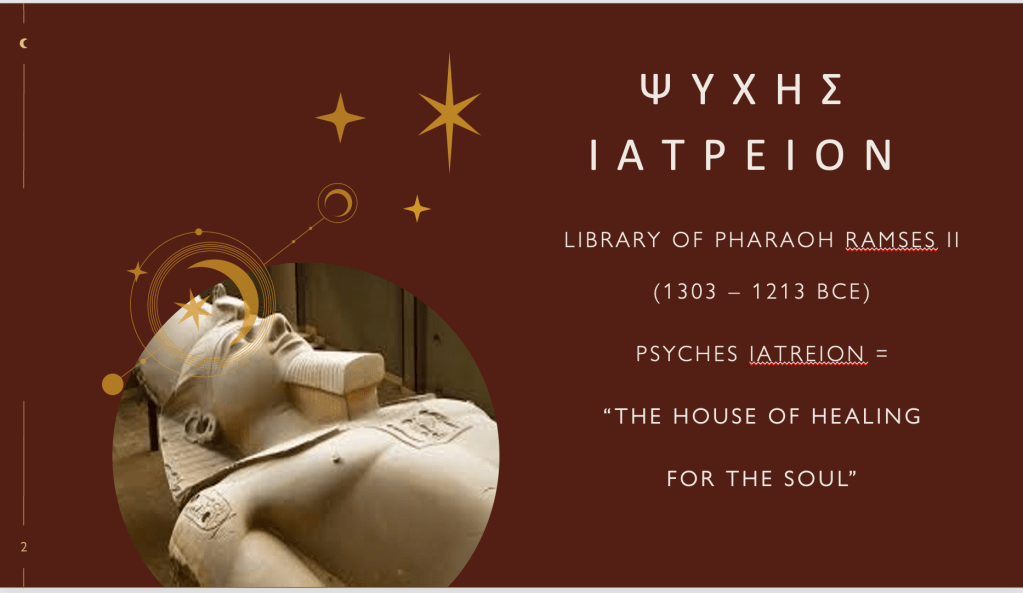
(Greek inscription alongside the fallen colossus of Ramses II; text identifies the library of Pharaoh Ramses II, 1303–1213 BCE)
Tim introduced an inscription recorded by the Greek historian Diodorus Siculus, who lived during the age of Caesar. This inscription was found in the tomb complex of Ramses II — the Ramesseum — in what Diodorus identified as the world’s oldest known library, predating the Library of Alexandria. The Greek reads Psyches Iatreion, which translates: “The House of Healing for the Soul.”
Tim found this deeply fitting, because when Ra describes their purpose in coming to Earth, healing is the central word. But the nature of that healing, as Tim would argue across the next several slides, contains a distinction most readers gloss over.
Slide 3 — Ra: Session 2.2 and Session 23.6
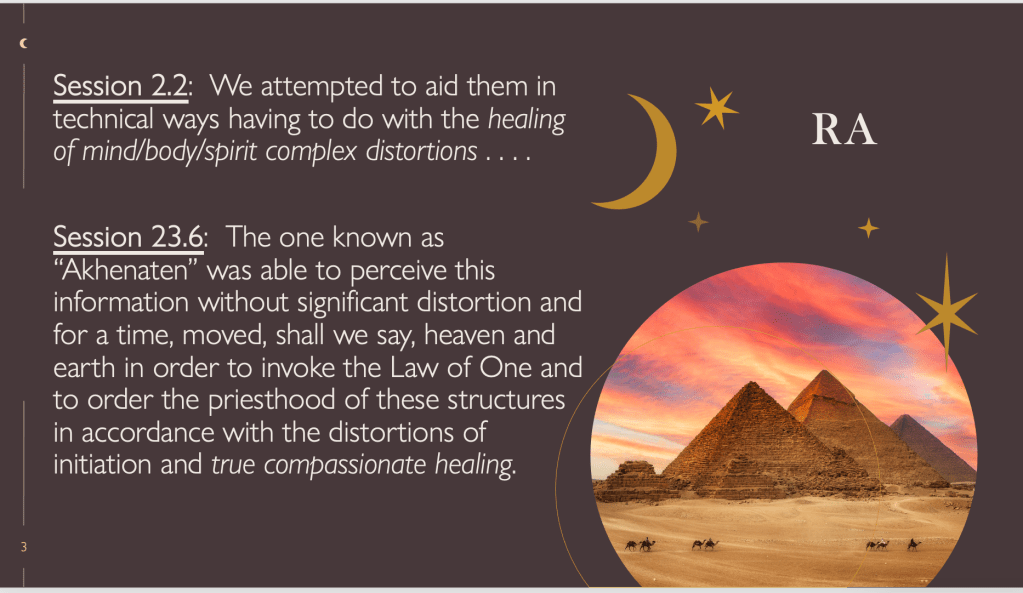
(The Giza pyramids at sunset, with camels in silhouette; Ra Material quotes on the left)
The slide presented two key Ra passages. From Session 2.2: “We attempted to aid them in technical ways having to do with the healing of mind/body/spirit complex distortions.” And from Session 23.6: “The one known as ‘Akhenaten’ was able to perceive this information without significant distortion and for a time, moved, shall we say, heaven and earth in order to invoke the Law of One and to order the priesthood of these structures in accordance with the distortions of initiation and true compassionate healing.”
Tim paused on the word distortions — and this became the interpretive key for the entire presentation. “I want to highlight the fact that they are not healing our mind-body-spirit complexes,” he said. “This is a nuance and a distinction that only became meaningful to me when I looked at this like a lawyer looks at language.” Our mind-body-spirit complexes, Tim argued, are in a sense already complete, already whole, already one with the Creator. What Ra came to heal was the distortions — the warping, the misalignment. “So when we’re sick in the body, don’t think, ‘Oh, I’ve got to heal my this or that is off.’ It’s more like: where are these distortions? It’s not that something is wrong with us, or that we are broken. There are distortions that we can resolve.”
He then traced Ra’s continued commitment to Earth: “We have never left your vibration, due to our responsibility for the changes in consciousness we had first caused and then found distorted.” What began as a mission of healing, Tim observed, became conjoined with changes in consciousness — and Ra has remained ever since.
Tim cited Session 14.23, where Don asks whether Ra works with other planets. Ra’s answer: “We only work with this planetary sphere at this time.” They journeyed from Venus by thought. And their ongoing service, across the past 2,300 years, has been carried out primarily through channels — most of whom feel inspired by dreams and visions “without being aware, consciously, of our identity or existence.”
“I’m trying to thread a needle here,” Tim said. “If Ra came with a specific purpose in mind — to heal us through the Law of One — then the technique was crystals in the pyramids, and more broadly, through channels, through dreams and visions. We don’t often think of dreams and visions and channeled inspiration as being of a healing sort.”
Slide 4 — The Stele of Akhenaten and Nefertiti
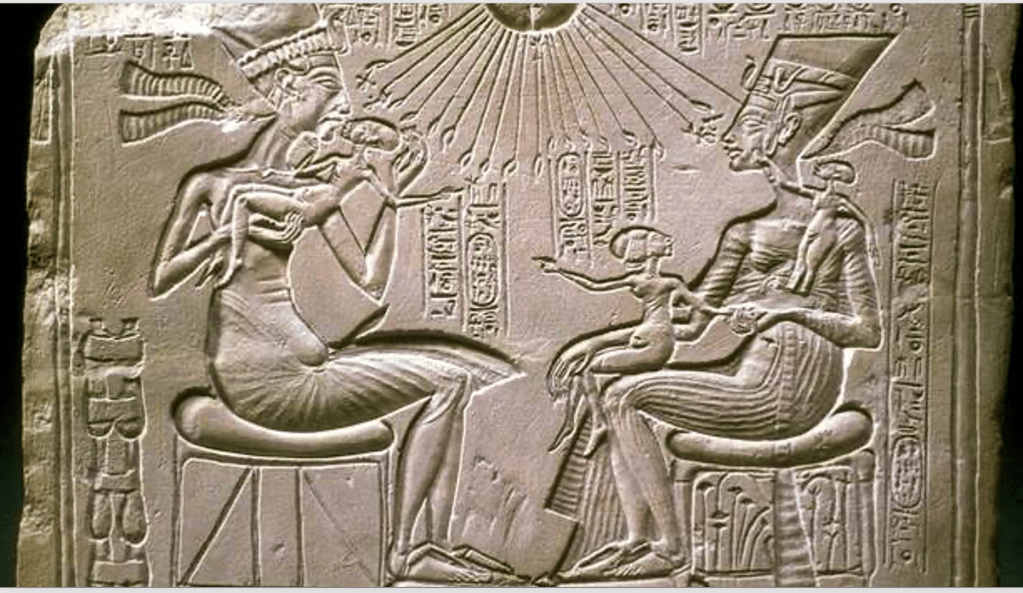
(Full-slide image: the famous limestone relief of Akhenaten and Nefertiti with their children beneath the rays of the Aten — each ray terminating in a small hand offering the ankh)
Tim displayed the stele of Akhenaten with Queen Nefertiti. “So cool,” he said. “Kind of human looking.” He explained that Ra identifies Akhenaten as a wanderer who became convinced that the vibration of one was the true spiritual vibration, and thus decreed the Law of One.
Tim then read from Session 14.26, where Ra explains the conditions that made Akhenaten’s reception possible: “The entities of the nation of Egypt were in a state of pantheism — as you may call the distortion towards separate worship of various portions of the Creator. We were able to contact one whose orientation was towards the one.” This wanderer stood out because he was able to reorient from a pantheistic worldview — the worship of many separate deities — toward a worldview oriented to unity. And Don confirms: Ra can only contact entities in dreams who are “first seeking in the direction of the Law of One.”
From Session 1.5, Tim read Ra’s explanation of why they originally came to Egypt: “At the time of which you speak, there were those who chose to worship the hawk-headed sun god, which you know as vibrational sound complex Horus.” He paused to clarify: the Eye of Horus is the left eye, associated with the moon, while the Eye of Ra is the right eye, the sun.
Slide 5 — Egyptian Book of the Dead, Poetry
(Stylized text on dark background)
Tim read aloud from the Egyptian Book of the Dead:
“I am the first-born, the light of the sky. I breathe in the presence of a powerful god. My breath is like a child to me. I have traveled through the tomb, dark and lonely ground. I am here now. I have come.”
Slide 6 — A Hymn to Ra
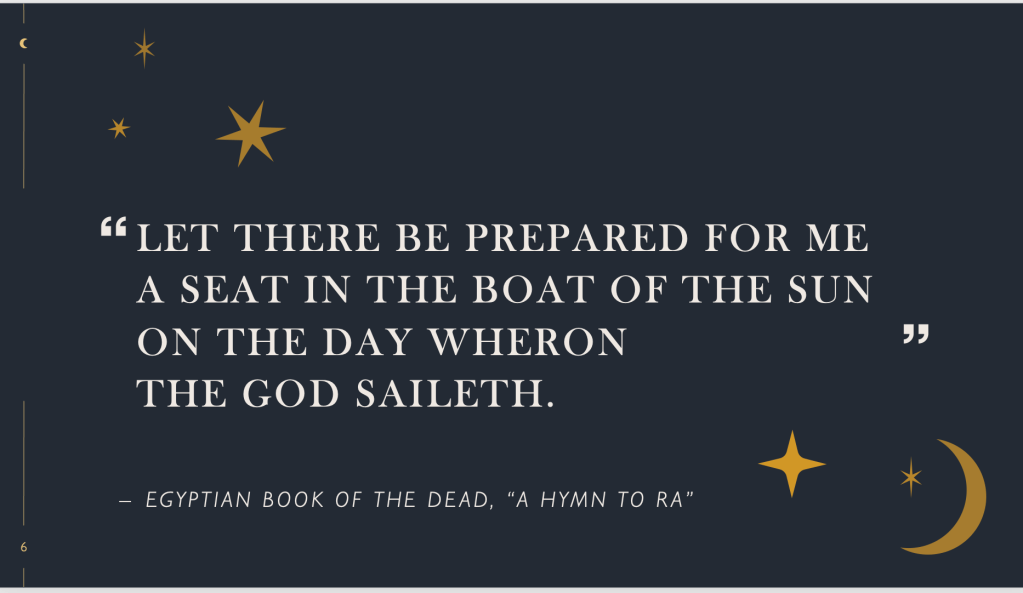
(Stylized text: a passage from the Egyptian Book of the Dead)
Tim read the hymn: “Let there be prepared for me a seat in the boat of the Sun, on the day whereon the god saileth.”
“Doesn’t this just make you want to jump on Ra’s boat?” he said, grinning.
Slide 7 — Ra (aka the Sun God): The “Good” Guy
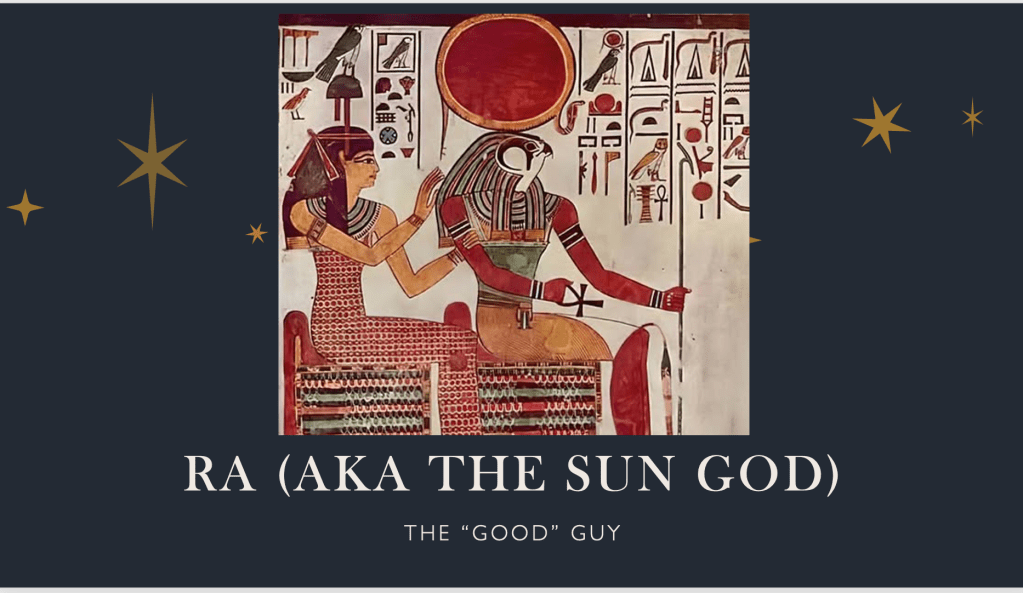
(Tomb of Queen Nefertari: Ra depicted in his falcon-headed form, seated, holding the ankh, with a female figure behind him)
Tim transitioned to the mythological Ra — the sun god as the Egyptians understood him. Ra is depicted in the tomb of Queen Nefertari with a falcon head, representing flight, the sky, and the sun. Ra was believed to light the world by day, traveling in his sun barge. But every night, he would dip into the underworld, confront the powers of chaos in battle, and overcome them — rising again each morning, ensuring the sun’s rebirth. “He represents creation, and power, and the promise of eternal life,” Tim said, “in this endless, eternal dance between day and night, life and death, light and darkness.”
Slide 8 — The Three Faces of Ra: Morning / Midday / Night
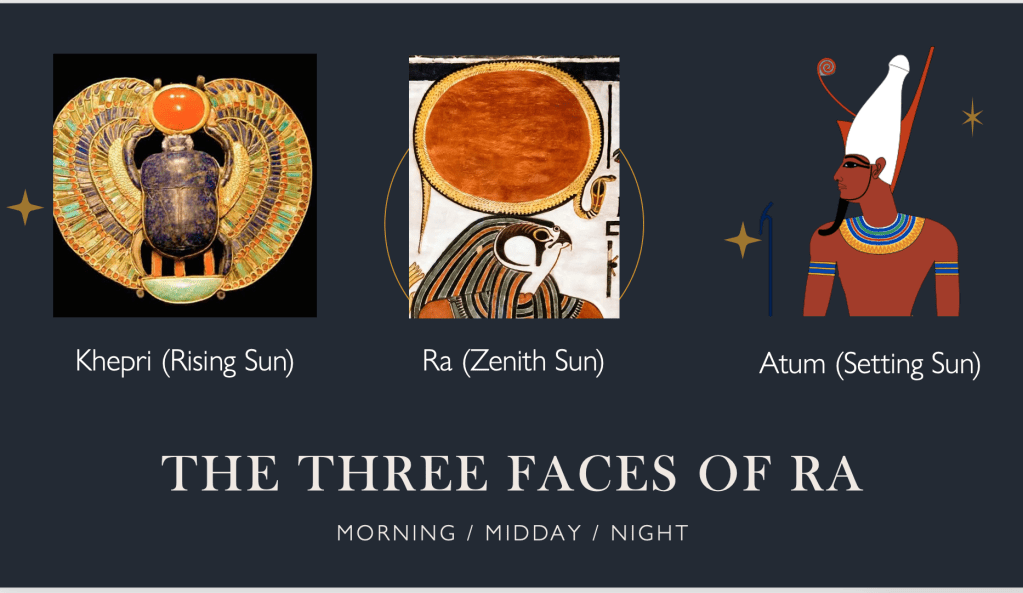
(Three images side by side: the winged scarab beetle jewel [Khepri, Rising Sun]; the falcon-headed sun disc [Ra, Zenith Sun]; and Atum in human form wearing the double crown [Setting Sun])
Tim revealed what he called Ra’s Trinitarian aspect — something he hadn’t been aware of before. In the morning, Ra appears as Khepri, represented by the scarab beetle with outstretched wings, carrying the sun. At midday — the zenith — he takes his falcon-headed form, which is Ra proper. And at evening, Ra takes the form of Atum, the human figure, before descending below the horizon and entering the underworld.
“All these three make Ra,” Tim said. The triple form mirrors the arc of the sun and the arc of consciousness: emergence, fullness, and descent into the dark — where the real work begins.
Slide 9 — Apophis (aka Apep): The “Bad” Guy
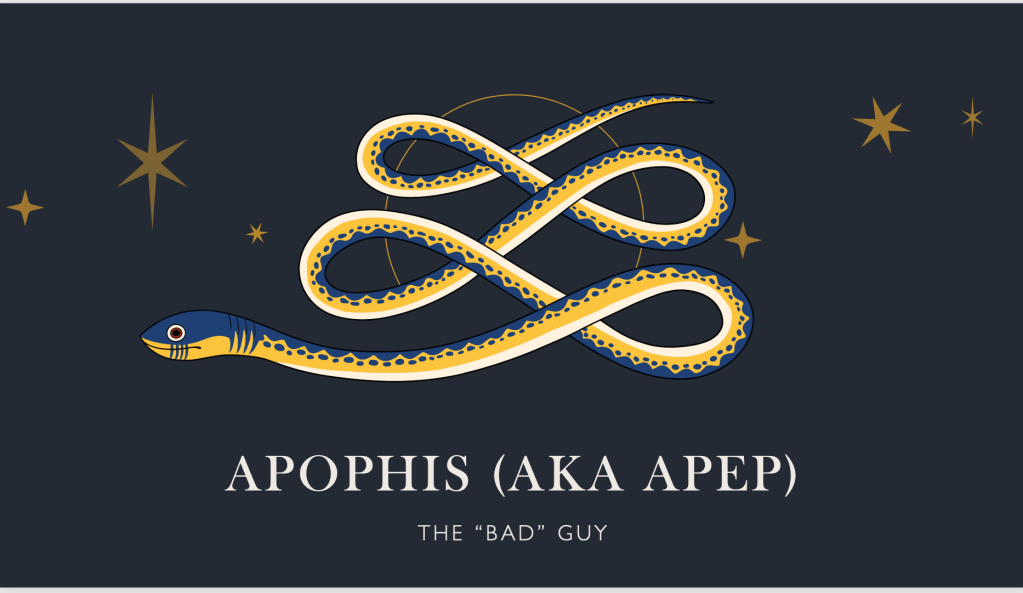
(Stylized illustration of the great serpent Apep, coiled in infinity loops against a dark starfield)
“Every good hero needs a good villain,” Tim said. “As we’ve learned from Darth Vader — a story is only as compelling as its villain has good character depth.”
He introduced Apophis, or Apep — the great serpent of Egyptian mythology. Apophis’ plan is simple: kill Ra, prevent the sunrise, plunge the world back into chaos and darkness. “Every evil mastermind — that’s always what they want, isn’t it?” Because of the serpent’s design, the Egyptians associated all manner of suffering and calamity with Apophis: earthquakes, storms, darkness, destruction. “Your classic bad guy.”
Slide 10 — Atum-Ra Facing Apep
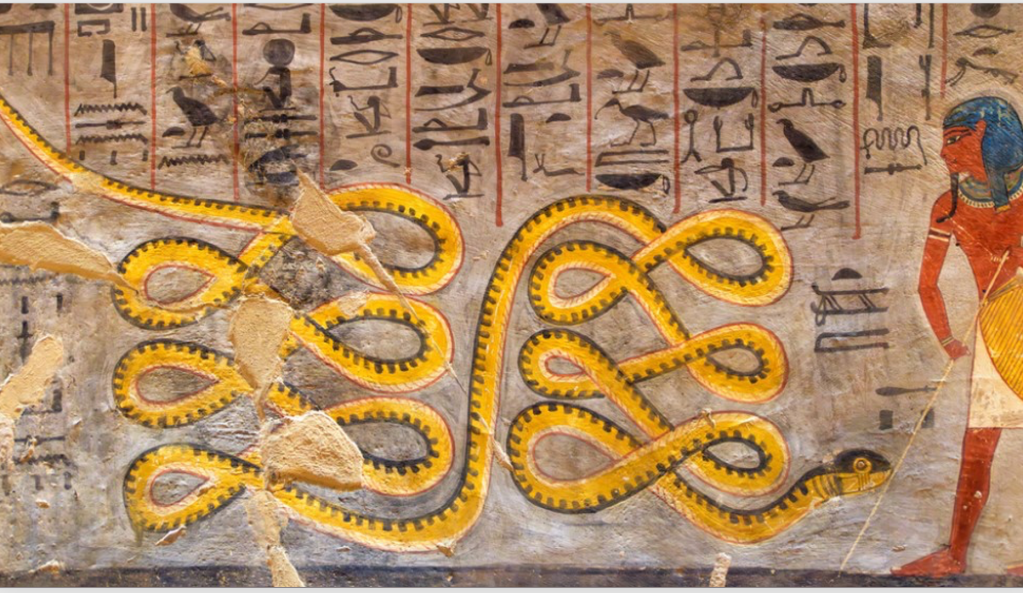
(Tomb wall painting: Atum-Ra stands with a weapon while Apep writhes in massive golden coils of infinity-loops before him, hieroglyphic text above)
Tim pointed to one of the more famous reliefs: Atum-Ra facing off against Apep. “Look how they depicted the snake,” he said, “in these coils of infinity — endless eights, back and forth in the recursive spiral.” The Egyptian religion told how the gods and goddesses would unite and defeat Apophis, restoring order — but they were continually at it, because it never ended.
Slide 11 — Mau Defends the Tree of Life
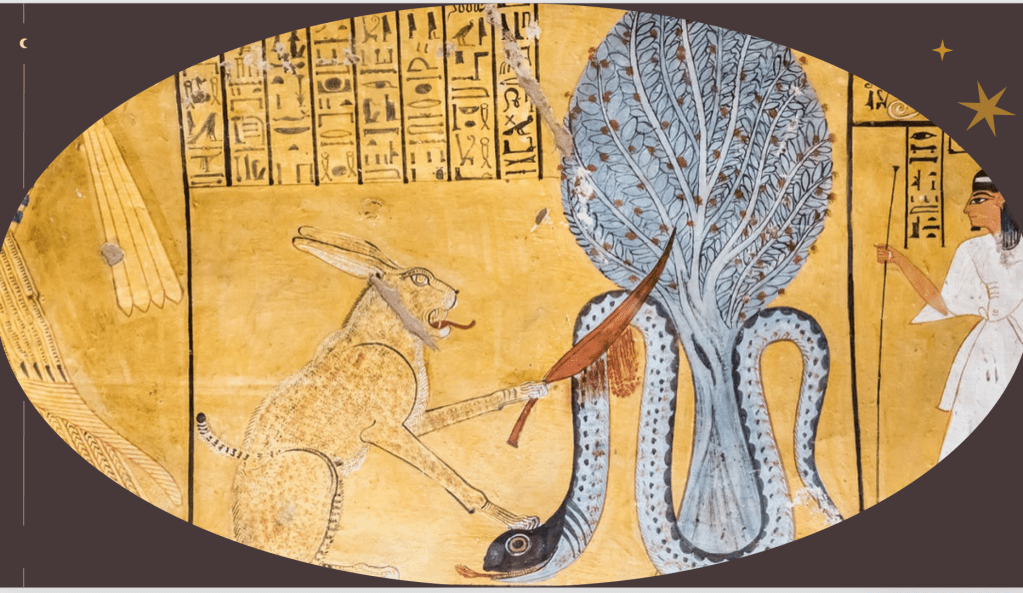
(Egyptian Book of the Dead, Spell 17: the great cat Mau, a manifestation of Ra, holds a blade and confronts Apep, who coils around the trunk of the Tree of Life)
This was one of Tim’s favorites. The god-cat Mau — a depiction of Ra himself — holds the secrets of eternal life and defends the Tree of Life from Apophis. “Do you see the snake coiling around the tree’s trunk?” Tim asked. Mau holds what looks like a sharp leaf but is actually a knife.
Tim drew the parallel: a tree of life, a serpent, the struggle between light and dark. “For those of us from a Christian background, think of the Garden of Eden motif. The Egyptian myths predate those, but they do have a lot of similarities.” In this account, Mau mortally wounds Apep with his knife, cutting him into pieces — much like the winged serpent called “the dragon” in the Book of Revelation, with its seven heads. In the Egyptian myth, Apep is cut into seven pieces with seven deadly knives. “In the Law of One, is seven significant?” Tim asked. “When you think about the seven levels or densities, the seven states of consciousness that we go through.”
Slide 12 — P. Louvre N. 3292, Book of Breathings
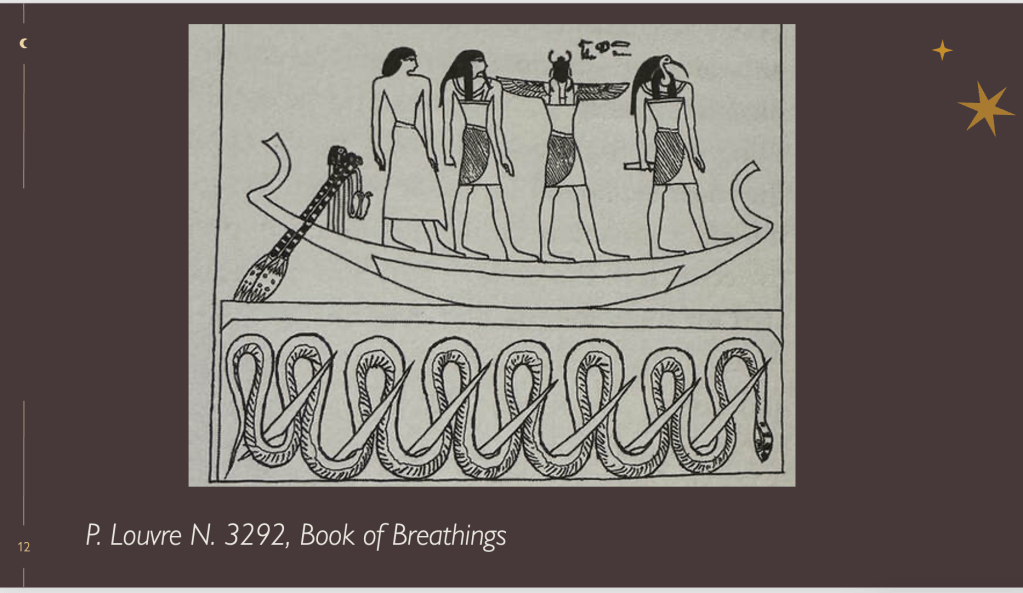
(Line drawing from the Louvre collection: Ra in his scarab-headed form stands aboard the sun barge with Thoth at the bow; beneath the boat, Apep coils in seven repeating loops)
Tim identified Ra on the barge by his scarab head — Khepri — and pointed out Thoth leading at the bow. But the problem, he noted, is that snakes regenerate. Apep, killed each night, grows back during the day. The battle recommences every evening. “The darkness is never, ever vanquished and destroyed,” Tim said. “It’s merely kept in place.”
Slide 13 — Ra Surrounded by Apophis
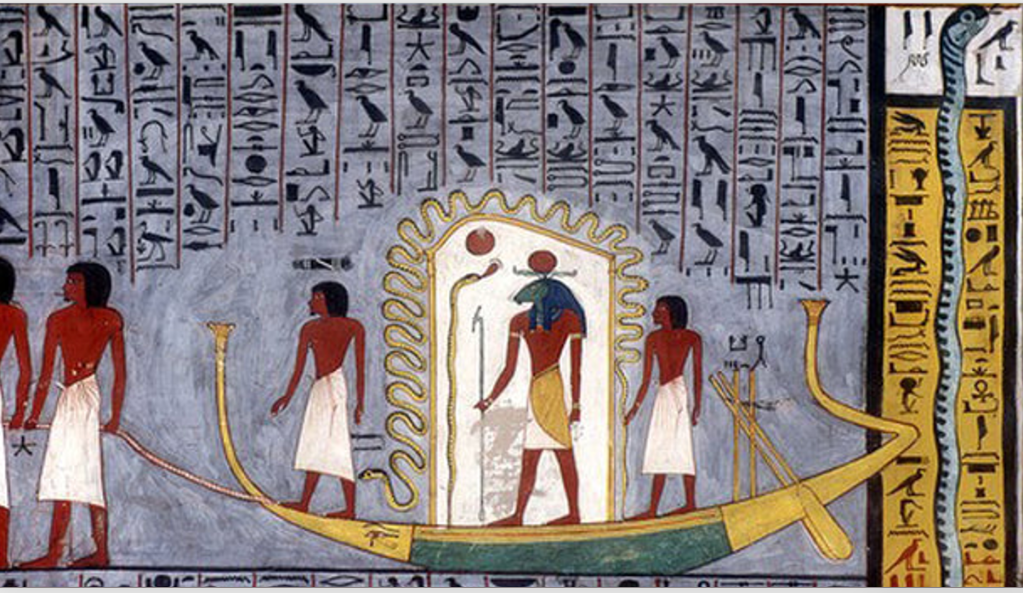
(Tomb wall painting: Ra in his beetle form stands in a shrine of light aboard his barge, attended by figures — but Apophis, depicted as a golden serpent, boxes the light in on all sides)
“Look at how Ra is surrounded by light,” Tim said, “but then Apophis, the snake, boxes the light in — on all sides.” The serpent surrounds Ra, seeking to prevent his radiance from spreading outward. Tim saw in this an illustration that chaos is always searching for cracks and seams through which to get in.
“And I think the darkness would succeed and overcome,” he said, “but for the fact that we are lightbringers. We are like Ra, traversing the creation through the cosmos, carrying the eternal flame.”
Slide 14 — Canopic Jars
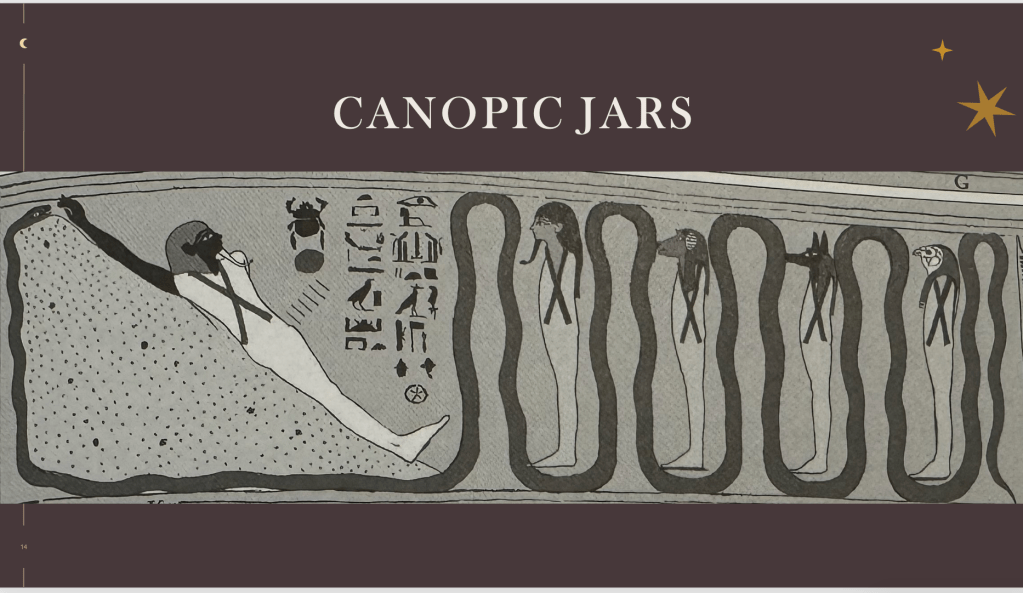
(A carving showing a reclining mummified figure beside four canopic jars, each encircled by the coils of Apep — the serpent looping around every single jar)
Tim explained that when the Egyptians prepared bodies for burial, the organs were placed in four canopic jars, each associated with one of the four elements. “Do you notice how the Egyptians drew Apep going around every single jar?” he asked.
The image carried a deep implication: Apophis is present in all of our members. The serpent passes around us and through us. “We must pass through him on our journey forward,” Tim said. “In order for us to be reborn, we have to — I guess the only way to heaven is through hell.”
Slide 15 — The Milky Way
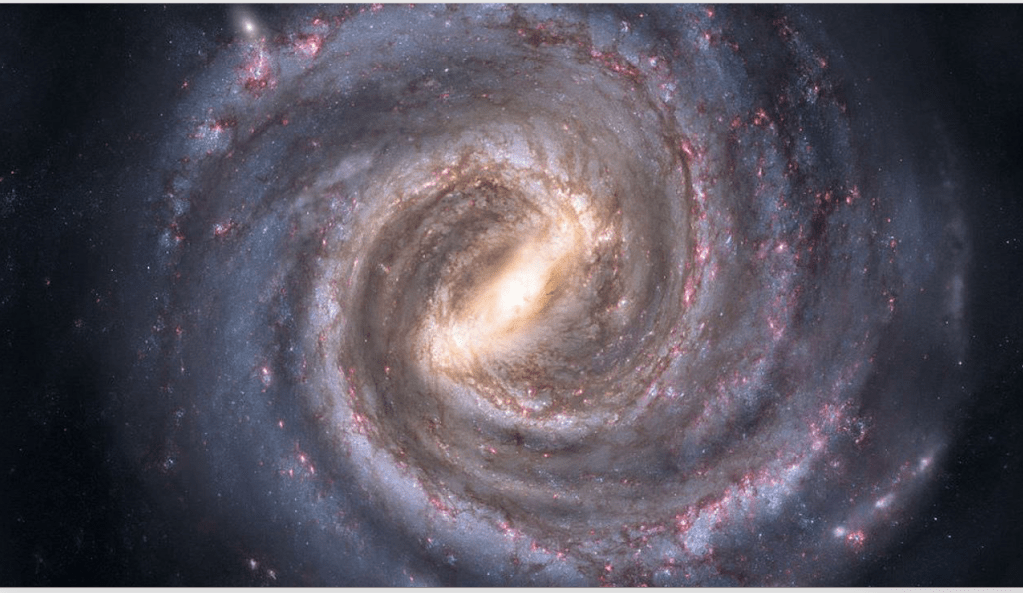
(Full-slide image: the spiral galaxy, its arms curling outward like a great celestial serpent)
Tim drew the connection between the spiraling coils of Apophis and the spiral structure of the galaxy itself. “Doesn’t that look like a snake?” he asked. “This is the Milky Way.” The Egyptians called the heavens a duat — a word now associated with the underworld, but which originally also referred to the starry sky above. “It’s so interesting that the Egyptians linked what is above with what is below. The way that we rise is through descent.”
Slide 16 — The Heliosphere: The Interstellar Medium
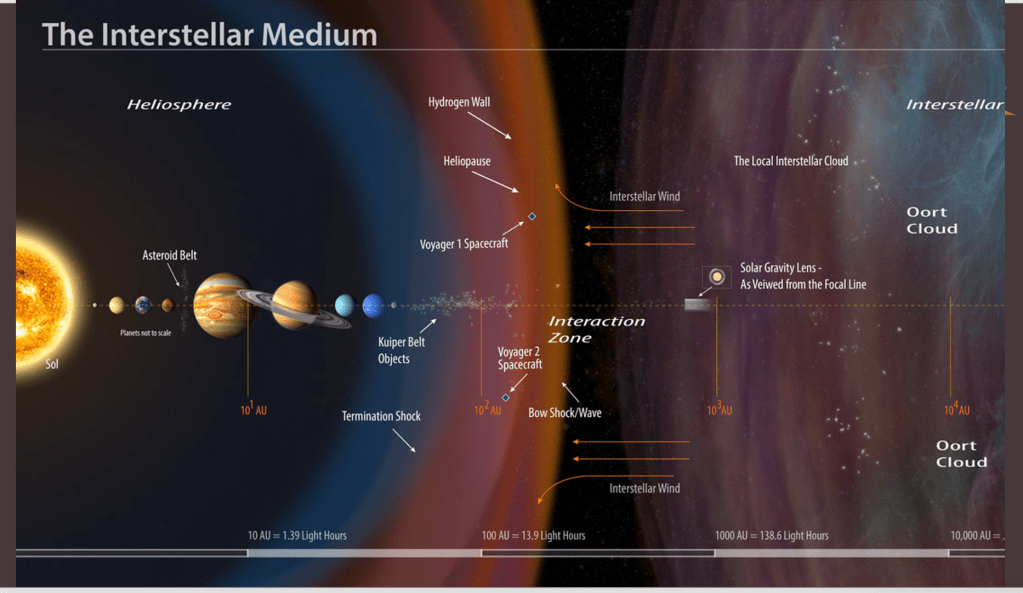
(Scientific diagram of the heliosphere, showing the sun, the planets nested within its protective torus, the heliopause, and interstellar space beyond)
Tim brought the presentation to its cosmic scale. The Earth’s spiritual evolution follows our own, he said — marked by the planet’s celestial journey through the galaxy, its place in the cosmos influencing the nature of the energies received from our governing stars. He pointed to the heliosphere — the sun’s protective field that shields the solar family from harmful electromagnetic radiation, allowing life to flourish. “We are a solar family,” he said. “I really view our solar system within the protective womb of the heliosphere.”
And the Earth, like us, is traversing the seven rungs of density. The formation of a social memory complex — our next step of evolution — will be a team effort.
Slide 17 — Discussion
Tim posed two questions to the group: “What has this taught us about healing? How has the Ra Material helped us become better at facing Apep?”
Doug responded first, invoking the ankh — the archetype of archetypes, which Ra discusses in Sessions 92 and 94. The ankh contains the idea that there is no manifestation of love without the losing of itself: dying and rising, death and resurrection, loss and renewal. “All these archetypes that you spoke about tonight seem to be fleshing out, in narrative form, the underlying grand meta-archetype of the ankh,” Doug said.
Russell asked whether the Egyptians believed these stories literally or experienced them as metaphor. Tim responded that in postmodern America, most seekers — and certainly those in the group — drive meaning from the symbolism, the archetypical, rather than viewing it dogmatically or literally. “That’s what I’ve been growing into with this group,” he said, “more of that psycho-spirituality — where what I believe is becoming as I am becoming, and there’s a reciprocal sharing that’s occurring.”
Peter elaborated: every culture contains a gradation of awareness, from the exoteric and dualistic to the esoteric and unitive. For people in this community, he said, “we’re able to see the oneness — the esoteric quality — of all images and iconography and all religions.”
Tim then offered his most personal metaphor of the evening. The Law of One, he said, is like a hairnet — “which I know is ironic because I’m bald.” A hairnet shapes around whatever you’ve got going on. It holds things together without forcing them into a rigid mold. It allows everything to breathe. The Law of One harmonizes Rudolf Steiner with Carl Jung, a Mormon upbringing with Eastern philosophy, Doug’s process philosophy with Whitehead and Teilhard. “Over time, I see that they all remain with their distinct identity, but something is coalescing together for me. I see congruences where things kind of line up now, where I hadn’t noticed before.”
He mentioned the cult of Mithras and its seven stages of initiation — each mapping suggestively onto the seven densities: the snake at the lowest, Venus and the veil at the second, Mars and the warrior at the third (where polarity is chosen), the lion and laurel crown at the fourth (the density of love), the scholar’s cap at the fifth (wisdom), and the shepherd-father at the seventh.
Tim shared the rubric his wife uses to ground him when he comes home buzzing with metaphysical ideas — “like walking through the perfume counter at Macy’s.” She always asks: “Sweetheart, how has this made you more loving?” That, he said, is the real principle of discernment. “Is my heart open? And what is the wisest thing my heart is telling me now? If it’s not helping me on the ground — to be a better father, a husband, a fellowshipper — then I’m just doing this for egotistical, selfish, service-to-self reasons.”
Russell asked whether Ra explicitly claimed to be the same Ra depicted in the Egyptian mythology. Austin fielded the question: Ra does say they are the same entity that interacted with the Egyptians, but implies that their memory was heavily distorted — the Egyptians beheld them more as gods than as fellow seekers. Ra withdrew, and over the centuries, their image was folded into the broader pantheon with layers of cultural distortion built on top.
In the closing moments, the group explored the universality of serpent symbolism. Peter noted it is global — deeply embedded in Vedic astrology (Rahu and Ketu, the head and tail of the serpent), present in Asian mythologies, woven into the primordial human psyche. Danny mentioned Moses fashioning a bronze serpent to heal the Israelites who had been bitten by snakes — the very thing that poisons also heals. Barbara pointed to the caduceus, the intertwining serpents of the medical symbol. Austin connected it to Ra’s own teaching: the serpent as a symbol of wisdom with both positive and negative applications — the negative being venom, the positive being the uncoiling of kundalini energy rising to meet the indigo-ray chakra.
Tim closed with one final image: the Egyptian pharaonic headdress, where the uraeus — the serpent — emerges from the crown of the head, marking the sixth chakra, the shuttle to intelligent infinity.
Troy offered the closing prayer: gratitude for minds that seek from differing yet complementary understandings, expressed in freedom and harmony. “So glad that we have chosen the service-to-others path, and we serve each other. Use all of this good energy in all of us to love better. Amen.”
 Building 4th Cosmic Christ
An excellent summary.
>
LikeLike