
A reflection from a recent Building 4th gathering, offered in the conviction that the mundane is sacred.
AUDIO
My phone is propped in the grass about twenty feet away. I’m raking the leaves and twigs of my children’s piano teacher — a woman in her mid-eighties, arthritis in her hands, chronic pain, who has taught children piano for the better part of sixty years and can no longer kneel in the garden she loves. Somewhere along the way I became a kind of adopted son. So I brought my rake, and I joined our circle from her backyard, raking and listening and, when my turn came, speaking.
I mention the leaves because they’re the ground the whole evening grew out of. Nothing about this night was extraordinary. That is exactly the point.
As we shared what we were carrying, one theme kept surfacing — quietly, in different voices. A breakup. A hard season. An unnamed heaviness that comes and goes and refuses to be filed neatly under any diagnosis. More than one person in our circle was living close to the surface of their own sadness. And I found that I was too.
So I want to talk about something my spiritual father, Richard Rohr, writes about in what he believes will be his last book, The Tears of Things: Prophetic Wisdom for an Age of Outrage. He says it gathers up the whole of his teaching across more than fifty years. It’s an easy read, and if you don’t have the bandwidth for it, his recent conversation with Oprah lays it out beautifully. The sentiment of this book has touched me deeply, because it names something I keep meeting in my own life and in the lives of the people I sit with as a therapist:
Life, most of the time, is the kind of thing that evokes tears.
Gratitude for all that was; yes to all that will be
There’s a refrain I keep returning to — one Dag Hammarskjöld set down years ago, and one Rohr’s book kept bringing back to me: for all that was, gratitude; and for all that will be, yes. I prayed it over B earlier that same night, holding in the light a home she is leaving and a home she is entering. For all that was, thank you. For all that will be, yes.
Underneath that “yes” lies a feeling most of us know and few of us welcome. Call it melancholia. Let me be careful here, because I hold a therapist’s respect for clinical language: depressive disorders are real, and there is a real place for that diagnosis and for treatment. What I’m pointing at is something adjacent and easily confused with it — a spiritual melancholia that, as far as I can read the great traditions, functions less like a malfunction to be corrected and more like a gift.
The Christian name for the shape of it is the Paschal Mystery. Don’t be impressed by the phrase — it only means the Easter mystery. And what it means is this: there is always death, and if we can learn to die well, without gripping, then something can be reborn on the other side of the dying.
M put it more beautifully than any theology when she said she was trying to keep her hands open. That’s the whole teaching, right there. Keep the hands open. Keep the heart open. Don’t grip in the sadness. It’s a very Eastern kind of wisdom, and it also sits at the center of the Gospel — a non-gripping that doesn’t even need to figure the sorrow out, because feeling sadness and joy is simply the condition of being alive.
Joy is not the opposite of sadness
Here’s a distinction worth holding onto. Happiness may be the opposite of sadness. Joy is something else entirely. Joy is the acknowledgment — the felt movement — of life itself, and it tends to arrive precisely when we have some perspective, some sense of transcendence, some intuition that our suffering and our gladness both carry intrinsic meaning. That’s why joy can live right in the middle of heartbreak and confusion. Underneath the anguish, there can be a steady, quiet sense: this too belongs. I didn’t choose it, I don’t like it, and I’ve been here before — I’ll get through it.
If you’re anything like me, you’ll notice that the times of deepest pain are the ones we most clearly remember having survived. I’ve been in that kind of despair myself — years ago now, but I’ve never forgotten what it felt like. And what many of us can say, looking back, is a strange sentence: I would never have chosen the circumstances that brought me there — and yet, on the other side, I can feel a trajectory that was uniquely mine, somehow woven through with God. God in it, through it, with me, in me, as me, through all of it. Participating in something larger than the wound.
Everything laments
Now, about that title. In the moment that night, I told our circle I thought “the tears of things” might be a Jewish saying. Let me sort that out, because I was half right in an interesting way.
The phrase is Virgil’s — lacrimae rerum, from the first book of the Aeneid, where Aeneas stands before a mural of the Trojan War, sees his friends and countrymen among the dead, and weeps at the tears of things. Rohr has said the line stayed with him from his Latin studies and eventually became his title.
The wisdom of the book, though, comes straight from the Hebrew prophets — Amos, Hosea, Isaiah, Jeremiah, Ezekiel, Jonah, and the book of Lamentations. So my instinct was pointing in the right direction; I’d just attached it to the phrase instead of to the substance underneath. And what Rohr finds in those prophets is a pattern of maturation: their writings begin in rage and accusation, move into lamentation over our shared human condition and the world’s suffering, and arrive finally at compassion. He calls that arc sacred criticism — a way of confronting evil and injustice that holds the wholeness of history and the interconnectedness of every living being at the same time. The prophets set the stage; Jesus follows the identical pattern.
Which tells us something about lament, an archetype that’s easy to mistake. Lament is not “I’m crying, and now I want revenge, or I want to fix it.” That’s not the wisdom of lament. The archetype of lament is to let the healing tears pass through us and in us — because that is our way of not gripping, our way of keeping the hands open. Jewish wisdom took this so seriously it gave us an entire book of the Bible devoted to it.
And notice what the phrase actually says. Not the tears of people — the tears of things. Everything has a lament in it. Everything, in some sense, is crying.
I’ve been told that if you analyzed the chemistry of tears you’d find them almost entirely water, with a small fraction of something like stress hormones — the body’s own quiet way of releasing what it cannot otherwise resolve. Crying over suffering we can do nothing about is, in itself, a relief. And it isn’t only our crying.
If we take seriously that we are all part of one body, and that this one body is the Earth — the planet from which we emerge — then we are the Earth’s feelings. At the level of self-awareness, we are the membrane of the Earth’s brain, the part that feels and knows itself, each of us a different cell inside one organism. When enough cells in that organism are unable or unwilling to lament, the whole body carries a blockage.
Ra names this condition with a phrase I can’t shake. Don asks why the Earth feels so negative when, as Ra had said, the positively oriented actually outnumber the negatively oriented. Ra answers that the Earth only seems that way, and that the appearance comes from “the quiet, shall we say, horror which is the common distortion which those good, or positively oriented, entities have towards the occurrences” of the present moment (Ra, Session 17.23). A quiet horror — carried, notice, by the good ones, precisely because they feel the world’s pain and cannot fix it. Well. That’s enough to lament, isn’t it?
And here is what I think that quiet horror is, writ large: the same human organism failing to metabolize its own pain. We don’t lament, so we project. We react and blame and escalate instead of grieving and growing, and that generates more bellicosity — which is the very thing we’re being asked to learn to process. We mostly refuse. Except for those who take their own ordinary pain and offer it, deliberately, as a kind of sacrament of solidarity.
The Bodhisattva tradition points at exactly these people — the enlightened ones who return to help humanity with its pervasive suffering, and who do it by teaching us how to lament well, to cry well, to not react. From the Law of One perspective we might call the destination fourth density. From a Christian perspective, the Kingdom of God. Different names for one threshold, which we cross together or not at all.
The Sacrament of Solidarity
So that’s what I wanted to pray about that night — and to actually do together. Not to talk about our pain, but to transmute it. It’s a practice that frees me from whatever has me in its grip while never negating the pain; in fact it uses the pain, letting it become a blessing for others. It works for me. I offer it to you here as I offered it then. Everything in it rests on free will, and you can stop at any threshold.
Begin by uniting your heart with the others. Say yes to sharing one another’s sadness — to being willing, if you will, to help carry the other’s cross of sorrow. You are not alone.
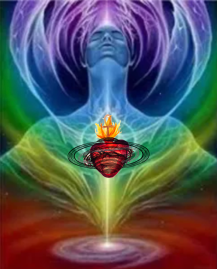
Find the energy in the body. About three fingers below the navel, picture a sphere — swirling, orange and red. This is sadness, sometimes anger, sometimes nervousness: an energy that is, as Ra puts it, undirected. (Ra calls anger “the undirected, or random, energy,” and teaches that the positive path meets it through acceptance — blessing and loving it until it can be integrated. Acceptance is the key to the positive use of catalyst; control is the key to the negative. — Ra, Session 46.9.) These spheres of fear are heavy, and they convince us we are utterly alone in carrying them. We are not alone, even when we feel most alone. That’s the paradox — and everyone in the circle knows it, myself included, loving wife and three children and dear friends notwithstanding. My day-to-day experience is still often one of solitude and sometimes alienation. Be not afraid of being afraid.
Let it rise, and surrender control. See the sphere rise until it meets a membrane just below the heart. It wants to pass through, and the only way through is to say, honestly: I surrender my need to control the outcome. Release the grip on the people and the situations that are hurting. Surrender the desire to control anything at all.
Watch it transform. As it passes through, the sphere turns emerald green, shining like a gem, and rises into the heart — the seat of universal love. Here you are most fully human. It is all one heart; your heart is a fraction and a fractal of that one heart, and you are held inside it. Feel into that unity.
Then the question — again, freely given. Do you wish to use your pain to bless others? If your answer is yes, let the sphere rise and settle behind the throat, the place of honest speech, where we raise the host to be consecrated on the altar of our hearts. Lodge there a message of love, ready to be delivered.
Open the inner eye. Let the sphere rise into the forehead and turn a deep indigo. You may feel a swirling pressure between the eyes. Open your mind’s eye, your heart’s eye, your spiritual intuition, and begin to notice your brothers and sisters across the world who are carrying heartache right now. The parents in places of war, powerless to protect their children — the most basic instinct there is. The young person whose whole world has just ended in a breakup, standing somewhere high up, certain that life is over. (If you doubt how common that is, I sat with exactly this today.) The child told they must earn certain grades and enter a certain profession or they don’t belong to their own family — think of the heartbreak in that. Then widen the circle to include our own community, those present and those absent, and anyone else who comes to mind.
Direct the blessing. Feel the crown of your head open, and a violet ray pour out — no longer a sphere, but the sphere cracked open like an egg. Direct it with your will, your intention, and your faith toward everyone who is hurting, carrying this message:
You are not alone. I am here with you. Your pain is understood. I will help you carry this.
Rest in the rhythm. For two minutes, breathe. On the out-breath, say silently in your heart: I wish you well-being and peace. On the in-breath: I wish for myself well-being and peace. Let it become a rhythm of blessing.
Then come back to the body, with gratitude, and with the quiet sense of having transmuted — alchemically, spiritually — pain into a blessing. We are all here, right now, with the power to change the collective through our will and our faith.
Amen.
Afterward, one member said the breathing at the end was what landed most — in and out, for others and for ourselves. Another said it was rare for her to sit with sadness in a way that felt productive, and that seeing the suffering of the world through the mind’s eye brought a comfort she hadn’t expected. This is agape, she said. I received the joy and the happiness — why not the sadness as well? They’re just different parts of life. To be sad well. To grieve well.
That’s it exactly. Joy cannot be felt at the same time as alienation; joy is always some form of connection, even when we’re physically alone. And sadness, once shared, can become joy — as it did that night, in a backyard, among the leaves.
So this week: hold one another in your hearts. And if some sadness or disappointment surfaces, don’t fret it. It’s an opportunity to transmute it into shared blessing. I think that’s the gateway back to joy.
A note for anyone reading this who is carrying that kind of pain right now: please don’t carry it alone. Reach out — to someone you trust, to someone in this community, or to a professional. The whole point of a sacrament of solidarity is that no one is meant to lament by themselves.

