By Doug Scott
Abstract: This long article bridges the apparent gap between Christianity and the Law of One, which I hold as the clearest statement of the Perennial Philosophy beneath the world’s religions. It traces one movement in four parts. First, the pattern of love: the Trinity, the Law of Three, and the Paschal Mystery as the way God becomes. Second, the veil and its shadow: the Great BASH, the collective thoughtform of bellicosity that holds our planet in a closed circuit, and the gardeners who keep the climate livable. Third, the Jesus Christ Event: our Solar Logos—whom Israel came to know as Yahweh—moving “down and in” to meet itself face to face, through Jesus of Nazareth, a fourth-density Wanderer whose will and faith, honed to the highest level of adeptness, held open the opening through which that Logos experienced third density directly. On the cross, the forgiveness principle was installed within the heart of the Great BASH itself, and what emerged is the Christic Logos, a living presence with whom relationship remains possible. Fourth, the new arising: how we live this through the Path of Metanoia and my SH!PS Approach to accompanying others. It is a benevolent universe, and love is the God-glue that holds it together.
This has long been the most widely read post on this blog, and I have rewritten it to reflect what my work in Raian Process Metaphysics has clarified. Readers who want the fuller argument can find it in my book (available at cosmicchrist.net), especially Chapters 4, 9, 10, 12, 14, and 15.
I draw from the Bible, my Christian formation, my master’s degrees in clinical social work and pastoral ministry, more than two decades as a counselor, the Law of One (the Ra Contact), the L/L Research channelings (which I treat as sources of hypotheses), Richard Rohr, OFM, Cynthia Bourgeault, Ilia Delio, OSF, Karl Rahner, SJ, Pierre Teilhard de Chardin, SJ, Thomas Merton, René Girard, Alfred North Whitehead, Rudolf Steiner, and Daskalos and the Researchers of Truth.
My writing style is circular—themes come around more than once, each time from a slightly different angle. I bow to you, my sisters and brothers, and thank you for your presence on Earth at this time. We are all part of the great body of Christ, the Logos, and each of us is precious beyond price.
Introduction: The Shape of What Follows
Let me lay out the whole arc before we begin, because this is a long road and it helps to see the map.
At the heart of this article is a claim I hold as a Christian and as a student of the Ra Contact: the Jesus Christ Event changed something real on this side of the veil. It was more than a beautiful example or a moral teaching. Our Solar Logos—the one Israel came to know as Yahweh—came face to face with itself in a human life, and in doing so it installed something within our planetary consciousness that wasn’t available before. I’ll call it the forgiveness principle. To see why that matters, we need a few pieces in place first.
The article is built the way creation itself is built, according to what Gurdjieff called the Law of Three and what Cynthia Bourgeault has brought into Christian theology. Every new arising requires three forces: an affirming force (the yes), a denying force (the resistance, the not-yet), and a reconciling force that brings forth something neither could produce alone. So the four parts follow that pattern:
- Part One, The Pattern of Love (the affirming). Who God is and how love works: the One Original Thought, the Trinity, the Law of Three itself, and the Paschal Mystery—dying and rising—as the way God becomes.
- Part Two, The Veil and Its Shadow (the denying). Why our planet is in such pain: the veil of forgetting, the Accuser and the Advocate, and the Great BASH, the collective thoughtform of bellicosity humanity has built over 75,000 years. It runs as a closed circuit that individual effort alone cannot break. I’ll also share how the higher densities tend us like gardeners tending a greenhouse.
- Part Three, The Christ Event (the reconciling). Yahweh as our Solar Logos coming toward us; Jesus as the adept who held the opening; Golgotha as the Law of Three at cosmic scale; the forgiveness principle installed within the heart of the Great BASH; and the Christic Logos who remains.
- Part Four, The New Arising (living it). What the Christ Event reveals, the protection of love, the Path of Metanoia (the inner work of the heart), my SH!PS Approach (the outer work of accompanying others), Eucharist and community, the nadir where the Living Ankh touches ground, and the return of Christ.
If you are new to the Law of One, the next two sections introduce it. If you know it well, feel free to skip ahead using the table of contents.
Contents
- Why This Matters · The Law of One and the Ra Contact
- Part One: The Pattern of Love — One Original Thought · The Trinity · The Law of Three · The Paschal Mystery
- Part Two: The Veil and Its Shadow — The Accuser and the Advocate · The Great BASH · The Greenhouse and the Conspiring of Wholeness
- Part Three: The Christ Event — Yahweh · Ra’s Jesus · Two Movements, One Meeting · Jesus the Adept · Golgotha · The Forgiveness Principle Installed · The Christic Logos
- Part Four: The New Arising — What the Christ Event Reveals · The Holy Name · The Path of Metanoia · The SH!PS Approach · Eucharist and Community · Where the Living Ankh Touches Ground · The Return of Christ
- Concluding Remarks · Notes and Sources
Why This Matters
Every writer believes what they write matters—why else write it? Still, I do feel this material speaks to our moment. Humanity stands at the threshold of a new mode of consciousness, and a new mind and heart will be needed to participate fully in the love that is streaming in.
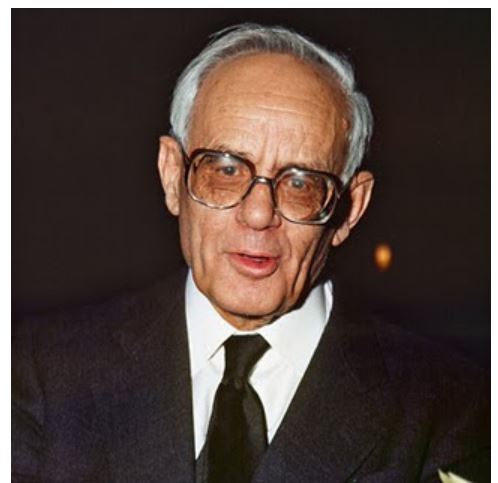
Karl Rahner, one of the most influential theologians of the twentieth century, said that if Christianity does not move to the mystical level, it will cease to exist. The mystical level, as I understand it, privileges lived experience of union with God over doctrinal precision. Theology and metaphysics still matter (I’ve spent much of my life on both), but if they don’t lead toward unitive consciousness, they may be part of what’s in the way. Richard Rohr says something similar: Christianity was always meant to help people see that all is one, that creation is God’s body, and that Jesus is the visible icon of the hidden God.
I write this for three reasons:
- Humanity is on the cusp of a new chapter in its collective consciousness. Much that was latent is surfacing, and the veil between us and God, and between us and each other, is thinning.
- Many Christians are awakening into wider things and finding resonance with other spiritualities. That awakening can feel like a mix of anxiety and ecstasy. I hope to show that the Law of One and mystical Christianity are deeply congruent. I’ll admit that I hold the Ra Contact as the standard against which I measure other metaphysical presentations.
- This article may be something you can share with friends and loved ones who are trying to connect the same dots. Take your time with it, and come back often.
There’s an old Scholastic axiom worth keeping in front of us the whole way: whatever is received is received according to the manner of the receiver. Each of us meets material like this through the lens of our existing worldview. That’s no failing; it’s simply how minds work. But it does invite humility, and curiosity about our own lenses.
I’m not trying to throw out any babies here, but I do hope to clean some of the bathwater. Christianity, as Rohr puts it, is “a lifestyle—a way of being in the world that is simple, non-violent, shared, and loving.” At its best it was never an exclusionary belief system. It was a great revealing—an apocalypse, in the old sense of the word—of what the Infinite Creator has been up to all along, and of how intimate God really is with our evolution. Ra found the phrase “close encounters” amusing for exactly this reason: “in a universe of unending unity… are not all encounters of a nature of self with self? Therefore, how can any encounter be less than very, very close?” (53.9).
Nor do I mean that other religions are less. Ra says plainly that each of our orthodox religious systems, though mixed in orientation, offers “a pure path to the One Creator which is seen by the pure seeker” (60.18). Whatever activates the heart, helps a person see God everywhere, and moves them to serve others in humility and love—that is what matters.
Ironically, it was my encounter with the Law of One that helped me affirm my Christian vocation in new and unexpected ways. For Christians new to the Law of One: you’re most welcome here. Nowhere will I say that Ra is to be worshiped or followed. Ra is more like an angelic messenger—a humble one—who offered a message. For Law of One students wary of Christianity: please keep an open mind, too. You may be surprised how much mystical Christianity and the Law of One are saying the same thing. If the word Christianity carries too much baggage, try reading it as Logos-ity. The Law of One clarifies Christianity, and Christianity can help people live out the Law of One in a rooted way that changes the world.
The Law of One and the Ra Contact
The Law of One is a channeled text received between 1981 and 1984 by a triad of loving friends who called themselves L/L Research. Their harmonious relationship allowed for the tuning necessary to bring the transmission in. Carla Rueckert was the “instrument,” speaking Ra’s words in an unconscious trance; Don Elkins was the questioner who shaped the dialogue; and Jim McCarty was the scribe, who transcribed the sessions and held the circle in love and light through meditation. Without all three, a transmission this concise would not have been possible.

In Tilting at Windmills: An Interview with Carla L. Rueckert and Jim McCarty (L/L Research, 2016), Carla recounts the first time she “heard” Ra knocking at her mind’s door while she was teaching channeling to a student:
I was about halfway through the session when there was a very powerful sort of knock-knock-knock on my inner door. I said, “Is there a spirit that wants to work through me?”
I kept getting, “I am Ra.” I’m thinking, “I don’t want to talk to a Ra,” because the only Ra I knew was from mythology. Egyptian mythology, and it was a fairly negatively orientated entity—it was a god of war, Horus the hawk-headed god and all that, not something I wanted to encourage. So I challenged with every ounce of energy in my little body, and I kept saying, “Do you come in the name of Jesus the Christ?”
They were indignant. It was like, “Do you think that you’re the only people that have Jesus? Do you think you’re the only planet that has Jesus? Come on—of course we come in the name of Jesus the Christ. Of course. What else is there when you’re talking about love? We come in the name of Jesus Christ, no problem. Get on with it, girl!”
I challenged three times and they were very strongly affirmative: “Yes, of course we come in the name of Jesus the Christ. We come in the name of love.” I thought, “I can’t go wrong with that,” so I said okay.
Carla then slipped into a deep trance and remembered nothing else. When she awoke, she was astonished to find a large transmission. I include the first session here because it sets the tone for everything that follows. I’ve redacted a few lines for brevity and clarity, and my own comments appear in brackets. You can read the whole session here.
Session 1, with my comments
1.0 Ra: I am Ra. I have not spoken through this instrument [Doug: Carla] before. We had to wait until she was precisely tuned, as we send a narrow-band vibration. We greet you in the love and in the light of our Infinite Creator.
We have watched your group. We have been called to your group, for you have a need for the diversity of experiences in channeling which go with a more intensive, or as you might call it, advanced approach to the system of studying the patterns of the illusions of your body, your mind, and your spirit, which you call seeking the truth. We hope to offer you a somewhat different slant upon the information which is always and ever the same [Doug: the Perennial Philosophy].
The Confederation of Planets in the Service of the Infinite Creator has only one important statement. That statement, my friends, as you know, is “All things, all of life, all of the creation is part of one original thought.” [Doug: Richard Rohr has long said that “Christ” was God’s first idea—the Logos of John 1:1, through whom all things were made. To my ear, Ra is saying the same thing. The One Original Thought is the Cosmic Christ. We’ll return to this in Part One.]
The reception of our beam is a somewhat more advanced feat than some of the more broad vibration channels opened by other members for more introductory and intermediate work.
Let us for a moment consider thought. What is it, my friends, to take thought? Took you then thought today? What thoughts did you think today? What thoughts were part of the original thought today? [Doug: In other words, which of my thoughts today were congruent with the Original Thought—that “Christ is all and in all,” as Paul puts it in Colossians 3:11?]
In how many of your thoughts did the creation abide? Was love contained? And was service freely given? You are not part of a material universe. You are part of a thought. You are dancing in a ballroom in which there is no material. You are dancing thoughts. [Doug: Christians are told that we are always held in the mind of God. Why couldn’t the vibrations that make up our world be God’s own thoughts?] You move your body, your mind, and your spirit in somewhat eccentric patterns for you have not completely grasped the concept that you are part of the original thought.
At this time we would be glad to attempt to speak to any subject or question which those entities in the room may have potential use in the requesting.
1.1 Questioner [Doug: Don Elkins]: It seems members of the Confederation have a specific purpose. Is this true with you, and if so, what is your purpose?
Ra: I am Ra. We communicate now. We, too, have our place. We are not those of the Love [Doug: fourth density] or of the Light [Doug: fifth density]. We are those who are of the Law of One [Doug: sixth density; Earth’s humanity is in third density, and we’ll explore what these terms mean below]. In our vibration the polarities are harmonized, the complexities are simplified, and the paradoxes have their solution. We are one. That is our nature and our purpose.
We are old upon your planet and have served with varying degrees of success in transmitting the Law of One, of Unity, of Singleness to your peoples. We have walked your earth. We have seen the faces of your peoples. This is not so with many of the entities of the Confederation. We found it was not efficacious. However, we then felt the great responsibility of staying in the capacity of removing the distortions and powers that had been given to the Law of One. We will continue in this until your, shall we say, cycle is appropriately ended. If not this one, then the next. We are not a part of time and, thus, are able to be with you in any of your times.
Does this give you enough information from which to extract our purpose, my brother?
1.2 Questioner: Yes, it does. Thank you.
Ra: We appreciate your vibration. [Doug: Ra perceives energy. They could feel that Don’s energy welcomed what was coming through and that he understood it. I like to imagine the members of the Ra group giving each other high fives that this mode of communication might actually work.] Is there another query?
1.3 Questioner: I’ve heard of the name “Ra” in connection with the Egyptians. Are you connected with that Ra in any way?
Ra: I am Ra. Yes, the connection is congruency. May we elucidate?
1.4 Questioner: Please do.
Ra: What do you not understand?
1.5 Questioner: Could you give me a little more detail about your role with the Egyptians?
Ra: I am Ra. The identity of the vibration Ra is our identity. We as a group, or what you would call a social memory complex [Doug: a society totally unified in mind and heart. Carl Jung spoke of humanity’s “collective unconscious”; a social memory complex is something like a collective conscious] made contact with a race of your planetary kind which you call Egyptians. Others from our density made contact at the same time in South America, and the so-called “lost cities” were their attempts to contribute to the Law of One.
We spoke to one who heard and understood and was in a position to decree the Law of One. However, the priests and peoples of that era quickly distorted our message, robbing it of the, shall we say, compassion with which unity is informed by its very nature. Since it contains all, it cannot abhor any.
When we were no longer able to have appropriate channels through which to enunciate the Law of One, we removed ourselves from the now hypocritical position which we had allowed ourselves to be placed in. And other myths, shall we say, other understandings having more to do with polarity and the things of your vibrational complex, again took over in that particular society complex. Does this form a sufficient amount of information, or could we speak further?
1.7 Ra: I am Ra. Consider, if you will, that the universe is infinite. This has yet to be proven or disproven, but we can assure you that there is no end to your selves, your understanding, what you would call your journey of seeking, or your perceptions of the creation.
That which is infinite cannot be many, for many-ness is a finite concept. To have infinity you must identify or define that infinity as unity; otherwise, the term does not have any referent or meaning. In an Infinite Creator there is only unity. [Doug: In Mark 12:29–31, Jesus was asked which commandment was the most important. His answer is the whole Law of One in three sentences: “Hear, O Israel: The Lord our God, the Lord is one. Love the Lord your God with all your heart and with all your soul and with all your mind and with all your strength. The second is this: Love your neighbor as yourself.”]
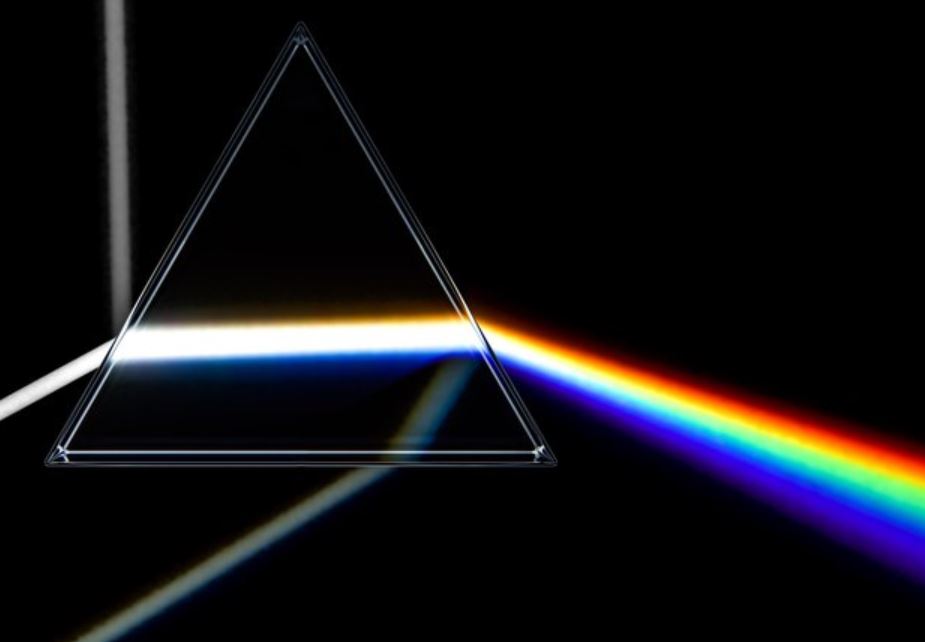
You have seen simple examples of unity. You have seen the prism which shows all colors stemming from the sunlight. This is a simplistic example of unity.
In truth there is no right or wrong. [Doug: true from the perspective of nonduality.] There is no polarity for all will be reconciled at some point in your dance through the mind/body/spirit complex which you amuse yourself by distorting [Doug: “distortion” means nuance, hue, or differentiation of the One] in various ways at this time. [Doug: “Mind/body/spirit complex” is Ra’s term for a person. And “all will be reconciled” is perfectly symbolized in the outstretched arms of the crucified Christ—the cruciform shape of reality I’ll explore in Part One.] This distortion is not in any case necessary. It is chosen by each of you as an alternative to understanding the complete unity of thought which binds all things. You are not speaking of similar or somewhat like entities or things. You are every thing, every being, every emotion, every event, every situation. You are unity. You are infinity. You are love/light, light/love. You are. This is the Law of One. [Doug: Is this shocking? Consider how it could be otherwise. If Christ is all and in all, there is no ontological “other” here. I’ll return to what does differ between Creator and creation in the Concluding Remarks.]
May we enunciate this law in more detail?
1.9 Questioner: Can you say anything about the coming planetary changes?
Ra: The changes are very, very trivial. We do not concern ourselves with the conditions which bring about harvest. [Doug: “Harvest” refers to the great shift now underway from one bandwidth of consciousness to another. More on this in Part Two.]
1.10 Questioner: Another question. Is it possible to create any acceleration of understanding [in] other entities [or are] all efforts… efforts by the individual on himself accelerating his understanding? In other words, if an individual tries to act as a catalyst in general to increase the awareness of planetary consciousness, is he doing nothing but acting upon himself or is it possible [inaudible]?
Ra: I am Ra. We shall answer your question in two parts, both of which are important equally.
Firstly, you must understand that the distinction between yourself and others is not visible to us. We do not consider that a separation exists between the consciousness-raising efforts of the distortion which you project as a personality and the distortion which you project as an other personality. [Doug: Ra can fully see what many human mystics intuit: we are all cells in a larger being.] Thus, to learn is the same as to teach unless you are not teaching what you are learning; in which case you have done you/they little or no good. This understanding should be pondered by your mind/body/spirit complex as it is a distortion which plays a part in your experiences at this nexus.
To turn to the second part of our response may we state our understanding, limited though it is.
Group-individuated consciousness is that state of sharing understanding with the other distortions of mind/body/spirit complexes, which are within the evident reach of the mind/body/spirit complex individual or group. Thus, we are speaking to you and accepting both our distortions and your own in order to enunciate the laws of creation, more especially the Law of One. We are not available to many of your peoples, for this is not an easily understood way of communication or type of philosophy. However, our very being is hopefully a poignant example of both the necessity and the near-hopelessness of attempting to teach.
Each of those in this group is striving to use, digest, and diversify the information which we are sending this instrument into the channels of the mind/body/spirit complex without distortion. The few whom you will illuminate by sharing your light are far more than enough reason for the greatest possible effort. To serve one is to serve all. Therefore, we offer the question back to you to state that indeed it is the only activity worth doing: to learn/teach or teach/learn. There is nothing else which is of aid in demonstrating the original thought except your very being, and the distortions that come from the unexplained, inarticulate, or mystery-clad being are many. Thus, to attempt to discern and weave your way through as many group mind/body/spirit distortions as possible among your peoples in the course of your teaching is a very good effort to make. We can speak no more valiantly of your desire to serve.
May we speak in any other capacity upon this subject?
1.11 Questioner: Will you be available for communication? Can we call on you in the future?
Ra: I am Ra. We have good contact with this instrument because of her recent experiences with trance. She is to be able to communicate our thoughts in your future. However, we advise care in disturbing the channel for a few moments and then the proper procedure for aiding an instrument who has, to some extent, the need of re-entering the mind/body/spirit complex which the instrument has chosen for the life experience of this time/space. Do you understand how to nurture this instrument?
1.12 Questioner: No. Could you explain it?
Ra: We suggest first a brief period of silence. Then the repetition of the instrument’s vibratory complex of sound in your density which you call name. Repeat until an answer is obtained. Then the laying on of the hands at the neck region for a brief period so that the instrument may recharge batteries which are not, shall we say, full of the essence of this particular field at this time. And finally, a gift of water into which the love of all present has been given. This will restore this entity, for her distortions contain great sensitivity towards the vibrations of love and the charged water will effect comfort. Do you now understand?
1.13 Questioner: Not completely.
Ra: I am Ra. We search your mind to find the vibration “Alrac.” [Doug: “Alrac” is Carla spelled backwards, Don’s endearing nickname for her.] It is this vibration from you which contains the largest amount of what you would call love. Others would call this entity “Carla.” The charging of the water is done by those present placing their hands over the glass and visualizing the power of love entering the water. This will charge that very effective medium with those vibrations. [Doug: Note well that love counts. Blessings count. We may not see love and light with our physical eyes, but blessing others really makes a difference. Praying for one another matters.]
This instrument is, at this time, quite fatigued. However, her heart is such that she continues to remain open to us and useful as a channel. This is why we have spent the time explaining how the distortions of what you may call fatigue may be ameliorated.
Under no circumstances should this instrument be touched until she has responded to her name. I do not wish to take this instrument beyond her capacity for physical energy. It grows low. Therefore, I must leave this instrument. I leave you in the glory and peace of unity. Go forth in peace, rejoicing in the power of the One Creator. I am Ra.
To my liturgy-loving ears, I relish Ra’s benediction at the close of each session. With the opening greeting—”I am Ra. We greet you in the love and in the light of the One Infinite Creator”—they anchor the connection along a narrow, protected band. The benediction closes that channel between their density and ours.
More on the Ra group
The source of the Law of One is a unified society some two billion years more advanced than Earth’s humanity, which names itself “Ra.” From their side, “Ra” is less a name than a sounding of their own nature—the vibration of a particular spectrum of divine light (23.6). The ancient Egyptians saw the sun as a symbol of divine light, and Ra recognized a congruence through which they could make themselves known. That is why every response begins “I am Ra”: they are tethering their energy to the channeling team along a narrow band, something like an encrypted line that outside parties cannot hack.

Why I trust this material
When I first met the Law of One in September 2013, I was intrigued and inspired. I was not very familiar with channeling, and I still consider it suspicious work. It is hard to know who is on the other line. After years of studying different channelings, I’ve come to believe that most combine the channeler’s own conscious and unconscious filters; when there is an entity on the line, it is usually only a little more developed than we are, nowhere near Ra’s level. Channelers without discernment can also pick up a negative source mimicking positivity, or have a positive contact hijacked midway. So why do I trust the L/L Research transmission of the Ra material?
- They were practiced in discernment. Don Elkins had worked for years, with a strong scientific mind, to hone channeling processes. By the time Carla joined him, there was a well-established practice honoring the metaphysical safeguards needed to connect with positive beings.
- Carla’s heart. Carla had the highest intention to serve others as purely as she could. She was a devout mystical Christian who loved Jesus Christ deeply, attended her beloved Episcopal church until her death, and had known a profound relationship with Jesus since the age of two. She knew from experience what a high-vibrational contact felt like.
- Their preparation. The team prepared each session intentionally: meditating together, harmonizing mind, body, and spirit with one another, and praying one of my own favorite prayers, the Prayer of St. Francis: “Lord, make me an instrument of your peace; where there is hatred, let me sow love… for it is in giving that we receive, it is in pardoning that we are pardoned, and it is in dying that we are born to eternal life.”
- The challenge in Christ’s name. Unlike almost all channeling, Carla offered herself so completely that she went into unconscious trance. Just before going under, she would challenge the approaching presence three times: did it come in the name of Jesus the Christ? Only if it could answer yes each time would she open herself as Ra’s “instrument.” Ra always invited the challenge and affirmed its place.
- Its scope. The material is the most comprehensive channeling I’ve encountered, touching nearly every area of the paranormal that had fascinated me since I was a young boy.
- Its care for free will. Across all 106 sessions, Ra was meticulous about not abridging the free will of the group or of future readers, often declining to answer fully. Only very positive beings would be so careful—and so loving.
- Its disinterest in transient detail. Ra had little interest in conveying details about secret operations or the machinations of negative beings. They knew that if Don’s curiosity led there, the contact could be lost or overtaken, because “the level and purity of this contact is dependent upon the level and purity of information sought” (37.4). Their concern was that all is part of the One Infinite Creator, and that souls evolve through bandwidths of consciousness over billions of years.
Part One: The Pattern of Love
One Original Thought
Everything in this article grows from the single statement Ra calls the Confederation’s “only one important statement”: all things, all of life, all of the creation is part of one original thought (1.0).

I hear in that statement the opening of John’s Gospel. “In the beginning was the Word, and the Word was with God, and the Word was God… All things came into being through him” (John 1:1–3). The Greek is Logos: the Word, the pattern, the meaning that runs through everything. Rohr calls Christ God’s first idea. Paul says “Christ is all and in all” (Colossians 3:11) and that “your life is hidden with Christ in God” (Colossians 3:3). The Original Thought, for me, is the Cosmic Christ: the divine life hidden and disguised as our life, ourselves, other people, and all of creation.
This is why Ra can say “You are dancing thoughts.” And it is why Ra later gives the simplest practice I know:
The universe is one being. When a mind/body/spirit complex views another mind/body/spirit complex, see the Creator… Gaze within a mirror. See the Creator… Gaze at the creation which lies about the mind/body/spirit complex of each entity. See the Creator. (10.14)
I work as a counselor, and I sometimes tell clients that in more than twenty years I’ve had only one client. They look at me puzzled. I tell them that client is Christ, who comes disguised as the person in front of me—and that it is Christ in me, as me, who meets the Christ in them, as them. My real job is to help them awaken to their own True Self and to live in a way congruent with it. During the therapeutic hour I often feel the Logos overshadowing me and using me as a conduit. I’m moved to tears at times by the sheer beauty of two faces of the same eternal Christ meeting each other.
Hold that image. It will come back when we reach the Christ Event and, at the end, my SH!PS Approach.
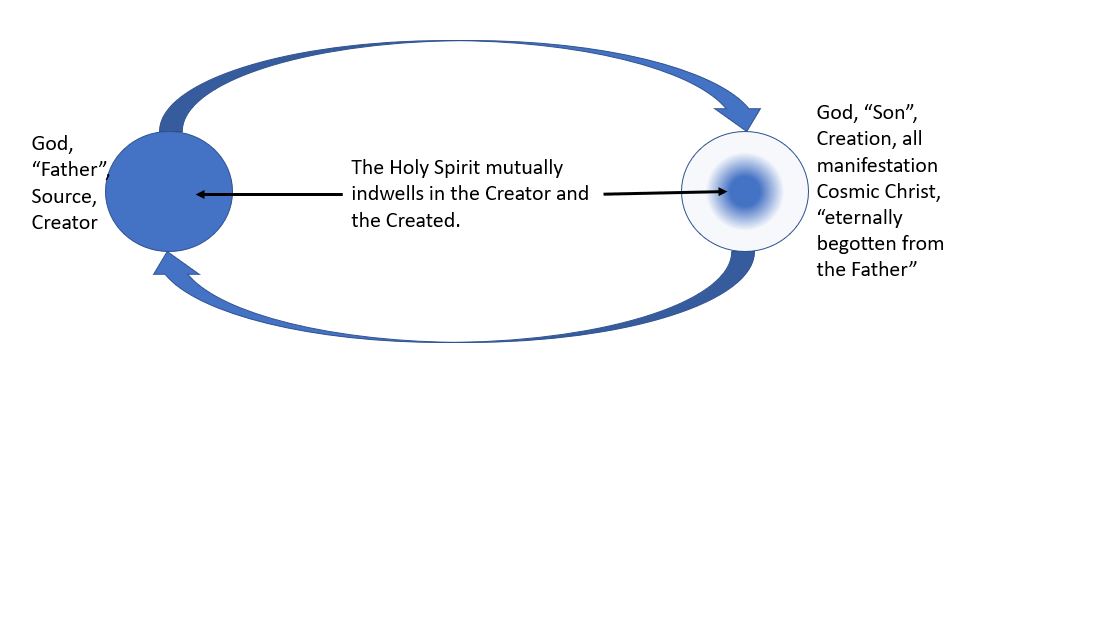
The Trinity
If something is cosmically true, it should be true everywhere and at every scale. I believe the Trinity is that kind of truth, and Ra, in its own vocabulary, points the same way.

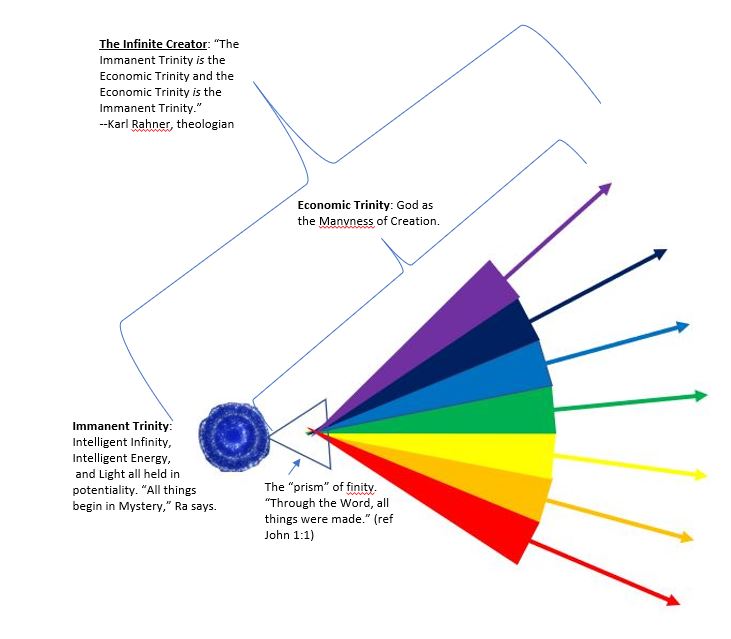
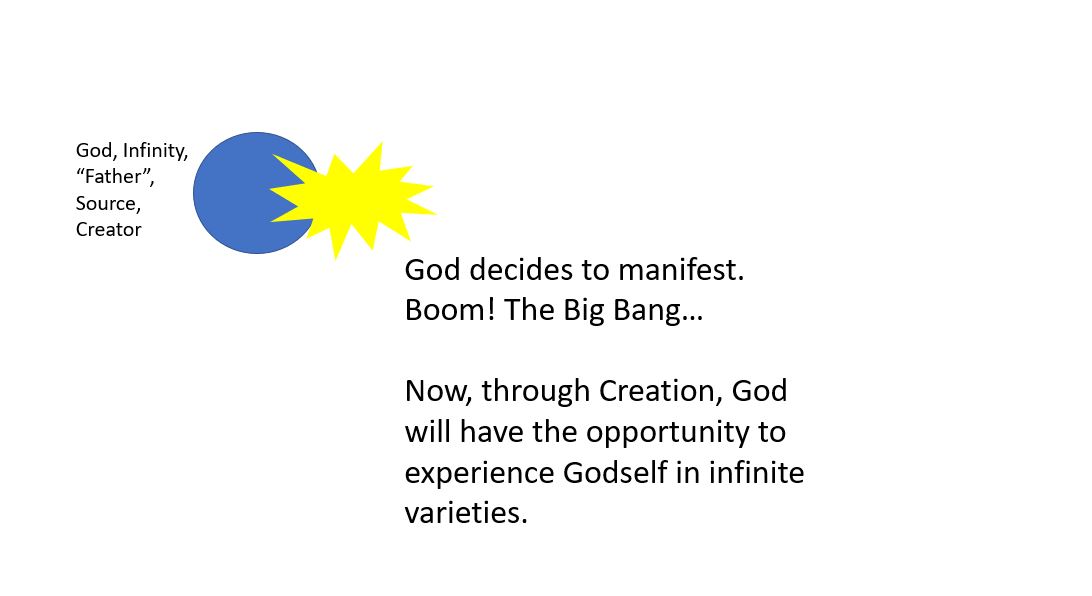
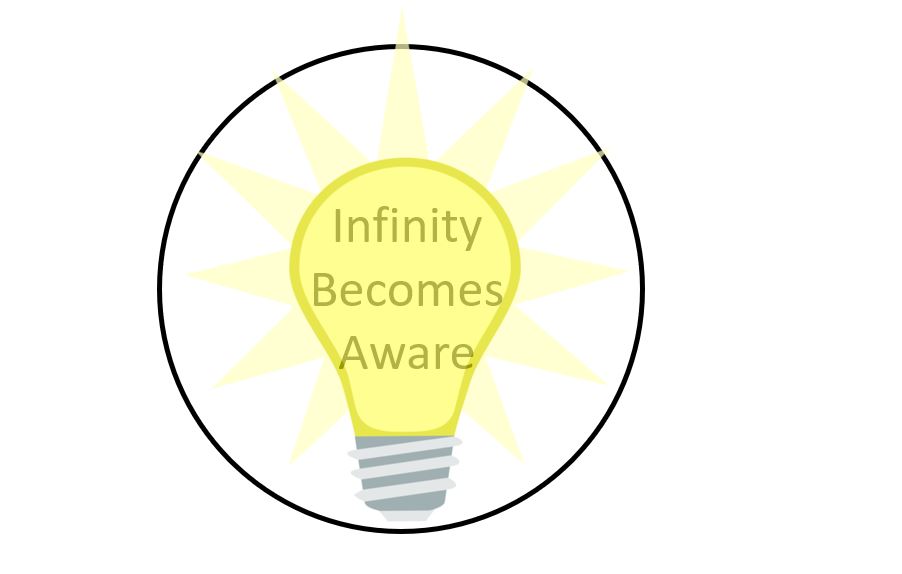
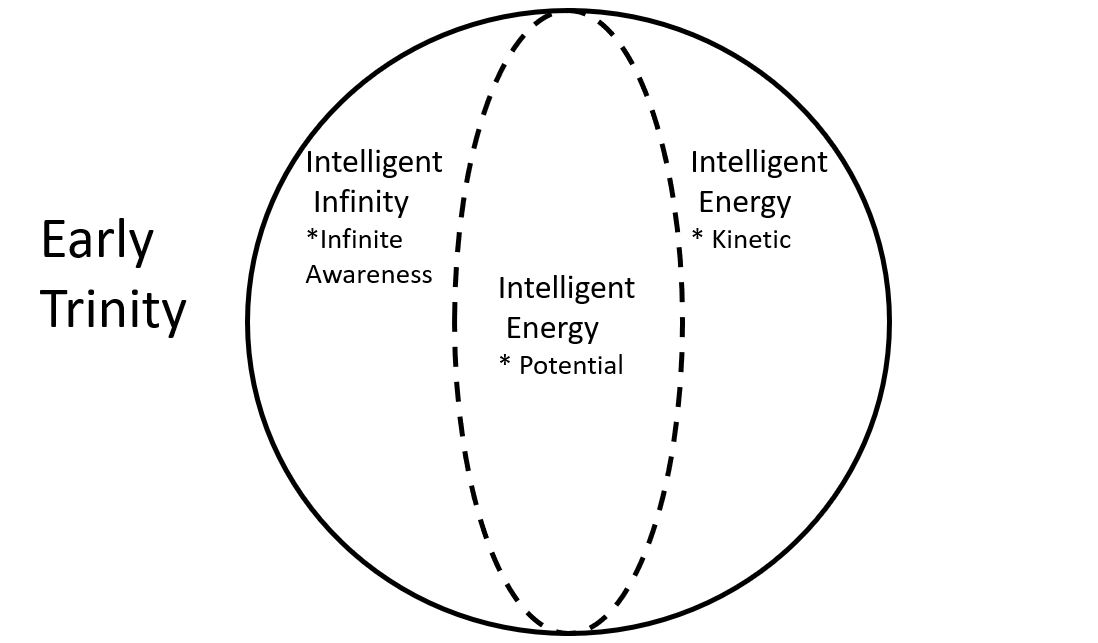
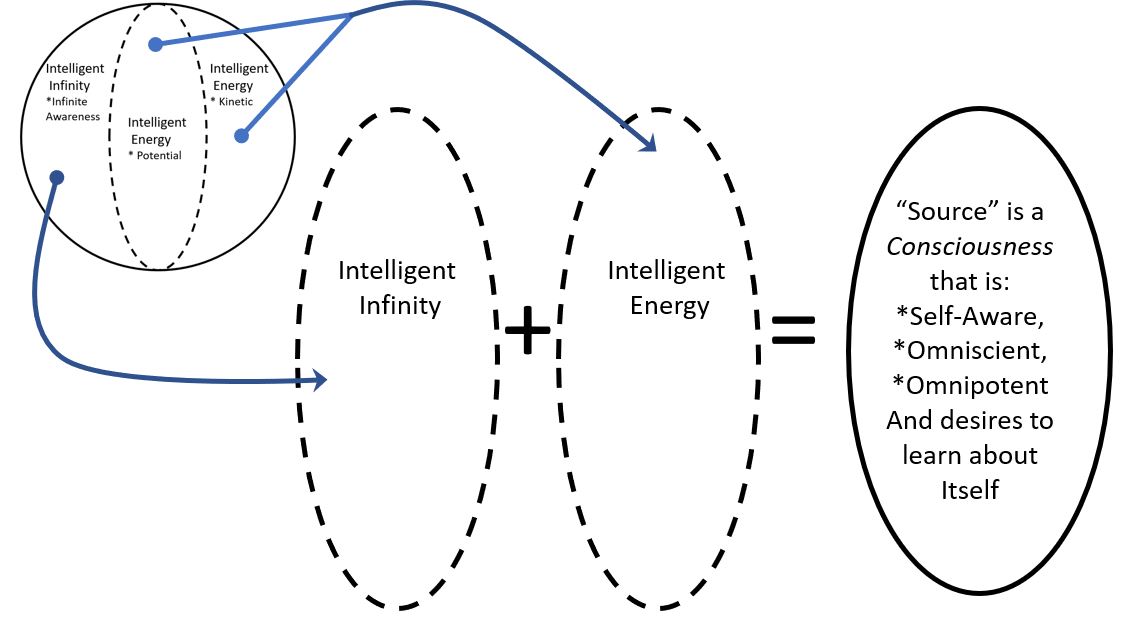
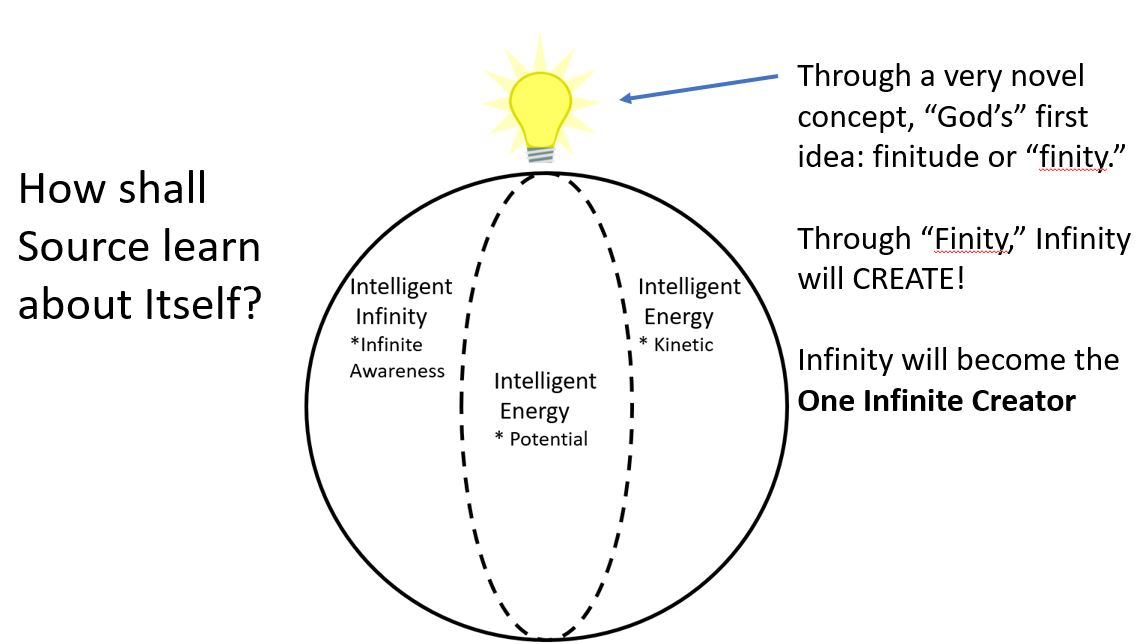
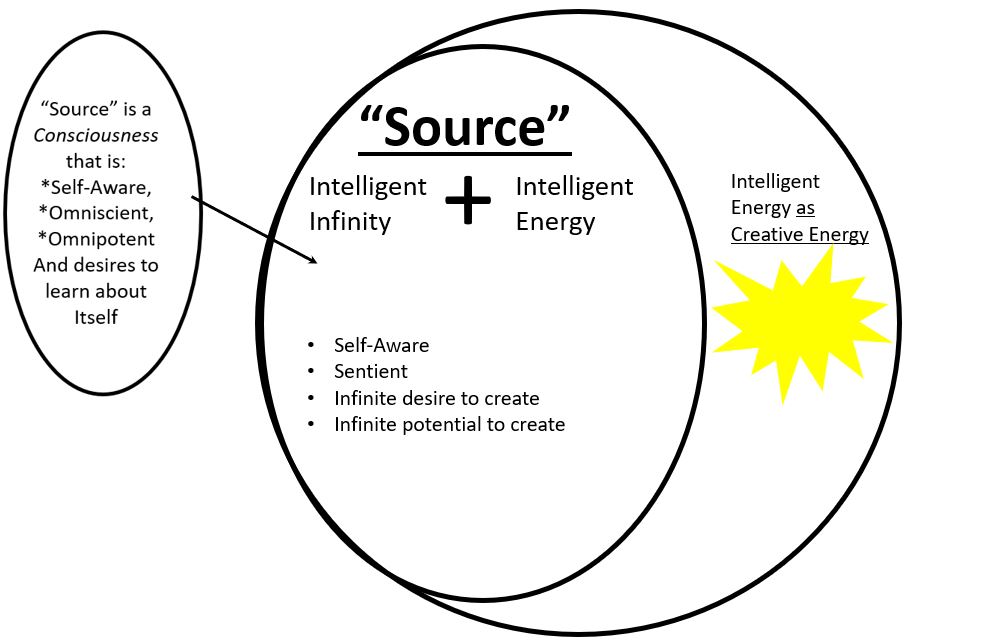
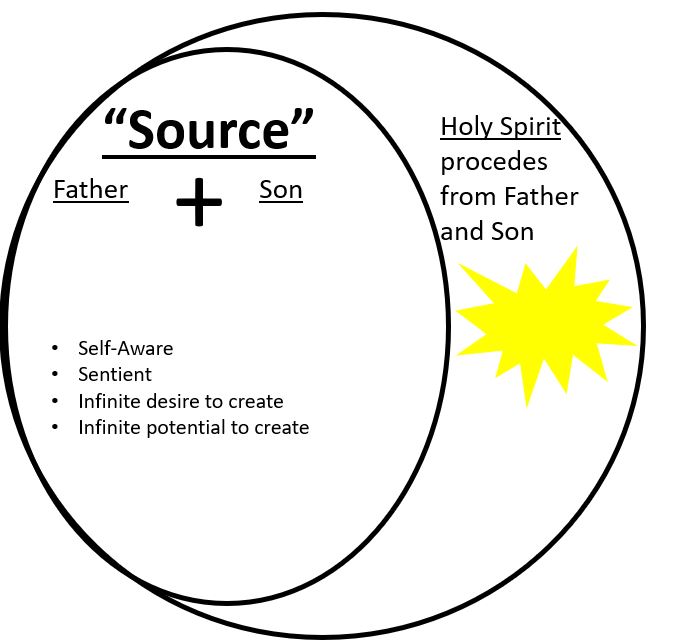
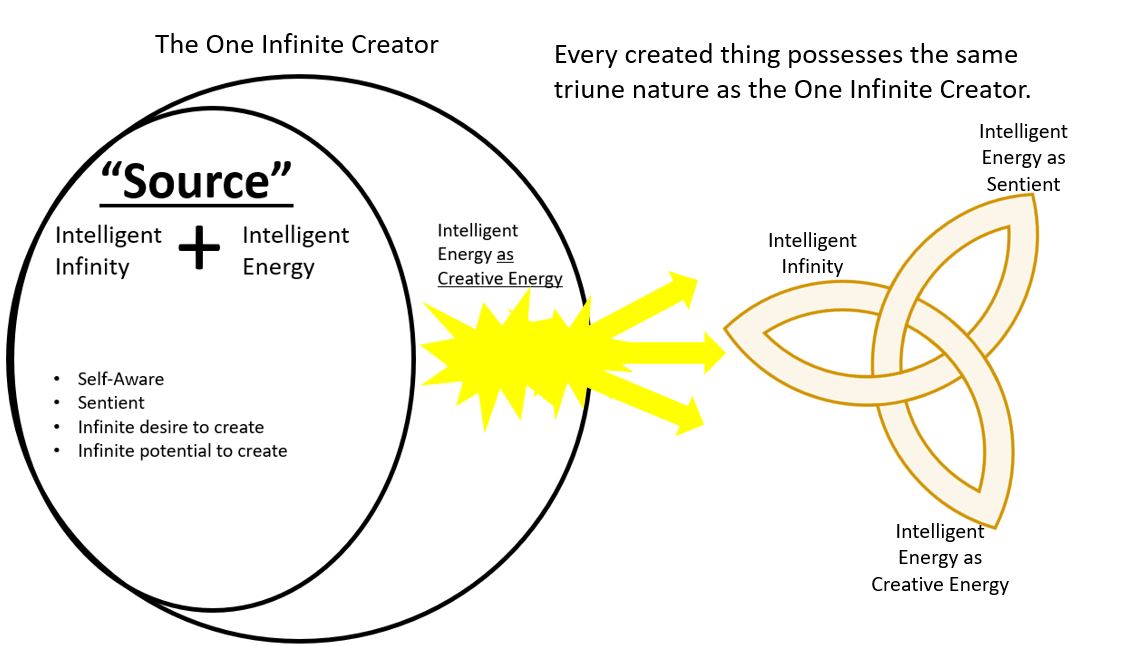
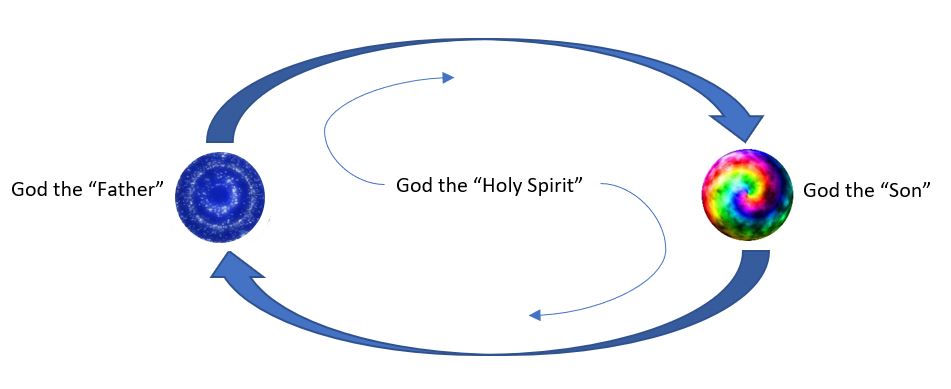
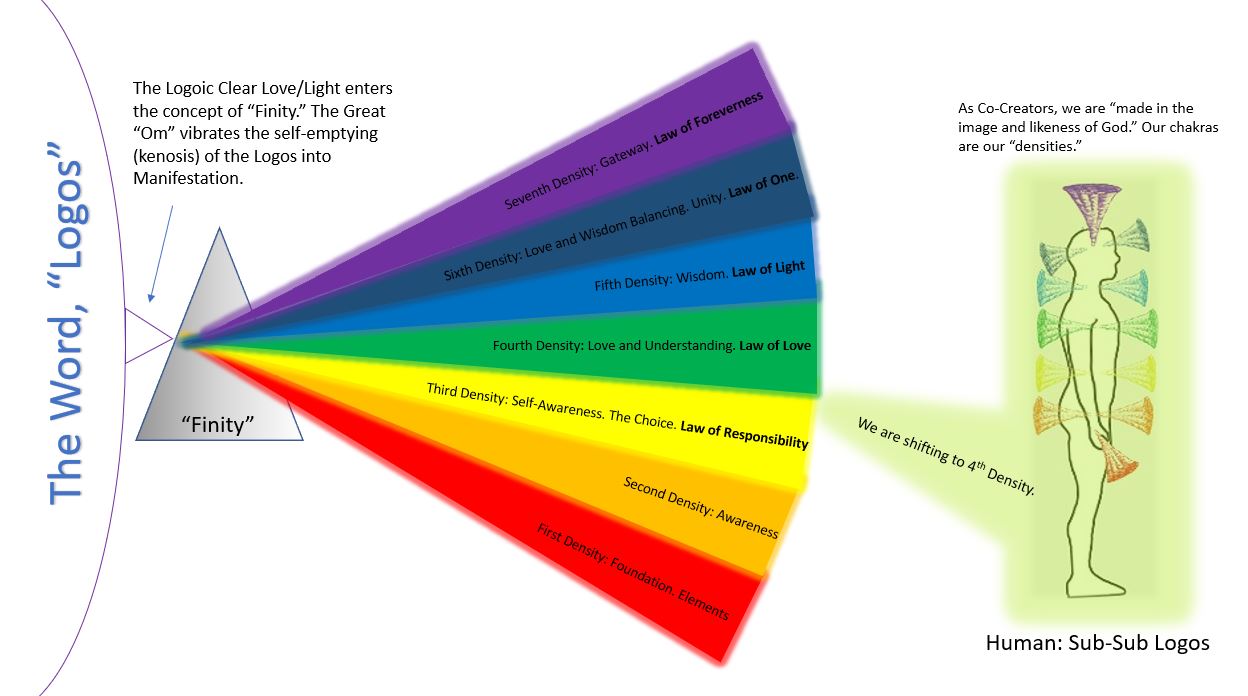
Ra says the first known thing is Infinity, which then becomes aware (13.5–13.6)—God, as I like to say, with the lights turned on. To speak of steps here is already to borrow the language of time, since there is only the eternal now. With awareness comes being, and being is triune. Ra names three primal distortions: Free Will, Love, and Light. Free will and love are begotten rather than made; light is the first manifestation, “the action of free will upon love” (54.27). Christian theology would call this the inner life of God—the immanent Trinity—the template that will be imprinted on everything that comes to be.

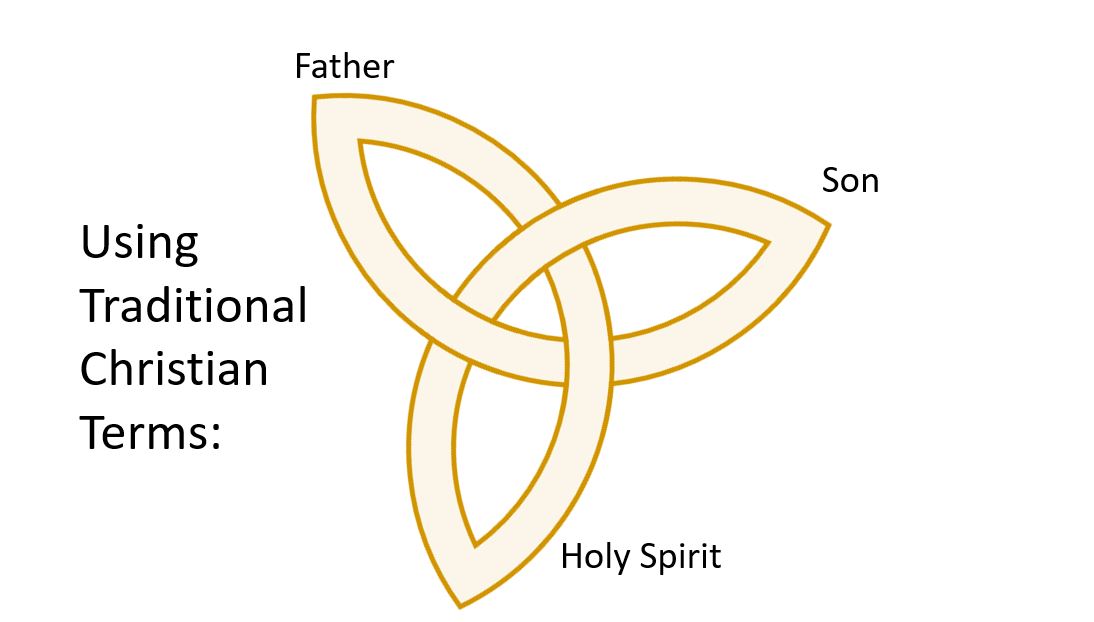
In Ra’s terms, I read the triune nature this way:
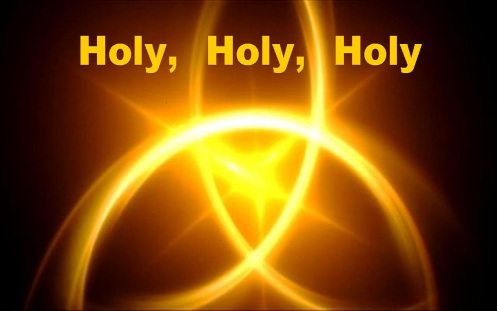
- Intelligent Infinity, which forever transcends (the “Father”).
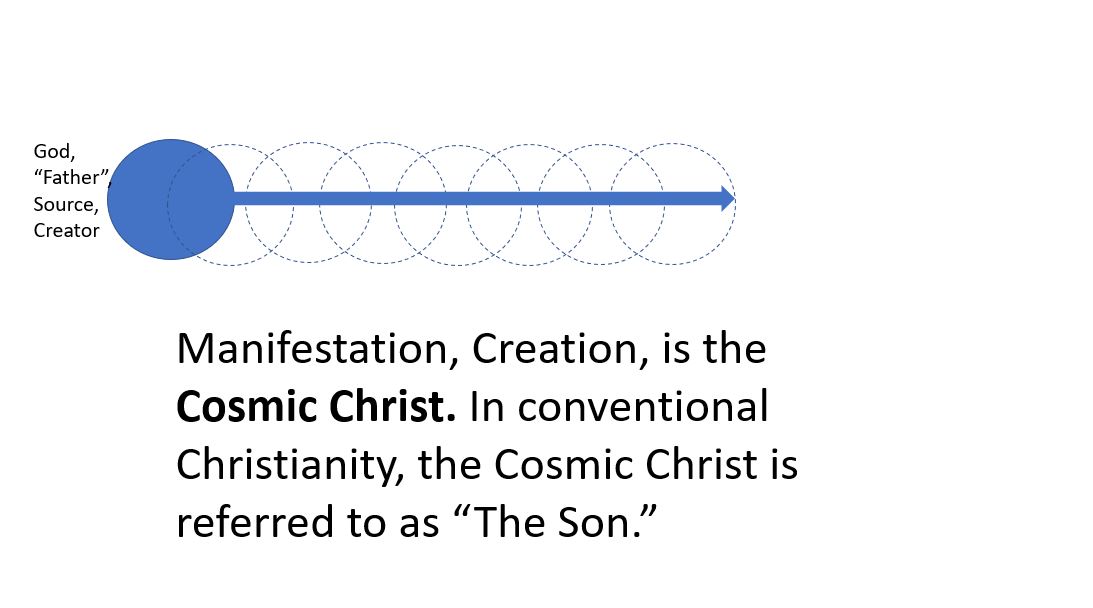
- Intelligent Energy as Logos—an individuated focus of the Creator (the “Son,” the Word).
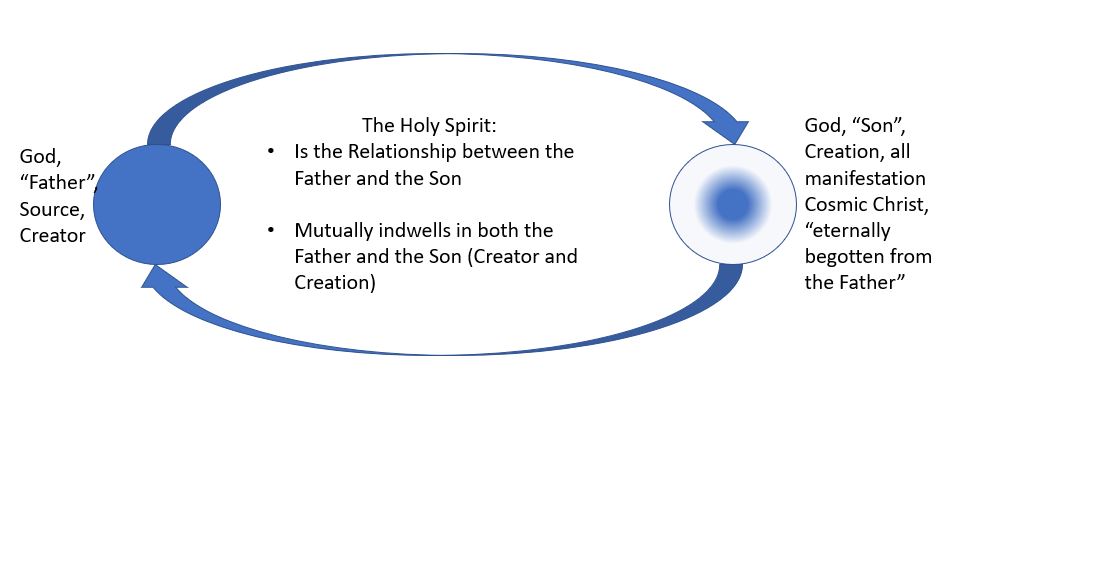
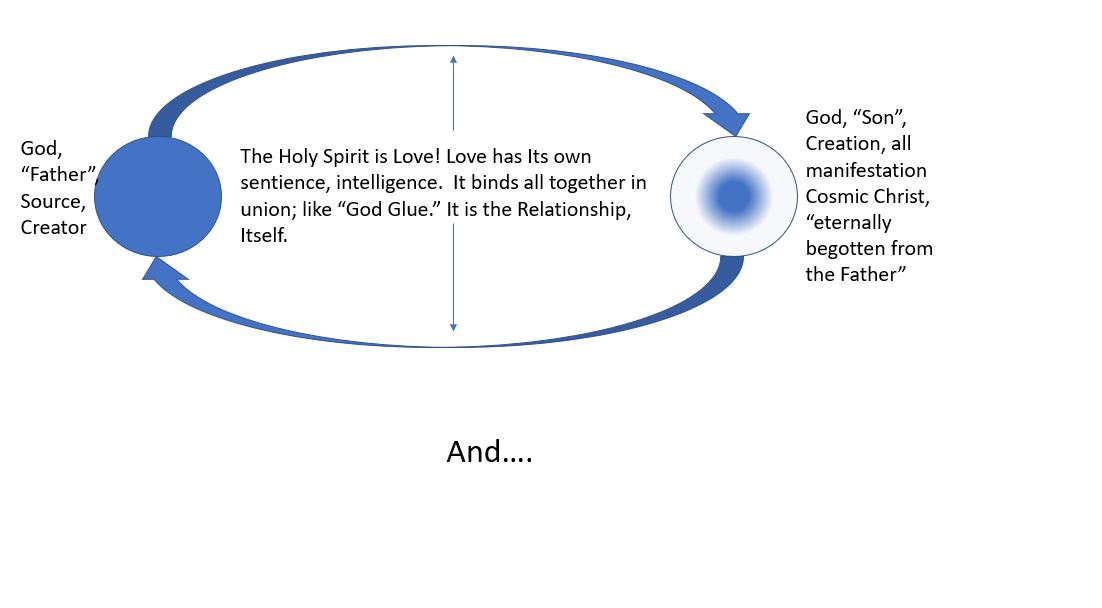
- Intelligent Energy as Spirit—indwelling and enlivening all things as the original desire “that entities seek and become one” (20.27) (the Holy Spirit).

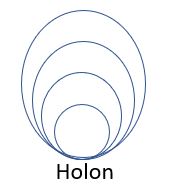
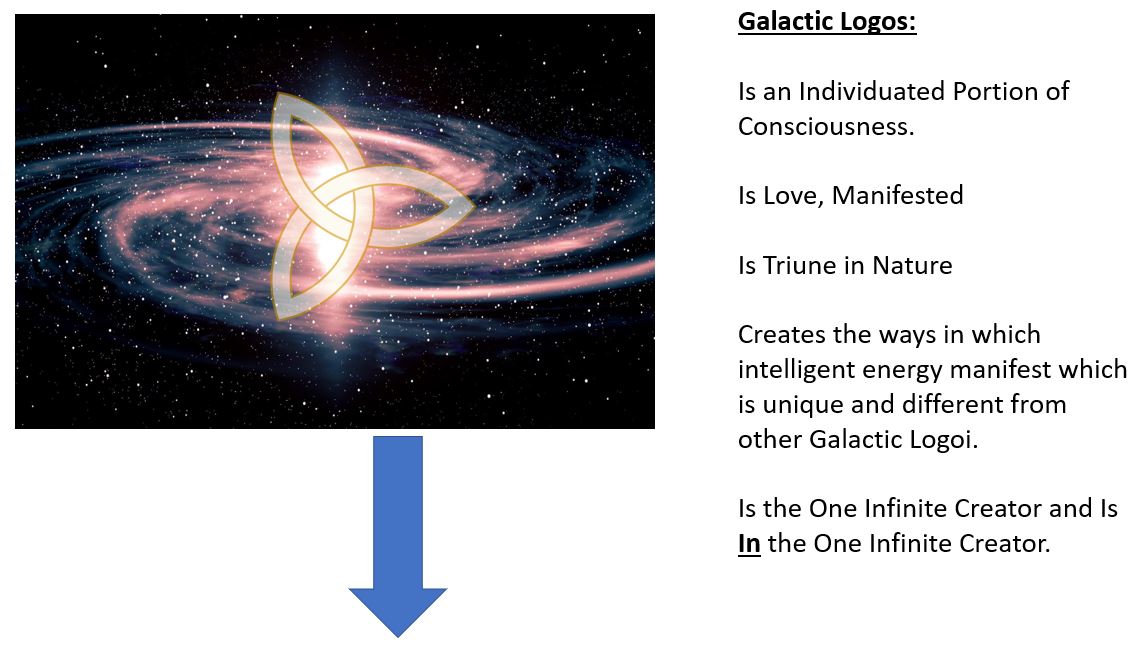
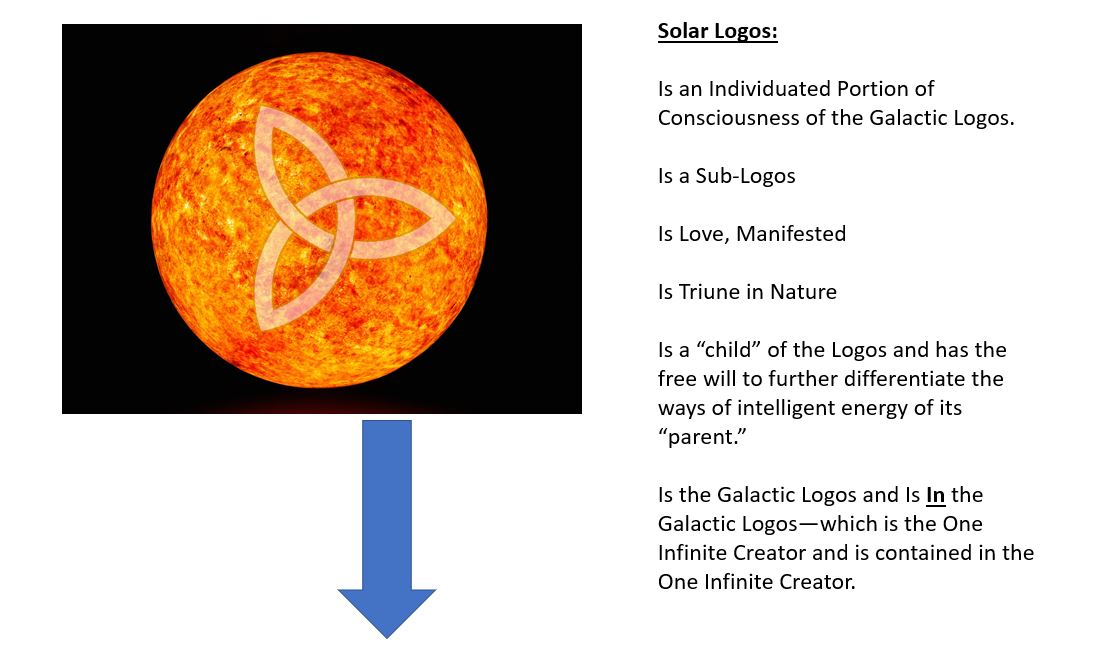
Every created thing, from the photon to the Galactic Logos, is a holon bearing that same triune imprint. And still the Void remains; the eternal now unfolds forever at the cusp of “lights off” and “lights on.”
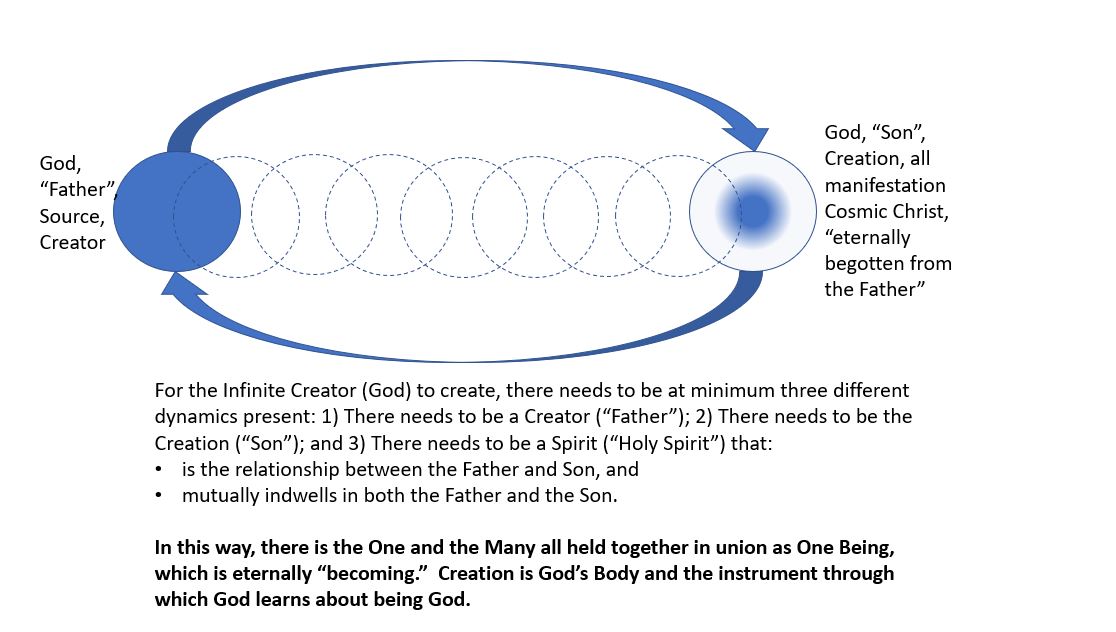
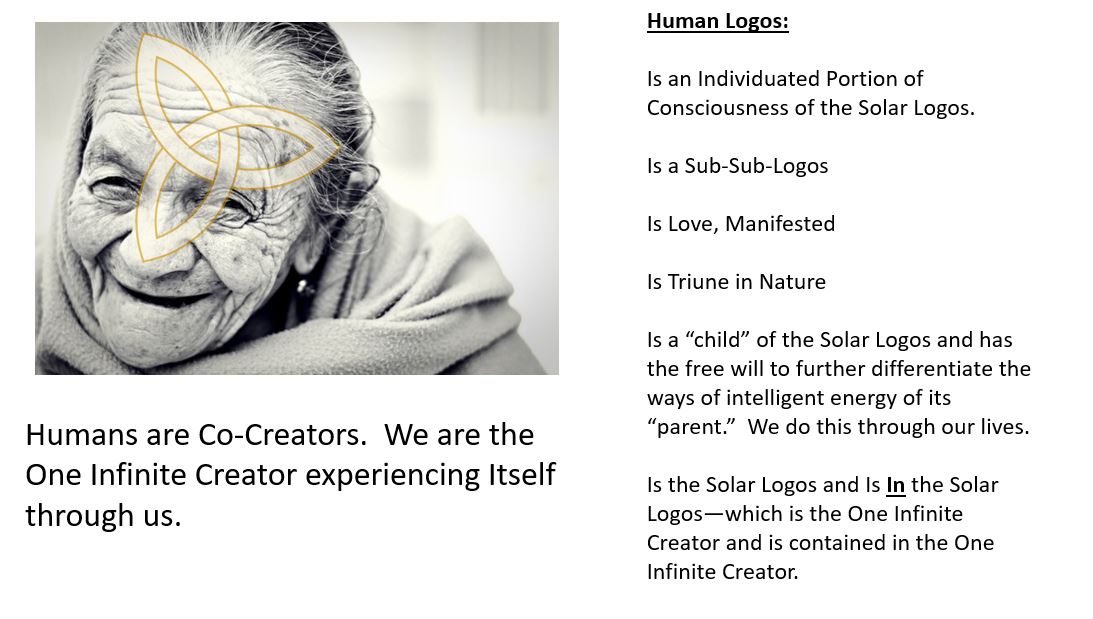
Here my thinking has shifted since earlier versions of this article. I no longer say “the Logos is in charge.” What holds everything together is the pattern of love itself, moving according to the Law of Three (the next section). Every Logos—ours included—is a fellow participant in that relationship, subject to the same original desire to seek and become one. The early church called this interplay perichoresis, the divine circle dance. Not a bad intuition for people living nearly seventeen hundred years ago.
A Logos, at any scale, is what I now call Alpha-potential, Omega-kinetic. Its plan is held in potential completion (41.8); it becomes kinetic through the lived experience of the beings within its body. In other words, a Logos is like an acorn: potentially complete, and completing as its body gives it experience. The Alpha holds the template; the Omega lives it; and the two grow toward each other.
This matters for everything that follows. Unity grows by maintaining diversity within itself—uniformity would never get off the ground. The whole enterprise is the Creator experiencing the Creator-self, and that requires real relationship, real tension, real choice. Love thrusts things out and draws them in, individuates and coalesces, disguises itself as you and me and makes us one.
The Law of Three
The pattern of love has a shape, and once you see it, you see it everywhere. G. I. Gurdjieff carried it to the West as the Law of Three, and Cynthia Bourgeault, in The Holy Trinity and the Law of Three, brought it into conversation with Christian Trinitarian theology. I’ve given its developmental movement a name of my own: teleopotentiation—teleo- (toward an aim) plus potentiation—because each resolution potentiates the next.
Every new arising requires three forces:
- Affirming force—the yes: desire seeking expression, vision seeking form, love seeking manifestation.
- Denying force—the not-yet: resistance, limitation, the cost of incarnation. Bourgeault insists this force is “never an obstacle to be overcome but always a legitimate and essential component of the new manifestation.” Put more simply, the enemy is never the problem but the opportunity.
- Reconciling force—almost always hidden, like a seed below ground or a diamond underground. It is present in plain sight yet invisible to our current level of awareness until we are broken open enough to see it. Bourgeault’s image: seed (affirming) meets ground (denying), and only with sunlight (reconciling) does a sprout arise.
The result is a new arising—a genuine novelty, a new way of seeing and being. And the movement keeps going. Every contrast creates potential for tension; every tension creates potential for resolution; every resolution creates potential for a higher-level contrast. It is a spiral, not a circle.
Tension can resolve in two ways. I call them the tomb and the womb.
| The tomb | The womb | |
|---|---|---|
| What happens | The tension resolves at the same level of awareness that produced it | The tension is brought into awareness and resolves upward |
| Image | An eddy, energy swirling fast and going nowhere | Gestation, new life hidden and growing |
| Result | The cycle repeats under greater pressure | A new arising (“born from above”) |
The tomb is no trap or sin; it’s simply what happens when catalysts go unseen. Tension is holy, and the tomb is never the final word.
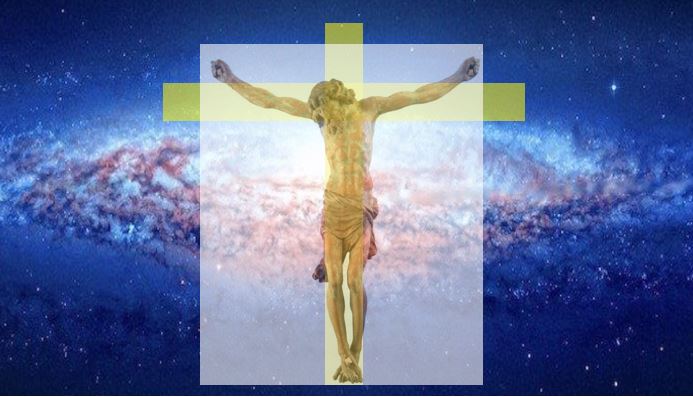
This pattern has a cruciform shape. Ra describes the cross as “that nature of manifestation which may only be valued by the losing” (93.24), and adds: “All things in manifestation may be seen in one way or another to be offering themselves in order that transformations may take place upon the level appropriate to the action” (94.26). Picture the affirming force descending vertically, from eternal intention into manifestation, and the denying force running horizontally, the resistance of what already exists. Where they cross is the point of maximum tension, where something must die for something new to be born. The reconciling force does not go around that crossing. It passes through. This is why I can say that everything belongs, even evil, as catalyst we can accept, love, and transform rather than transmit.
The Law of Three shows up in the smallest places. Imagine a couple at an impasse: she wants one thing, he wants another, and they’ve oscillated for days. Binary thinking offers compromise (neither gets what they want), capitulation (one wins), or separation. The Law of Three offers another possibility. If both can hold the tension long enough, honoring both desires as legitimate forces, something new may emerge—a resolution that addresses what both actually need in ways neither had imagined. The reconciling force isn’t manufactured. It becomes visible when the tension is held with enough consciousness.
Keep this pattern close. In Part Three we’ll watch it play out at cosmic scale.
The Paschal Mystery: How God Becomes
If the Trinity describes what God is, and love describes what God does, then the Paschal Mystery describes the flow of God’s love. Christians use the phrase for the death and resurrection of Jesus. I use it more widely, for the cycle of dying and rising, giving and receiving, letting go and being made new, that runs through every scale of creation. The Infinite Creator is simultaneously Being and Becoming; seen from infinity, the Paschal Mystery is how God becomes.
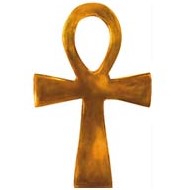
Ra’s teaching on the ankh, the crux ansata, captures it exactly:
The cross indicating that nature of manifestation which may only be valued by the losing. Thus the crux ansata is intended to be seen as an image of the eternal in and through manifestation and beyond manifestation through the sacrifice and transformation of that which is manifest. (93.24)
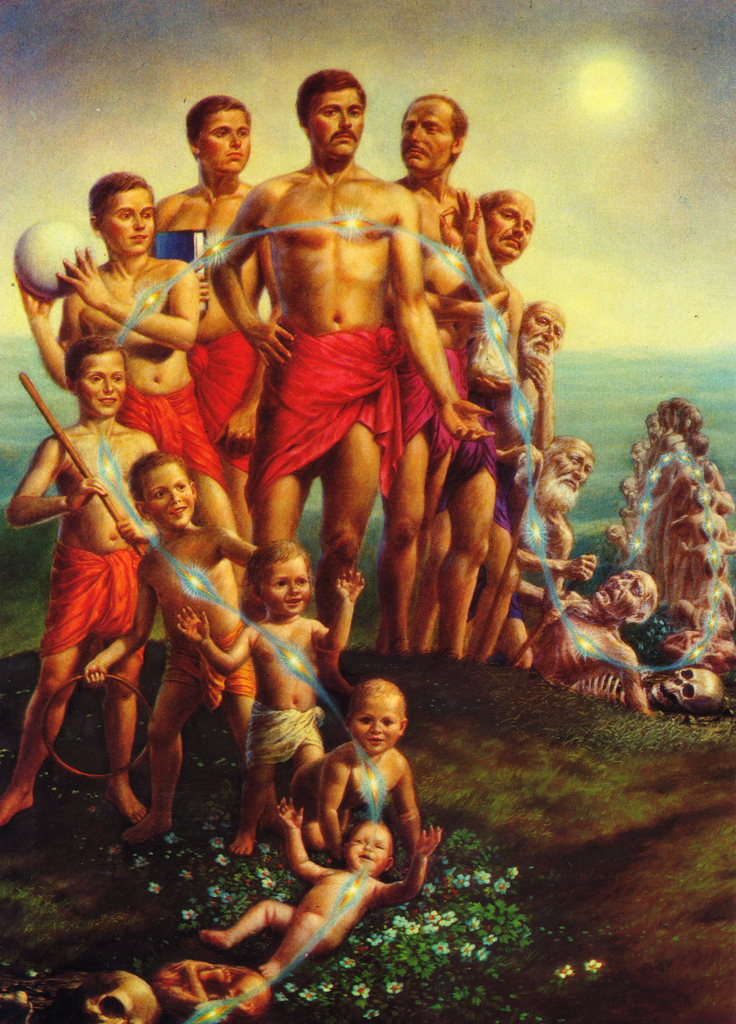
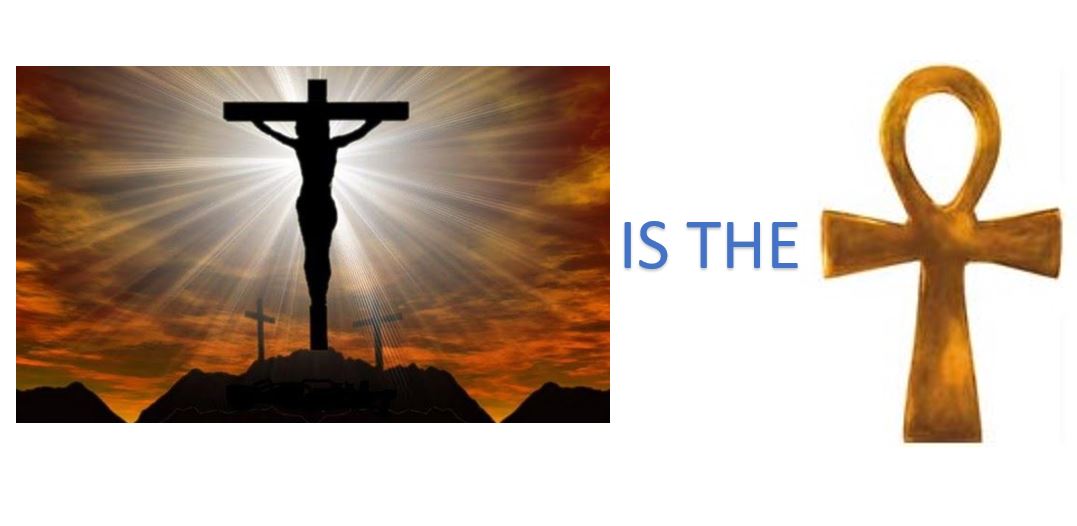
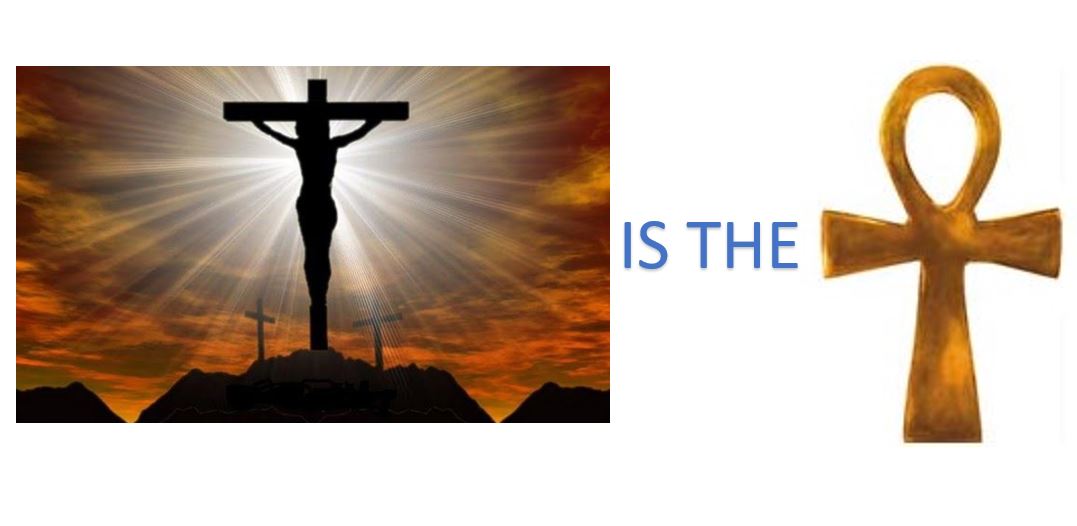
The circle is the eternal. The cross is manifestation, valued only by losing. Together they show the eternal entering manifestation, offering itself, and rising transformed. To live as a Christian, I’ve come to believe, is to become a living ankh.
This cycle runs through our own lives many times over: each “little death” (a disappointment, a loss, a dismantling of who we thought we were) can open into new life if we allow it. It runs across lifetimes too. Many Christians feel they aren’t allowed to wonder about reincarnation, but I see it as one more expression of the same pattern, held within the Paschal Mystery. Ra calls third density “the density of choice”: its great work is choosing a polarity, service to others or service to self, which becomes the thrust of the soul’s further journey. We are reborn, and reborn again, until that choice is made strongly enough to graduate.
Two terms from Ra belong here, because we’ll need them all the way to the end of this article.
Karma is inertia. “Our understanding of karma is that which may be called inertia. Those actions which are put into motion will continue using the ways of balancing until such time as the controlling or higher principle which you may liken unto your braking or stopping is invoked” (34.4).
Forgiveness is the brake. “This stoppage of the inertia of action may be called forgiveness. These two concepts are inseparable” (34.4). And forgiveness always includes the self: “Forgiveness of other-self is forgiveness of self” (18.12). Ra adds that at any point in an incarnation, “one who has set in motion an action may forgive itself and never again make that error. This also brakes or stops what you call karma” (34.5). The Old English for-giefan means to give away completely.
Karma and forgiveness are two sides of one coin. A soul moves forward through the oscillation of losing and regaining balance, dying and rising, perhaps many times. Those who learn to trust that flow come to see karma itself as a gift, catalyst offered in the moment for growth. Julian of Norwich intuited it: both the falling and the recovering are gifts. What hurts now helps in the long run. No one is lost; there is no hell except the ones we make, and every rebirth, great or small, is evidence of the flow of love.
Hold on to karma as inertia and forgiveness as the brake. In Part Two we’ll see what happens when the inertia belongs to a whole planet, and in Part Three, what changed on the cross.
Part Two: The Veil and Its Shadow
The Accuser and the Advocate
Why does a universe this saturated with love feel so separate, so harsh? Ra’s answer is the veil of forgetting: an innovation of the Logos that drew a curtain between our conscious and unconscious minds, so that third-density beings would not automatically know that all is one. In the poker game Ra describes, if all the cards are face up, the game is played correctly but “with no interest.” Under the veil we cannot see the other players’ hands, and so every act of love carries weight (50.7). The veil makes the choice real.
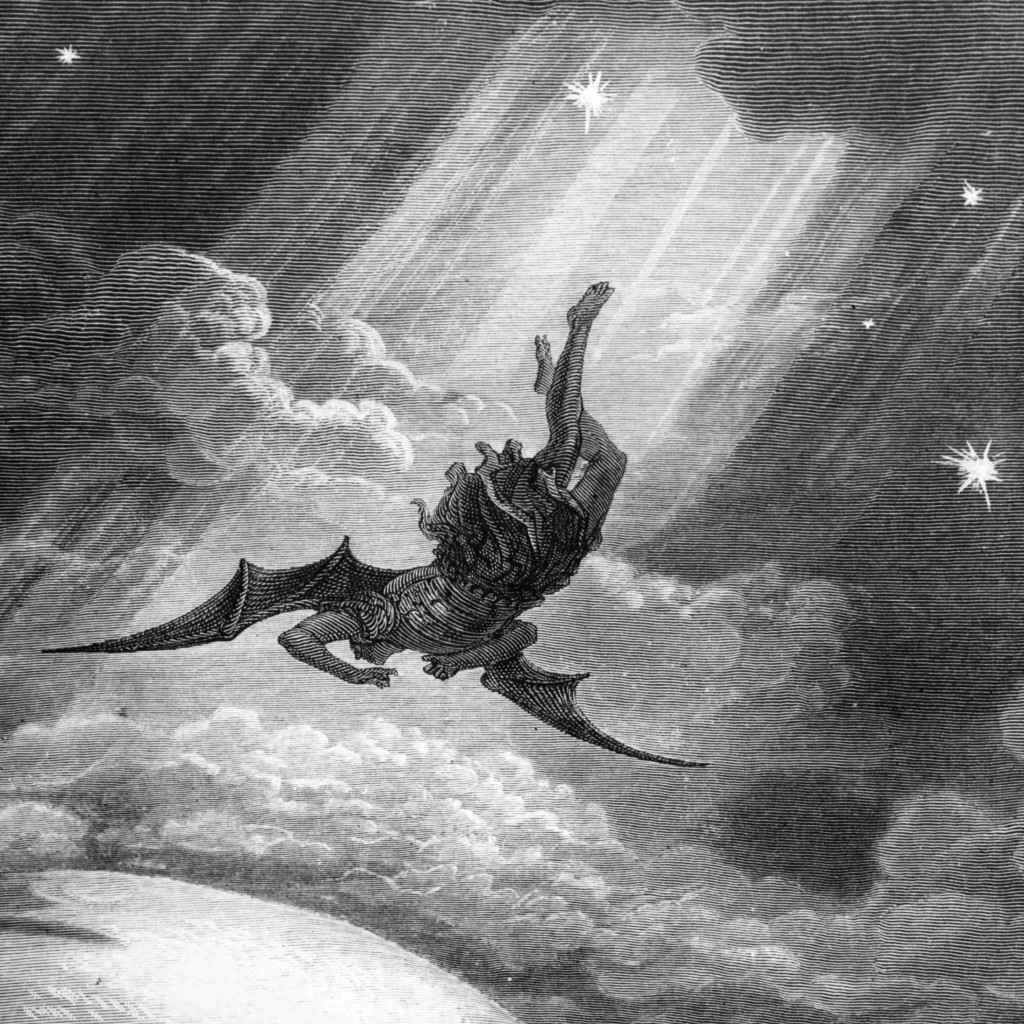
The Hebrew word satan means “adversary” or “accuser.” In Job, the satan is a functional role within the divine council, the one who questions and tests. I’ve come to see the veil itself working as the Accuser: the voice inside every one of us that says you ARE separate—from God, from each other, from your own worth. It prosecutes; it divides; it insists that self and other are fundamentally opposed. Every time I look at another person and see an enemy rather than another self, the Accuser has done its work.
But the Accuser is not the whole story. There is also the Advocate, the Paraclete, the Spirit of the Infinite Creator, whispering through the forgetting that we are not separate and never were. From the Logos’s view, both belong to the design. The Accuser creates the conditions of choice; the Advocate keeps the way home open within them. The veil enables; it doesn’t exploit. And it sets the stage for the hardest thing on our planet, which is the subject of the next section.
The Great BASH
Many people believe a shadowy cabal is behind everything wrong with our world. I’ve come to believe there is one—though it isn’t a group of people. The real shadowy cabal is the unacknowledged inertia of bellicosity hidden in us, in our communities, and in our collective mind.
I call it the Great BASH:
- Bellicose Attitude
- Aggressive Actions
- Scarred and Scared
- Hope through Hostility
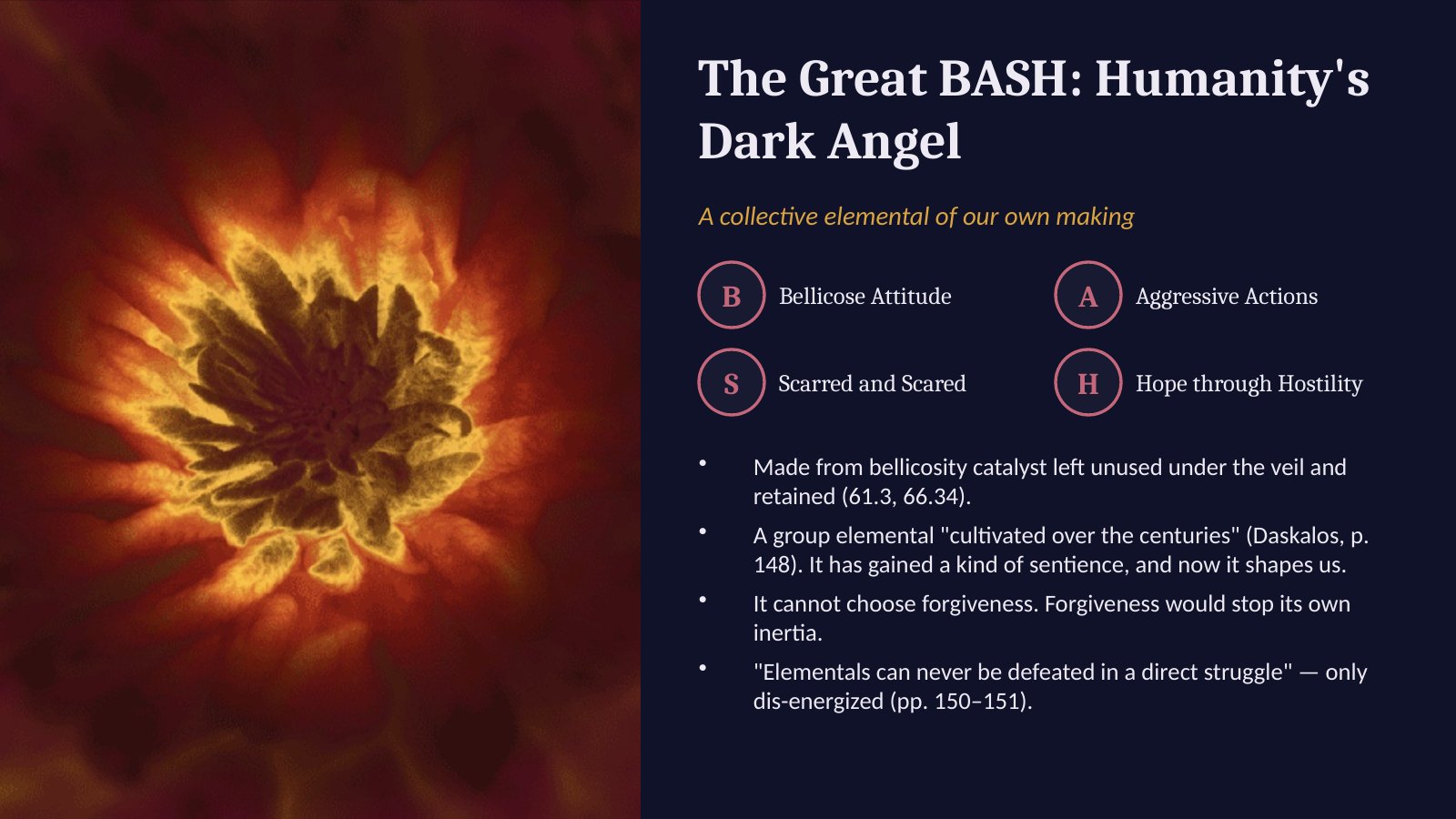
The Great BASH is a planetary-scale collective thoughtform, an egregore, that humanity itself has built through lifetimes of bellicosity we haven’t processed. Over time it has gained a kind of life of its own: we shaped it, and now it shapes us. It does not think outside of bellicosity, and it creates conditions that prevent clear perception of itself, like an organism that suppresses the immune response needed to fight it.
At its root is one fear with a counterphobic twin: the fear of being violated and the desire to violate others. These feed each other in an endless cycle of scapegoating and victimization. René Girard called the scapegoat mechanism the central pattern for creating and maintaining cultures since the beginning. Rohr summarizes the sequence: “we compare, we copy, we compete, we conflict, we conspire, we condemn, and we crucify.” When the scapegoat mechanism joins what psychologists call conspiracy bias (the pull, under stress or shame, toward stories that make us innocent victims of malicious others), we meet the Great BASH face to face.
The Christian tradition has old names for this. Satan, the Accuser of the previous section, is the Great BASH writ large: the operational form separation-consciousness takes at planetary scale. Sin, in Greek hamartia, is an archery term meaning “missing the mark.” And what is consciousness actually aiming for? Union, connection, love. The Great BASH is, in this sense, a sin-generating machine. It is what Rohr calls capital-S Sin, the collective sin we all participate in, and what John Dominic Crossan names as humanity’s great sin: our predisposition to violence.
Remember karma as inertia. Now apply it to a planet. According to Ra, many of the souls on Earth came here from Mars some 75,000 years ago, after their own “tendencies… towards bellicose actions” made that planet uninhabitable (9.10). They brought the pattern with them. Seventy-five thousand years of largely unresolved bellicosity, each generation inheriting what the last did not resolve—the momentum compounds, like interest working against us.
Ra teaches that when seekers unite in will and faith, their calling grows exponentially through what Ra calls the Law of Doubling, or the Law of Squares (7.3–7.5). That is why “where two or three are gathered” matters. But the same exponential mathematics works in both directions. Bellicosity unified across millennia doesn’t add up; it multiplies. That’s why individual effort, however sincere, cannot break the logjam alone. You cannot bail out the ocean with a teaspoon.
This is the closed circuit of the Terran condition. Individual effort matters, and each act of forgiveness weakens the Great BASH a little. But a circuit that encompasses the individual cannot be broken from inside by the individual alone. Something from outside the circuit had to enter it.
The Greenhouse and the Conspiring of Wholeness
If the Great BASH were the whole story, despair would be reasonable. It isn’t the whole story. There is a hand at work beneath it that I call the conspiring of wholeness. Con-spirare means “to breathe with.” All the actors in our planetary drama, human and otherwise, benevolent and malevolent, end up breathing together in the service of wholeness-making. Love keeps winning, even through what was bent.
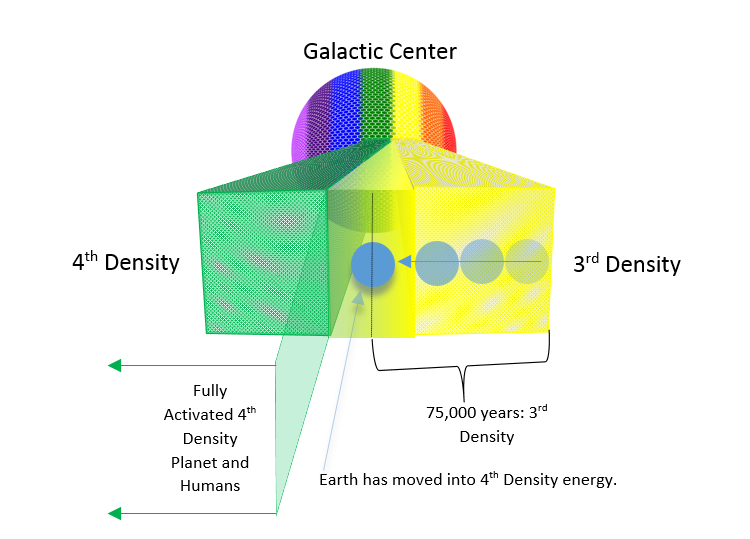
Ra tells us our planet is already in fourth-density vibration, and that the birth is not going smoothly: “Its material is quite confused due to the society memory complexes embedded in its consciousness. It has not made an easy transition to the vibrations which beckon. Therefore, it will be fetched with some inconvenience” (6.16). Ra speaks of “the difficult birthing of the planetary self into fourth density” (65.10), and says that “the earth… is ready to be born, and the delivery is not going smoothly” (65.17). As I read Ra, the planet is already fourth density in time/space, the metaphysical side of things, while our physical space/time lags behind, its pace set by human consciousness. On most planets the two shift close together. Here they’ve been stretched apart, mainly because of the great variety of soul origins on Earth.
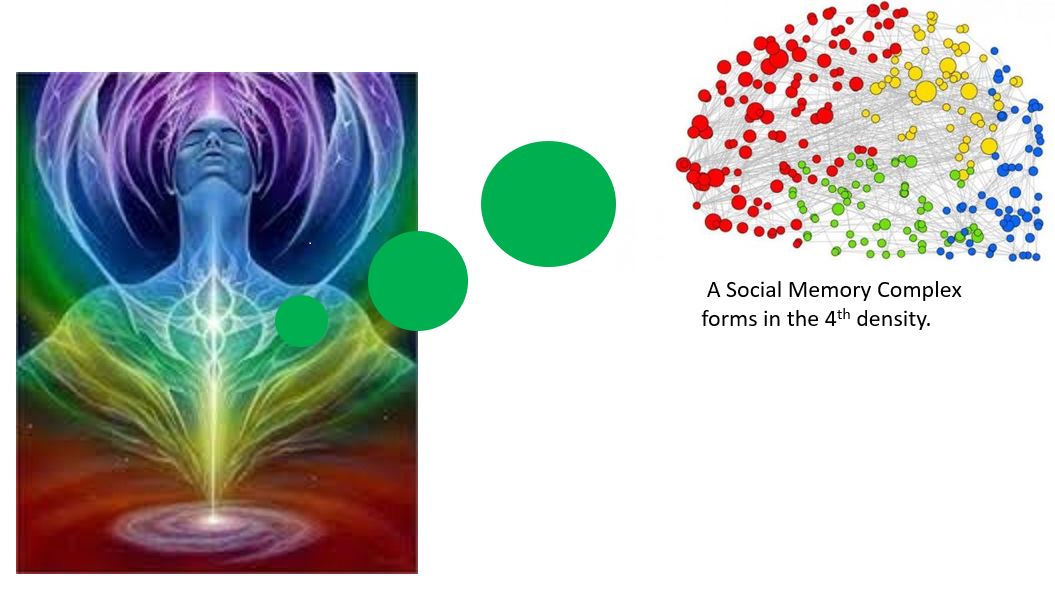
Picture a car tire mounted badly. At highway speed it wobbles; the wasted energy turns into friction, heat, smoke, and eventually a blowout. Earth’s humanity is that tire. Unprocessed bellicosity is our poor connection to the vehicle as the planet speeds into green-ray, heart-centered conditions.
The greenhouse
Here is the image I’ve been living with. Picture a greenhouse. A master gardener has to read the room, know which plant needs which light, open the vents when it’s too hot and close them against the winter. Ra calls the beings who tend our planet’s quarantine “the Guardians, or gardeners, as you may call them” (21.8). They balance it with exquisite precision, opening and closing according to the planet’s karmic needs and its calling (16.1–16.6).
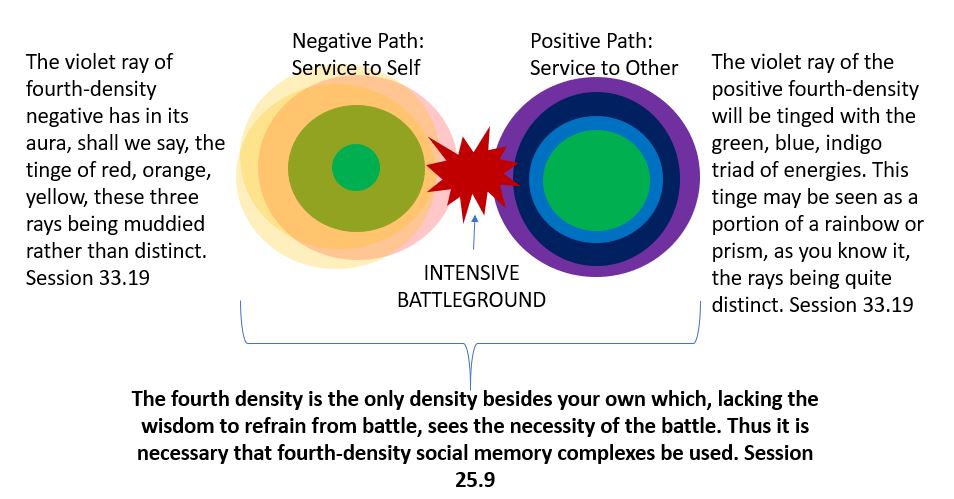
Now imagine that greenhouse in a Texas July: 105 degrees, every vent open, and still too hot. The heat is metaphysical, and it’s ours. It’s our inefficient use of catalyst, our bellicosity, the Great BASH. So the gardeners allow an air conditioner (fourth-density positive beings) and, opposing it, a heater (fourth-density negative beings). Ra says an equal influx of positive and negative is allowed, balanced by the distortions of our own social complex (16.6). Their contest, running on the very air we’ve heated, holds the room at a temperature where small plants can still be watered and grow. Ra describes the result plainly:
It has not been fruitful for either side. The only consequence which has been helpful is a balancing of the energies available to this planet so that these energies have less necessity to be balanced in this space/time, thus lessening the chances of planetary annihilation. (25.6)
The sensitive among us feel every hot and cold current directly, and it can be genuinely disturbing. Over time, I think, we learn to dress in layers.
Disclosure as integration
The growing public conversation about extraterrestrials belongs here too. Many disclosure narratives are built on what I call warfare disclosure: an evil elite controlled by evil aliens, an enslaved humanity, and salvation through exposure and uprising. That framing comes out of the gravity of our bellicosity, so it is part of the problem it hopes to solve. There is no such thing as redemptive bellicosity.
There’s a better way to hold it. If we look at the human race as one Self, disclosure is integration: a whole system taking back what it split off, without hating the split-off part. In counseling, good work helps people integrate their shadow, and nobody does that by hating the shadow. You learn it, accept it, forgive it. Ra suggests disclosure comes because the collective’s own desire to know has become loud enough—the same law of the calling (7.6–7.8). For Christians, some of what surfaces may feel like an earthquake: that Jesus was a fourth-density Wanderer, or that the Yahweh story includes genetic work and a battleground over Moses. None of this has to demolish the tradition. It widens it.
And Ra offers a caution I try to keep close: “It is not the specificity of the information which attracts negative influences. It is the importance placed upon it” (26.36). Be curious. Hold what you find lightly.
The real battle
Warfare spirituality puts the fight “up there,” in the heavens, with us as pawns. I see it the other way around. The path of ascension runs down and in. There is nothing “up there” that isn’t fully present and accessible “down here.” The fourth-density actors serve third density’s evolutionary needs, not the reverse. For most of us, the real battle is learning to process all that assaults our senses with acceptance, forgiveness, and balance. It is fought in the gulf between the lower energy centers, where unprocessed bellicosity circulates, and the heart.
The gardeners keep the climate livable. But they cannot do our growing for us, and they cannot reach inside the Great BASH and change what it is. That required something else.
Part Three: The Christ Event
Yahweh: The Solar Logos Coming Toward Us
In earlier versions of this article, I treated Yahweh as a Confederation group like Ra. My work since has led me somewhere else. I now hold that the name Yahweh, as Israel came to know it, belongs to our Solar Logos itself. More precisely, I propose that Yahweh is the Significator of the Solar Logos, the face it turns toward the beings within its own body. Read this way, the Hebrew scriptures document that Logos’s progressive self-disclosure: storm god, covenant partner, the God of the prophets, Wisdom dwelling among us, and finally the expectation of Immanuel, “God with us.”
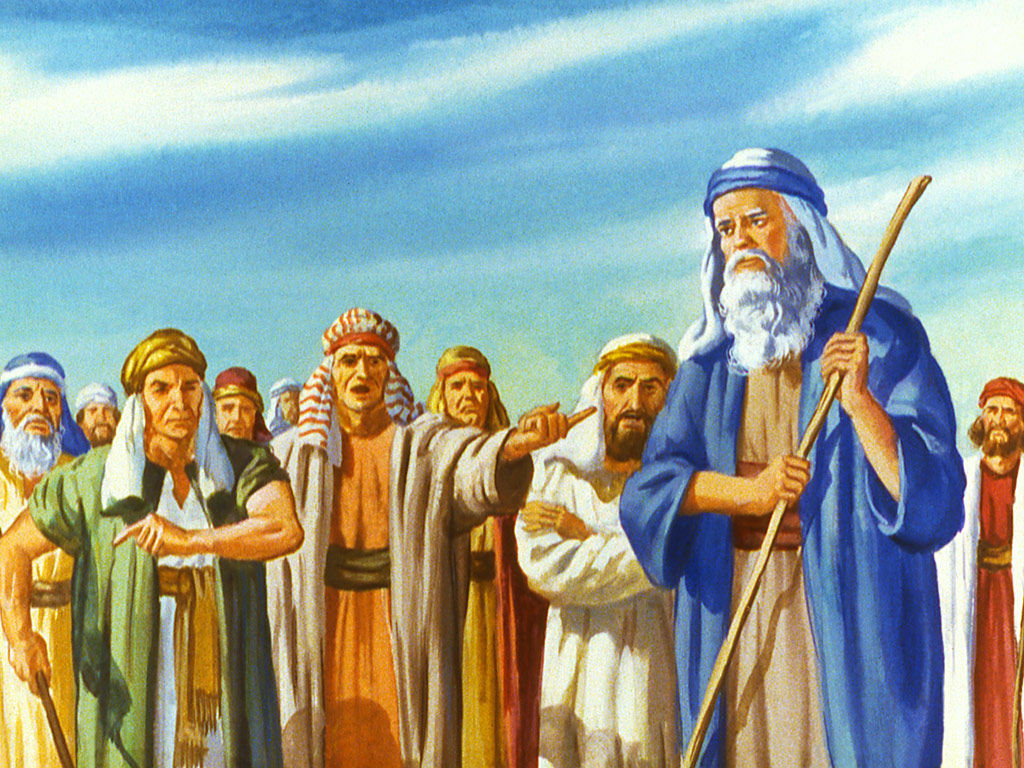
The Bible, as Rohr and Girard put it, is “a text in travail.” It edges forward toward mercy, inclusion, nonviolence, and trust, then pulls back toward vengeance, tribalism, and a petty, insecure god—three steps forward, two steps back, just as our own consciousness moves. God does not change so much as we do. Jesus read his scriptures this way, lifting up the texts that made a highway for God and quietly setting aside the rest. Underneath the whole story, I see a Logos learning to come face to face with itself.
A few threads from Ra support this reading.
“He comes.” About 3,300 years ago, Ra says, the one known as Yahweh “felt a great responsibility,” took stock of its vibratory patterns, and became “a more eloquently effective sound vibration complex” meaning “He comes” (24.6). Elsewhere Ra spells the name with an inserted Shin: Yod Heh Shin Vau Heh (24.9). I read that Shin as the mark of this refinement and a stage in the Solar Logos’s own development (my interpretation; Ra doesn’t date the Shin directly). Yod Heh Shin Vau Heh is very nearly Yehoshua: Joshua, Jesus. In light of the Logos’s progression, I hear the name as “He comes and saves.” Jesus carried that name as the embodiment of an archetype that would come fully through in the Christ Event.
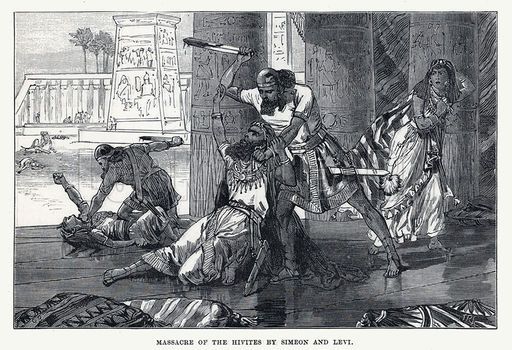
The genetic work. Ra describes how Yahweh worked with the souls transferred from Mars “in what you would call the cloning process” some 75,000 years ago (18.20, 9.7), and how a later attempt to raise up beings capable of grasping the Law of One turned instead into a temptation toward elitism (18.21). I prefer to call that outcome a surprise rather than a failure. The veil and the conditions of third density enabled both polarities—always present in the deep architecture of creation—to become active at our level for the first time. Nothing was lacking; something potential was becoming kinetic.
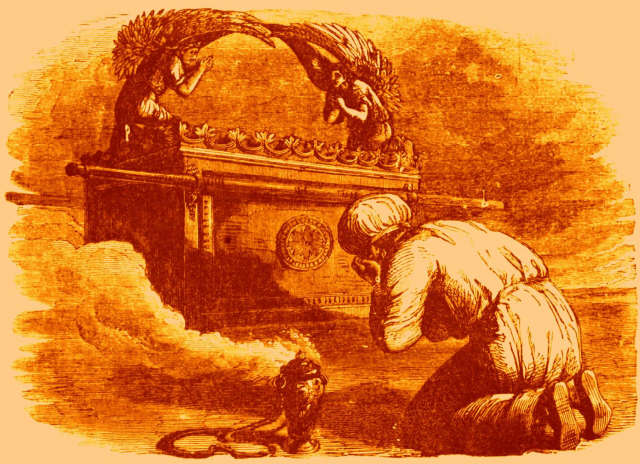
The battleground. Ra is frank that Moses received the Law of One “in its most simple form,” but that pressure from his people to “do specific physical things” opened the door to negatively oriented influence (16.19), and that the Ark of the Covenant was designed by negative entities to create an elite priesthood (60.17). Yet Ra adds that “to those whose faith became that untarnished by unrighteousness or separation, this power designed for negativity became positive” (60.18). This is the conspiring of wholeness at work.
The Hebrew name Elohim—grammatically plural, used with a singular verb—I read as “the united many,” a fitting name for a Logos holding countless lives within one body.
Ra’s Jesus
I hit a hard wall at the seventeenth session. My understanding of Jesus came from my faith tradition: the Only Begotten Son, the Second Person of the Trinity, sharing a divine substance categorically different from that of creation. And then I read this:
Questioner: Can you tell me if Jesus of Nazareth came from the Confederation before incarnation here?
Ra: I am Ra. The one known to you as Jesus of Nazareth did not have a name. This entity was a member of fourth density of the highest level of that sub-octave. This entity was desirous of entering this planetary sphere in order to share the love vibration in as pure a manner as possible. Thus, this entity received permission to perform this mission. This entity was then a Wanderer of no name, of Confederation origins, of fourth density, representing the fourth-density understanding of the vibration of understanding or love. (17.11)
A Wanderer, in Ra’s language, is a soul from a more inclusive density who volunteers to incarnate on a third-density planet in answer to its call for help. Ra calls them the Brothers and Sisters of Sorrow, “bound together by the desire to serve” (12.26). Wanderers take on the veil of forgetting as fully as anyone, which is both their gift and their risk: “The challenge/danger of the Wanderer is that it will forget its mission, become karmically involved” (12.28). Ra adds that Jesus “remembered more than most Wanderers do” (17.19).
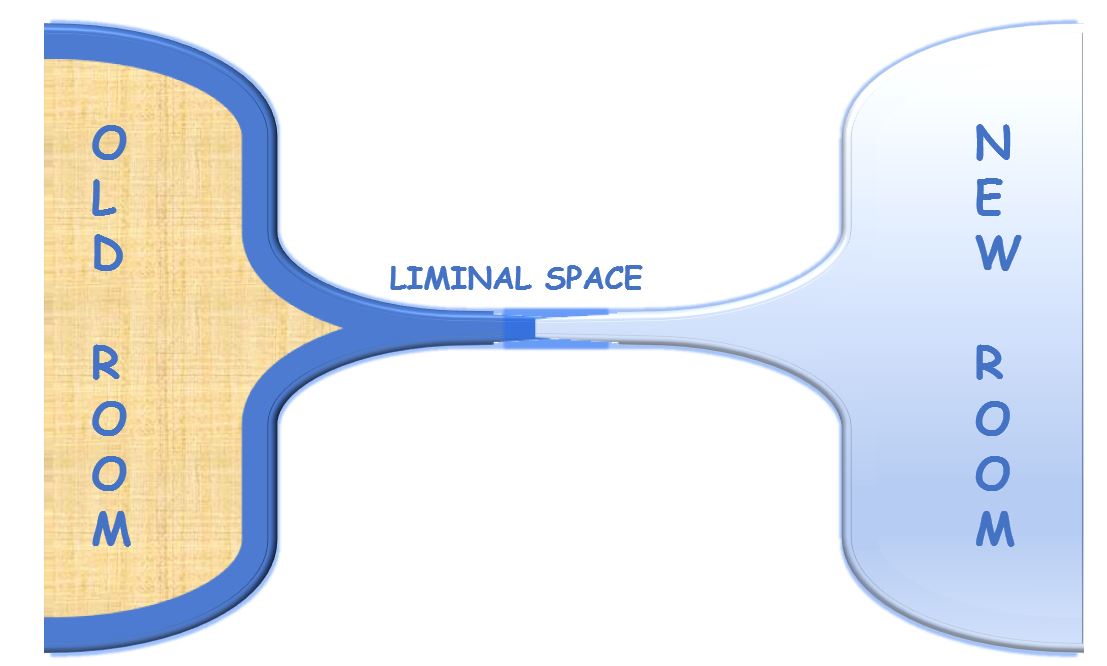
I wrote to the friend who had introduced me to the Law of One, an experienced spiritual director, about my confusion. He met me where I was and wrote back: “Ra can’t see everything.” That simple sentence let me keep reading. For years I held the two sources in tension, thrust out of the “old room” of my conventional beliefs without yet finding a home in a “new room.” I learned to live in the liminal space of knowing and not knowing. Most Christians would dismiss Ra’s account out of hand; many Law of One students would say Jesus was simply a wise sage who learned to channel love perfectly. I’ve come to believe both are pointing at something true, and that the way they fit together only became clear once I stopped looking at Jesus alone and began looking at what our Solar Logos was doing through him.
One thing I can say up front: Jesus did not come to change the mind of God about humanity. It didn’t need changing. He came to change humanity’s mind about God—that the Infinite Creator is love and is radically intimate with creation. Penal substitution, the story of a wrathful God demanding a blood sacrifice in order to love us again, is driving people out of the church in droves, and for good reason. That story isn’t true.
Two Movements, One Meeting
Ra’s overt teaching describes one vertical movement: beings like us spiraling through the densities toward unity with the Creator. I propose a second movement running the other way. Our Solar Logos moves “down and in” toward the beings within its own body, seeking to meet itself face to face at our order of being. Where the two movements meet, something new concresces, to borrow Whitehead’s word for many becoming one and being increased by one.
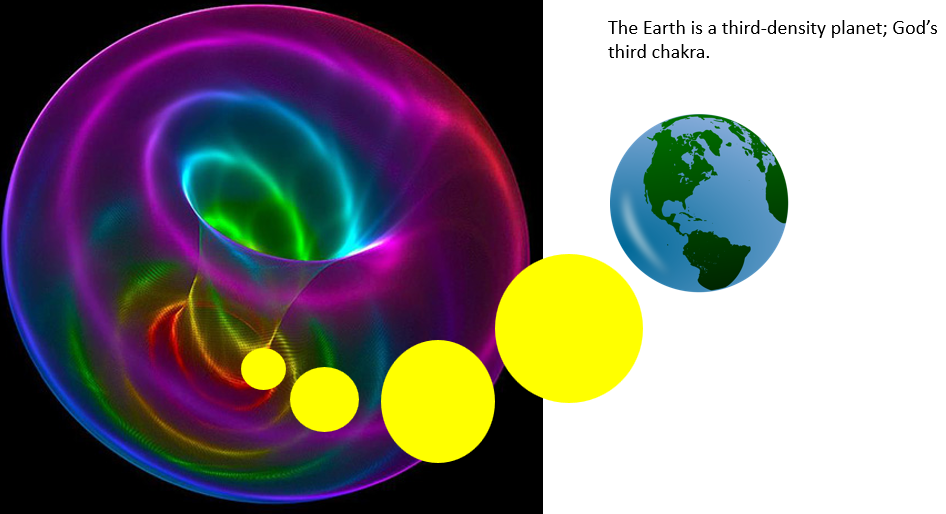
Why would a Solar Logos turn inward? First, because that is the nature of the original desire we met in the Trinity, “that entities seek and become one” (20.27). That desire runs within a density (atoms forming molecules; two people forming a family), across densities (a pet awakened by a human’s love; Wanderers answering a call), and across orders of magnitude (a Solar Logos becoming one with itself within its own body). It is love’s natural telos.

Second, because third density is, in Ra’s words, “the axis upon which the creation turns” (76.16). Under the veil, each of us is a small Logos freely choosing the manner of our seeking—an experience found nowhere else in creation. A Solar Logos does not grow by climbing the densities. Its growth is a journey toward itself, down and in. Notice that this is the same path I described for us at the end of Part Two: the way up is the way down. The Logos and the seeker walk the same road from opposite ends.
For this meeting to happen in a human life, someone had to be able to hold it.
Jesus the Adept
Here I need to correct how I put things in earlier versions of this article. I once wrote that Jesus forfeited or paused his incarnation so the Logos could step in. That language isn’t accurate. Jesus never stepped aside.
Ra tells us Jesus discovered early, and painfully, that “there dwelt in him a terrible potential,” and that he “determined to discover how to use this energy for the good” (17.19). He studied “day and night” and became a rabbi young; from about thirteen and a half to about twenty-five he traveled widely, seeking; then he came home, practiced his earthly father’s trade, and integrated what he had learned before he began to teach (17.20). Cynthia Bourgeault notes that by the time of his public ministry he was known as an ihidaya, “the single one,” the unified one.

In other words, Jesus honed will and faith to the highest level of adeptness. And an adept, Ra teaches, can learn to invoke what Ra calls the magical personality:
When the magical personality is properly and efficaciously invoked, the self has invoked its higher self. Thus a bridge betwixt space/time and time/space is made, and the sixth-density magical personality experiences directly the third-density catalyst for the duration of the working. (75.36)
The Christ Event, as I understand it, scales that same mechanism to the solar order. Through will and faith brought to their fullest, Jesus held the capacity to bring through the Solar Logos itself, the way an adept learns to put on the magical personality. His “working” lasted the three years of his ministry. Jesus’s own consciousness remained awake and engaged the entire time, holding the opening through which the Logos experienced third density directly. Perhaps the biblical word for this is overshadowing.
From harmony to union
Q’uo (which I treat as a source of hypotheses) offers a description I find illuminating. At first, “intelligent infinity as experienced by the Logos and with the bias of the Logos would enter a third-density experience, not erasing the one known as Jesus’ personality or being, but coming into the closest possible harmony with that being.” Then something deepened:
In the end, Jesus the man became so able to bear both joy and agony that this entity stopped experiencing the Creator and for long periods of time became the Creator experiencing third density. Such is the perfect channeling of love. The achievement of the perfect channeling was the mystery of union between Creator and illusion. (Q’uo, December 14, 1986)
There is movement here, from harmony to union, from channeling to becoming. Two independent Christian clairvoyants describe the same progression. Rudolf Steiner called the baptism a kind of conception and the three years an embryonic period, with the Christ-being binding itself ever more closely to Jesus. Daskalos insisted that “the only healer is Christ.” I hold their visionary claims with caution, but the convergence is worth noticing.
The healer and the archetype of solidarity
This is also why Jesus healed as he did. Ra says that “a crystallized healer has no will” of its own and offers an opportunity “without attachment to the outcome” (66.15). When Jesus healed, he ended with two admonitions: that the person’s own faith had healed them, and “Tell no one”—workings that “attempt a maximal quality of free will while maintaining fidelity to the positive purity of the working” (73.13).
And in Jesus, the Creator entered humanity all the way down: humble birth, ordinary community, betrayal, and death on a cross with its felt abandonment. Jesus is the archetype of total solidarity. Remember that word. It will become the ground of the practice I describe in Part Four.
Golgotha: The Law of Three at Cosmic Scale
Now we can see the whole pattern. The Christ Event is the Law of Three playing out at the largest scale we can glimpse:
- Affirming force: the Solar Logos, divine intention seeking full incarnate experience, coming down and in through the opening Jesus held.
- Denying force: the Great BASH, the accumulated collective shadow of our planet, maximum resistance.
- Reconciling force: what emerged when they met—the Christic Logos, a new arising neither could have produced alone.
Bourgeault reads the Paschal Mystery the same way at the human scale: Jesus’s teaching of love as affirming, the crucifixion as denying, kenotic love as reconciling, and the Kingdom as the new arising. I see one pattern at two scales.
The Great BASH concentrated on one point
The crucifixion was maximum catalyst. Everything the Great BASH could deliver converged on a single body:
- Bellicose Attitude: the fury of the crowd.
- Aggressive Actions: torture and execution.
- Scarred and Scared: disciples fleeing in terror.
- Hope through Hostility: religious authorities convinced they served God by eliminating a threat.
Q’uo puts it starkly: by the time of the crucifixion “there were almost no tears left, there were no bones unbroken, there was no companionship that had not been betrayed… Nevertheless, Jesus the Christ lived well and did not stop the channeling until the breath left the physical vehicle.”
The opening held. Under torture, abandonment, and the concentrated weight of humanity’s collective shadow, it never closed. Ra teaches that every service bears a price “commensurate with its purity” (94.26). No offering in human history approached the purity of a Solar Logos holding open its meeting with us through maximum catalyst, and the price paid corresponded to what was offered.
The nadir of the Ankh
In the Paschal Mystery we met the ankh: the eternal circle entering the cross of manifestation, valued only by losing. If creation is the Creator’s heartbeat, pulsing outward into manifestation and gathering back toward return, then Golgotha is the furthest point of that outward beat. It is the nadir of the cross, where manifestation is most intense and longing is greatest. And precisely there, the turn toward return began. The cross of Calvary is the ankh made flesh.
Tetelestai
“It is finished” (tetelestai) marks the completion of what the incarnation needed to accomplish. The life had been lived fully, the teaching given, the opening held through everything third density could produce. Some imagine the Solar Logos leaving at that moment, mission accomplished, leaving Jesus to die alone. I see it otherwise. In, through, and as Jesus, the Logos also died. That is kenosis completed: self-emptying unto death. The one who spoke galaxies into being experienced what it means for breath to cease.
The Forgiveness Principle Installed
This is the heart of the matter, and it is esoteric, so let me go slowly.
“Father, forgive them, for they know not what they do” (Luke 23:34). Those words were spoken from the place where the Solar Logos and human consciousness met, while the full concentrated force of collective bellicosity was bearing down. Remember karma as inertia and forgiveness as the brake (34.4). At that moment, the karmic circuit that would ordinarily perpetuate itself—violence generating violence, suffering generating suffering—was stopped at its point of origin. What could have continued indefinitely was given away completely, for-giefan. And because the one forgiving was the Solar Logos in kenotic manifestation, the forgiveness reached the pattern of offense and retribution itself, at its cosmic root.
Ra makes the connection explicit. Jesus, Ra says, “was absolved karmically… when it was in its last portion of lifetime and spoke upon what you would call a cross saying, ‘Father, forgive them, for they know not what they do.’ In forgiveness lies the stoppage of the wheel of action, or what you call karma” (17.20).
Think of it as an upgrade to our operating system. Before the Christ Event, forgiveness existed as a true principle, taught by the Confederation and the wisdom traditions. But each person had to discover and enact it alone, against the full momentum of the Great BASH, with a teaspoon against the ocean. After the Christ Event, forgiveness works as a template installed within the heart of the Great BASH itself, embedded in our planetary consciousness. It is reachable through relationship with the Christic Logos, and anyone can engage it through will and faith.
This doesn’t bypass the real work. Forgiveness still requires will and faith from the one forgiving. But the pathway is now open. What once required extraordinary individual achievement now works through the grace of an established pattern available to anyone who sincerely engages it.
The Great BASH did not disappear. It remains, it still operates, and it still enmeshes us. But a new resource now lives within its field. People who open to this presence find themselves able to release what seemed impossible to release, forgive what seemed unforgivable, love what seemed unlovable. The closed circuit of Part Two now has a door in it, opened from the inside.
And the pattern works fractally. What Jesus demonstrated as a singularity—the ihidaya, the undivided one, integrated under the most intense conditions imaginable—now exists in our collective consciousness as an accessible template. No one has to replicate the crucifixion. The same dynamic of self-emptying, holding, and new arising operates at whatever scale fits each life: the person in contemplative prayer, the activist, the parent in patient nurture. The sticky thoughtforms the desert fathers called logismoi, the ones that move from assault to consent to captivity, can now be interrupted with help that wasn’t available before.
The Christic Logos
What emerged from Golgotha is neither Jesus, nor the Solar Logos, nor their simple sum. It is what I call the Christic Logos: a new living configuration that includes and transcends everything that produced it, and that remains available for relationship now.

Classical theology spoke of the hypostatic union, two natures united in one person, complete from eternity, with no development within the union. I speak instead of a concrescent hypostasis: Alpha and Omega genuinely growing together through relationship, neither abolished, both co-present. The Logos learns from what the human life discovers; the human life grows from what the Logos provides.
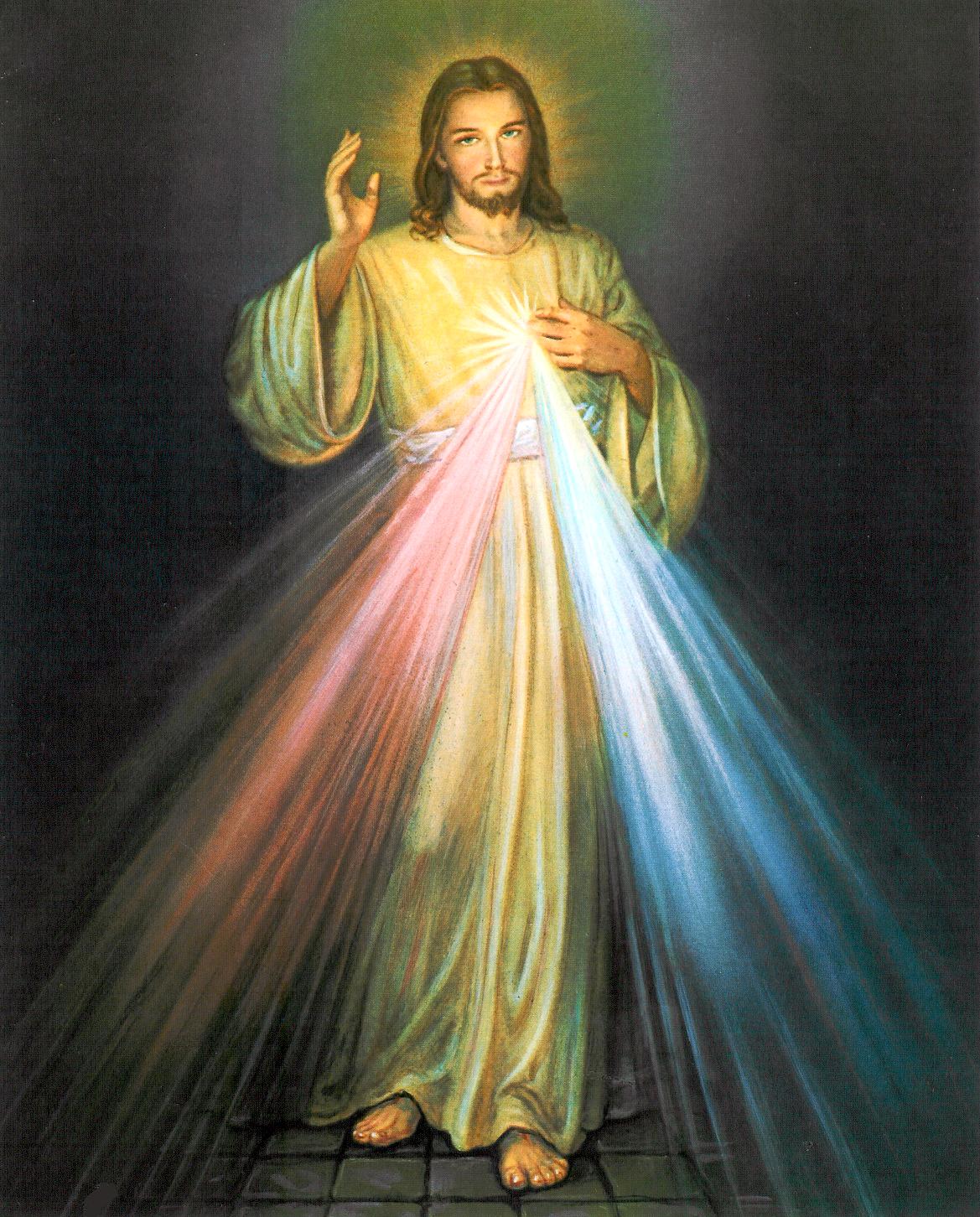
This is where my thinking dovetails with traditional Christianity. By the time of his ministry, the Jesus of the Gospels was the Logos incarnate in a particular person, fully human and fully divine. Through his own free and continuous “yes,” he became the face of the Cosmic Christ. In him, God was given a face we could see and a heart we could fall in love with. As Rohr puts it, “we don’t (or can’t?) fall in love with abstractions.” Jesus never asked us to worship him. He asked us to follow him.
The circuit completed
One more esoteric piece. Before the Christ Event, the flow between our Solar Logos and our planet ran mostly one way. The Logos poured out light and love, sustaining our lower energy centers—survival, identity, belonging. But the return flow couldn’t complete, because the Logos had never incarnated behind the veil and could not yet receive what it had never learned to recognize.
The Christ Event established what I call interscalar kenosis: mutual self-pouring between orders of magnitude. Grace descends as the Logos pours itself into the planetary field; devotion ascends as we pour our lived experience back toward our source. Each side grows in theosis, becoming more fully what it always was. This is why the heart opens through relationship more than through information. When we open to the Christic Logos, we enter a circuit that now flows in both directions.
Outside sources, held as hypotheses
Some readers will know other accounts that touch the life of Jesus. I mention them as unverified hypotheses, not as evidence. Edgar Cayce’s readings suggest the soul who became Jesus had many prior incarnations within the biblical story (Adam, Enoch, Melchizedek, Joshua, and others). Dolores Cannon’s past-life regressions, published as Jesus and the Essenes, describe a young Jesus taught within an Essene community. Michael Newton’s between-lives research suggests souls choose their incarnations and missions before birth, which fits the idea that Jesus freely volunteered for his. None of these can be verified, and none carries the argument above.
Part Four: The New Arising
What the Christ Event Reveals
The Christ Event reveals more than its esoteric mechanics. Here, briefly, is what I see it showing all of us.
- God is mercy. Jesus read his scriptures through the lens of inclusion, mercy, and justice for the oppressed, setting aside the punitive and triumphalist texts. In Rohr’s words: “Nothing ‘changed’ on Calvary but everything was revealed—an eternally outpouring love. Jesus switched the engines of history: instead of us needing to spill blood to get to God, we have God spilling blood to get to us!” On the cross Jesus became a cosmic mirror: we projected our fear onto Love itself and crucified it, and Love answered with kenosis rather than retaliation.
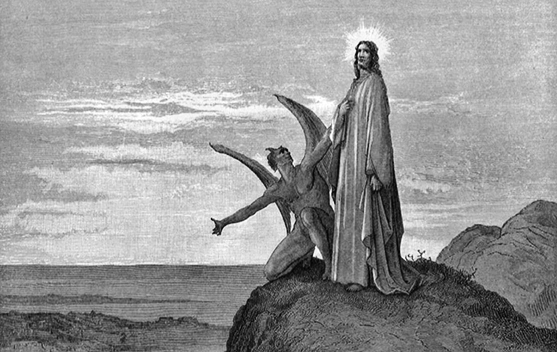
- Separation is an illusion. In the desert, Jesus refused to worship the spirit of separation, and it departed (Matthew 4:1–11); he didn’t fight it, he saw through it. When the seventy-two returned rejoicing, he said, “I saw Satan fall like lightning from heaven” (Luke 10:18). He said, “I and the Father are one” (John 10:30), a statement that includes us. And at his death, the temple veil tore from top to bottom (Matthew 27:51): there is no wall between the sacred and the ordinary. Unity, for me, is the Tao, the way itself; within it the manners of experience are free, but the fact of unity is never in question.
- There has only ever been one Incarnation. Many spiritualities quietly disdain matter, wishing to escape the “valley of tears.” But materiality is light, and light is love set in motion by free will. Matter is the Creator’s masterpiece, not leftovers from a divine trickle-down. There has only ever been one Incarnation: the original outpouring of light from the inner life of God. How do we know? Through the Incarnation. How did we come to the idea of Incarnation? Through Jesus.
- Relationship is the key. “Any interaction betwixt self and other-self has whatever potential for catalyst that there exists in the potential difference between self and other-self, this moderated and undergirded by the constant fact of the Creator as self and as other-self” (33.17). Jesus opened an I–Thou path: by falling in love with a person, people found themselves falling in love with God, and their hearts opened. Ra says harvest into fourth density requires polarity of at least 51 percent service to others. A face we could love was the most direct way to open human hearts. I suspect other planets with mixed harvests have their own version of this event.
- The fire is kindled. “I came to cast fire on the earth, and would that it were already kindled!” (Luke 12:49). Jesus came to light the match in our hearts so we’d be ready for the shift. When we surrender into the flow of love, we radiate a joy that kindles others, and we join the ministry he longed for.


The Holy Name and the Protection of Love
Philippians 2:10 calls Jesus the name above every name, at which every knee should bow. Christians have long known that this name works—in healing, in prayer, and in releasing attachments that don’t belong to a person. Why?

Put “Jesus” and “Christ” together and you are making two affirmations at once. Jesus names the particular: a historical person, a Wanderer, a moment in time. Christ names the universal: the Logos, love as the God-glue of creation. Joined, they say that the universal has a particular face. To pray “Jesus Christ” is to invoke wholeness through a doorway we can actually walk through. When John’s Gospel has Jesus say, “No one comes to the Father except through me” (John 14:6), I hear a statement about how universal love becomes reachable through the particular, rather than an exclusionary password.
Ra adds that certain sound vibrations, appropriately vibrated “with accompanying will and concentration,” act like dialing a telephone, so that “many upon your metaphysical or inner planes received a telephone call” (74.12). Hebrew sounds in particular carry creative power. If any name carries the vibration of “Love comes to you and saves you from the illusion of separation,” it is Yehoshua. And since the Christ Event, that name opens onto a living presence.
Ra also tells us that love is the greatest protection (64.21, 75.2). I read that as love at its most expansive: the recognition and embodiment of unity and wholeness, something far deeper than sending warm feelings. Seen in what Ra calls the “pitch of light” of wholeness (95.24), every temptation—to despair, fear, retribution, or bellicosity—becomes catalyst, offered and then set down with equanimity. Ra puts it this way: “to the pure, all that is encountered speaks of the love and the light of the One Infinite Creator” (95.24).
A practice I use and teach: seek the center of the heart and desire the highest and greatest good for yourself and for all beings who may be drawn to you, positive or negative. Then, according to your own spiritual framework, fill your whole mind, body, and spirit with golden light—the Christic light and love. Then invite all who wish to become one, for the highest good of all, to stay and be blessed; those who do not may take their leave and continue on their journey by the path they have chosen. Whatever the source of a difficulty, inner or outer, the work that follows is the same, and it is the subject of the next section.
The Path of Metanoia
Metanoia is usually translated “repentance,” but the Greek is richer: meta (beyond) plus nous, the heart-mind, the “eye of the heart” where divine and human knowing meet. Metanoia is the enlarging of the heart-mind, so that we can see more broadly and respond rather than react. I call the inner work that serves it the Path of Metanoia.
Its five movements come straight from Ra. In a passage I return to again and again, Ra compares a lifetime to the longest poker game imaginable, played with cards we cannot see:
This game can only be won by those who lose their cards in the melting influence of love; can only be won by those who lay their pleasures, their limitations, their all upon the table face up and say inwardly: “All, all of you players, each other-self, whatever your hand, I love you.” This is the game: to know, to accept, to forgive, to balance, and to open the self in love. (50.7)
So the Path of Metanoia has five movements:
- To know the self—becoming curious about what arises within: “Why do I feel this way when that happens? What am I assuming?”
- To accept the self—receiving what we find without hating it.
- To forgive the self and others—the brake on karmic inertia, and since the Christ Event, an installed pattern we can lean on.
- To balance the self—this is where healthy boundaries belong, with others, with ourselves, and in the subtle realms.
- To open the self to more love.
These movements are the Law of Three lived from the inside. Catalyst arrives (all that assaults the senses, Ra says, is catalyst). Tension rises. We can resolve it in the tomb, at the same level of awareness, or carry it into awareness, where it can resolve in the womb. In the language of the energy centers, the passage runs through the lower triad (survival, identity, belonging), across a membrane that feels like death, and into the heart. That passage asks of us at least the desire to admit our powerlessness, accept ourselves, forgive ourselves and others, and seek balance. Anyone who has worked the Twelve Steps will recognize the shape.
The Path of Metanoia is the inner work. But the Christ Event revealed that relationship is the key, so the inner work always turns outward. The next section describes how.
The SH!PS Approach: Accompanying Others
The SH!PS Approach (pronounced “ships”) is a framework I’ve developed for loving accompaniment—how one person can walk with another toward healing and growth. It is the practical fruit of everything in this article, and it grew out of two decades of counseling, pastoral ministry, and community. It’s offered as a guide, not a clinically researched protocol.
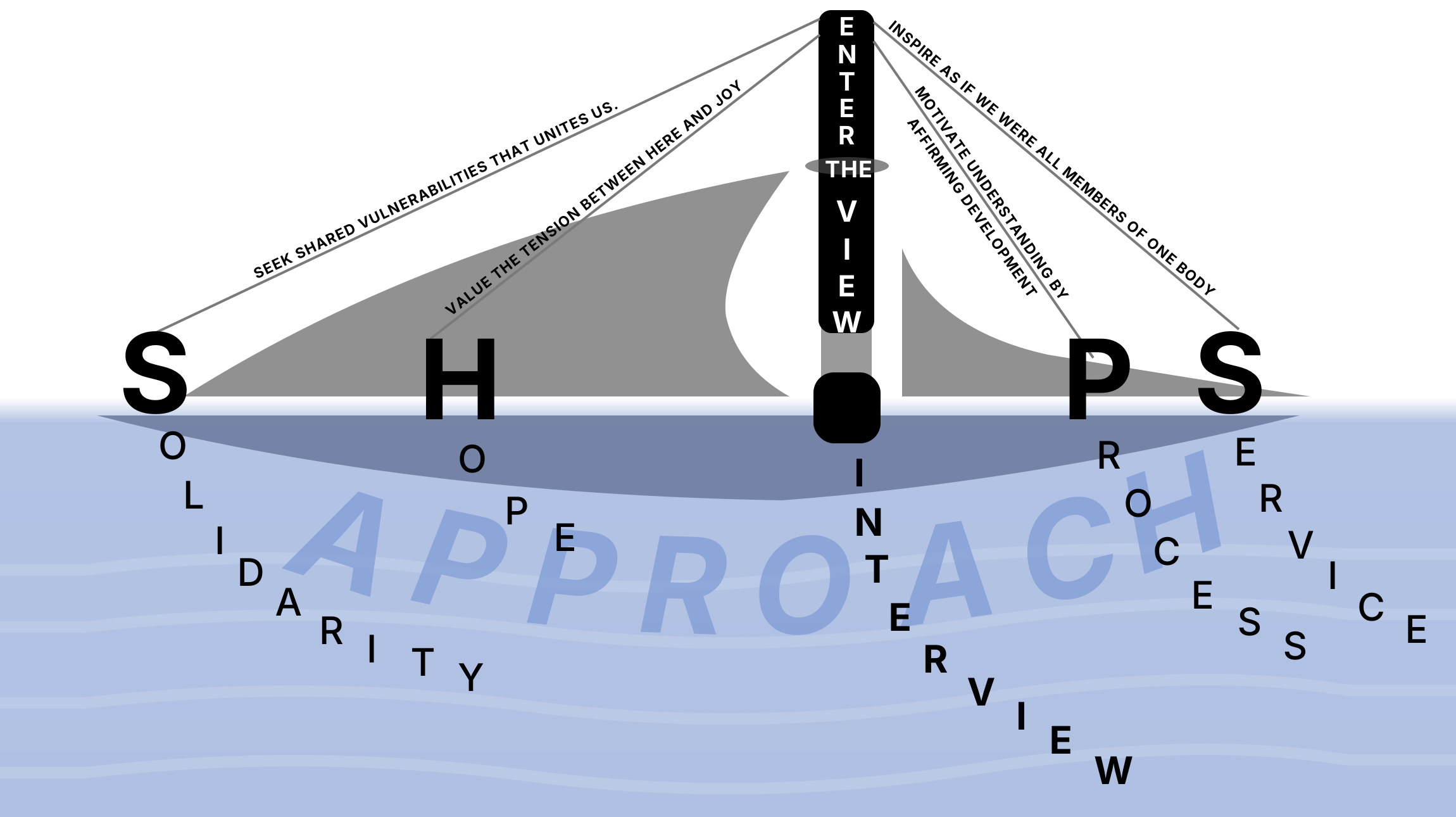
Why I developed it
Over the years, two questions kept pressing on me.
- A spiritual question. When someone engages a spiritual tradition and becomes more loving, more openhearted, less bellicose, and freer—able to respond rather than react, from a balance of love and wisdom—is a universal pattern at work?
- A therapeutic question. When someone emerges from therapy with new freedom—able to hold tension, more empathic and humble, with hope, meaning, and a wider perspective—is there a pattern there too?
My conviction is that it’s the same pattern in both. SH!PS is my map of it. The pattern took shape across many settings: informal ministry in Bluefields, Nicaragua; nonprofit work in Worcester, Massachusetts; Catholic Charities in Chicago; the University of Dallas; my counseling practice; and Building 4th, the weekly psychospiritual community I lead. (The name carries several meanings: we are building fourth density now, building the heart’s activation, and building forth on our journeys.)
In every one of those settings I met the same core wound: people do not feel seen or heard. SH!PS begins there.
The five elements
The acronym stands for Solidarity, Hope, Interview, Process, and Service. The exclamation point marks Interview, the third letter, as the entry point and heart of the whole approach: the work begins there, even though it sits in the middle.
- Interview (the heart). From the French s’entrevoir, “to see each other” or “to see between.” Interview means entering the other person’s view of the world with curiosity and compassion, holding their reality as their reality. It’s a discipline of presence rather than information-gathering. Theologically, I think of it as putting on the mind of Christ.
- Solidarity. From the Latin solidus, “whole.” At root, solidarity is wholeness through interdependence. Its axiom: solidarity in and of itself is therapeutic. At the end of every conversation, whether five minutes or years of counseling, I hope the person walks away feeling more deeply seen, heard, and well met. Jesus, as we saw, is the archetype of total solidarity.
- Hope. The Spanish esperar means both “to hope” and “to wait”: hope is active expectancy. Its engine is the gap between a person’s ideal values (what they profess) and their operational values (what their daily choices reveal). Naming that gap gently, without shame, brings hidden tension into awareness. And when someone can’t find hope at all, the one accompanying them carries it until they’re ready to receive it back.
- Process. The Law of Three as the engine of growth, which I call teleopotentiation: contrast, tension, resolution, and a higher contrast. Process teaches that change takes time, follows a pattern of loss and renewal, and asks for patience and compassion. It helps a person tell the tomb from the womb. Tension is holy; the tomb is never the final word.
- Service. From a root meaning “guardian” or “shepherd.” Service is where values become flesh: a deliberate, non-transactional act of love, chosen to close the gap between ideal and operational values. I call this the Way of Responsibility: whatever gnosis of love we have been given, we are called to embody. Or, as the Twelve Steps put it, if you don’t give it away, you don’t keep it.
The one who accompanies
I call a person who practices this a SH!PS Worker, a word chosen for its groundedness and humility. Its first principle is simple: you cannot hold space you haven’t inhabited yourself. The Worker’s own inner life—the Path of Metanoia—is the framework turned inward. A Worker offers two capacities. Love is the heart’s unconditional yes, receiving the other without condition. Wisdom is the discerning yes, and…, seeing clearly and speaking honestly. Love without wisdom becomes enmeshment; wisdom without love becomes cold assessment.

Here the circle closes. The Christic Logos is love that entered our condition all the way down and stayed. Jesus healed by entering solidarity, honoring free will, awakening the person’s own faith, and sending them back into their lives. SH!PS is my attempt to practice that same accompaniment in ordinary rooms: a counseling office, a kitchen table, a hospital bed. If you’d like to go deeper, I’ve written more about SH!PS on this blog.
Eucharist, Community, and the Social Memory Complex
“Do this in remembrance of me.” I hear in those words something more than a memorial. The Last Supper established a repeatable pattern for meeting the Christic Logos: an ongoing invitation into the living circuit the Christ Event opened. This is why sacramental traditions insist on real presence. The ritual form offers reliably what contemplatives reach through years of interior practice, receiving grace and offering our lives back, and it supports that interior work rather than replacing it. And the pattern doesn’t stay at the altar. Every shared meal can participate in Eucharistic consciousness; every genuine encounter can become communion.
Jesus prayed “that they may all be one. As you, Father, are in me and I am in you” (John 17:21). I hear in that prayer a longing for what Ra calls the social memory complex: a whole society sharing one mind and heart, transparent in love, while each member remains fully distinct. I see the twelve disciples gathered around Jesus as the first seed of such a community, and Pentecost as its first visible emergence, the Spirit poured out on a gathered community. Paul’s “Body of Christ” becomes literal rather than metaphorical. The social memory complex is church come to its fulfillment. It is collective Christification: the union Jesus embodied in one life, becoming the shared life of a people.
This is part of why I gather with a community each week. We can’t do this alone, and we weren’t meant to.
Where the Living Ankh Touches Ground
All of this cosmic architecture has to answer to one question: what does it mean for those whose lives are a daily crucifixion—the battered, the abused, the poor, those treated as nothing? If it doesn’t speak to them, it has no right to speak at all.
Here is what my Franciscan formation forced me to see. If reality is cruciform all the way down, then those who suffer most intensely occupy the very center of what is most real. Golgotha was the nadir of the ankh, the place of maximum intensity, and the Christic Logos entered precisely there. So the nadir is where the Living Ankh is most present. The liberation theologians are essential witnesses here. They insist that the crucified peoples of history are not at the margins of God’s concern; they are where God is found.
I call this love’s metric: we measure a spirituality by how it identifies with and serves the marginalized—a preferential option for the poor. And this applies inwardly too. Outer poverty often mirrors an inner poverty: the blocked lower energy centers where unprocessed bellicosity keeps circulating, cut off from the heart. We live segregated inner lives, and we build segregated outer worlds from them. When we go out and actually encounter the poor, we discover these other-selves are us, and they are hurting. Encountering them heals something in us as well.
The Return of Christ
Asked whether Jesus would return, Ra answered:
This entity became aware that it was not an entity of itself but operated as a messenger of the One Creator, whom this entity saw as Love. This entity was aware that this cycle was in its last portion and spoke to the effect that those of its consciousness would return at the harvest. The particular mind/body/spirit complex you call Jesus is, as what you would call an entity, not to return except as a member of the Confederation occasionally speaking through a channel. However, there are others of the identical congruency of consciousness that will welcome those to the fourth density. This is the meaning of the returning. (17.22)
Ra also describes children now being born with what it calls a “double body in activation” (63.13), able to receive fourth-density vibrations as they stream in.
In other words, the return of Christ is less a single dramatic arrival than a continual harvest: Christic consciousness emerging in our midst, heart by heart, through many beings. Each person who opens the heart, engages the forgiveness principle, and enters the circuit the Christ Event completed becomes another place where that presence lives. The seed planted at Golgotha keeps sprouting wherever a heart opens. And since the Christic Logos remains a living presence, the return is also relational: the more of us who open to that presence and to one another, the closer the turning comes.
Concluding Remarks
When I studied for my master’s in pastoral ministry, I met Karl Rahner’s axiom: the immanent Trinity is the economic Trinity, and the economic Trinity is the immanent Trinity. The message I picked up was that God is creation. But I was taught that this was pantheism, a heresy, and that the safe word was panentheism—God in creation, creation in God. I was also taught that Jesus shares the Father’s substance (homoousios), a substance categorically different from that of creation. So there were two substances, but one God? The tension stayed quietly in the background for years.
The Law of One unlocked it for me. There is only one God, for who else is there? There is only one substance. Jesus does share the substance of the Father—and so do we, and so does all of creation. What differs between Creator and creature is gnosis, lived and experiential knowing of that oneness, rather than essence. That’s the point of finitude: it lets the Creator explore itself from every angle, and every time one part of God recognizes itself in another, love is born again. Jacob Boehme said it beautifully: “the eternal delight becomes perceivable, and this perceiving of the Unity is called LOVE.” Perhaps we need a new word that holds pantheism and panentheism together. I’ve playfully suggested panambitheism (from the Latin ambo, “both”).
The Christ Event adds one more layer. When Alpha and Omega meet—when a Logos comes face to face with itself in a human life—a new vertical complex is born, a united diversity in which neither is abolished and both keep learning. Whitehead gives us the language: the many become one and are increased by one.
For mystical Christianity, little of this would change; mystics have always intuited this kind of knowing. For conventional Christianity, some disillusionment may follow. Yet Christianity has carried cosmic truth from the beginning, and the Law of One offers a corrective for its dead ends—the places where communities have made the “two steps back” their home. Those places are easy to spot by their fruit: orthodoxy privileged over orthopraxis, tribalism, separatism, a demand for conformity, and scapegoating.
I’ll end with an image I use in my own practice. Picture yourself as the host of a great banquet, and your feelings as the guests. When shame or anger or grief arrives, you don’t turn it away. You invite it in, seat it, serve it food—and then you turn your gaze, because a hundred other guests are here too: joy, presence, gladness. Rumi called it the guest house. The greenhouse and the guest house are the same gesture at different scales: welcome what arrives, tend the climate, refuse to exile any part—the shadow of a species, the hidden parts of a soul, the wider cosmos pressing at the edges of an old theology. The way down is the way up.
Whether I am right or wrong about any of this, I know that I am loved, and that I am held in a reality that includes and transcends me. Once you get the Who right, the how becomes a matter of discovery and discernment. May these words help affirm whatever journey you are on.
Notes and Sources
- Ra session numbers (for example, 17.11) refer to session and question in The Law of One. Full text: lawofone.info and L/L Research.
- Q’uo, December 14, 1986, on the Christ and Jesus: L/L Research transcript. I treat the L/L Research channelings after the Ra Contact as sources of hypotheses.
- Carla Rueckert and Jim McCarty, Tilting at Windmills (L/L Research, 2016).
- Doug Scott, Raian Process Metaphysics (available at cosmicchrist.net): Chapter 4 (the Accuser and the Advocate), Chapter 9 (the Terran condition and the Great BASH), Chapter 10 (the Alphaic Logos), Chapter 12 (the Law of Three), Chapter 14 (the Christ Event), Chapter 15 (the Living Ankh and the forgiveness operating system), and Appendix B (Steiner, Daskalos, and comparative Christology).
- Doug Scott, “The Greenhouse and the Guest House: Disclosure as Integration” (July 2026).
- Doug Scott, “Alien Disclosure and the Conspiring of Wholeness” (March 2023).
- Doug Scott, “The SH!PS Approach: a psychospiritual framework for loving service to others” (May 2024).
- Richard Rohr, OFM, Center for Action and Contemplation daily meditations: cac.org.
- Cynthia Bourgeault, The Wisdom Jesus and The Holy Trinity and the Law of Three.
- René Girard on the scapegoat mechanism; John Dominic Crossan on violence as humanity’s great sin.
- Rudolf Steiner, The Fifth Gospel (GA 148) and From Jesus to Christ (GA 131).
- Kyriacos Markides, The Magus of Strovolos (on Daskalos).
- Hypotheses mentioned but not relied on: Edgar Cayce readings on the past lives of Jesus; Dolores Cannon, Jesus and the Essenes; Michael Newton, Journey of Souls.
- Atonement
- Bridge Building
- Centering Prayer
- Christianity
- Christianity after disclosure
- Cosmic Christ
- Daskalos
- Divine Chakras
- Immanent and Economic Trinity
- Jesus Christ
- Kingdom of God
- Law of One
- Law of Three
- Living the Law of One
- Reincarnation
- Researchers of Truth
- Richard Rohr
- Social Memory Complex
- Teilhard de Chardin
- universal christ
- Wanderers


Reblogged this on Blue Dragon Journal.
LikeLike
Wow! Awesome work! Thank you!!
LikeLike
When’s the book coming out?
LikeLike
Hello, I stumbled upon your website searching on how to make sense of the visions that I have been receiving since 2014. One of these visions is of the splitting of the Earth from 3rd density to Fourth density. I would love to email you a photo of the painting of this vision. As an artist I paint the visions that I received during prayer and meditation, however this latest vision of the splitting Earth into two really has me in all and I wonder many things which I’m finding answers to through you. Thank you and please reach out if I may share with you.
LikeLike
Sure! Share away. I’m honored you read my work. Doug@cosmicchrist.net
LikeLike